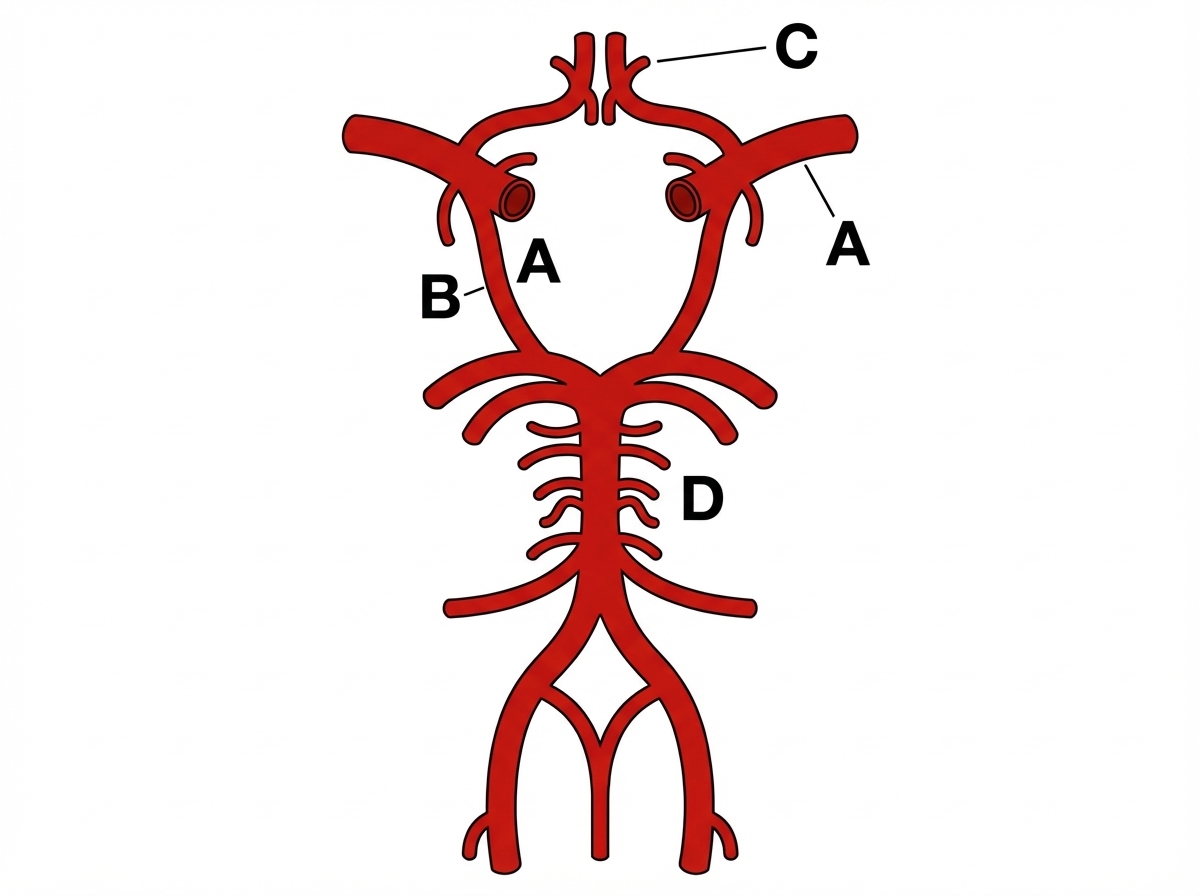
All of the following structures are involved in Weber syndrome EXCEPT?
Which of the following glial cells helps in myelination of CNS neurons?
Which cranial nerve is most commonly involved in a posterior communicating artery aneurysm?
All of the following are parts of the hindbrain EXCEPT?
Which of the following statements regarding the anatomy of the cerebellum is true?
What artery supplies the hippocampus?
The trochlear nerve nucleus is located at the level of which midbrain structure?
Which of the following statements is TRUE about the limbic system?
The marked cell inhibits which of the following structure?

Which part of the brain contains the olivary nucleus?
Explanation: **Explanation** **Weber Syndrome** (Superior Alternating Hemiplegia) is a midbrain stroke syndrome typically caused by occlusion of the paramedian branches of the posterior cerebral artery. It involves the **ventral (anterior) part of the midbrain**. 1. **Why Cerebellar Peduncles is the correct answer:** The cerebellar peduncles (specifically the superior cerebellar peduncle) are located in the **dorsal** aspect (tegmentum) of the midbrain. Lesions involving the cerebellar peduncles result in syndromes like **Claude Syndrome** or **Benedikt Syndrome**, but not Weber Syndrome, which is strictly a ventral midbrain lesion. 2. **Why the other options are incorrect:** * **Oculomotor nerve roots (A):** These exit through the interpeduncular fossa in the ventral midbrain [2]. Damage leads to ipsilateral CN III palsy (ptosis, dilated pupil, and "down and out" eye). * **Corticobulbar tracts (B):** Located in the middle 3/5ths of the crus cerebri [1]. Damage results in contralateral weakness of the lower face (CN VII) and tongue (CN XII). * **Corticospinal tract (D):** Also located in the crus cerebri [1]. Damage leads to contralateral hemiplegia of the trunk and limbs. **Clinical Pearls for NEET-PG:** * **Classic Presentation:** Ipsilateral CN III palsy + Contralateral Hemiplegia. * **Anatomical Site:** Ventral Midbrain (Crus Cerebri). * **Vascular Supply:** Paramedian branches of the Posterior Cerebral Artery (PCA). * **Differential:** If the lesion extends dorsally to include the **Red Nucleus**, it becomes **Benedikt Syndrome** (adds contralateral tremors/ataxia). If it involves only the Red Nucleus and CN III (sparing the crus cerebri), it is **Claude Syndrome**.
Explanation: ### Explanation **Correct Answer: D. Oligodendrocytes** **Mechanism and Concept:** In the Central Nervous System (CNS), myelination is performed by **Oligodendrocytes** [3]. A single oligodendrocyte is capable of myelinating segments of multiple axons (up to 50) by extending its cytoplasmic processes to wrap around them [4]. Myelin acts as an electrical insulator, increasing the speed of nerve impulse conduction via saltatory conduction. **Analysis of Incorrect Options:** * **A. Astrocytes:** These are the most numerous glial cells. They form the **Blood-Brain Barrier (BBB)**, provide structural support, regulate the extracellular ionic environment, and form "glial scars" (gliosis) after injury [1]. They do not produce myelin. * **B. Schwann cells:** These cells provide myelination for the **Peripheral Nervous System (PNS)**. Unlike oligodendrocytes, one Schwann cell myelinates only a single segment of a single axon [4]. * **C. Microglial cells:** These are the resident macrophages of the CNS [1]. Derived from the **mesoderm** (monocyte-macrophage lineage), they act as the primary immune defense and are responsible for phagocytosis. **High-Yield Clinical Pearls for NEET-PG:** * **Origin:** Most glial cells (Astrocytes, Oligodendrocytes, Ependymal cells) are derived from the **Neuroectoderm**, whereas Microglia are derived from the **Mesoderm** [1]. * **Demyelinating Diseases:** * **Multiple Sclerosis (MS):** Affects Oligodendrocytes (CNS demyelination) [2]. * **Guillain-Barré Syndrome (GBS):** Affects Schwann cells (PNS demyelination). * **Friedenwald’s Rule:** In the CNS, the ratio of glia to neurons is approximately 10:1. * **Acoustic Neuroma:** This tumor arises from Schwann cells (Schwannoma) of the vestibular nerve, even though it is located within the cranial cavity.
Explanation: ### Explanation **Correct Option: A (Oculomotor Nerve)** The **Oculomotor nerve (CN III)** is the most commonly affected cranial nerve in a **Posterior Communicating (P-Com) artery aneurysm**. This is due to the close anatomical proximity: the CN III passes between the Posterior Cerebral Artery (PCA) and the Superior Cerebellar Artery (SCA), running parallel and lateral to the P-Com artery. An aneurysm at the junction of the Internal Carotid Artery (ICA) and P-Com artery can compress the nerve directly [1]. **Why the other options are incorrect:** * **B. Facial Nerve (CN VII):** This nerve emerges from the pontomedullary junction and travels through the internal acoustic meatus. It is far from the Circle of Willis and is more commonly affected by parotid tumors or CPA angle tumors. * **C. Optic Nerve (CN II):** While the optic chiasm is near the Circle of Willis, it is typically compressed by **Pituitary adenomas** or **Anterior Communicating (A-Com) artery** aneurysms, not P-Com. * **D. Trigeminal Nerve (CN V):** This nerve is located deeper in the pons and Meckel’s cave. It is more likely to be involved in cavernous sinus pathology or superior cerebellar artery compression (Trigeminal Neuralgia). **High-Yield Clinical Pearls for NEET-PG:** * **Rule of Pupil:** In P-Com aneurysms, the **pupil is typically dilated and fixed** (Mydriasis) [2]. This is because parasympathetic fibers are located superficially on the nerve and are compressed first. * **Medical vs. Surgical Third Nerve Palsy:** * *Surgical (Aneurysm):* Pupil-involving (dilated). * *Medical (Diabetes/Hypertension):* Pupil-sparing (due to microvascular ischemia of the central fibers). * **Down and Out:** Complete CN III palsy results in the eye being displaced "down and out" due to the unopposed action of the Superior Oblique (CN IV) and Lateral Rectus (CN VI).
Explanation: The brain develops from three primary vesicles: the **Prosencephalon** (forebrain), **Mesencephalon** (midbrain), and **Rhombencephalon** (hindbrain). [1] ### 1. Why Diencephalon is the Correct Answer The **Diencephalon** is a derivative of the **Prosencephalon** (forebrain). During secondary vesicle formation, the Prosencephalon divides into the Telencephalon (which becomes the cerebral hemispheres) and the Diencephalon (which includes the Thalamus, Hypothalamus, Epithalamus, and Subthalamus). Therefore, it is not part of the hindbrain. ### 2. Analysis of Incorrect Options (Parts of the Hindbrain) The **Rhombencephalon** (hindbrain) differentiates into two secondary vesicles: * **Metencephalon:** This gives rise to the **Pons** (Option A) and the **Cerebellum** (Option C). [2] * **Myelencephalon:** This gives rise to the **Medulla Oblongata** (Option B). [1] Since Pons, Medulla, and Cerebellum are all direct derivatives of the Rhombencephalon, they are correctly classified as parts of the hindbrain. [1] ### 3. NEET-PG High-Yield Clinical Pearls * **Brainstem Components:** The brainstem consists of the Midbrain, Pons, and Medulla. [2] Note that the Cerebellum is part of the hindbrain but *not* part of the brainstem. [1] * **Cavities (Ventricular System):** * The cavity of the Rhombencephalon becomes the **Fourth Ventricle**. * The cavity of the Diencephalon becomes the **Third Ventricle**. * **Isthmus Rhombencephali:** This is the constriction that separates the Mesencephalon from the Rhombencephalon. * **Pons-Cerebellum Relationship:** The cerebellum is often referred to as the "Little Brain" and is connected to the pons via the middle cerebellar peduncles.
Explanation: The cerebellum is a vital structure for motor control, posture, and balance. Understanding its anatomical subdivisions and internal nuclei is high-yield for NEET-PG. [1] ### **Explanation of the Correct Answer** **Option B is correct.** Anatomically, the cerebellum consists of two large lateral hemispheres joined by a narrow, worm-like midline structure called the **vermis**. The vermis is responsible for coordinating the movements of the axial skeleton (trunk, neck, and shoulders). [1] ### **Analysis of Incorrect Options** * **Option A:** Globose cells (part of the nucleus interpositus) are located within the **white matter** of the cerebellar hemispheres, not the roof. The "roof" of the fourth ventricle is formed by the superior and inferior medullary vela, which are associated with the cerebellum but do not contain these nuclei. * **Option C:** The **flocculonodular lobe** (Archicerebellum) is primarily involved in **maintenance of equilibrium and posture** via its connections with the vestibular system. [1] The smoothening and coordination of voluntary movements are functions of the **Neocerebellum** (Posterior lobe). * **Option D:** The **dentate nucleus** is the **most lateral** and largest of the deep cerebellar nuclei. From lateral to medial, the nuclei are arranged as: **D**entate, **E**mboliform, **G**lobose, and **F**astigial (Mnemonic: **"Don't Eat Greasy Food"**). ### **High-Yield Clinical Pearls for NEET-PG** * **Cerebellar Lesions:** Ipsilateral symptoms are a hallmark (e.g., a right-sided lesion causes right-sided ataxia). * **Archicerebellum Lesion:** Results in truncal ataxia and swaying (unsteady gait). * **Neocerebellum Lesion:** Results in "DANISH" symptoms: **D**ysdiadochokinesia, **A**taxia, **N**ystagmus, **I**ntention tremor, **S**lurred speech (scanning speech), and **H**ypotonia. [1] * **Blood Supply:** Primarily via the PICA, AICA, and Superior Cerebellar Artery. PICA occlusion leads to Lateral Medullary (Wallenberg) Syndrome.
Explanation: **Explanation:** The **Anterior Choroidal Artery (AChA)**, a branch of the internal carotid artery, is the primary blood supply to the hippocampus. It follows a long subarachnoid course to supply deep structures of the brain, including the hippocampal formation, the uncus, the tail of the caudate nucleus, and the posterior limb of the internal capsule. **Analysis of Options:** * **Anterior Choroidal Artery (Correct):** It enters the inferior horn of the lateral ventricle to supply the choroid plexus and the adjacent **hippocampus**. * **Medial Striate Artery (Incorrect):** Also known as the Recurrent Artery of Heubner (from the ACA), it supplies the head of the caudate nucleus and the anterior limb of the internal capsule. * **Lateral Striate Arteries (Incorrect):** These are lenticulostriate branches of the MCA that supply the putamen, globus pallidus, and the superior part of the internal capsule. They are the common site for "Charcot-Bouchard" aneurysms. * **Anterior Cerebral Artery (Incorrect):** This supplies the medial surface of the frontal and parietal lobes (motor and sensory areas for the lower limbs). **NEET-PG High-Yield Pearls:** 1. **Dual Supply:** While the AChA is the classic answer, the **Posterior Cerebral Artery (PCA)** also contributes to the hippocampal supply via its hippocampal branches. 2. **Clinical Correlation:** Occlusion of the Anterior Choroidal Artery leads to a triad of **"3 Hs"**: Hemiplegia (internal capsule), Hemianesthesia, and Hemi-anopia (lateral geniculate body). 3. **Vulnerability:** The hippocampus (specifically Sommer’s sector/CA1) is highly sensitive to hypoxia and ischemia, often being the first area affected during cardiac arrest.
Explanation: The midbrain is divided into two main levels based on the transverse sections: the level of the **inferior colliculus** and the level of the **superior colliculus**. 1. **Why Option B is correct:** The **Trochlear nerve (CN IV) nucleus** is located in the periaqueductal gray matter of the midbrain at the level of the **inferior colliculus**, just ventral to the cerebral aqueduct. It is unique because it is the only cranial nerve that emerges from the dorsal aspect of the brainstem and decussates before exiting. [2] 2. **Why other options are incorrect:** * **Option C:** The **Superior colliculus** level contains the nucleus of the **Oculomotor nerve (CN III)** and the Edinger-Westphal nucleus. [1] * **Options A & D:** The cerebellar peduncles are white matter tracts connecting the cerebellum to the brainstem. While the superior cerebellar peduncle decussates at the level of the inferior colliculus, it is a tract, not the site of the trochlear nucleus. The inferior cerebellar peduncle is located lower, primarily at the level of the medulla. **High-Yield Clinical Pearls for NEET-PG:** * **Longest Intracranial Course:** CN IV has the longest intracranial course but is the thinnest cranial nerve. * **Dorsal Exit:** It is the only cranial nerve to exit from the posterior (dorsal) surface of the brainstem. * **Clinical Deficit:** Lesion of CN IV leads to paralysis of the **Superior Oblique** muscle, resulting in vertical diplopia (worse when looking down and in, e.g., walking down stairs). Patients often present with a compensatory **head tilt** to the opposite side.
Explanation: ### Explanation **Correct Option: C. It is concerned with memory and the emotional aspects of behavior.** The limbic system (from the Latin *limbus*, meaning "border") is a complex set of structures located on the medial aspect of the cerebral hemispheres. It is functionally known as the **"emotional brain."** Its primary roles include the regulation of emotions (fear, aggression, pleasure), motivation, and the formation of long-term memory (specifically via the hippocampus) [1]. #### Why the other options are incorrect: * **A. It has five layers:** The limbic cortex (allocortex) is phylogenetically older than the neocortex. It typically consists of **three layers** (archicortex, like the hippocampus, and paleocortex, like the olfactory cortex), unlike the six-layered neocortex. * **B. It has not phylogenetically evolved in humans:** This is false. The limbic system is one of the oldest parts of the brain (the "reptilian brain" origins), but it has evolved significantly in mammals and humans to integrate complex emotional responses with higher cortical functions. * **D. Subcortical nuclei exclude the septum:** The subcortical nuclei of the limbic system **include** the amygdala, the **septal nuclei**, the hypothalamus, and the anterior thalamic nuclei. The septum is a key component involved in reward and reinforcement. #### NEET-PG High-Yield Pearls: * **Papez Circuit:** The classic pathway for emotional expression: *Hippocampus → Fornix → Mammillary body → Anterior thalamic nucleus → Cingulate gyrus → Entorhinal cortex → Hippocampus.* * **Klüver-Bucy Syndrome:** Results from bilateral destruction of the **amygdala**. Symptoms include hyperorality, hypersexuality, and docility (loss of fear). * **Hippocampus:** The first area affected in Alzheimer’s disease, leading to short-term memory loss [1]. * **Fear Center:** The **amygdala** is the specific structure responsible for the "fight or flight" response and processing fear [1].
Explanation: ***Deep cerebellar nuclei*** - **Purkinje cells** are the sole output neurons of the cerebellar cortex and are **GABAergic (inhibitory)**, projecting primarily to the deep cerebellar nuclei. - They serve as the main pathway for cerebellar cortical inhibition of the **deep cerebellar nuclei**, which are the primary output structures of the cerebellum. *Golgi cell* - **Golgi cells** are inhibited BY **granule cells** via parallel fibers, not inhibited by Purkinje cells. - They provide **inhibitory feedback** to granule cells in the cerebellar cortex glomeruli. *Basket cell* - **Basket cells** actually inhibit **Purkinje cells**, not the other way around. - They are **GABAergic interneurons** that provide lateral inhibition to Purkinje cell bodies and dendrites. *Vestibular nuclei* - While some **Purkinje cells** from the **flocculonodular lobe** do project to vestibular nuclei, this is not the primary target. - The **deep cerebellar nuclei** receive the majority of Purkinje cell inhibitory output, making them the main structure inhibited.
Explanation: The **Medulla Oblongata** is the correct answer because it houses the **Inferior Olivary Nucleus**, which produces a distinct surface elevation on the anterolateral aspect of the medulla known as the **Olive**. [1] ### **Detailed Explanation** 1. **Medulla Oblongata (Correct):** The medulla is divided into an upper "open" part and a lower "closed" part. The inferior olivary nuclei are large, corrugated masses of gray matter located in the upper part of the medulla, lateral to the pyramids. They are essential for motor learning and cerebellar function, as they give rise to **climbing fibers** that reach the contralateral cerebellum via the inferior cerebellar peduncle. 2. **Pons (Incorrect):** The pons contains the pontine nuclei and the nuclei for cranial nerves V, VI, VII, and VIII. While it contains the *superior* olivary nucleus (involved in the auditory pathway), the "olivary nucleus" referred to in general neuroanatomy contexts (and the one forming the visible "olive") is the inferior one in the medulla. [2] 3. **Midbrain (Incorrect):** The midbrain is characterized by the red nucleus, substantia nigra, and the nuclei of cranial nerves III and IV. 4. **Spinal Cord (Incorrect):** The spinal cord consists of Rexed laminae and long ascending/descending tracts but does not contain the olivary complex. ### **High-Yield Clinical Pearls for NEET-PG** * **The Olive vs. The Pyramid:** The Olive lies **lateral** to the Pyramid. The groove between them (anterolateral sulcus) gives exit to the **Hypoglossal nerve (CN XII)**. * **Connections:** The inferior olivary nucleus sends **climbing fibers** to the Purkinje cells of the cerebellum. * **Superior Olivary Nucleus:** Located in the **Pons**, it is part of the ascending auditory pathway and helps in the localization of sound. [2] * **Hypertrophic Olivary Degeneration:** Occurs due to lesions in the **Guillain-Mollaret triangle** (Red nucleus, Inferior Olive, and Dentate nucleus).
Cerebral Hemispheres
Practice Questions
Diencephalon
Practice Questions
Brainstem
Practice Questions
Cerebellum
Practice Questions
Basal Ganglia
Practice Questions
Limbic System
Practice Questions
Ventricular System and CSF
Practice Questions
Blood Supply of the Brain
Practice Questions
Cranial Nerves and Nuclei
Practice Questions
Functional Systems and Pathways
Practice Questions
Applied Neuroanatomy
Practice Questions
Neuroimaging Correlations
Practice Questions
Get full access to all questions, explanations, and performance tracking.
Start For Free