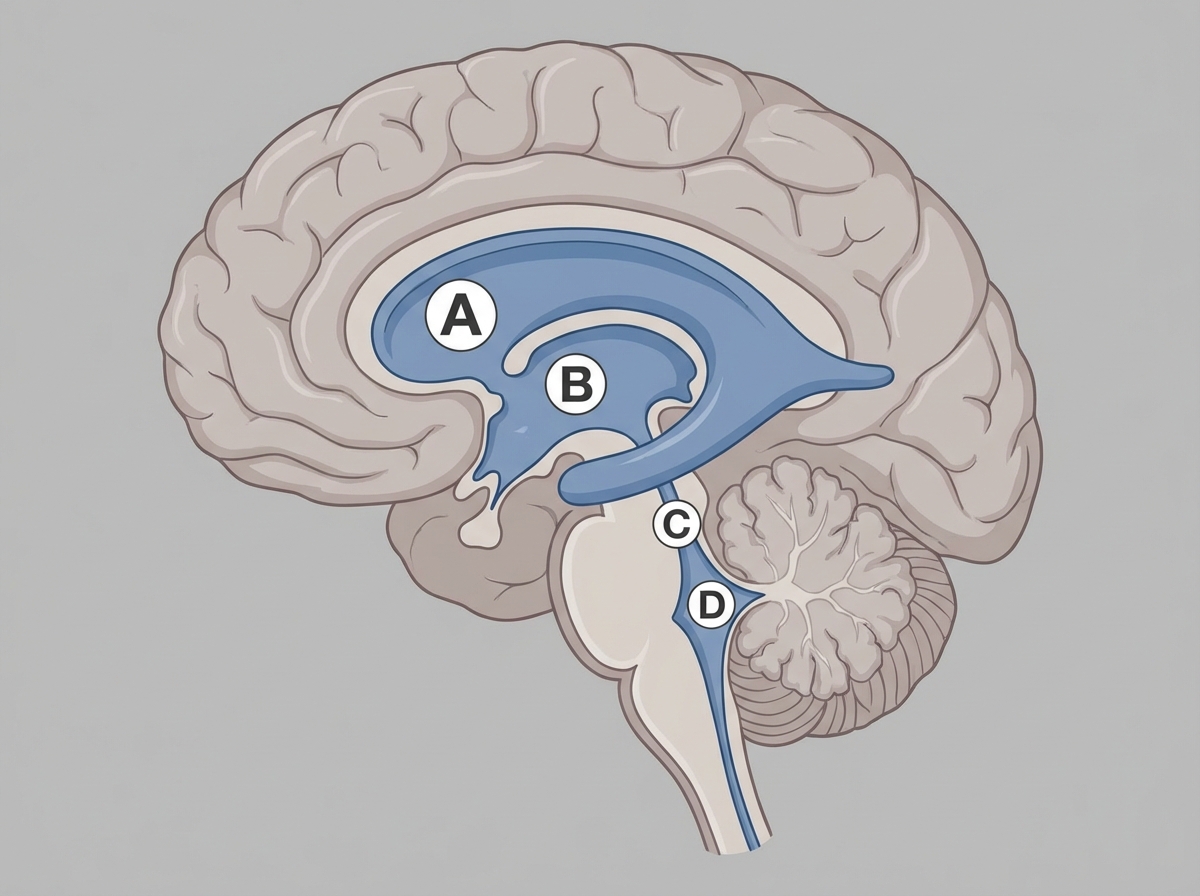
Tectal bridging is a characteristic finding in which of the following conditions?
The nucleus ambiguus is shared by all of the following cranial nerves except?
Which areas in or near the brainstem are situated outside the blood-brain barrier?
Which of the following cranial structures are insensitive to pain?
The falx cerebri contains which of the following sinuses?
Which part of the brain is supplied by the anterior cerebral artery?
The first spinal nerve is related to which of the following cranial nerves?
Which one of the following tracts terminates in the posteromedial ventral nucleus of the Thalamus?
Which of the following is NOT a branch of the intracranial portion of the internal carotid artery?
Transtentorial uncal herniation compresses which cranial nerve?
Explanation: **Explanation:** **Arnold-Chiari Malformation (specifically Type II)** is characterized by a downward displacement of the cerebellum and brainstem through the foramen magnum [1]. This displacement causes a unique deformity of the midbrain tectum known as **"tectal bridging" or "beaking."** [1] 1. **Why it is correct:** In Chiari II malformation, the caudal displacement of the brainstem and the compression of the midbrain result in the fusion or prominent pointing of the superior and inferior colliculi [1]. On imaging (MRI), this appears as a sharp, beak-like protrusion of the tectal plate, hence the term "tectal beaking" or "bridging" [3]. This is often associated with a small posterior fossa and myelomeningocele [1],[2]. 2. **Why other options are incorrect:** * **Dandy-Walker Malformation:** Characterized by agenesis/hypoplasia of the cerebellar vermis and cystic dilation of the fourth ventricle. It does not involve tectal fusion. * **Aqueductal Stenosis:** While it causes obstructive hydrocephalus and may lead to thinning of the midbrain due to pressure, it does not produce the characteristic structural "beaking" or bridging seen in Chiari [1]. * **Third Ventricular Tumor:** These (e.g., colloid cysts) cause hydrocephalus but do not result in the specific developmental hindbrain herniation pattern required for tectal beaking. **High-Yield NEET-PG Pearls:** * **Chiari II Triad:** Myelomeningocele, Hydrocephalus, and Tectal Beaking. * **Imaging Sign:** Look for the **"Cascading Cerebellum"** or **"Banana Sign"** (curved cerebellum) and **"Lemon Sign"** (scalloping of frontal bones) on prenatal ultrasound. * **Associated finding:** Syringomyelia (fluid-filled cavity in the spinal cord) is frequently seen in Chiari malformations [3].
Explanation: The **Nucleus Ambiguus** is a long column of motor neurons located in the reticular formation of the medulla oblongata. It provides the **Special Visceral Efferent (SVE)** fibers that innervate the muscles derived from the branchial (pharyngeal) arches. **Why Option D is Correct:** * **Cranial Nerve XII (Hypoglossal Nerve):** This nerve originates from the **Hypoglossal Nucleus**, not the nucleus ambiguus. It provides General Somatic Efferent (GSE) fibers to the intrinsic and extrinsic muscles of the tongue (except the palatoglossus) [1]. **Why Other Options are Incorrect:** The Nucleus Ambiguus contributes motor fibers to the following nerves: * **Cranial Nerve IX (Glossopharyngeal):** Supplies the stylopharyngeus muscle (3rd arch). * **Cranial Nerve X (Vagus):** Supplies the muscles of the pharynx, larynx, and soft palate (4th and 6th arches). * **Cranial Nerve XI (Cranial part of Accessory):** These fibers actually join the Vagus nerve to supply the laryngeal muscles. (Note: The spinal part of CN XI arises from the spinal accessory nucleus in the cervical cord). **High-Yield Clinical Pearls for NEET-PG:** * **Lesion Sign:** A lesion of the nucleus ambiguus results in **"Bulbar Palsy,"** characterized by dysphagia (difficulty swallowing), dysarthria (speech difficulty), and loss of the gag reflex. * **Uvula Deviation:** In a unilateral lesion, the uvula deviates to the **opposite (normal) side** due to paralysis of the levator veli palatini. * **Location:** It is located in the **lateral medulla**. It is classically involved in **Wallenberg Syndrome** (Lateral Medullary Syndrome), leading to hoarseness and swallowing defects.
Explanation: ### Explanation The **Blood-Brain Barrier (BBB)** is a highly selective semipermeable border of endothelial cells that prevents solutes in the circulating blood from non-selectively crossing into the extracellular fluid of the central nervous system. However, specific midline structures called **Circumventricular Organs (CVOs)** lack a BBB [1]. They possess fenestrated capillaries, allowing them to monitor blood chemistry or release hormones directly into the bloodstream [1]. **Why Option B is Correct:** Option B correctly lists the primary sensory and secretory CVOs: * **Area Postrema:** Located in the floor of the 4th ventricle; it is the "chemoreceptor trigger zone" (CTZ) that induces vomiting in response to toxins [1]. * **Organum Vasculosum of Lamina Terminalis (OVLT):** Senses plasma osmolarity [1]. * **Subfornical Organ (SFO):** Regulates fluid balance by responding to Angiotensin II [1]. * **Posterior Pituitary (Neurohypophysis):** Secretes ADH and Oxytocin directly into the systemic circulation [1]. **Analysis of Incorrect Options:** * **Options A, C, and D:** These are incorrect primarily because they include the **Anterior Pituitary (Adenohypophysis)**. While the anterior pituitary receives blood via the hypophyseal portal system, it is technically an endocrine gland derived from Rathke’s pouch (oral ectoderm) and is situated outside the dural environment of the brain itself. The **Median Eminence** is a CVO, but the most complete and accurate list of brainstem-adjacent structures without a BBB is found in Option B [1]. **High-Yield NEET-PG Pearls:** 1. **Pineal Gland:** Another CVO (secretes melatonin) often tested as lacking a BBB [1]. 2. **Area Postrema Clinical:** Dopamine agonists (like Bromocriptine) or Digoxin can trigger the area postrema, leading to nausea/vomiting as a side effect. 3. **The "Vomit Center":** Do not confuse the Area Postrema (sensory) with the Nucleus Tractus Solitarius (integrative), though they are anatomically close in the medulla.
Explanation: The sensitivity of intracranial structures to pain is a high-yield topic in neuroanatomy, primarily governed by the distribution of the **trigeminal nerve (CN V)** and upper cervical nerves. ### **Why Choroid Plexus is the Correct Answer** The **brain parenchyma**, the **ventricular ependyma**, and the **choroid plexus** are fundamentally **insensitive to pain**. These structures lack nociceptors (pain receptors). While the choroid plexus is highly vascularized for cerebrospinal fluid production, it does not possess the sensory innervation required to transmit pain signals. ### **Analysis of Incorrect Options** The rule of thumb is that most "supporting" and "vascular" structures *outside* the brain tissue are pain-sensitive: * **Dural sheath surrounding vascular sinuses:** The venous sinuses (e.g., Superior Sagittal Sinus) and their surrounding dural sheaths are highly sensitive. Traction or inflammation here causes referred pain via the ophthalmic division of the trigeminal nerve. * **Falx cerebri:** As a major fold of the dura mater, the falx is sensitive to pain, especially in its peripheral portions. * **Middle meningeal artery:** The dural arteries are among the most pain-sensitive structures in the cranium. Irritation or stretching of these vessels is a primary mechanism in various types of headaches. ### **NEET-PG High-Yield Pearls** * **Pain-Sensitive Structures:** Dura mater (especially the cranial base), dural arteries (Middle Meningeal), proximal portions of large cerebral arteries (Circle of Willis), and dural venous sinuses. * **Pain-Insensitive Structures:** Brain parenchyma, arachnoid mater, pia mater (except near vessels), choroid plexus, and the skull (diploe). * **Clinical Correlation:** "Brain biopsies" can be performed on conscious patients because the brain tissue itself cannot feel pain [1]; only the scalp, muscle, and dura require local anesthesia.
Explanation: The **falx cerebri** is a large, sickle-shaped fold of dura mater that occupies the longitudinal fissure between the two cerebral hemispheres. It contains three major dural venous sinuses: 1. **Superior Sagittal Sinus:** Located in the upper convex attached margin [1]. 2. **Inferior Sagittal Sinus:** Located in the lower free concave margin. 3. **Straight Sinus:** Formed at the junction of the falx cerebri and the **tentorium cerebelli**. It receives the Great Vein of Galen and the inferior sagittal sinus. **Analysis of Options:** * **Straight Sinus (Correct):** As mentioned, it lies at the line of attachment between the falx cerebri and the tentorium cerebelli. * **Occipital Sinus:** Located in the attached margin of the **falx cerebelli** (not cerebri) along the internal occipital crest. * **Superior Petrosal Sinus:** Runs along the superior border of the petrous part of the temporal bone, within the attached margin of the **tentorium cerebelli**. * **Transverse Sinus:** Located in the attached posterior margin of the **tentorium cerebelli**, grooving the occipital bone. **High-Yield NEET-PG Pearls:** * **Confluence of Sinuses (Torcular Herophili):** The meeting point of the superior sagittal, straight, occipital, and transverse sinuses. * **Safety Tip:** The Straight Sinus is formed by the union of the **Inferior Sagittal Sinus** and the **Great Cerebral Vein of Galen**. * **Clinical Correlation:** The falx cerebri can calcify with age (normal finding), but displacement of a calcified falx on imaging is a key sign of a "midline shift" due to space-occupying lesions.
Explanation: The **Anterior Cerebral Artery (ACA)** is a terminal branch of the internal carotid artery and plays a vital role in the Circle of Willis. [1] ### **Why the Correct Answer is Right** The ACA primarily supplies the **medial surface** of the cerebral hemispheres (frontal and parietal lobes). Specifically, it follows the corpus callosum to supply the medial part of the motor and sensory cortex. This area corresponds to the **lower limb and perineum** on the motor/sensory homunculus. Therefore, an ACA stroke typically results in contralateral motor and sensory loss specifically in the leg and foot. [1] ### **Why Other Options are Wrong** * **Lateral Surface (B):** This is primarily supplied by the **Middle Cerebral Artery (MCA)**. The MCA covers the majority of the lateral convexity, including the areas for the face and upper limbs. * **Posterior Surface (D):** The posterior part of the brain (occipital lobe and inferior temporal lobe) is supplied by the **Posterior Cerebral Artery (PCA)**, which arises from the basilar artery. [1] * **Anterior (A):** While the ACA is "anterior" by name, the term refers to its origin. In terms of cortical distribution, "medial" is the precise anatomical description of its territory. ### **High-Yield Clinical Pearls for NEET-PG** * **Heubner’s Artery:** A significant branch of the ACA (specifically the recurrent branch) that supplies the **head of the caudate nucleus** and the anterior limb of the internal capsule. * **Homunculus:** Remember: **ACA = Leg/Foot**; **MCA = Face/Arm**. * **Aphasia:** Unlike MCA strokes, ACA strokes rarely cause aphasia unless they are bilateral or involve the supplementary motor area. * **Frontal Lobe Signs:** ACA occlusion can lead to personality changes, urinary incontinence, and "gait apraxia" due to involvement of the medial frontal lobe.
Explanation: The **Hypoglossal nerve (CN XII)** is the correct answer due to its unique developmental and anatomical relationship with the cervical spinal nerves. 1. **Why Hypoglossal is correct:** * **Developmental Origin:** The muscles of the tongue are derived from **occipital myotomes**. During development, the hypoglossal nerve (which supplies these muscles) migrates alongside them. * **Anatomical Proximity:** As the hypoglossal nerve exits the skull via the hypoglossal canal, it descends and is joined by a communication from the **ventral ramus of the first cervical spinal nerve (C1)**. * **Functional Link:** Fibers from C1 actually travel within the sheath of CN XII to form the **superior root of the Ansa Cervicalis** and to supply the thyrohyoid and geniohyoid muscles. Thus, CN XII and C1 are intimately related both structurally and functionally. 2. **Why other options are incorrect:** * **Glossopharyngeal (CN IX) & Vagus (CN X):** These nerves emerge from the medulla and exit through the jugular foramen. While they are close to the upper cervical region, they do not carry C1 fibers or share the same intimate developmental pathway as CN XII. * **Facial (CN VII):** This nerve exits via the stylomastoid foramen and primarily supplies the muscles of facial expression (second branchial arch). It has no direct anatomical relationship with the first spinal nerve. **High-Yield Clinical Pearls for NEET-PG:** * **Ansa Cervicalis:** Remember that the superior root is formed by **C1** (via CN XII) and the inferior root is formed by **C2 and C3**. * **Muscle Supply:** The **Thyrohyoid** and **Geniohyoid** are the only two muscles supplied by C1 fibers traveling with the Hypoglossal nerve. * **Occipital Myotomes:** The migration of these myotomes explains why the nerve supply to the tongue (CN XII) originates so far inferiorly compared to the tongue's position.
Explanation: The thalamus acts as the primary relay station for sensory information [1]. The **Ventral Posterior (VP) nucleus** is divided into two distinct functional parts based on the origin of the sensory input: 1. **Ventral Posteromedial (VPM) Nucleus:** Receives sensory information from the **face and oral cavity**. This input is carried by the **Trigeminal lemniscus** (representing touch, pressure, and pain/temperature from the trigeminal nerve). 2. **Ventral Posterolateral (VPL) Nucleus:** Receives sensory information from the **body and limbs** [2]. ### Analysis of Options: * **Trigeminal lemniscus (Correct):** It carries general somatic afferent fibers from the head/face and terminates specifically in the **VPM** nucleus. * **Medial lemniscus (Incorrect):** This tract carries fine touch, vibration, and proprioception from the body. It terminates in the **VPL** nucleus [2]. * **Spinothalamic tract (Incorrect):** This tract carries pain, temperature, and crude touch from the body. It also terminates in the **VPL** nucleus [2]. * **Lateral lemniscus (Incorrect):** This is part of the **auditory pathway**. It terminates in the **Medial Geniculate Body (MGB)** of the thalamus, not the VP nucleus. ### High-Yield NEET-PG Pearls: * **Mnemonic for VPM:** "**M**" for **M**outh/Face (VPM = Medial = Mouth). * **Mnemonic for VPL:** "**L**" for **L**imb (VPL = Lateral = Limb). * **Mnemonic for Geniculate Bodies:** **M**GB is for **M**usic (Hearing); **L**GB is for **L**ight (Vision). * The VPM also receives **taste** sensations via the solitary nucleus (solitarothalamic tract).
Explanation: The **Internal Carotid Artery (ICA)** enters the cranial cavity and terminates by dividing into its major branches. To answer this question, one must distinguish between the direct branches of the ICA and the components of the Circle of Willis. ### Why Option A is Correct The **Anterior Communicating Artery (AComm)** is a short vessel that connects the two anterior cerebral arteries. It is **not** a direct branch of the internal carotid artery itself. Instead, it serves as a bridge in the Circle of Willis to provide collateral circulation between the left and right carotid systems. ### Why the Other Options are Incorrect The intracranial (terminal) portion of the ICA typically gives off five branches, often remembered by the mnemonic **"OPAAM"**: * **Ophthalmic Artery:** The first branch of the cavernous/supraclinoid ICA. * **Posterior Communicating Artery (Option D):** Connects the ICA to the posterior cerebral artery. * **Anterior Choroidal Artery:** Supplies the internal capsule and choroid plexus. * **Anterior Cerebral Artery (Option B):** One of the two terminal branches. * **Middle Cerebral Artery (Option C):** The larger terminal branch and the direct continuation of the ICA. ### NEET-PG High-Yield Pearls * **Most common site of Berry Aneurysm:** The junction of the **Anterior Communicating Artery** and the Anterior Cerebral Artery. * **Stroke Correlation:** The Middle Cerebral Artery (MCA) is the most common site of embolic stroke. * **Course:** The ICA has four parts: Cervical (no branches), Petrous, Cavernous, and Cerebral (Supraclinoid). * **Carotid Siphon:** The U-shaped bend of the ICA within the cavernous sinus is a frequent landmark in radiology.
Explanation: **Explanation:** **Transtentorial (Uncal) Herniation** occurs when increased intracranial pressure forces the **uncus** (the innermost part of the temporal lobe) over the free edge of the **tentorium cerebelli** [1]. **Why Option A is correct:** The **Oculomotor nerve (CN III)** emerges from the midbrain and passes through the subarachnoid space between the posterior cerebral and superior cerebellar arteries. As the uncus herniates downward, it directly compresses CN III against the rigid tentorial edge [1]. This results in the classic clinical triad: 1. **Ipsilateral pupillary dilation** (due to loss of parasympathetic fibers) [2]. 2. **Ptosis** and **"Down and Out"** eye deviation (due to motor fiber paralysis). **Why the other options are incorrect:** * **Option B (CN IV):** While the Trochlear nerve also passes near the tentorium, its dorsal exit and long intracranial course make it less susceptible to direct compression during the initial stages of uncal herniation compared to CN III. * **Option C (CN VI):** The Abducens nerve is most commonly affected by generalized increased intracranial pressure (false localizing sign) due to its long intradural course over the petrous temporal bone, but it is not the primary nerve compressed at the tentorial notch. * **Option D (CN VII):** The Facial nerve is located in the posterior cranial fossa and enters the internal acoustic meatus; it is anatomically distant from the tentorial hiatus. **High-Yield Clinical Pearls for NEET-PG:** * **Kernohan’s Notch Phenomenon:** Severe herniation can push the contralateral cerebral peduncle against the tentorium, causing **ipsilateral hemiparesis** (a paradoxical sign). * **Hutchinson’s Pupil:** The initial sign of CN III compression is a sluggishly reacting, then dilated pupil on the side of the lesion. * **Duret Hemorrhages:** Late-stage herniation leads to brainstem (pons/midbrain) hemorrhages due to stretching of the basilar artery branches.
Cerebral Hemispheres
Practice Questions
Diencephalon
Practice Questions
Brainstem
Practice Questions
Cerebellum
Practice Questions
Basal Ganglia
Practice Questions
Limbic System
Practice Questions
Ventricular System and CSF
Practice Questions
Blood Supply of the Brain
Practice Questions
Cranial Nerves and Nuclei
Practice Questions
Functional Systems and Pathways
Practice Questions
Applied Neuroanatomy
Practice Questions
Neuroimaging Correlations
Practice Questions
Get full access to all questions, explanations, and performance tracking.
Start For Free