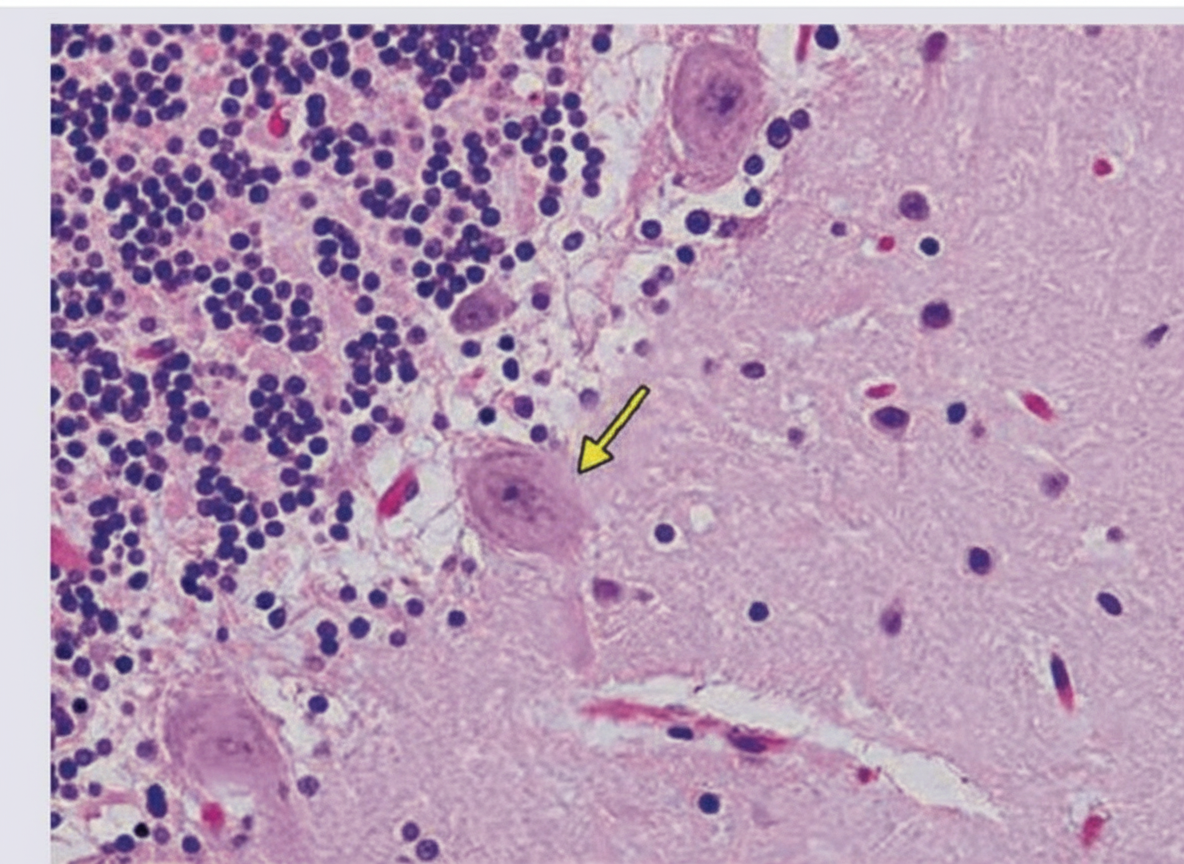
Substance P belongs to the tachykinin family of peptides. Which of the following peripheral tissues contain substance P?
The foramen of Magendie is the central opening of which ventricle?
The cavity of the mesencephalic brain vesicle is which of the following?
All of the following form the deep venous system of the brain, EXCEPT:
What is the junction of the anterior horn and posterior horn of the lateral ventricle called?
Which of the following does NOT contribute to the floor of the fourth ventricle?
Which of the following thalamic nuclei does not project to the neocortex?
Anton syndrome is characterized by which of the following?
The middle superior alveolar nerve is a branch of which nerve division?
Which cells are phagocytic in the Central Nervous System?
Explanation: Substance P is a potent neuropeptide belonging to the tachykinin family. It primarily functions as a neurotransmitter and neuromodulator. Why Nerve Terminals are Correct: Substance P is synthesized in the cell bodies of first-order sensory neurons (located in the dorsal root ganglia) and is transported to both central and peripheral nerve terminals [1]. In the periphery, it is released from the terminals of non-myelinated C-fibers. Its primary role is the transmission of pain signals (nociception) and the mediation of neurogenic inflammation, where its release causes vasodilation and increased vascular permeability [2]. Why Other Options are Incorrect: * Plasma Cells & Mast Cells: While these cells have receptors for Substance P (NK1 receptors) and are activated by it during inflammatory responses (causing mast cell degranulation), they do not synthesize or "contain" the peptide as a primary source [2]. * Vascular Endothelium: The endothelium is a target tissue for Substance P. When Substance P binds to endothelial receptors, it triggers the release of nitric oxide, leading to vasodilation. It is not the site of production or storage. NEET-PG High-Yield Pearls: * Receptor: Substance P acts primarily via the NK1 (Neurokinin-1) receptor, which is a G-protein coupled receptor. * Antagonist: Aprepitant is a clinically significant NK1 receptor antagonist used as an antiemetic in chemotherapy. * Capsaicin: Found in chili peppers, capsaicin causes the depletion of Substance P from sensory nerve endings, which is the basis for its use in topical analgesic creams for post-herpetic neuralgia. * Co-localization: In the spinal cord (dorsal horn), Substance P is often co-released with Glutamate to enhance pain transmission [2].
Explanation: **Explanation:** The **4th ventricle** is a tent-shaped cavity located between the brainstem (pons and medulla) and the cerebellum. It serves as a critical junction for Cerebrospinal Fluid (CSF) circulation. CSF exits the ventricular system to enter the subarachnoid space through three specific apertures in the roof of the 4th ventricle [1], [2]: 1. **Foramen of Magendie (Median aperture):** A single, midline opening that drains CSF into the cisterna magna [1], [2]. 2. **Foramina of Luschka (Lateral apertures):** Two lateral openings that drain CSF into the pontine cistern [1]. *Mnemonic: **M**agendie is **M**edian; **L**uschka is **L**ateral.* **Analysis of Incorrect Options:** * **Option A (Lateral Ventricle):** These are C-shaped cavities within the cerebral hemispheres. They communicate with the 3rd ventricle via the **Interventricular Foramen of Monro**. They do not have direct openings to the subarachnoid space. * **Option C (3rd Ventricle):** This is a slit-like cavity between the two thalami. It communicates with the 4th ventricle via the **Cerebral Aqueduct (of Sylvius)**. It does not contain the foramen of Magendie. **High-Yield Clinical Pearls for NEET-PG:** * **Flow of CSF:** Lateral Ventricles → Foramen of Monro → 3rd Ventricle → Aqueduct of Sylvius → 4th Ventricle → Foramina of Luschka & Magendie → Subarachnoid space [2]. * **Non-communicating Hydrocephalus:** Obstruction at any of these narrow points (most commonly the Aqueduct of Sylvius) leads to internal hydrocephalus [1]. * **Dandy-Walker Malformation:** Characterized by the congenital absence or atresia of the Foramina of Magendie and Luschka, leading to massive dilation of the 4th ventricle.
Explanation: ### Explanation The brain develops from three primary brain vesicles, which further subdivide into five secondary vesicles. Each vesicle contains a specific cavity that persists as part of the adult ventricular system. **1. Why the Correct Answer is Right:** The **Mesencephalon** (midbrain) is the only primary vesicle that does not subdivide into secondary vesicles. Its central cavity narrows significantly during development to form the **Cerebral Aqueduct (of Sylvius)**. This narrow channel connects the third ventricle to the fourth ventricle. **2. Analysis of Incorrect Options:** * **A. Lateral Ventricle:** These are the cavities of the **Telencephalon** (cerebral hemispheres), which is a derivative of the Prosencephalon. * **B. Third Ventricle:** This is the cavity of the **Diencephalon** (thalamus, hypothalamus), also a derivative of the Prosencephalon. * **C. Fourth Ventricle:** This is the cavity of the **Rhombencephalon** (hindbrain). Specifically, the superior part belongs to the Metencephalon and the inferior part to the Myelencephalon. **3. High-Yield Facts for NEET-PG:** * **Narrowest Point:** The cerebral aqueduct is the narrowest part of the ventricular system, making it the most common site for **obstructive (non-communicating) hydrocephalus** [1], [2]. * **Periaqueductal Gray (PAG):** The aqueduct is surrounded by a mass of gray matter (PAG) involved in pain modulation and the descending analgesic pathway. * **Summary Table:** * **Prosencephalon** $ ightarrow$ Telencephalon (Lateral Ventricles) & Diencephalon (3rd Ventricle) * **Mesencephalon** $ ightarrow$ Midbrain (Cerebral Aqueduct) * **Rhombencephalon** $ ightarrow$ Metencephalon & Myelencephalon (4th Ventricle)
Explanation: The venous drainage of the brain is divided into two systems: the **Superficial System** (draining the cortex and subcortical white matter into dural venous sinuses) and the **Deep System** (draining the deep structures like the basal ganglia, thalamus, and internal capsule). ### Why Cavernous Sinus is the Correct Answer The **Cavernous sinus** is a **Dural Venous Sinus**, not a deep vein. Dural sinuses are endothelial-lined channels located between the periosteal and meningeal layers of the dura mater [2]. While they receive blood from both superficial and deep systems, they are categorized as part of the dural sinus network rather than the deep venous system itself [1]. ### Analysis of Incorrect Options (Deep Venous System) * **Internal Cerebral Veins (A):** Formed by the union of the thalamostriate and choroid veins at the interventricular foramen (of Monro). These are the primary components of the deep system. * **Great Cerebral Vein of Galen (B):** Formed by the union of the two internal cerebral veins. It is a short, thick trunk that drains into the Straight Sinus. * **Basal Veins of Rosenthal (C):** Formed at the anterior perforated substance by the union of the anterior cerebral vein and deep middle cerebral vein. They travel around the midbrain to join the Great Cerebral Vein. ### NEET-PG High-Yield Pearls * **The "Confluence of Sinuses":** The Great Cerebral Vein joins the Inferior Sagittal Sinus to form the **Straight Sinus**. * **Tributaries of Cavernous Sinus:** It receives the Superior Ophthalmic Vein, Inferior Ophthalmic Vein, and the **Superficial Middle Cerebral Vein**. * **Clinical Correlation:** Thrombosis of the deep venous system (Internal Cerebral Veins) typically presents with bilateral thalamic infarcts, a classic finding on MRI.
Explanation: ### Explanation The **Trigone of the lateral ventricle** (also known as the **Atrium**) is the triangular area where the **body**, the **posterior horn**, and the **inferior horn** of the lateral ventricle converge. While the question specifically mentions the junction of the anterior and posterior components, the trigone serves as the central "hub" or crossroads of the ventricular system within each cerebral hemisphere. **Analysis of Options:** * **A. Trigone of lateral ventricle (Correct):** This is the widest part of the lateral ventricle. It contains a prominent tuft of the choroid plexus called the **Glomus**, which often calcifies with age and is visible on CT scans. * **B. Body of lateral ventricle:** This is the central portion extending from the interventricular foramen to the trigone. It lies within the parietal lobe, superior to the thalamus. * **C. Foramen of Monro:** Also called the interventricular foramen, this is the channel that connects the lateral ventricles to the third ventricle. * **D. Cerebral Aqueduct:** Also known as the Aqueduct of Sylvius, this narrow canal connects the third ventricle to the fourth ventricle within the midbrain. **High-Yield Clinical Pearls for NEET-PG:** * **The Glomus:** The calcified choroid plexus in the trigone is a normal radiological finding and should not be mistaken for a tumor or hemorrhage. * **Boundaries:** The floor of the trigone is formed by the **collateral eminence** (produced by the collateral fissure). * **CSF Flow:** Lateral Ventricle → Foramen of Monro → 3rd Ventricle → Cerebral Aqueduct → 4th Ventricle → Foramina of Luschka/Magendie → Subarachnoid space. * **Hydrocephalus:** Obstruction at the narrowest point (Cerebral Aqueduct) leads to "triventricular" hydrocephalus.
Explanation: The **floor of the fourth ventricle**, also known as the **rhomboid fossa**, is a diamond-shaped area formed by the dorsal surfaces of the brainstem. ### Why Option D is Correct The **Inferior Medullary Velum** (along with the superior medullary velum) forms the **roof** of the fourth ventricle, not the floor. It is a thin layer of non-neural tissue (ependyma and pia mater) that stretches between the cerebellar peduncles to close the lower part of the ventricular cavity. ### Why Other Options are Incorrect * **Option A (Posterior surface of pons):** The upper triangular part of the rhomboid fossa is formed by the posterior surface of the pons. It contains landmarks like the facial colliculus. * **Option B (Sulcus limitans):** This is a longitudinal groove found on the floor of the ventricle. It is a crucial developmental landmark that separates the medial motor (basal plate) derivatives from the lateral sensory (alar plate) derivatives. * **Option C (Posterior surface of medulla):** The lower triangular part of the floor is formed by the open part of the medulla oblongata, containing the hypoglossal and vagal triangles. ### High-Yield Clinical Pearls for NEET-PG * **Facial Colliculus:** Found in the pontine part of the floor; it is formed by the fibers of the Facial nerve (CN VII) looping around the Abducens nucleus (CN VI). * **Striae Medullaris:** These transverse nerve fibers divide the floor into its upper pontine and lower medullary parts. * **Area Postrema:** Located at the inferior-most tip of the floor (the **obex**); it lacks a blood-brain barrier and serves as the "vomiting center" (chemoreceptor trigger zone). * **Locus Coeruleus:** Found in the upper part of the sulcus limitans; it is the primary site for norepinephrine synthesis in the brain.
Explanation: The thalamus is the primary "relay station" of the brain, where almost all sensory and motor information is processed before being sent to the cerebral cortex [1]. However, the **Reticular Nucleus** is a unique exception to this rule. ### **Explanation of the Correct Answer** The **Reticular Nucleus (Option B)** is the only thalamic nucleus that **does not project to the neocortex**. Instead, it projects its inhibitory (GABAergic) fibers back to other thalamic nuclei. It forms a thin shell around the lateral aspect of the thalamus and acts as a "gatekeeper," modulating the activity of other thalamic relay neurons. Its primary role is to regulate the flow of information between the thalamus and the cortex, rather than sending information to the cortex itself. ### **Analysis of Incorrect Options** * **Intralaminar Nuclei (Option A):** These are non-specific nuclei (e.g., Centromedian nucleus) that project widely to the neocortex and the striatum [1]. They play a key role in arousal and the consciousness-maintaining functions of the Reticular Activating System (RAS) [2]. * **Pulvinar Nuclei (Option C):** This is the largest nucleus of the thalamus. It is an association nucleus that projects extensively to the parietal, temporal, and occipital lobes (neocortex), integrating visual and auditory information. * **Anterior Thalamic Nuclei (Option D):** Part of the Papez circuit (limbic system), these nuclei receive input from the mammillary bodies and project to the **cingulate gyrus** (a part of the neocortex), playing a vital role in memory and emotion [1]. ### **High-Yield Facts for NEET-PG** * **GABAergic Nature:** Most thalamic nuclei are excitatory (Glutamate), but the Reticular nucleus is **inhibitory (GABA)**. * **Blood Supply:** The thalamus is primarily supplied by branches of the **Posterior Cerebral Artery (PCA)**, specifically the thalamoperforating and thalamogeniculate branches. * **Yakovlev’s Circuit:** Remember that the Mediodorsal nucleus is the major relay for the prefrontal cortex, often linked to executive functions and personality.
Explanation: **Explanation:** **Anton Syndrome** (also known as Anton-Babinski syndrome) is a rare clinical condition characterized by the combination of **cortical blindness** and **anosognosia** (the lack of awareness or denial of a deficit). 1. **Why Option C is Correct:** The syndrome occurs due to bilateral lesions in the **occipital lobes** (specifically the primary visual cortex, Brodmann area 17). Bilateral destruction of the occipital cortex in humans causes subjective blindness [2]. Despite being functionally blind, patients adamantly deny their loss of vision and may even describe vivid visual scenes (confabulations). This occurs because the visual association areas are disconnected from the speech and consciousness centers, leading the brain to "fill in" the missing sensory input with false information. 2. **Why Other Options are Incorrect:** * **Option A:** Cortical blindness alone is simply the loss of vision due to a brain lesion (with intact pupillary reflexes). It does not encompass the psychological denial characteristic of Anton Syndrome. * **Option B:** Denial of blindness can occur in various psychiatric or neurological states, but in the context of neuroanatomy, it must be paired with cortical blindness to be classified as Anton Syndrome. **High-Yield Clinical Pearls for NEET-PG:** * **Vascular Cause:** The most common cause is bilateral infarction of the **Posterior Cerebral Arteries (PCA)**. * **Key Finding:** Patients have **intact pupillary light reflexes** [1] because the lesion is post-geniculate (the reflex arc bypasses the visual cortex). This pathway involves ganglion cell axons that project directly to the pretectal area [1]. * **Confabulation:** Patients may provide detailed, false descriptions of their surroundings to "prove" they can see. * **Contrast with Charles Bonnet Syndrome:** In Charles Bonnet, patients have visual hallucinations due to vision loss but *possess insight* (they know the visions aren't real). In Anton Syndrome, insight is completely absent.
Explanation: ### Explanation **Correct Option: B. Maxillary division of the trigeminal nerve** The **Middle Superior Alveolar Nerve (MSAN)** is a branch of the **Infraorbital nerve**, which is the direct continuation of the **Maxillary nerve (V2)**. The Maxillary nerve enters the pterygopalatine fossa and continues into the orbit via the infraorbital groove as the infraorbital nerve. Along its course, it gives off three superior alveolar branches: 1. **Posterior Superior Alveolar (PSA):** Arises in the pterygopalatine fossa; supplies the maxillary molars. 2. **Middle Superior Alveolar (MSAN):** Arises in the infraorbital canal; supplies the maxillary premolars and the mesiobuccal root of the first molar. 3. **Anterior Superior Alveolar (ASAN):** Arises in the infraorbital canal; supplies the maxillary incisors and canines. Together, these branches form the **superior dental plexus**. --- ### Why Other Options Are Incorrect: * **Option A (Mandibular division - V3):** This nerve supplies the lower teeth via the **Inferior Alveolar Nerve**. It also provides motor innervation to the muscles of mastication. * **Option C (Ophthalmic division - V1):** This is purely sensory and supplies the forehead, scalp, and upper eyelid. It does not provide innervation to the dental arches. * **Option D (Trochlear nerve - CN IV):** This is a motor nerve that supplies only one muscle: the Superior Oblique muscle of the eye. --- ### High-Yield Clinical Pearls for NEET-PG: * **Anatomical Variation:** The MSAN is absent in approximately 28–54% of individuals. In its absence, the ASAN usually provides the nerve supply to the premolars. * **Maxillary Sinusitis:** Because the superior alveolar nerves run in the walls of the maxillary sinus, inflammation of the sinus (sinusitis) can often present as referred pain to the upper teeth. * **Foramen Rotundum:** Remember that V2 exits the skull through the Foramen Rotundum, while V3 exits through the Foramen Ovale.
Explanation: **Explanation:** **1. Why Microglial cells are correct:** Microglial cells are the resident macrophages of the Central Nervous System (CNS) [1]. Unlike other glial cells, they are derived from **mesoderm** (specifically yolk sac hematopoietic progenitors) rather than the neuroectoderm [1]. They act as the primary immune defense, constantly scavenging the CNS for plaques, damaged neurons, and infectious agents. Upon activation, they undergo morphological changes, becoming amoeboid to perform **phagocytosis** and antigen presentation [1]. **2. Why the other options are incorrect:** * **Oligodendrocytes:** These are responsible for the **myelination** of axons within the CNS [2]. One oligodendrocyte can myelinate multiple segments of several axons [2]. * **Schwann cells:** These provide myelination in the **Peripheral Nervous System (PNS)** [2]. Unlike oligodendrocytes, one Schwann cell myelinates only a single segment of one axon [2]. * **Astrocytes:** These are the most numerous glial cells. Their primary roles include forming the **Blood-Brain Barrier (BBB)**, maintaining extracellular ion balance, and providing structural support. While they can perform limited debris clearance, they are not classified as professional phagocytes. **3. High-Yield Clinical Pearls for NEET-PG:** * **Origin:** Microglia are the only CNS glial cells of **mesodermal origin** (others are neuroectodermal) [1]. * **Gitter Cells:** When microglia phagocytose lipids from necrotic brain tissue (e.g., after an ischemic stroke), they are called Gitter cells or "compound granular corpuscles." * **HIV Pathology:** Microglial cells fuse to form **multinucleated giant cells** in the brains of patients with HIV-associated dementia [1]. * **Friedrich Nissl:** He originally described these cells as "Stäbchenzellen" (rod cells) [2].
Cerebral Hemispheres
Practice Questions
Diencephalon
Practice Questions
Brainstem
Practice Questions
Cerebellum
Practice Questions
Basal Ganglia
Practice Questions
Limbic System
Practice Questions
Ventricular System and CSF
Practice Questions
Blood Supply of the Brain
Practice Questions
Cranial Nerves and Nuclei
Practice Questions
Functional Systems and Pathways
Practice Questions
Applied Neuroanatomy
Practice Questions
Neuroimaging Correlations
Practice Questions
Get full access to all questions, explanations, and performance tracking.
Start For Free