Community Medicine
9 questionsPhysical Quality of life consolidates which of the following indicators? 1. Infant Mortality Rate 2. Life expectancy at birth 3. Literacy 4. Per capita income 5. Mean years of schooling 6. Life expectancy at age one Select the correct answer using the code given below:
The sequence of events leading to disability and handicap is:
Which one of the following statements is NOT true for taking a decision on screening for disease?
In a case-control study, 300 women aged 20-45 years suffering from breast cancer were compared with age-matched 300 women without breast cancer. It was observed that 120 women among cases and 60 women among controls were obese. The odds ratio of developing breast cancer among obese women is:
Standardized Mortality ratio is best explained by which one of the following statements?
In a family of six (2 parents and 4 children), the youngest child catches measles infection. The parents are immune to the infection. On 3rd and 5th day of the infection of the first child, the two other children also suffer from measles. The secondary attack rate (SAR) of measles is:
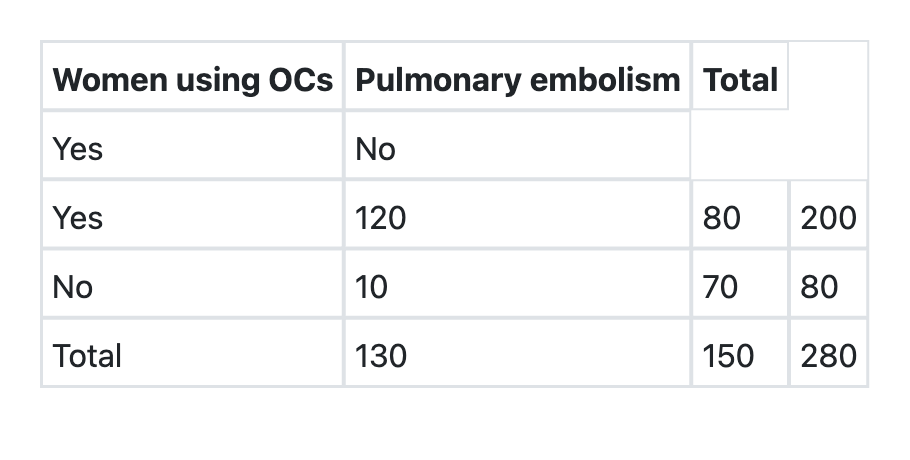
What is the relative risk of developing pulmonary embolism in users of oral contraceptives as per the information given below?
Which one of the following epidemiologic methods can be used to identify risk factors and estimate the degree of risk?
Which one of the following tests should be applied to compare mean haemoglobin level of two groups of antenatal mothers?
UPSC-CMS 2019 - Community Medicine UPSC-CMS Practice Questions and MCQs
Question 81: Physical Quality of life consolidates which of the following indicators? 1. Infant Mortality Rate 2. Life expectancy at birth 3. Literacy 4. Per capita income 5. Mean years of schooling 6. Life expectancy at age one Select the correct answer using the code given below:
- A. 1, 3 and 6 (Correct Answer)
- B. 1, 2 and 3
- C. 2, 3 and 6
- D. 1, 4 and 5
Explanation: ***1, 3 and 6*** - The **Physical Quality of Life Index (PQLI)** comprises **infant mortality rate**, **life expectancy at age one**, and **literacy rate**. - These indicators were selected to reflect basic human needs and well-being, independent of purely economic measures. *1, 2 and 3* - While **infant mortality rate** and **literacy** are part of PQLI, **life expectancy at birth** is not one of its three core components. - PQLI specifically uses **life expectancy at age one** to avoid the significant influence of high infant mortality on overall life expectancy at birth. *2, 3 and 6* - **Life expectancy at age one** and **literacy** are included in PQLI, but **life expectancy at birth** is not. - The PQLI's design intentionally focuses on outcomes after the critical first year of life. *1, 4 and 5* - **Infant mortality rate** is a PQLI component, but **per capita income** and **mean years of schooling** are not. - **Per capita income** is an economic indicator and explicitly excluded from PQLI, while **mean years of schooling** is more commonly associated with the Human Development Index (HDI).
Question 82: The sequence of events leading to disability and handicap is:
- A. Disease → Disability→Impairment→Handicap
- B. Disease → Impairment→Disability→Handicap (Correct Answer)
- C. Disease → Disability→Handicap→Impairment
- D. Disease → Handicap→Impairment→Disability
Explanation: ***Disease → Impairment→Disability→Handicap*** - This sequence follows the **WHO International Classification of Impairments, Disabilities, and Handicaps (ICIDH, 1980)** model, which correctly illustrates the progression from a health condition to its societal consequences. - A **disease** or health condition leads to **impairment** (loss or abnormality of body structure/function), which then restricts activities (**disability**), and ultimately impacts social roles (**handicap**). *Disease → Disability→Impairment→Handicap* - This order is incorrect because **impairment** (a problem in body function or structure) logically precedes **disability** (a difficulty executing tasks). - **Disability** arises from the *functional limitation* caused by impairment, not the other way around. *Disease → Disability→Handicap→Impairment* - This sequence is incorrect as **impairment** is the initial consequence of disease on a functional level, occurring before **disability** and **handicap**. - **Handicap** represents the societal and environmental disadvantage, which is the final stage in this classic WHO model. *Disease → Handicap→Impairment→Disability* - This order is incorrect because **handicap**, which refers to a social disadvantage, is the last step in the disablement process, following impairment and disability. - **Impairment** is a direct result of the disease, and **disability** follows from that impairment.
Question 83: Which one of the following statements is NOT true for taking a decision on screening for disease?
- A. Sensitivity and specificity are high
- B. Proportion of false negatives is high (Correct Answer)
- C. Disease prevalence should be high
- D. Disease is lethal
Explanation: ***Proportion of false negatives is high*** - A **high proportion of false negatives** means that many individuals with the disease are missed by the screening test. - This is **absolutely undesirable** for screening and directly contradicts the fundamental principle that screening tests should have **high sensitivity**. - This statement is clearly NOT true as a criterion for making screening decisions. *Sensitivity and specificity are high* - **High sensitivity** means the test correctly identifies most people who have the disease, minimizing false negatives. - **High specificity** means the test correctly identifies most people who do not have the disease, minimizing false positives. - Both are desirable characteristics according to Wilson-Jungner screening criteria. *Disease prevalence should be high* - This statement is **oversimplified and not strictly accurate** according to Wilson-Jungner criteria. - The actual criterion is: **"The condition should be an important health problem"** - based on disease burden, severity, and consequences, NOT necessarily high prevalence. - Many successful screening programs target **low prevalence diseases** (e.g., phenylketonuria in newborns, congenital hypothyroidism). - What matters is the **positive predictive value (PPV)** and cost-effectiveness, which are influenced by prevalence but don't require "high" prevalence. *Disease is lethal* - The Wilson-Jungner criterion states the disease should have **"serious consequences if left untreated"** - this includes but is not limited to lethality. - Screening is justified for diseases causing **significant morbidity or mortality** where early detection improves outcomes. - The disease should be sufficiently serious to warrant the costs and potential harms of screening.
Question 84: In a case-control study, 300 women aged 20-45 years suffering from breast cancer were compared with age-matched 300 women without breast cancer. It was observed that 120 women among cases and 60 women among controls were obese. The odds ratio of developing breast cancer among obese women is:
- A. 11/5
- B. 11/3
- C. 9/5
- D. 8/3 (Correct Answer)
Explanation: **8/3** - The **odds ratio** is calculated using the formula (a×d) / (b×c) from a 2×2 contingency table. - Setting up the table: Cases (breast cancer) vs Controls (no breast cancer) by exposure (obesity status) - a = obese cases = 120 - b = obese controls = 60 - c = non-obese cases = 300 - 120 = 180 - d = non-obese controls = 300 - 60 = 240 - **Odds ratio = (120 × 240) / (60 × 180) = 28,800 / 10,800 = 8/3** - This indicates that **obese women have 2.67 times the odds** of developing breast cancer compared to non-obese women. *11/5* - This answer suggests an **incorrect calculation** of the odds ratio, likely due to misassignment of values in the 2×2 table or an arithmetic error. - The result (2.2) does not match the correct cross-product ratio from the given data. *11/3* - This value is not derived from the correct **odds ratio** calculation using the given data. - Errors in setting up the 2×2 table or confusing which cells represent **exposed cases**, **exposed controls**, **unexposed cases**, and **unexposed controls** lead to such incorrect results. *9/5* - This option would result from an **incorrect placement** of values when calculating the cross-product ratio. - Possibly from reversing the numerator and denominator components or miscalculating the unexposed groups.
Question 85: Standardized Mortality ratio is best explained by which one of the following statements?
- A. New spells of disease in a given period of time per 1000 population
- B. Number of deaths in a given period of time per 1000 population
- C. Percentage of deaths in women as compared to deaths in men
- D. Ratio of observed number of deaths to the expected number of deaths in a population (Correct Answer)
Explanation: ***Ratio of observed number of deaths to the expected number of deaths in a population*** - The **Standardized Mortality Ratio (SMR)** is calculated as: **SMR = (Observed deaths / Expected deaths) × 100** - It compares the actual number of deaths observed in a study population to the number that would be expected based on standard population mortality rates, after adjusting for factors like age and sex distribution - **SMR = 100** indicates observed mortality equals expected mortality - **SMR > 100** indicates higher mortality than expected; **SMR < 100** indicates lower mortality than expected - This is the most accurate definition among the given options *New spells of disease in a given period of time per 1000 population* - This describes **incidence rate**, which measures the rate at which new cases of disease occur in a population over a specified time period - Incidence focuses on disease occurrence, not mortality or standardized comparisons *Number of deaths in a given period of time per 1000 population* - This defines the **crude death rate** or **crude mortality rate**, which is a simple count of total deaths per unit population in a given period - It does not involve standardization or comparison to expected deaths based on a reference population, which is the key feature of SMR *Percentage of deaths in women as compared to deaths in men* - This describes a **sex-specific mortality comparison** or proportionate mortality by gender - It does not relate to the concept of standardization against expected mortality rates, which is fundamental to SMR
Question 86: In a family of six (2 parents and 4 children), the youngest child catches measles infection. The parents are immune to the infection. On 3rd and 5th day of the infection of the first child, the two other children also suffer from measles. The secondary attack rate (SAR) of measles is:
- A. 40 %
- B. 66.6 % (Correct Answer)
- C. 50 %
- D. 33.3 %
Explanation: ***66.6 %*** - The **secondary attack rate (SAR)** is calculated by dividing the number of new cases among susceptible contacts by the total number of susceptible contacts. - In this scenario, there are 3 susceptible children (the index case came from the 4 children, leaving 3 susceptible), and 2 of them developed measles, making the SAR (2/3) * 100 = **66.6%**. *40 %* - This percentage would be obtained if you incorrectly included the immune parents in the susceptible population or used the total family size in the denominator for susceptible individuals. - **Parents are immune**, hence they are not at risk, and should not be included in the denominator for calculating SAR among susceptible contacts. *50 %* - This would be the SAR if either 1 out of 2 susceptible contacts became ill, or 2 out of 4 susceptible contacts became ill. - In this case, 2 out of 3 susceptible children developed measles, not 2 out of 4, therefore this option is incorrect. *33.3 %* - This percentage would result if only 1 out of the 3 susceptible children developed measles, or 2 out of 6 total family members (including parents) who were susceptible fell ill. - Since **2 out of 3 susceptible children** became infected, this option is incorrect.
Question 87: What is the relative risk of developing pulmonary embolism in users of oral contraceptives as per the information given below?
- A. 4.80 (Correct Answer)
- B. 0.24
- C. 0.48
- D. 2.40
Explanation: ***4.80*** - **Relative Risk (RR)** = Risk in exposed / Risk in unexposed - From the table provided: - **OC users (exposed):** 120 developed PE out of 200 women → Risk = 120/200 = 0.60 - **Non-OC users (unexposed):** 10 developed PE out of 80 women → Risk = 10/80 = 0.125 - **RR = 0.60 / 0.125 = 4.8** - This indicates OC users have **4.8 times higher risk** of developing pulmonary embolism compared to non-users - This significant association aligns with known **thrombogenic effects** of estrogen-containing oral contraceptives - **Clinical relevance:** Highlights importance of screening for VTE risk factors before prescribing OCs *0.24* - This value would result from incorrect calculation or misinterpretation of table values - Does not represent any valid epidemiological measure from the given data *0.48* - This is simply the decimal misplacement of 4.8 divided by 10 - Results from calculation error, not proper relative risk computation *2.40* - This is exactly half of the correct answer (4.8/2) - May result from using wrong numerator or denominator values - Does not represent the correct relative risk calculation
Question 88: Which one of the following epidemiologic methods can be used to identify risk factors and estimate the degree of risk?
- A. Case control and Cohort studies (Correct Answer)
- B. Cohort study and Ecological studies
- C. Case control and Cross-sectional studies
- D. Cohort study and Randomized controlled trial
Explanation: **Case control and Cohort studies** - **Case-control studies** effectively identify **risk factors** by comparing exposure histories between individuals with a disease (cases) and those without (controls). - **Cohort studies** directly estimate the **degree of risk** (e.g., relative risk, incidence rates) by following exposed and unexposed groups over time to observe disease development. *Cohort study and Randomized control trial* - While **cohort studies** identify risk factors, **randomized controlled trials (RCTs)** primarily evaluate the **efficacy of interventions** by randomly assigning exposure. - RCTs are ethically difficult to use for identifying harmful risk factors directly, as intentionally exposing participants to potential harm is generally not permissible. *Cohort study and Ecological studies* - **Ecological studies** examine disease rates and exposures at a **population level**, making them useful for generating hypotheses but not for establishing individual-level risk factors or degrees of risk due to the **ecological fallacy**. - They cannot directly link individual exposure to individual outcome. *Case control and Cross-sectional studies* - **Cross-sectional studies** assess prevalence and provide a snapshot of health status and exposure at a single point in time, but they cannot establish **temporality** or the degree of association between exposure and outcome. - They are useful for describing prevalence but not for inferring causality or precise risk.
Question 89: Which one of the following tests should be applied to compare mean haemoglobin level of two groups of antenatal mothers?
- A. Analysis of variance
- B. Chi-square test
- C. Unpaired t-test (Correct Answer)
- D. Paired t-test
Explanation: ***Unpaired t-Test*** - The **unpaired t-test** is used to compare the means of **two independent groups** on a continuous variable, such as hemoglobin levels. - Antenatal mothers in two distinct groups are independent, and **hemoglobin level is a continuous variable**, making this the appropriate choice. *Analysis of variance* - **ANOVA** (Analysis of Variance) is used to compare the means of **three or more independent groups**. - Since there are only **two groups** being compared, ANOVA is not the most efficient or appropriate test. *Chi-square test* - The **Chi-square test** is used to analyze the association between **two categorical variables**. - Hemoglobin level is a **continuous variable**, not categorical, so this test is not suitable for comparing means. *Paired t-test* - The **paired t-test** is used to compare the means of **two related groups** or the same group measured at two different times (e.g., before and after an intervention). - The two groups of antenatal mothers are **independent**, not paired or related.
Obstetrics and Gynecology
1 questionsWhich one of the following is NOT done as screening test in pregnancy?
UPSC-CMS 2019 - Obstetrics and Gynecology UPSC-CMS Practice Questions and MCQs
Question 81: Which one of the following is NOT done as screening test in pregnancy?
- A. Serum cholesterol (Correct Answer)
- B. Neural tube defects
- C. Syphilis-VDRL
- D. Diabetes
Explanation: ***Serum cholesterol*** - **Serum cholesterol** levels are not routinely measured as a screening test during pregnancy. - While lipid metabolism changes during pregnancy, monitoring cholesterol levels specifically for screening purposes is not standard practice. *Neural tube defects (NTDs)* - Screening for **neural tube defects** is a crucial part of antenatal care, typically involving maternal serum alpha-fetoprotein (**MSAFP**) screening and targeted ultrasound. - Early detection allows for counseling and management options for the pregnancy due to conditions like **spina bifida** or **anencephaly**. *Syphilis-VDRL* - Screening for **syphilis** using tests like **VDRL** (Venereal Disease Research Laboratory) or RPR (Rapid Plasma Reagin) is a mandatory part of antenatal screening in many regions. - This is done to prevent congenital syphilis, which can cause severe fetal and neonatal complications. *Diabetes* - All pregnant women are screened for **gestational diabetes mellitus (GDM)**, typically between 24 and 28 weeks of gestation, using a **glucose challenge test** followed by an oral glucose tolerance test if screening is positive. - Undiagnosed and untreated GDM can lead to adverse maternal and fetal outcomes, including macrosomia, pre-eclampsia, and neonatal hypoglycemia.