Biochemistry
3 questionsWhich one of the following vitamins given as a supplement during the peri-conceptional period to a woman can help prevent the neural tube defects in the baby ?
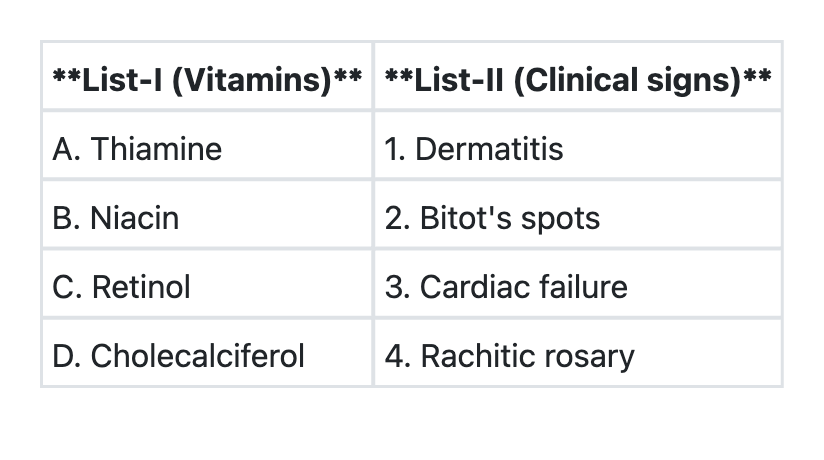
Match List-I with List-II and select the correct answer using the code given below the Lists:
An average-sized hen egg would provide
UPSC-CMS 2012 - Biochemistry UPSC-CMS Practice Questions and MCQs
Question 81: Which one of the following vitamins given as a supplement during the peri-conceptional period to a woman can help prevent the neural tube defects in the baby ?
- A. Riboflavin
- B. Folic acid (Correct Answer)
- C. Thiamine
- D. Vitamin B12
Explanation: ***Folic acid*** - **Folic acid** (vitamin B9) supplementation is crucial during the **peri-conceptional period** to prevent neural tube defects. - Adequate folic acid intake helps in the proper development and closure of the **neural tube** in the embryo, which forms the brain and spinal cord. *Riboflavin* - **Riboflavin** (vitamin B2) is essential for energy metabolism and cellular growth but has no direct, established role in preventing neural tube defects. - Deficiency can lead to **ariboflavinosis**, characterized by skin lesions, but not directly linked to neural tube malformations. *Thiamine* - **Thiamine** (vitamin B1) is vital for carbohydrate metabolism and nerve function. - Its deficiency causes **beriberi** and neurological problems in adults, but it does not directly prevent neural tube defects. *Vitamin B12* - **Vitamin B12** (cobalamin) is important for DNA synthesis and nerve function, and it works closely with folate. - While B12 deficiency can lead to megaloblastic anemia and neurological issues, **folic acid** is the primary vitamin for preventing neural tube defects.
Question 82: Match List-I with List-II and select the correct answer using the code given below the Lists:
- A. A→3 B→2 C→1 D→4
- B. A→1 B→4 C→2 D→3
- C. A→4 B→2 C→1 D→3
- D. A→3 B→1 C→2 D→4 (Correct Answer)
Explanation: ***A→3 B→1 C→2 D→4*** - **Thiamine (Vitamin B1)** deficiency can lead to **beriberi**, which often manifests as **wet beriberi** characterized by **high-output cardiac failure**, edema, and peripheral neuropathy. - **Niacin (Vitamin B3)** deficiency causes **pellagra**, a disease classically presenting with the "4 Ds": **dermatitis**, diarrhea, dementia, and death. - **Retinol (Vitamin A)** deficiency is primarily known for causing **xerophthalmia**, which includes early signs like **night blindness** and later stages like Bitot's spots (foamy keratin debris on the conjunctiva) and keratomalacia. - **Cholecalciferol (Vitamin D)** deficiency leads to **rickets in children**, characterized by impaired bone mineralization causing skeletal deformities such as a **rachitic rosary** (enlargement of the costochondral junctions). *A→3 B→2 C→1 D→4* - This option incorrectly matches Niacin with Bitot's spots (Vitamin A deficiency) and Retinol with Dermatitis (Niacin deficiency). - The correct associations are Thiamine with cardiac failure, Niacin with dermatitis, Retinol with Bitot's spots, and Cholecalciferol with rachitic rosary. *A→1 B→4 C→2 D→3* - This option incorrectly matches Thiamine with dermatitis, Niacin with rachitic rosary, and Cholecalciferol with cardiac failure. - Each of these pairings contradicts the established clinical manifestations of the respective vitamin deficiencies. *A→4 B→2 C→1 D→3* - This option incorrectly associates Thiamine with rachitic rosary, Niacin with Bitot's spots, and Retinol with dermatitis. - The symptoms listed are characteristic of different vitamin deficiencies than those incorrectly matched in this choice.
Question 83: An average-sized hen egg would provide
- A. 90 Kcal
- B. 70 Kcal (Correct Answer)
- C. 50 Kcal
- D. 110 Kcal
Explanation: ***70 Kcal*** - An average-sized hen egg (approximately 50 grams) typically provides around **70-75 kilocalories** of energy. - This energy content is primarily derived from the egg's **protein and fat** components. *90 Kcal* - This value is slightly higher than the average for a standard hen egg and might be applicable to a **larger-sized egg** or if additional ingredients are included. - The precise caloric content varies with the **size and preparation** of the egg. *50 Kcal* - This value is generally **too low** for an average-sized whole hen egg. - An egg white alone might be closer to this caloric count, as **most of the fat and calories are in the yolk**. *110 Kcal* - This caloric value is significantly **higher** than what an average hen egg provides. - Such a high value would typically be found in **very large eggs** or in egg preparations that include added fats like butter or oil.
Community Medicine
3 questionsA Health Assistant (Male) covers a population of
Case Fatality Rate of a disease is a measure of its
The incubation period of mumps is
UPSC-CMS 2012 - Community Medicine UPSC-CMS Practice Questions and MCQs
Question 81: A Health Assistant (Male) covers a population of
- A. 1,000
- B. 30,000 (Correct Answer)
- C. 5,000
- D. 1,00,000
Explanation: ***Correct Answer: 30,000*** - A Health Assistant (Male), also known as a **Multi-Purpose Worker (Male) [MPW(M)]**, is responsible for a population of **30,000** in a rural plain area. - Their duties include assisting with family planning, maternal and child health, immunization, and communicable disease control programs. - This is the standard population norm as per **Indian Public Health Standards (IPHS)**. *Incorrect Option: 1,000* - A population of **1,000** is typically covered by an **Accredited Social Health Activist (ASHA)**, who operates at the village level. - ASHAs are community health workers primarily focused on mobilizing the community for health services and providing basic health education. - This represents a much smaller coverage area than Health Assistant (Male). *Incorrect Option: 5,000* - A **Sub-Centre**, the most peripheral and first contact point between the primary health care system and the community, covers a population of **5,000 in plain areas** and **3,000 in hilly/tribal areas**. - Sub-Centre is staffed by one ANM (Auxiliary Nurse Midwife) and one Male Health Worker. - This is the coverage for a health facility, not specifically for Health Assistant (Male). *Incorrect Option: 1,00,000* - A **Community Health Centre (CHC)** serves as a referral unit for **4-5 Primary Health Centres** and covers a population of **80,000 to 1.2 lakh** in plain areas. - CHCs provide specialist services like obstetrics and gynecology, surgery, pediatrics, and emergency services. - This represents the coverage of a referral-level health facility, much larger than Health Assistant (Male) coverage.
Question 82: Case Fatality Rate of a disease is a measure of its
- A. Chronicity
- B. Endemicity
- C. Infectivity
- D. Virulence (Correct Answer)
Explanation: ***Virulence*** - **Case fatality rate (CFR)** is defined as the proportion of persons with a disease who **die from that disease**. - It directly reflects the **severity** or **lethality** of a disease among those infected. - A higher CFR indicates that the disease is more **virulent**, causing a greater proportion of infected individuals to die. - CFR is the standard epidemiological measure of **virulence**. *Chronicity* - **Chronicity** refers to the **duration** of a disease, indicating whether it is long-lasting or recurrent. - It does not directly measure the disease's ability to cause death among those infected. *Endemicity* - **Endemicity** describes the **constant presence** and/or usual prevalence of a disease in a geographic area or population. - This term relates to the typical occurrence pattern, not the deadliness of the disease. *Infectivity* - **Infectivity** is the ability of an organism to **cause infection** in a susceptible host. - It measures how easily an agent can spread and establish itself, not its capacity to cause severe disease or death.
Question 83: The incubation period of mumps is
- A. 2-3 weeks (Correct Answer)
- B. 4-5 weeks
- C. 1-2 weeks
- D. 3-4 weeks
Explanation: ***2-3 weeks*** - The incubation period for **mumps** is typically 16 to 18 days, with a range of 12 to 25 days, which falls within the 2-3 week timeframe. - This period is the time from exposure to the mumps virus until the onset of symptoms, such as **parotitis**. *4-5 weeks* - An incubation period of 4-5 weeks is longer than the typical range for mumps, suggesting a different viral infection. - This duration is more characteristic of diseases like **hepatitis B** rather than mumps. *1-2 weeks* - An incubation period of 1-2 weeks is shorter than the typical range for mumps. - This timeframe is more commonly associated with various **respiratory viruses** or **influenza**. *3-4 weeks* - While 3-4 weeks (21-28 days) can include the upper end of the mumps incubation period, it is not the most common or typical duration. - The average incubation is closer to **2.5 weeks**, making 2-3 weeks the more accurate general range.
Internal Medicine
1 questionsWhich of the following conditions may produce "wrist drop" ?
UPSC-CMS 2012 - Internal Medicine UPSC-CMS Practice Questions and MCQs
Question 81: Which of the following conditions may produce "wrist drop" ?
- A. Alcoholics
- B. Beriberi
- C. Lead poisoning (Correct Answer)
- D. Diabetes mellitus
Explanation: ***Lead poisoning*** - **Lead neuropathy** predominantly affects motor nerves, often leading to **wrist drop** and **foot drop** due to involvement of the radial and peroneal nerves, respectively [1]. - The toxic effects of lead interfere with heme synthesis and neuronal function, leading to **demyelination** and axonal degeneration [1]. *Alcoholics* - **Alcoholic neuropathy** typically affects peripheral nerves, causing sensory and motor deficits, often as a **stocking-glove distribution** [3]. - While it can manifest as weakness, classic "wrist drop" is not a hallmark feature; rather, it often involves generalized weakness and sensory loss. *Beriberi* - **Beriberi** is caused by **thiamine (vitamin B1) deficiency** and presents in two main forms: wet (cardiovascular) and dry (neurological). - Dry beriberi causes **peripheral neuropathy** with symmetrical motor and sensory impairment, but **wrist drop** is not a characteristic isolated sign. *Diabetes mellitus* - **Diabetic neuropathy** commonly leads to a **stocking-glove sensory loss** and - Can cause motor weakness, but isolated **wrist drop** [2] is not a typical presentation; rather, it's often polyneuropathy or mononeuropathy multiplex [3].
Microbiology
1 questionsThe pathogenic organism responsible for the causation of Donovaniasis is
UPSC-CMS 2012 - Microbiology UPSC-CMS Practice Questions and MCQs
Question 81: The pathogenic organism responsible for the causation of Donovaniasis is
- A. Herpes simplex virus
- B. Klebsiella granulomatis (Correct Answer)
- C. Haemophilus ducreyi
- D. Chlamydia trachomatis
Explanation: ***Klebsiella granulomatis*** - This bacterium is the causative agent of **granuloma inguinale**, also known as **donovaniasis**. - It infects macrophages and causes chronic, progressive **genital ulcers** with a characteristic beefy-red appearance. *Herpes simplex virus* - This virus causes **genital herpes**, characterized by painful **vesicular or ulcerative lesions** that tend to recur. *Haemophilus ducreyi* - This bacterium causes **chancroid**, characterized by painful, soft chancres with **ragged, undermined borders**. *Chlamydia trachomatis* - This bacterium is responsible for several sexually transmitted infections, including **lymphogranuloma venereum (LGV)**, which presents with transient genital lesions followed by painful, suppurative lymphadenopathy, and **genital chlamydial infections** which often cause urethritis or cervicitis.
Obstetrics and Gynecology
1 questionsWhat is the recommendation for use of Levonorgestrel for the purpose of emergency contraception ?
UPSC-CMS 2012 - Obstetrics and Gynecology UPSC-CMS Practice Questions and MCQs
Question 81: What is the recommendation for use of Levonorgestrel for the purpose of emergency contraception ?
- A. Two tablets of 0-75 mg Levonorgestrel to be taken soon after the act of unprotected coitus but within 96 hours (Correct Answer)
- B. One tablet of 0-75 mg Levonorgestrel to be taken soon after the act of unprotected coitus but within 72 hours
- C. None of the options
- D. One tablet of 0-75 mg Levonorgestrel to be taken soon after the act of unprotected coitus but within 120 hours
Explanation: ***Two tablets of 0.75 mg Levonorgestrel to be taken soon after the act of unprotected coitus but within 96 hours*** - This represents the **correct total dose of 1.5 mg** (0.75 mg × 2 tablets) for emergency contraception. - The standard regimen for **levonorgestrel emergency contraception** can be administered as either a **single dose of 1.5 mg** or as **two doses of 0.75 mg taken 12 hours apart**. - Current WHO guidelines recommend taking both tablets together (single 1.5 mg dose) for ease of compliance, which is equally effective as the split-dose regimen. - The **96-hour window** is within the acceptable timeframe, as levonorgestrel EC can be effective for up to **120 hours** (5 days) after unprotected intercourse, though efficacy is highest within **72 hours**. - The phrase "soon after" reasonably implies taking the tablets together or in quick succession, which aligns with current practice. *One tablet of 0.75 mg Levonorgestrel to be taken soon after the act of unprotected coitus but within 72 hours* - This option specifies only a **single 0.75 mg tablet**, which is **half the required total dose (1.5 mg)** for emergency contraception. - While the **72-hour window** is correct for optimal efficacy, the **insufficient dosage** makes this option incorrect. *One tablet of 0.75 mg Levonorgestrel to be taken soon after the act of unprotected coitus but within 120 hours* - This option also presents an **insufficient dose of only 0.75 mg** when the standard requirement is **1.5 mg total**. - Although **120 hours** represents the maximum effective window for levonorgestrel EC, the inadequate dosage makes this incorrect. *None of the options* - This is incorrect because **Option 3** appropriately describes the recommended total dose and timeframe for levonorgestrel emergency contraception based on current guidelines.
Pediatrics
1 questionsAmong the following, the best indicator for acute malnutrition in the under-fives is
UPSC-CMS 2012 - Pediatrics UPSC-CMS Practice Questions and MCQs
Question 81: Among the following, the best indicator for acute malnutrition in the under-fives is
- A. Height for age
- B. Head/chest circumference ratio
- C. Mid arm circumference
- D. Weight for height (Correct Answer)
Explanation: ***Weight for height*** - **Weight-for-height** is the best indicator for **acute malnutrition** (wasting) in under-fives as it reflects recent nutritional deficits. - It compares a child's weight to the expected weight for a child of the same height, identifying if they are too thin for their height. *Height for age* - **Height-for-age** is an indicator of **chronic malnutrition (stunting)**, reflecting long-term nutritional deprivation. - It does not accurately capture acute, recent weight loss or wasting. *Head/chest circumference ratio* - The **head/chest circumference ratio** can be used as a screening tool in some contexts, but it is less precise and sensitive for assessing acute malnutrition than weight-for-height. - Its utility decreases beyond the first year of life as the chest circumference typically begins to exceed head circumference. *Mid arm circumference* - **Mid-upper arm circumference (MUAC)** is a useful **screening tool** for severe acute malnutrition, particularly in community settings. - However, **weight-for-height** is generally considered a more comprehensive and accurate indicator for diagnosing and assessing the severity of acute malnutrition across all severities.