Community Medicine
6 questionsThe detection of sore throat cases in children and their treatment with Benzathine Penicillin in Community Control Programme of Rheumatic Fever/Rheumatic Heart Disease (RF/RHD) constitutes
Which one of the following is a stomach poison for the larvae of insects of medical importance ?
In a village, every fifth house was selected for a study. This is an example of
In disability rates, event type indicators are the following except
A randomized trial comparing the efficacy of two drugs showed a difference between the two (p value < 0.05). However, in reality the drugs do not differ. This is an example of
Which one of the following formulae is used for computing the Aedes aegypti Index at International Airports and sea ports ?
UPSC-CMS 2012 - Community Medicine UPSC-CMS Practice Questions and MCQs
Question 101: The detection of sore throat cases in children and their treatment with Benzathine Penicillin in Community Control Programme of Rheumatic Fever/Rheumatic Heart Disease (RF/RHD) constitutes
- A. Primary prevention of RF/RHD (Correct Answer)
- B. Primordial prevention of RF/RHD
- C. Tertiary prevention of RF/RHD
- D. Secondary prevention of RF/RHD
Explanation: ***Primary prevention of RF/RHD*** - **Early detection and treatment** of streptococcal sore throat prevents the initial episode of **acute rheumatic fever (ARF)**, thus preventing the onset of **rheumatic heart disease (RHD)**. - This intervention targets preventing the disease's **initial occurrence** by eliminating the precipitating cause. *Primordial prevention of RF/RHD* - **Primordial prevention** focuses on preventing the development of **risk factors** in the first place, often through broad social or environmental changes. - This involves strategies like improving **socioeconomic conditions** or **housing sanitation** to reduce the overall burden of streptococcal infections, rather than treating individual cases. *Tertiary prevention of RF/RHD* - **Tertiary prevention** aims to **reduce the impact** of an established disease, minimizing complications and improving quality of life. - For RF/RHD, this would involve managing **existing RHD**, such as through cardiac surgery or long-term medication, to prevent further deterioration or disability. *Secondary prevention of RF/RHD* - **Secondary prevention** involves detecting and treating a disease **early** to prevent its progression or recurrence *after* an initial episode. - In the context of RF/RHD, this would refer to **secondary prophylaxis with penicillin** given to individuals who have already had ARF to prevent subsequent attacks and progression to RHD.
Question 102: Which one of the following is a stomach poison for the larvae of insects of medical importance ?
- A. Anti larva oil
- B. Pyrethrum
- C. D.D.T.
- D. Paris Green (Correct Answer)
Explanation: ***Paris Green*** - **Paris Green (copper acetoarsenite)** acts as a **stomach poison** when ingested by insect larvae, particularly effective against mosquito larvae. - It is an **arsenical compound** that disrupts cellular respiration and enzyme function in the insect's digestive system. *Anti larva oil* - **Anti-larval oils** primarily act by forming a **thin film on the water surface**, preventing mosquito larvae from breathing. - This method is a **physical action** causing suffocation, rather than a stomach poison. *Pyrethrum* - **Pyrethrum** is a broad-spectrum **contact insecticide** derived from chrysanthemum flowers. - It acts on the **nervous system** of insects, causing rapid knockdown and paralysis, but is not primarily a stomach poison for larvae. *D.D.T.* - **DDT (dichlorodiphenyltrichloroethane)** is a **contact insecticide** that acts on the nervous system of insects. - It was widely used for adult mosquito control but is not typically applied as a stomach poison for larvae in a water environment.
Question 103: In a village, every fifth house was selected for a study. This is an example of
- A. Simple random sampling
- B. Convenience sampling
- C. Systematic random sampling (Correct Answer)
- D. Stratified random sampling
Explanation: ***Systematic random sampling*** - This method involves selecting subjects from a **ordered sampling frame** at regular intervals, such as every k-th item. - In this scenario, selecting every fifth house represents a fixed interval (k=5), which is characteristic of systematic random sampling. *Simple random sampling* - This method ensures that every member of the population has an **equal chance of being selected**, often through random number generation. - It does not involve a predetermined, fixed interval of selection from an ordered list. *Convenience sampling* - This technique involves selecting subjects who are **easily accessible or readily available**, without any systematic or random process. - It is prone to bias as it does not represent the entire population. *Stratified random sampling* - This method involves dividing the population into **homogeneous subgroups (strata)** and then conducting simple random sampling within each stratum. - The scenario does not describe dividing the village households into distinct subgroups before selection.
Question 104: In disability rates, event type indicators are the following except
- A. Work loss days
- B. Bed disability days
- C. Number of days of restricted activity
- D. Limitation of activity (Correct Answer)
Explanation: ***Limitation of activity*** - While related to disability measurement, **limitation of activity** is typically classified as a **chronic disability indicator** or **impact indicator** rather than an event type indicator measured in discrete time units. - Event type indicators usually quantify disability in **specific time units (days)** representing acute episodes or events. - **Limitation of activity** describes a long-term functional status rather than countable discrete events. *Work loss days* - **Work loss days** are a standard **event type indicator** measuring days of work lost due to illness or injury. - This is a specific type of restricted activity day for the employed population. - Quantifies disability impact in discrete, countable time units (days). *Bed disability days* - **Bed disability days** directly measure severe disability events where an individual is confined to bed. - This is a classic **event type indicator** used in national health surveys. - Represents the most severe form of restricted activity days. *Number of days of restricted activity* - **Restricted activity days** are the primary **event type indicator** in disability measurement. - Quantifies days when usual activities are limited due to health conditions. - This is the broadest category of event type indicators, encompassing bed disability days and work loss days.
Question 105: A randomized trial comparing the efficacy of two drugs showed a difference between the two (p value < 0.05). However, in reality the drugs do not differ. This is an example of
- A. Type I error (Correct Answer)
- B. Both type I and II error
- C. Random error
- D. Type II error
Explanation: ***Type I error*** - A **Type I error** occurs when the **null hypothesis is incorrectly rejected**, leading to the conclusion that a significant difference exists when, in reality, there is no true difference. - In this scenario, the trial concluded a difference (p < 0.05), but the drugs are truly equivalent, which is precisely the definition of a **Type I error**. *Both type I and II error* - It is impossible to commit both a **Type I** and a **Type II error** simultaneously for the same statistical test. - A **Type I error** involves rejecting a true null hypothesis, while a **Type II error** involves failing to reject a false null hypothesis. *Random error* - **Random error** refers to unpredictable fluctuations in measurements or results, which can be minimized but not eliminated. - While random error can contribute to variability in data, it is not the direct statistical error of concluding a non-existent difference when analyzing the results, which is a **Type I error**. *Type II error* - A **Type II error** occurs when the **null hypothesis is incorrectly accepted** (or not rejected), meaning a real difference exists but the study fails to detect it. - This scenario describes the opposite: a difference was detected and concluded, but it was false.
Question 106: Which one of the following formulae is used for computing the Aedes aegypti Index at International Airports and sea ports ?
- A. Number of houses positive for Aedes aegypti breeding / Total number of houses x 100
- B. Number of bites of Aedes aegypti / Total number of man hours x 100
- C. Number of containers positive for Aedes aegypti breeding / Total number of houses x 100
- D. Number of containers positive for Aedes aegypti breeding / Total number of containers x 100 (Correct Answer)
Explanation: ***Number of containers positive for Aedes aegypti breeding / Total number of containers x 100*** - The **Aedes Index (or Container Index)** specifically measures the percentage of water-holding containers found with *Aedes aegypti* larvae or pupae. - This index is crucial for assessing the **risk of dengue, Zika, and chikungunya transmission** by identifying breeding sites in areas like airports and seaports. *Number of houses positive for Aedes aegypti breeding / Total number of houses x 100* - This formula represents the **House Index**, which is a different measure of *Aedes aegypti* infestation, focusing on the percentage of houses with breeding sites. - While relevant, it is not the primary index used to assess risk at **international transit points** where containers are critical. *Number of bites of Aedes aegypti / Total number of man hours x 100* - This formula relates to **human biting rates** or **landing rates**, which assess adult mosquito activity and exposure, not the presence of breeding sites. - It does not directly measure the **potential for larval development** in containers. *Number of containers positive for Aedes aegypti breeding / Total number of houses x 100* - This formula mixes two different denominators: **containers (for positives)** and **houses (for total)**. - This is an **incorrect or hybrid formula** that does not correspond to any standard entomological index for *Aedes aegypti*.
Internal Medicine
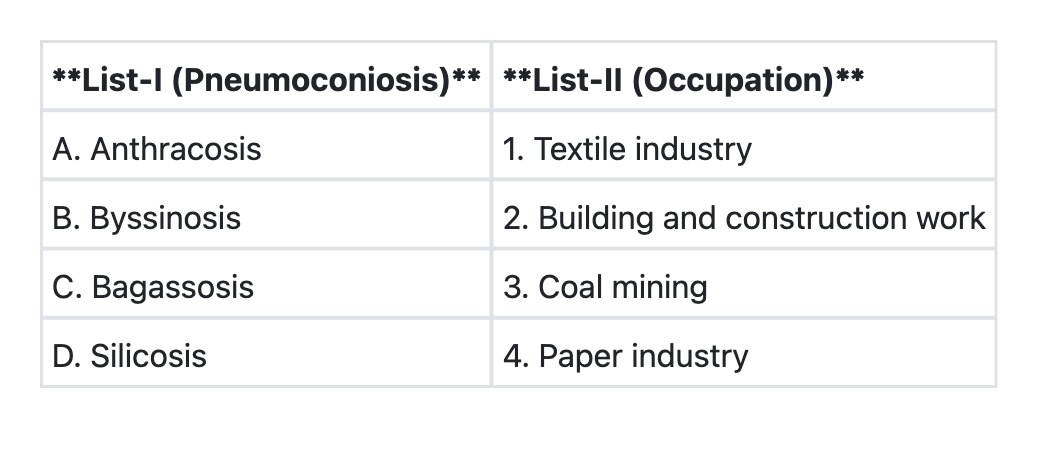
2 questionsMatch List-I with List-II and select the correct answer using the code given below the Lists:
Which of the following is a non-modifiable risk factor for coronary heart disease ?
UPSC-CMS 2012 - Internal Medicine UPSC-CMS Practice Questions and MCQs
Question 101: Match List-I with List-II and select the correct answer using the code given below the Lists:
- A. A→3 B→1 C→2 D→4 (Correct Answer)
- B. A→3 B→2 C→1 D→4
- C. A→1 B→4 C→2 D→3
- D. A→4 B→2 C→1 D→3
Explanation: ***A→3 B→1 C→2 D→4*** - This option correctly matches each pneumoconiosis with its associated occupation. - **Anthracosis** is linked to coal mining, **Byssinosis** to the textile industry, **Bagassosis** to the paper industry, and **Silicosis** to building and construction work. *A→3 B→2 C→1 D→4* - This option incorrectly matches **Byssinosis** with building and construction work and **Bagassosis** with the textile industry. - Byssinosis is caused by cotton dust in the textile industry, and Bagassosis is caused by bagasse dust, commonly from the sugar cane or paper industry. *A→1 B→4 C→2 D→3* - This option contains multiple incorrect matches, including linking Anthracosis to the textile industry and Silicosis to coal mining. - Anthracosis is specifically tied to **coal dust exposure**, and Silicosis results from **silica dust inhalation**. *A→4 B→2 C→1 D→3* - This option is incorrect because it mismatches Anthracosis with the paper industry and Bagassosis with the textile industry, among others. - Each pneumoconiosis has a distinct occupational exposure source.
Question 102: Which of the following is a non-modifiable risk factor for coronary heart disease ?
- A. Elevated serum cholesterol
- B. Age (Correct Answer)
- C. Alcoholism
- D. Cigarette smoking
Explanation: ***Age*** - Age is a **non-modifiable risk factor** for coronary heart disease because it cannot be changed or controlled. As people age, their risk of developing CHD naturally increases due to physiological changes and increased exposure to other risk factors over time. [1] - The older an individual is, especially for men over 45 and women over 55, the higher their risk for developing **atherosclerosis** and its complications, including CHD. [1] *Elevated serum cholesterol* - **Elevated serum cholesterol**, particularly high levels of LDL cholesterol, is a **modifiable risk factor** because it can be lowered through diet, exercise, and medication. [1] - Reducing cholesterol levels can significantly decrease the risk of **atherosclerosis** and subsequent CHD. [1] *Alcoholism* - **Alcoholism** is a **modifiable risk factor** as it represents a lifestyle choice that can be changed through behavioral interventions and support. - Excessive alcohol consumption can contribute to high blood pressure, **cardiomyopathy**, and increased triglyceride levels, all of which raise the risk of CHD. *Cigarette smoking* - **Cigarette smoking** is a major **modifiable risk factor** for CHD because it is a habit that individuals can choose to stop. [1] - Smoking damages blood vessels, increases **blood clotting**, and reduces oxygen delivery to the heart, significantly accelerating the development of atherosclerosis. [1]
Pediatrics
1 questionsA 9-month-old infant is brought to you for immunization. The infant has previously received the first dose of OPV and DPT. What will you do ?
UPSC-CMS 2012 - Pediatrics UPSC-CMS Practice Questions and MCQs
Question 101: A 9-month-old infant is brought to you for immunization. The infant has previously received the first dose of OPV and DPT. What will you do ?
- A. Give the infant second dose of DPT/OPV (Correct Answer)
- B. Give the infant DT/OPV
- C. Repeat the first dose counting afresh
- D. Give the infant a booster dose of DPT/Polio
Explanation: ***Give the infant second dose of DPT/OPV*** - As per the **Expanded Programme on Immunization (EPI)** guidelines, even if there's a delay, one should **continue the vaccination schedule** from where it left off, rather than restarting. - The 9-month-old is due for the **second dose of DPT and OPV**, as the first dose has already been administered. *Give the infant DT/OPV* - **DT (Diphtheria and Tetanus)** vaccine is generally given to older children who have contraindications to the pertussis component of DPT or as part of a different schedule. - At 9 months, the infant still requires the **pertussis component** for protection against whooping cough. *Repeat the first dose counting afresh* - There is **no clinical or immunological basis** for restarting the vaccination schedule (counting afresh) simply because of a delay. - Antibodies from the first dose are still present and contribute to the immune response upon subsequent doses; hence, previous doses are **considered valid**. *Give the infant a booster dose of DPT/Polio* - A **booster dose** is typically given much later in childhood (e.g., at 18 months or 5 years) to enhance and prolong immunity after the primary series is completed. - The infant first needs to **complete the primary series** of DPT and OPV, which involves a second and third dose.