UPSC-CMS 2012 — Biochemistry
7 Previous Year Questions with Answers & Explanations
Consider the following statements: 1. Diets high in vitamin C have been claimed to lower the incidence of certain cancers, particularly oesophageal and gastric cancers. 2. Vitamin C can prevent the conversion of nitrites and secondary amines to carcinogenic nitrosamines. Which of the statements given above is/are correct?
The biological value of a given protein depends upon
Which one of the following vitamins given as a supplement during the peri-conceptional period to a woman can help prevent the neural tube defects in the baby ?
Match List-I with List-II and select the correct answer using the code given below the Lists:
An average-sized hen egg would provide
Which one of the following is a polyunsaturated fatty acid ?
Which of the following dietary sources contains the lowest percent of linoleic acid?
UPSC-CMS 2012 - Biochemistry UPSC-CMS Practice Questions and MCQs
Question 1: Consider the following statements: 1. Diets high in vitamin C have been claimed to lower the incidence of certain cancers, particularly oesophageal and gastric cancers. 2. Vitamin C can prevent the conversion of nitrites and secondary amines to carcinogenic nitrosamines. Which of the statements given above is/are correct?
- A. 1 only
- B. 2 only
- C. Both 1 and 2 (Correct Answer)
- D. Neither 1 nor 2
Explanation: ***Both 1 and 2*** - **Statement 1 is correct:** Epidemiological studies have consistently shown that diets high in vitamin C are associated with a **lower incidence of oesophageal and gastric cancers**, attributed to its antioxidant properties and protective mechanisms. - **Statement 2 is correct:** Vitamin C acts as a **reducing agent that blocks nitrosamine formation** by preventing nitrites and secondary amines from reacting to form these carcinogenic compounds in the acidic gastric environment. - Both statements are **independently true and complementary** - statement 2 explains one of the key mechanisms by which statement 1's observation occurs. *1 only* - This option is incorrect because it ignores statement 2, which describes a **well-established biochemical mechanism** of vitamin C's cancer-protective effect. - The ability of vitamin C to prevent nitrosamine formation is a **proven protective mechanism**, not just a claim. *2 only* - This option is incorrect because it ignores statement 1, which accurately reflects **epidemiological evidence** linking high vitamin C intake with reduced cancer risk. - The association between dietary vitamin C and lower cancer incidence is **well-documented in observational studies**. *Neither 1 nor 2* - This option is completely incorrect as **both statements are scientifically accurate** and supported by substantial evidence. - Vitamin C's role in **cancer prevention through antioxidant activity and nitrosamine inhibition** is well-established in biochemistry and nutrition science.
Question 2: The biological value of a given protein depends upon
- A. Digestibility and leucine content
- B. Digestibility and amino acid composition (Correct Answer)
- C. Amino acid composition and specific dynamic effect
- D. Amino acid composition alone
Explanation: ***Digestibility and amino acid composition*** - The **biological value (BV)** of a protein measures how efficiently the body can use the absorbed protein from a food source for growth and maintenance. - It is primarily determined by two factors: the **digestibility** of the protein (how much is absorbed) and its **amino acid composition** (the proportion and availability of essential amino acids). *Digestibility and leucine content* - While **digestibility** is an important factor for biological value, **leucine content** alone is not sufficient to determine it. - The biological value depends on the **overall balance of essential amino acids**, not just one specific amino acid. *Amino acid composition and specific dynamic effect* - **Amino acid composition** is crucial for biological value, but the **specific dynamic effect (SDE)**, also known as the thermic effect of food, refers to the energy expended during the digestion, absorption, and assimilation of food. - SDE is related to energy metabolism, not directly to the protein's utility for tissue synthesis. *Amino acid composition alone* - **Amino acid composition** is a key determinant, particularly the presence and proportion of **essential amino acids**. - However, for a protein to be utilized, it must first be **digested and absorbed**, making digestibility an equally critical factor affecting its overall biological value.
Question 3: Which one of the following vitamins given as a supplement during the peri-conceptional period to a woman can help prevent the neural tube defects in the baby ?
- A. Riboflavin
- B. Folic acid (Correct Answer)
- C. Thiamine
- D. Vitamin B12
Explanation: ***Folic acid*** - **Folic acid** (vitamin B9) supplementation is crucial during the **peri-conceptional period** to prevent neural tube defects. - Adequate folic acid intake helps in the proper development and closure of the **neural tube** in the embryo, which forms the brain and spinal cord. *Riboflavin* - **Riboflavin** (vitamin B2) is essential for energy metabolism and cellular growth but has no direct, established role in preventing neural tube defects. - Deficiency can lead to **ariboflavinosis**, characterized by skin lesions, but not directly linked to neural tube malformations. *Thiamine* - **Thiamine** (vitamin B1) is vital for carbohydrate metabolism and nerve function. - Its deficiency causes **beriberi** and neurological problems in adults, but it does not directly prevent neural tube defects. *Vitamin B12* - **Vitamin B12** (cobalamin) is important for DNA synthesis and nerve function, and it works closely with folate. - While B12 deficiency can lead to megaloblastic anemia and neurological issues, **folic acid** is the primary vitamin for preventing neural tube defects.
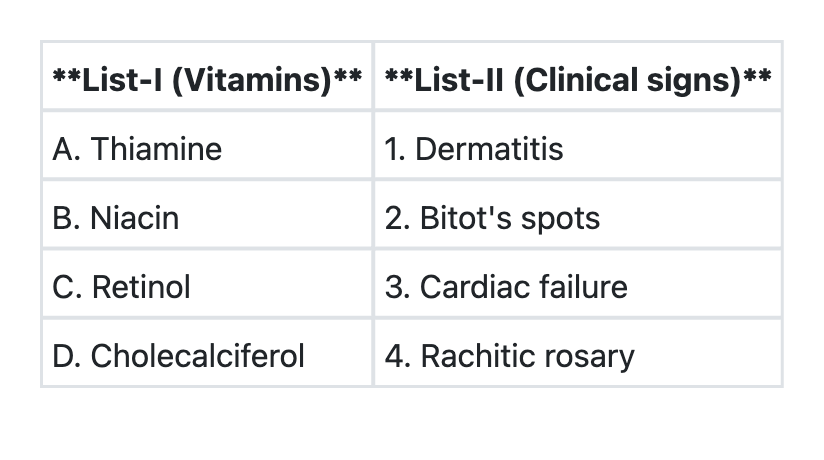
Question 4: Match List-I with List-II and select the correct answer using the code given below the Lists:
- A. A→3 B→2 C→1 D→4
- B. A→1 B→4 C→2 D→3
- C. A→4 B→2 C→1 D→3
- D. A→3 B→1 C→2 D→4 (Correct Answer)
Explanation: ***A→3 B→1 C→2 D→4*** - **Thiamine (Vitamin B1)** deficiency can lead to **beriberi**, which often manifests as **wet beriberi** characterized by **high-output cardiac failure**, edema, and peripheral neuropathy. - **Niacin (Vitamin B3)** deficiency causes **pellagra**, a disease classically presenting with the "4 Ds": **dermatitis**, diarrhea, dementia, and death. - **Retinol (Vitamin A)** deficiency is primarily known for causing **xerophthalmia**, which includes early signs like **night blindness** and later stages like Bitot's spots (foamy keratin debris on the conjunctiva) and keratomalacia. - **Cholecalciferol (Vitamin D)** deficiency leads to **rickets in children**, characterized by impaired bone mineralization causing skeletal deformities such as a **rachitic rosary** (enlargement of the costochondral junctions). *A→3 B→2 C→1 D→4* - This option incorrectly matches Niacin with Bitot's spots (Vitamin A deficiency) and Retinol with Dermatitis (Niacin deficiency). - The correct associations are Thiamine with cardiac failure, Niacin with dermatitis, Retinol with Bitot's spots, and Cholecalciferol with rachitic rosary. *A→1 B→4 C→2 D→3* - This option incorrectly matches Thiamine with dermatitis, Niacin with rachitic rosary, and Cholecalciferol with cardiac failure. - Each of these pairings contradicts the established clinical manifestations of the respective vitamin deficiencies. *A→4 B→2 C→1 D→3* - This option incorrectly associates Thiamine with rachitic rosary, Niacin with Bitot's spots, and Retinol with dermatitis. - The symptoms listed are characteristic of different vitamin deficiencies than those incorrectly matched in this choice.
Question 5: An average-sized hen egg would provide
- A. 90 Kcal
- B. 70 Kcal (Correct Answer)
- C. 50 Kcal
- D. 110 Kcal
Explanation: ***70 Kcal*** - An average-sized hen egg (approximately 50 grams) typically provides around **70-75 kilocalories** of energy. - This energy content is primarily derived from the egg's **protein and fat** components. *90 Kcal* - This value is slightly higher than the average for a standard hen egg and might be applicable to a **larger-sized egg** or if additional ingredients are included. - The precise caloric content varies with the **size and preparation** of the egg. *50 Kcal* - This value is generally **too low** for an average-sized whole hen egg. - An egg white alone might be closer to this caloric count, as **most of the fat and calories are in the yolk**. *110 Kcal* - This caloric value is significantly **higher** than what an average hen egg provides. - Such a high value would typically be found in **very large eggs** or in egg preparations that include added fats like butter or oil.
Question 6: Which one of the following is a polyunsaturated fatty acid ?
- A. Stearic acid
- B. Oleic acid
- C. Linoleic acid (Correct Answer)
- D. Palmitic acid
Explanation: ***Linoleic acid*** - **Linoleic acid** contains **two double bonds** in its carbon chain making it a **polyunsaturated fatty acid (PUFA)**. - It is an **omega-6 fatty acid**, and an essential fatty acid, meaning it cannot be synthesized by the human body and must be obtained from the diet. *Stearic acid* - **Stearic acid** is a **saturated fatty acid** with no double bonds in its hydrocarbon chain. - Saturated fatty acids are typically solid at room temperature and primarily found in animal fats. *Oleic acid* - **Oleic acid** is a **monounsaturated fatty acid (MUFA)**, meaning it contains only **one double bond** in its carbon chain. - It is an **omega-9 fatty acid**, commonly found in olive oil. *Palmitic acid* - **Palmitic acid** is also a **saturated fatty acid**, similar to stearic acid, with no double bonds. - It is one of the most common saturated fatty acids in animals and plants and is a major component of palm oil.
Question 7: Which of the following dietary sources contains the lowest percent of linoleic acid?
- A. Coconut oil (Correct Answer)
- B. Corn oil
- C. Mustard oil
- D. Groundnut oil
Explanation: ***Coconut oil*** - Coconut oil is primarily composed of **saturated fats**, particularly **lauric acid**, and has a very low percentage of linoleic acid. - Its high saturated fat content distinguishes it from most other vegetable oils, which are generally rich in unsaturated fats. *Corn oil* - Corn oil is a **polyunsaturated fatty acid (PUFA)**-rich oil, with a significant proportion of **linoleic acid** (an omega-6 fatty acid). - It is often used in cooking for its neutral flavor and high smoke point. *Mustard oil* - Mustard oil contains a substantial amount of **monounsaturated fatty acids (MUFA)**, like **erucic acid**, and also a notable percentage of **linoleic acid**. - Its distinct pungent flavor is popular in certain cuisines. *Groundnut oil* - Groundnut oil, also known as peanut oil, is rich in both **monounsaturated** and **polyunsaturated fatty acids**, including a good percentage of **linoleic acid**. - It is commonly used for frying due to its high smoke point and mild flavor.