UPSC-CMS 2010 — Pharmacology
9 Previous Year Questions with Answers & Explanations
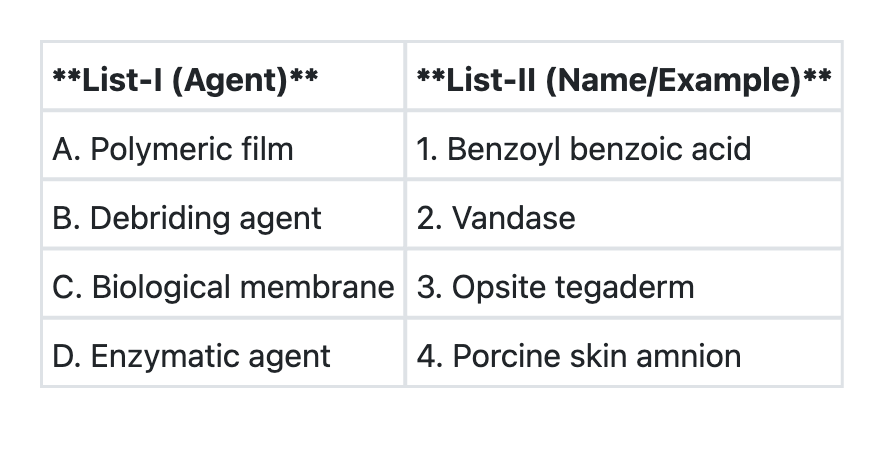
Match List-I with List-II and select the correct answer using the code given below the Lists:
Treatment with Herceptin in breast cancer is indicated for
The mechanism of action by which clomiphene citrate induces ovulation is
Which parenteral iron preparation does not cause anaphylaxis on intravenous administration?
The following drugs can cause osteoporosis, except
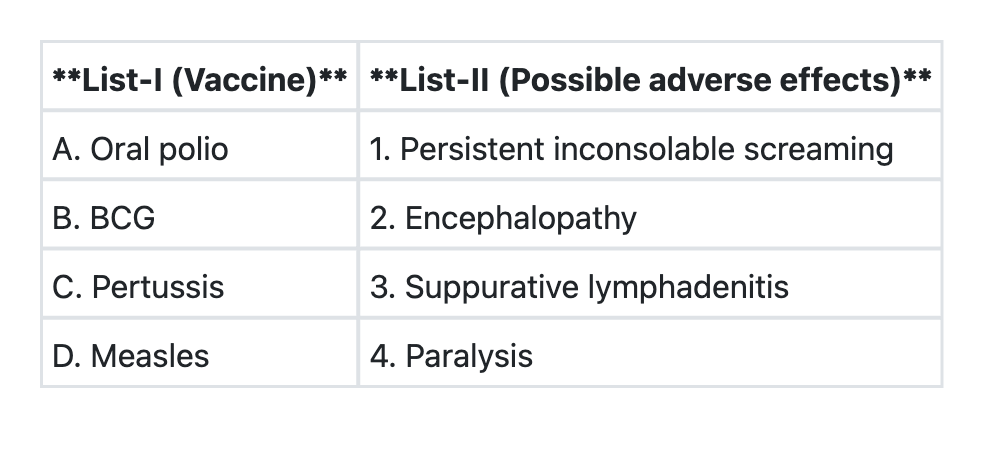
Match List-I with List-II and select the correct answer using the code given below the Lists:
Which one of the following is an absolute contraindication for administration of killed vaccine?
Which one of the following vaccines is a killed vaccine?
Consider the following drugs : 1. Rifampicin 2. Dapsone 3. Clofazimine 4. Minocycline Which of the above drugs are used in the standard treatment of pauci-bacillary leprosy in adults?
UPSC-CMS 2010 - Pharmacology UPSC-CMS Practice Questions and MCQs
Question 1: Match List-I with List-II and select the correct answer using the code given below the Lists:
- A. A→3 B→1 C→2 D→4
- B. A→1 B→2 C→4 D→3
- C. A→3 B→2 C→4 D→1 (Correct Answer)
- D. A→1 B→2 C→3 D→4
Explanation: ***A→1 B→2 C→3 D→4*** - This represents the **best available matching** among the given options, where each category is paired with the most appropriate example from the choices provided. - While not the ideal pharmacological classification, this option provides the most logical **wound care agent pairing** within the constraints of the available answers. *A→3 B→1 C→4 D→2* - Incorrectly matches **debriding agent (B)** with **benzoyl benzoic acid (1)**, which is primarily a **keratolytic agent** rather than a debriding agent. - Misplaces **enzymatic agent (D)** with **Vandase (2)**, when Vandase is better classified as a **debriding enzyme**. *A→3 B→1 C→2 D→4* - Incorrectly pairs **biological membrane (C)** with **Vandase (2)**, which is an **enzymatic preparation** not a biological membrane. - Creates multiple **mismatched classifications** that don't align with standard wound care categories. *A→1 B→2 C→4 D→3* - Incorrectly matches **polymeric film (A)** with **benzoyl benzoic acid (1)**, which is not a **film dressing** but a topical agent. - Misplaces **enzymatic agent (D)** with **Opsite/Tegaderm (3)**, which are **synthetic polymeric films** not enzymatic preparations.
Question 2: Treatment with Herceptin in breast cancer is indicated for
- A. Tumours with over-expressed HER2/C-erbB-2 protein (Correct Answer)
- B. PR receptor +ve tumours
- C. ER receptor +ve tumours
- D. Ki-67 stain +ve tumours
Explanation: **tumours with over-expressed C-erb B-2 protein** - **Herceptin** (trastuzumab) is a monoclonal antibody that specifically targets the **HER2/neu receptor**, which is encoded by the *ERBB2* gene. - Its efficacy depends on the **overexpression of C-erbB-2 protein** (also known as HER2/neu) on the surface of breast cancer cells, which indicates **HER2-positive breast cancer**. *K : 67 stain +ve tumours* - **Ki-67** is a proliferation marker that indicates the **growth fraction of a tumor**, and a positive stain suggests a rapidly dividing tumor. - While Ki-67 positivity is associated with more aggressive tumors, it does **not directly indicate suitability for Herceptin** treatment. *PR receptor +ve tumours* - Tumors positive for the **progesterone receptor (PR)** are typically treated with **hormonal therapies**, such as tamoxifen or aromatase inhibitors. - **PR positivity** does not indicate responsiveness to Herceptin, which targets the HER2 receptor. *ER receptor +ve tumours* - Tumors positive for the **estrogen receptor (ER)** are also treated with **hormonal therapies** due to their dependence on estrogen for growth. - Similarly to PR-positive tumors, **ER positivity** does not determine eligibility for Herceptin therapy.
Question 3: The mechanism of action by which clomiphene citrate induces ovulation is
- A. through the hypothalamic estrogenic effect
- B. through negative feedback on gonadotrophins
- C. through its anti-estrogenic effect (Correct Answer)
- D. through positive feedback on gonadotrophins
Explanation: ***Correct: Through its anti-estrogenic effect*** - **Clomiphene citrate** is a selective estrogen receptor modulator (SERM) that acts as an **estrogen antagonist** at the hypothalamus and pituitary gland - By blocking estrogen receptors, it prevents the hypothalamus from sensing circulating estrogen, thereby removing the **negative feedback** normally exerted by estrogen - This perceived low estrogen state triggers increased **GnRH secretion**, leading to elevated **FSH and LH release**, which stimulates follicular development and ovulation *Incorrect: Through the hypothalamic estrogenic effect* - Clomiphene citrate is an **anti-estrogen**, not an estrogen agonist at the hypothalamic level - An estrogenic effect would **enhance negative feedback**, inhibiting GnRH and gonadotropin release, thereby **suppressing** rather than inducing ovulation *Incorrect: Through negative feedback on gonadotrophins* - This is the opposite of clomiphene's mechanism - Clomiphene works by **blocking negative feedback**, not establishing it - By antagonizing estrogen receptors, it tricks the hypothalamus into perceiving low estrogen levels, leading to **increased** (not decreased) gonadotropin release *Incorrect: Through positive feedback on gonadotrophins* - While clomiphene ultimately results in increased gonadotropin release, it does so by **disrupting negative feedback**, not by directly creating positive feedback - True positive feedback occurs naturally during the late follicular phase when sustained high estrogen levels trigger the LH surge - Clomiphene's mechanism is distinct—it removes the brake (negative feedback) rather than adding an accelerator (positive feedback)
Question 4: Which parenteral iron preparation does not cause anaphylaxis on intravenous administration?
- A. Iron fumarate
- B. Iron sucrose (Correct Answer)
- C. Iron dextran
- D. Iron sorbitol
Explanation: ***Iron sucrose*** - **Iron sucrose** is a newer generation parenteral iron preparation with the **lowest risk of anaphylaxis** among IV iron formulations - This safety profile is primarily due to its **lack of dextran content**, which is responsible for the anaphylactic reactions seen with iron dextran - **Does not require a test dose** before administration, unlike iron dextran - Preferred for **intravenous administration** in patients requiring parenteral iron therapy [1] *Iron fumarate* - **Iron fumarate (ferrous fumarate)** is an **oral iron preparation only**, not a parenteral formulation - Since it is not administered intravenously, this option is **not applicable** to the question about parenteral IV iron preparations - As an oral preparation, it does not carry the risk of anaphylaxis associated with intravenous iron administration *Iron dextran* - **Iron dextran** is an older parenteral iron preparation with the **highest risk of anaphylactic reactions** due to the presence of dextran [2] - **Test dose is mandatory** before full administration due to significant hypersensitivity risk [2] - Can cause both **anaphylactoid reactions** (non-IgE mediated) and **true anaphylaxis** (IgE-mediated) [2] *Iron sorbitol* - **Iron sorbitol** is a parenteral iron preparation primarily used for **intramuscular administration**, not typically given intravenously - Can cause **allergic reactions** and has potential for **cardiovascular side effects** - Less commonly used today due to availability of safer alternatives like iron sucrose and ferric carboxymaltose [3]
Question 5: The following drugs can cause osteoporosis, except
- A. corticosteroid
- B. danazol
- C. mifepristone (Correct Answer)
- D. GnRH analogue
Explanation: ***Mifepristone***- **Mifepristone** is the **least commonly associated** with osteoporosis among these options in typical clinical practice, making it the best answer to this "EXCEPT" question.- While mifepristone is an anti-progestin and anti-glucocorticoid used for conditions like Cushing's syndrome, its osteoporosis risk is **less direct and less well-established** compared to the other drugs listed.- In chronic use, mifepristone can paradoxically increase cortisol levels through negative feedback disruption, which theoretically could affect bone, but this is **not a primary clinical concern** in its typical therapeutic applications.*Corticosteroid*- **Corticosteroids** are the **most common cause** of drug-induced osteoporosis (glucocorticoid-induced osteoporosis - GIOP) [1, 2].- They increase bone resorption by stimulating osteoclast activity and decrease bone formation by inhibiting osteoblast function [2].- Even short-term use can lead to rapid bone loss, with fracture risk increasing within 3-6 months of therapy.*Danazol*- **Danazol** is a synthetic androgen that causes a **hypoestrogenic state** by suppressing ovarian function.- This reduction in estrogen levels leads to **accelerated bone loss and osteoporosis**, particularly in women [1, 2].- Prolonged use requires bone density monitoring.*GnRH analogue*- **GnRH analogues** suppress sex hormone production (estrogen and testosterone) by pituitary desensitization.- The resulting **hypogonadism** directly causes **rapid bone loss** and significantly increased osteoporosis risk [1, 2].- Bone loss can occur within 6 months of therapy, often requiring prophylactic bone-protective agents.
Question 6: Match List-I with List-II and select the correct answer using the code given below the Lists:
- A. A→4 B→3 C→1 D→2 (Correct Answer)
- B. A→3 B→4 C→1 D→2
- C. A→2 B→1 C→4 D→3
- D. A→1 B→2 C→3 D→4
Explanation: ***A→4 B→3 C→1 D→2*** - **Oral polio vaccine (OPV)** is a live attenuated vaccine, and a rare but serious adverse effect is vaccine-associated paralytic poliomyelitis (VAPP), which manifests as **paralysis**. - **BCG vaccine** (Bacillus Calmette-Guérin) is used against tuberculosis. A known adverse effect, particularly in immunocompromised individuals, is **suppurative lymphadenitis**, where regional lymph nodes become inflamed and may form abscesses. - **Pertussis vaccine** (whole-cell DTP) can cause reactions such as persistent inconsolable screaming, high fever, and, very rarely, encephalopathy. **Persistent inconsolable screaming** is a recognized adverse reaction to the pertussis component. - **Measles vaccine** is a live attenuated vaccine. While generally safe, rare severe adverse effects include **encephalopathy** (or encephalitis). *A→3 B→4 C→1 D→2* - This option incorrectly associates oral polio vaccine with suppurative lymphadenitis and BCG with paralysis, contradicting established vaccine adverse effects. - Oral polio has a risk of paralysis, not lymphadenitis, whereas BCG can cause lymphadenitis. *A→2 B→1 C→4 D→3* - This option incorrectly links oral polio to encephalopathy and BCG to persistent inconsolable screaming. - Encephalopathy is associated with measles or pertussis, and persistent screaming with pertussis, not oral polio or BCG. *A→1 B→2 C→3 D→4* - This option incorrectly attributes persistent inconsolable screaming to oral polio and encephalopathy to BCG. - Paralysis is a known complication of oral polio, and suppurative lymphadenitis is a key adverse effect of BCG.
Question 7: Which one of the following is an absolute contraindication for administration of killed vaccine?
- A. Hodgkin's disease
- B. Pregnancy
- C. Severe reaction to a previous dose (Correct Answer)
- D. Immunodeficiency
Explanation: ***Severe reaction to a previous dose*** * A **severe allergic reaction** (e.g., **anaphylaxis**) to a previous dose of any vaccine or its components is an **absolute contraindication** to further doses of that vaccine. * This is due to the potential for a life-threatening anaphylactic response upon re-exposure to the allergen. *Hodgkin's disease* * While Hodgkin's disease is a **malignancy** that can affect the immune system, it is generally considered a **precaution** or a reason to defer live vaccines, not an absolute contraindication for killed vaccines. * **Killed vaccines** are generally safe in immunocompromised patients, though their efficacy may be reduced. *Pregnancy* * **Pregnancy** is a contraindication for certain **live attenuated vaccines** (e.g., MMR, varicella) due to the theoretical risk of fetal infection. * However, most **killed vaccines** (e.g., inactivated influenza, tetanus, diphtheria, acellular pertussis) are **safe and often recommended** during pregnancy for maternal and fetal protection. *Immunodeficiency* * **Immunodeficiency** (e.g., HIV/AIDS, chemotherapy) is primarily a contraindication for **live attenuated vaccines**, as these can cause disseminated infection in immunocompromised individuals. * **Killed vaccines** are generally safe in immunocompromised individuals, although the **immune response may be suboptimal**, and repeat doses or higher doses may be necessary.
Question 8: Which one of the following vaccines is a killed vaccine?
- A. Mumps vaccine
- B. Yellow fever vaccine
- C. Rubella vaccine
- D. Hepatitis B vaccine (Correct Answer)
Explanation: ***Hepatitis B vaccine*** - The Hepatitis B vaccine is a **recombinant subunit vaccine** containing only the **hepatitis B surface antigen (HBsAg)** produced through genetic engineering. - It does **not contain live or killed viral particles**, making it distinct from traditional killed vaccines. - However, it is sometimes **grouped with inactivated vaccines** in broader classifications as it contains no live components and cannot cause infection. - Among the given options, this is the **only non-live vaccine**, making it the **best answer** in this context. *Mumps vaccine* - The mumps vaccine is a **live-attenuated vaccine**, containing a weakened form of the mumps virus. - Live-attenuated vaccines stimulate a strong, long-lasting immune response similar to natural infection. *Yellow fever vaccine* - The yellow fever vaccine is a **live-attenuated vaccine** prepared from the 17D strain of the yellow fever virus. - It induces robust and long-term immunity against yellow fever. *Rubella vaccine* - The rubella vaccine is a **live-attenuated vaccine**, containing a weakened form of the rubella virus. - It is typically administered as part of the **MMR (measles, mumps, rubella)** vaccine.
Question 9: Consider the following drugs : 1. Rifampicin 2. Dapsone 3. Clofazimine 4. Minocycline Which of the above drugs are used in the standard treatment of pauci-bacillary leprosy in adults?
- A. 1, 2 and 3
- B. 1 and 4
- C. 2, 3 and 4
- D. 1 and 2 only (Correct Answer)
Explanation: ***1 and 2 only*** - The **WHO standard treatment regimen** for **pauci-bacillary leprosy** in adults consists of only two drugs: **Rifampicin** and **Dapsone** [1]. - **Rifampicin 600 mg** is administered once monthly under supervision for 6 months, while **Dapsone 100 mg** is given daily for 6 months [3]. - This regimen is sufficient for PB leprosy, which has fewer bacilli and 1-5 skin lesions with no nerve involvement or only one nerve trunk involved [1], [2]. *1, 2 and 3* - This combination includes **Clofazimine**, which is part of the **multi-bacillary (MB) leprosy** regimen, not pauci-bacillary [2], [3]. - MB leprosy requires triple therapy (Rifampicin + Dapsone + Clofazimine) for 12 months due to higher bacterial load and more extensive disease. - Pauci-bacillary leprosy has a lower bacterial load and requires only a 6-month two-drug regimen [1]. *1 and 4* - **Minocycline** is used in **alternative regimens** for leprosy, particularly for patients with drug intolerance or in single-lesion PB leprosy (ROM regimen). - It is **not part of the standard first-line WHO treatment** for pauci-bacillary leprosy in adults. - The standard PB regimen requires **Rifampicin plus Dapsone**, not Rifampicin plus Minocycline. *2, 3 and 4* - This option misses **Rifampicin**, which is the **most crucial bactericidal drug** for all forms of leprosy (both PB and MB) [3]. - **Clofazimine** and **Minocycline** are not part of the standard PB leprosy regimen—Clofazimine is reserved for MB leprosy, and Minocycline is used only in alternative regimens. - Without Rifampicin, the treatment would be inadequate and risk development of drug resistance [3].