Biochemistry
1 questionsBiochemical screening of newborn infants by heel-prick blood samples is performed by using the
UPSC-CMS 2010 - Biochemistry UPSC-CMS Practice Questions and MCQs
Question 81: Biochemical screening of newborn infants by heel-prick blood samples is performed by using the
- A. Duchenne Card
- B. Guthrie Card (Correct Answer)
- C. Tay-Sachs Card
- D. Maple Card
Explanation: ***Guthrie Card*** - The **Guthrie card**, also known as a **newborn screening card** or **filter paper card**, is specifically designed for collecting **heel-prick blood samples** from newborn infants for biochemical screening. - It allows for the detection of various **inborn errors of metabolism** and other genetic conditions, such as **phenylketonuria (PKU)** and **congenital hypothyroidism**. *Duchenne Card* - There is no specialized "Duchenne Card" used for **newborn biochemical screening**. - **Duchenne muscular dystrophy** is a genetic disorder diagnosed through **genetic testing** or **muscle biopsy**, not typically a specific screening card at birth. *Tay-Sachs Card* - There is no specific "Tay-Sachs Card" used for routine **newborn biochemical screening**. - **Tay-Sachs disease** is a **lysosomal storage disorder** diagnosed through enzyme activity tests or **genetic analysis**, often in populations at higher risk or with clinical suspicion. *Maple Card* - There is no recognized "Maple Card" for **newborn biochemical screening**. - "Maple" could potentially refer to **Maple Syrup Urine Disease (MSUD)**, which is one of the conditions screened for using the **Guthrie card**, but there is no dedicated "Maple Card."
Community Medicine
6 questionsWhat is the most cost-effective screening for identifying carcinoma cervix in a population?
Consider the following : 1. Hepatitis A outbreak 2. Polio outbreak 3. Gonorrhoea outbreak through prostitution Which of the above-listed outbreaks is/are classified under propagated epidemics?
What is the Body Mass Index of a person 150 cm tall and weighing 67.5 kg?
Consider the following indices : 1. Chandelier index 2. Sullivan's index 3. Waist-hip index 4. Ponderal index Which of the above is/are used for measuring obesity?
Which is the most common cause of mortality in infants between one and twelve months of age in India?
The cut-off standard for defining low birth-weight babies in India is considered to be
UPSC-CMS 2010 - Community Medicine UPSC-CMS Practice Questions and MCQs
Question 81: What is the most cost-effective screening for identifying carcinoma cervix in a population?
- A. Prospective screening
- B. Mass screening
- C. Multiphasic screening
- D. High risk selective screening (Correct Answer)
Explanation: ***Correct: High risk selective screening*** - **High-risk selective screening** is the **most cost-effective** strategy for cervical cancer screening as it targets populations with higher disease prevalence - Focuses resources on women at increased risk: age 30-65 years, multiple sexual partners, early sexual debut, HPV exposure, immunocompromised status, low socioeconomic status - **Maximizes detection yield per rupee spent** by concentrating efforts where disease probability is highest - Aligns with **WHO recommendations** and national guidelines for resource-limited settings - Better **cost-benefit ratio** compared to screening the entire population including low-risk groups *Incorrect: Mass screening* - Mass screening involves screening the **entire population** regardless of risk factors - While it may identify more total cases, it is **not cost-effective** as it expends resources on large low-risk populations - The question specifically asks for "**most cost-effective**" approach, not maximum coverage - In resource-limited settings (relevant for India), targeted screening provides better value *Incorrect: Multiphasic screening* - Refers to using **multiple screening tests** simultaneously for different diseases - Increases complexity and cost when applied to multiple conditions - Not specifically addressing cost-effectiveness for **single disease** (cervical cancer) screening *Incorrect: Prospective screening* - This term typically refers to **research methodology** involving forward-looking cohort studies - Not a standard classification of population screening strategies - More resource-intensive and used in research settings rather than routine public health programs
Question 82: Consider the following : 1. Hepatitis A outbreak 2. Polio outbreak 3. Gonorrhoea outbreak through prostitution Which of the above-listed outbreaks is/are classified under propagated epidemics?
- A. 2 and 3 only (Correct Answer)
- B. 1 and 2 only
- C. 1 only
- D. 1, 2 and 3
Explanation: ***2 and 3 only*** - A **propagated epidemic** is characterized by person-to-person transmission, leading to a gradual increase in cases over time, often forming multiple waves. - **Polio outbreaks** spread through person-to-person transmission via the fecal-oral route (contact with infected feces or oral secretions), making it a classic propagated epidemic. - **Gonorrhea outbreaks through prostitution** involve direct person-to-person transmission via sexual contact, clearly fitting the propagated epidemic pattern. - These outbreaks show progressive spread through the population with characteristic secondary and tertiary waves. *1, 2 and 3* - This option incorrectly includes **Hepatitis A outbreak**, which is typically a **common source epidemic**, not a propagated epidemic. - While Hepatitis A can be transmitted person-to-person via the fecal-oral route, most **outbreaks** are linked to a contaminated common source (water, food) and follow a common source pattern with a single sharp peak. - Common source epidemics have a characteristic sharp rise and fall, unlike the gradual progressive spread of propagated epidemics. *1 and 2 only* - This option incorrectly includes **Hepatitis A outbreak** (typically common source, not propagated) while excluding gonorrhea outbreak. - It also incorrectly excludes **gonorrhea outbreak**, which is clearly a propagated epidemic due to person-to-person sexual transmission. *1 only* - This option incorrectly suggests only Hepatitis A is a propagated epidemic, when in fact Hepatitis A outbreaks are typically **common source epidemics**. - It incorrectly excludes **Polio** and **Gonorrhea outbreaks**, both of which are true propagated epidemics involving progressive person-to-person transmission.
Question 83: What is the Body Mass Index of a person 150 cm tall and weighing 67.5 kg?
- A. 24
- B. 30 (Correct Answer)
- C. 27
- D. 33
Explanation: ***30*** - The Body Mass Index (BMI) is calculated using the formula: **weight (kg) / [height (m)]²**. - For a person weighing **67.5 kg** and standing **1.5 m (150 cm)** tall, the calculation is **67.5 / (1.5)² = 67.5 / 2.25 = 30**. - A BMI of **30** represents the threshold for **Obesity Class I** according to WHO classification (BMI ≥30). *24* - This value falls in the **normal to overweight range** (BMI 18.5-24.9 is normal) but is incorrect for the given measurements. - To achieve a BMI of 24 at 150 cm height, the person would need to weigh approximately **54 kg**, not 67.5 kg. *27* - This BMI would indicate **overweight** (BMI 25-29.9), but it is not the accurate calculation for the provided weight and height. - To achieve a BMI of 27 at 150 cm height, the person would need to weigh approximately **60.75 kg**, not 67.5 kg. *33* - A BMI of 33 indicates **Obesity Class I** (BMI 30-34.9), but it is higher than the correct calculation for the given parameters. - To achieve a BMI of 33 at 150 cm height, the person would need to weigh approximately **74.25 kg**, not 67.5 kg.
Question 84: Consider the following indices : 1. Chandelier index 2. Sullivan's index 3. Waist-hip index 4. Ponderal index Which of the above is/are used for measuring obesity?
- A. 1 and 3
- B. 3 and 4 (Correct Answer)
- C. 2 and 4
- D. 3 only
Explanation: ***3 and 4*** - The **waist-hip index** is a measure of **central obesity**, an important risk factor for metabolic diseases, indicating fat distribution. - The **Ponderal index** (or Rohrer's index) takes into account height and weight, similar to **BMI**, and is used to assess **overall adiposity**. *1 and 3* - The **Chandelier index** is not a standard or recognized index for measuring obesity. - While the **waist-hip index** is used, this option incorrectly includes an irrelevant index. *2 and 4* - **Sullivan's index** is related to **disability-free life expectancy** and is not used for measuring obesity. - While the **Ponderal index** is relevant, this option incorrectly includes an irrelevant index. *3 only* - While the **waist-hip index** is indeed used for measuring obesity, limiting the answer to only this index is incorrect because the **Ponderal index** is also a valid measure of obesity. - The question asks for all relevant indices among the given choices, making this option incomplete.
Question 85: Which is the most common cause of mortality in infants between one and twelve months of age in India?
- A. Respiratory infection (Correct Answer)
- B. Diarrhoea
- C. Malaria
- D. Pre-maturity
Explanation: ***Respiratory infection*** - **Acute respiratory infections (ARIs)**, particularly **pneumonia**, are currently the **leading cause of infant mortality** in the 1-12 month age group in India. - Despite improvements in healthcare, pneumonia remains responsible for the highest proportion of post-neonatal deaths due to factors like **malnutrition, indoor air pollution, inadequate immunization coverage**, and **delayed care-seeking**. - Recent epidemiological data shows respiratory infections have overtaken diarrheal diseases as the primary cause in this age group. *Diarrhoea* - **Diarrheal diseases** were historically the leading cause and remain a **major contributor** to infant mortality in India. - Public health interventions including **ORS therapy, zinc supplementation, rotavirus vaccination**, and improved sanitation have significantly reduced diarrhea-related deaths. - Currently ranks as the **second most common cause** in the 1-12 month age group. *Pre-maturity* - **Prematurity** and **low birth weight** are the leading causes of mortality in the **neonatal period** (0-28 days). - While complications can extend beyond 28 days, they are **less common** as a cause of death in the post-neonatal period (1-12 months) compared to infectious diseases. *Malaria* - **Malaria** remains a significant health problem in endemic regions of India and can cause severe illness in infants. - However, its contribution to overall infant mortality (1-12 months) is **substantially lower** than respiratory infections and diarrheal diseases nationwide.
Question 86: The cut-off standard for defining low birth-weight babies in India is considered to be
- A. 1500 gm
- B. 2000 gm
- C. 2800 gm
- D. 2500 gm (Correct Answer)
Explanation: ***Correct: 2500 gm*** - A birth weight of less than **2500 grams** (2.5 kg) is the standard international definition for **low birth weight (LBW)**, which is also adopted in India. - This threshold is crucial for identifying infants at higher risk of morbidity and mortality. *Incorrect: 1500 gm* - This weight typically defines **very low birth weight (VLBW)**, indicating a more severe degree of prematurity or growth restriction. - While significant, it is a subcategory of low birth weight, not the general cut-off for LBW. *Incorrect: 2000 gm* - This weight is considered **moderately low birth weight** and falls within the broader category of LBW (less than 2500 g). - It does not represent the universal cut-off for defining low birth weight itself. *Incorrect: 2800 gm* - A birth weight of 2800 grams (2.8 kg) is considered **normal birth weight** and does not fall under the definition of low birth weight. - Infants weighing 2800 grams are generally considered to be of healthy weight at birth.
Microbiology
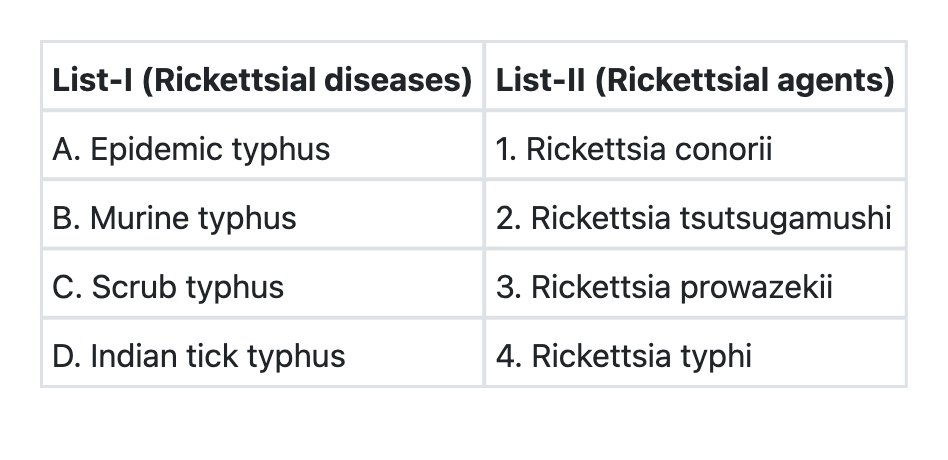
1 questionsMatch List-I with List-II and select the correct answer using the code given below the Lists:

UPSC-CMS 2010 - Microbiology UPSC-CMS Practice Questions and MCQs
Question 81: Match List-I with List-II and select the correct answer using the code given below the Lists:
- A. A→2 B→4 C→1 D→3
- B. A→1 B→4 C→3 D→2
- C. A→4 B→1 C→3 D→2
- D. A→3 B→4 C→2 D→1 (Correct Answer)
Explanation: ***A→3 B→4 C→2 D→1*** - **Epidemic typhus** is caused by *Rickettsia prowazekii*, primarily transmitted by the **human body louse**. - **Murine typhus** is caused by *Rickettsia typhi*, transmitted by **fleas typically found on rodents**. - **Scrub typhus** is caused by *Orientia tsutsugamushi* (formerly *Rickettsia tsutsugamushi*), transmitted by the bite of **chiggers (larval mites)**. - **Indian tick typhus** is a form of spotted fever group rickettsiosis, often caused by *Rickettsia conorii*, transmitted by **ticks.** *A→2 B→4 C→1 D→3* - This option incorrectly associates Epidemic typhus with *Rickettsia tsutsugamushi* and Indian tick typhus with *Rickettsia prowazekii*. - Epidemic typhus is caused by *Rickettsia prowazekii*, and *Rickettsia tsutsugamushi* causes Scrub typhus. *A→1 B→4 C→3 D→2* - This option incorrectly identifies *Rickettsia conorii* as the agent for Epidemic typhus and *Rickettsia tsutsugamushi* for Indian tick typhus. - *Rickettsia conorii* is associated with Mediterranean spotted fever (a form of tick typhus), and *Rickettsia tsutsugamushi* causes Scrub typhus. *A→4 B→1 C→3 D→2* - This option incorrectly matches Epidemic typhus with *Rickettsia typhi* and Scrub typhus with *Rickettsia prowazekii*. - *Rickettsia typhi* causes Murine typhus, and *Rickettsia prowazekii* causes Epidemic typhus.
Ophthalmology
1 questionsConsider the following : 1. Night blindness 2. Corneal xerosis 3. Conjunctival xerosis 4. Keratomalacia What is the correct sequence of the above in the progress of clinical presentation of vitamin A deficiency blindness?
UPSC-CMS 2010 - Ophthalmology UPSC-CMS Practice Questions and MCQs
Question 81: Consider the following : 1. Night blindness 2. Corneal xerosis 3. Conjunctival xerosis 4. Keratomalacia What is the correct sequence of the above in the progress of clinical presentation of vitamin A deficiency blindness?
- A. 1-3-2-4 (Correct Answer)
- B. 2-1-4-3
- C. 1-2-3-4
- D. 1-3-4-2
Explanation: ***1-3-2-4*** - This is the **correct sequence** according to WHO classification of xerophthalmia in vitamin A deficiency. - **Night blindness (XN)** is typically the **earliest clinical manifestation**, resulting from impaired rod photoreceptor function due to insufficient rhodopsin synthesis. - This is followed by **conjunctival xerosis (X1A)**, characterized by dryness and thickening of the bulbar conjunctiva, often accompanied by Bitot's spots (X1B) - foamy triangular patches of keratinized epithelium. - As deficiency progresses, **corneal xerosis (X2)** develops, with dryness extending to the corneal surface, creating a hazy, lusterless appearance. - The final and most severe stage is **keratomalacia (X3)**, involving corneal softening, ulceration, and potential perforation leading to irreversible blindness. *2-1-4-3* - This sequence incorrectly places **corneal xerosis** before **night blindness**. - Night blindness is a functional symptom that appears early, while corneal xerosis is a later structural change. - The progression also illogically places keratomalacia before conjunctival xerosis. *1-2-3-4* - This sequence incorrectly suggests **corneal xerosis** precedes **conjunctival xerosis**. - In vitamin A deficiency, xerosis (dryness) affects the **conjunctiva first**, then progresses to involve the **cornea**. - The conjunctiva is more susceptible to early changes than the cornea. *1-3-4-2* - This sequence incorrectly places **keratomalacia** before **corneal xerosis**. - Keratomalacia represents corneal softening and melting, which cannot occur before the cornea becomes xerotic (dry). - Corneal xerosis is a **prerequisite** for the development of keratomalacia.
Physiology
1 questionsWith reference to the role of fibre in diet, consider the following statements: 1. It inhibits faecal mutagen synthesis. 2. It reduces post-prandial glucose. 3. It decreases the transit time of food in the bowel. Which of the above represent(s) the role of fibre in our diet?
UPSC-CMS 2010 - Physiology UPSC-CMS Practice Questions and MCQs
Question 81: With reference to the role of fibre in diet, consider the following statements: 1. It inhibits faecal mutagen synthesis. 2. It reduces post-prandial glucose. 3. It decreases the transit time of food in the bowel. Which of the above represent(s) the role of fibre in our diet?
- A. 1 only
- B. 2 only
- C. 1 and 2 only
- D. 1, 2 and 3 (Correct Answer)
Explanation: ***1, 2 and 3*** - Dietary fiber aids in reducing the formation of **faecal mutagens** by diluting their concentration and promoting their excretion, thereby lowering the risk of colorectal cancer. - Fiber, especially **soluble fiber**, slows down the absorption of glucose from the digestive tract, which helps in reducing **post-prandial glucose** spikes and improving glycemic control. - It increases stool bulk and softness, which **decreases the transit time** of food through the bowel, preventing constipation and reducing exposure to potential toxins. *1 only* - This option is incomplete as it only includes the benefit of inhibiting faecal mutagen synthesis and ignores other established physiological roles of dietary fiber. - While fiber does inhibit faecal mutagen synthesis, it also has significant impacts on glucose metabolism and gut motility. *2 only* - This option is also incomplete, focusing solely on the reduction of post-prandial glucose. - It overlooks the crucial roles of fiber in gut health, such as inhibiting mutagen synthesis and regulating bowel transit time. *1 and 2 only* - This option recognizes the role of fiber in both **faecal mutagen synthesis** and **post-prandial glucose** control but fails to acknowledge its critical function in maintaining regular bowel movements. - Dietary fiber is well-known for its laxative effect and its ability to **decrease transit time**, which is a fundamental benefit for digestive health.