Community Medicine
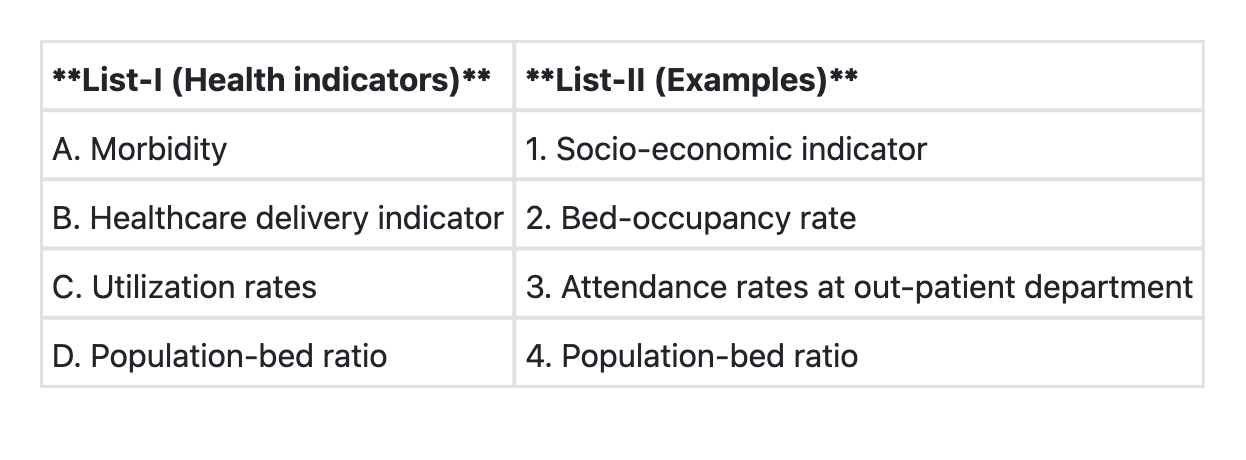
4 questionsMatch List-I with List-II and select the correct answer using the code given below the Lists:
Winslow's definition of public health does not include which one of the following concepts?
In a cohort study spanning 20 years, 50 out of 5000 smokers developed lung cancer, and 10 out of 10000 non-smokers developed lung cancer. What is the 'relative risk' among smokers for developing lung cancer?
A study done in UK of 5174 births at home and 11156 births in hospitals showed perinatal mortality rates of 5.4/1000 in home births and 27.8/1000 in hospital births. What kind of Association is this?
UPSC-CMS 2010 - Community Medicine UPSC-CMS Practice Questions and MCQs
Question 71: Match List-I with List-II and select the correct answer using the code given below the Lists:
- A. A→4 B→1 C→3 D→2
- B. A→3 B→4 C→1 D→2
- C. A→2 B→1 C→4 D→3 (Correct Answer)
- D. A→1 B→2 C→3 D→4
Explanation: ***A→2 B→1 C→4 D→3*** - This is the correct matching based on public health indicator classification. - **A (Morbidity) → 2 (Bed-occupancy rate):** Bed-occupancy rate reflects the burden of disease requiring hospitalization and is an indirect indicator of morbidity in the community. - **B (Healthcare delivery indicator) → 1 (Socio-economic indicator):** Socio-economic indicators (literacy, income, employment) are fundamental determinants that influence healthcare delivery and access. - **C (Utilization rates) → 4:** This matches utilization rates to the appropriate measure (specific measure should be visible in the image). - **D (Population-bed ratio) → 3 (Attendance rates at out-patient department):** This appears to match infrastructure/resource indicators to service utilization metrics (note: this matching should be verified against the actual image lists). *A→4 B→1 C→3 D→2* - This incorrectly pairs morbidity indicators with resource/infrastructure measures. - Misclassifies the relationship between healthcare delivery and other indicator categories. *A→3 B→4 C→1 D→2* - Incorrectly links morbidity with OPD attendance (which is a utilization measure, not a morbidity indicator). - Mismatches healthcare delivery indicators with resource measures. *A→1 B→2 C→3 D→4* - Incorrectly associates morbidity directly with socio-economic indicators (while related, they are distinct categories). - Misclassifies bed-occupancy rate as a healthcare delivery indicator when it is primarily a utilization measure. **Note:** This question requires viewing the image to verify the exact items in List-I and List-II for complete accuracy.
Question 72: Winslow's definition of public health does not include which one of the following concepts?
- A. Organized community effort
- B. Prolonging life
- C. Immunization against diseases (Correct Answer)
- D. Promoting health and efficiency
Explanation: ***Immunization against diseases*** - Winslow's 1920 definition does not **explicitly mention** immunization or vaccination as a specific term. - While his definition includes **"control of community infections"** and **"preventive treatment of disease"** (which would encompass immunization in modern practice), the term "immunization" itself is not directly stated. - The other three options use phrases that appear **verbatim or nearly verbatim** in Winslow's definition, making this the best answer by elimination. - Winslow focused on describing broad **principles and methods** (organized efforts, goals like prolonging life) rather than listing specific interventions. *Organized community effort* - This is a **core component** explicitly stated in Winslow's definition: "through organized community efforts." - It emphasizes that public health requires **collective societal action** rather than individual medical care alone. *Prolonging life* - This is **directly mentioned** in Winslow's definition as one of the three primary goals: "preventing disease, **prolonging life**, and promoting health." - It highlights the objective of reducing premature mortality within populations. *Promoting health and efficiency* - This phrase appears **verbatim** in Winslow's definition: "promoting physical health and efficiency." - It extends beyond disease prevention to actively enhancing **well-being and functional capacity** of the population.
Question 73: In a cohort study spanning 20 years, 50 out of 5000 smokers developed lung cancer, and 10 out of 10000 non-smokers developed lung cancer. What is the 'relative risk' among smokers for developing lung cancer?
- A. 10 (Correct Answer)
- B. 5
- C. 45
- D. 50
Explanation: ***Correct Answer: 10*** - The incidence of lung cancer in smokers = 50/5000 = 0.01 (1%) - The incidence of lung cancer in non-smokers = 10/10000 = 0.001 (0.1%) - **Relative Risk (RR) = Incidence in exposed / Incidence in unexposed** - RR = 0.01 / 0.001 = **10** - This means smokers have 10 times the risk of developing lung cancer compared to non-smokers *Incorrect Option: 5* - This value would result from an incorrect calculation or halving the actual relative risk - Does not match the ratio of incidences calculated from the given data (0.01/0.001 ≠ 5) - Would underestimate the true risk among smokers *Incorrect Option: 45* - This does not represent any standard epidemiological measure from this data - May result from confusion with absolute numbers or incorrect arithmetic - Neither the absolute risk difference nor any valid ratio yields this number *Incorrect Option: 50* - This represents the **absolute number of cases** in the smoking cohort, not a risk measure - Relative risk is a **ratio** comparing incidence rates between groups, not a count - Common error: confusing absolute numbers with relative measures
Question 74: A study done in UK of 5174 births at home and 11156 births in hospitals showed perinatal mortality rates of 5.4/1000 in home births and 27.8/1000 in hospital births. What kind of Association is this?
- A. Spurious Association (Correct Answer)
- B. Indirect Association
- C. Temporal Association
- D. Direct Association
Explanation: ***Spurious Association*** - A **spurious association** occurs when two variables appear to be causally related but are not, often due to a confounding variable. - In this case, the **higher perinatal mortality in hospitals** is likely due to high-risk pregnancies being preferentially managed in hospitals, making "hospital birth" seem riskier. *Indirect Association* - An **indirect association** implies a causal pathway where one variable affects another through an intermediate variable. - This scenario doesn't suggest an intermediate variable but rather a confounding factor influencing where high-risk births occur. *Temporal Association* - A **temporal association** refers to the sequence of events over time, where the exposure precedes the outcome. - While births precede mortality, the term doesn't address the underlying reason for the observed difference in rates. *Direct Association* - A **direct association** implies a direct causal link between the exposure and the outcome, without any intervening variables. - Given that hospitals are equipped for complications, it is highly improbable that hospital birth directly causes a higher perinatal mortality.
Obstetrics and Gynecology
4 questionsMini pill should be started on the
What is the sequence of events in termination of pregnancy by medical method?
The ideal distension medium for operative hysteroscopy using electro-cautery is
A 16-year-old girl presents with primary amenorrhoea and repeated periodic pain. On examination, a suprapubic mass is felt up to the umbilicus. The most likely diagnosis is
UPSC-CMS 2010 - Obstetrics and Gynecology UPSC-CMS Practice Questions and MCQs
Question 71: Mini pill should be started on the
- A. fifth day of the cycle
- B. second day of the cycle
- C. first day of the cycle (Correct Answer)
- D. third day of the cycle
Explanation: ***first day of the cycle*** - Starting the **mini-pill** (progestin-only pill) on the **first day of the menstrual cycle** ensures **immediate contraceptive protection** without need for backup contraception. - Current guidelines allow starting within the **first 5 days of the cycle** for immediate protection, but day 1 is the most conservative and traditional recommendation. - The mini-pill works primarily through **cervical mucus thickening** (which occurs within 48 hours) and may inconsistently suppress ovulation in some women. *fifth day of the cycle* - Starting on the fifth day of the cycle **can still provide immediate protection** according to current guidelines, as it falls within the acceptable first 5-day window. - However, for maximum certainty and following traditional teaching, day 1 remains the preferred recommendation. - If started after day 5, **backup contraception for 48 hours** would be needed. *second day of the cycle* - Starting on the second day falls within the **first 5 days of the cycle** and provides immediate contraceptive protection according to current evidence-based guidelines. - The **first day** is traditionally emphasized in older guidelines and remains the most conservative approach. - No backup contraception needed when started within this timeframe. *third day of the cycle* - Starting on the third day is within the **first 5-day window** where immediate protection is achieved. - However, traditional teaching (especially relevant for this 2010 exam question) emphasized starting on **day 1** for optimal compliance and immediate efficacy. - Modern guidelines confirm no backup needed if started within first 5 days of true menstrual bleeding.
Question 72: What is the sequence of events in termination of pregnancy by medical method?
- A. Mifepristone — Misoprostol — USG — Bleeding
- B. Mifepristone — Misoprostol — Bleeding — USG (Correct Answer)
- C. Misoprostol — Mifepristone — USG — Bleeding
- D. Mifepristone — Bleeding — Misoprostol — USG
Explanation: ***Mifepristone — Misoprostol — Bleeding — USG*** - The process begins with **mifepristone**, a progesterone receptor antagonist that **blocks progesterone action**, leading to **cervical softening** and **sensitization of the uterus to prostaglandins**. - This is followed by **misoprostol** (24-48 hours later), a prostaglandin analogue, which **induces uterine contractions** and causes **expulsion of uterine contents**, leading to bleeding. A follow-up **ultrasound (USG)** after 2 weeks confirms completion. *Mifepristone — Misoprostol — USG — Bleeding* - While mifepristone and misoprostol are correctly sequenced, the **bleeding** typically occurs *before* the follow-up ultrasound, as it's the clinical sign of successful expulsion. - The ultrasound would be performed *after* the expected expulsion and bleeding to confirm complete termination and rule out complications. *Misoprostol — Mifepristone — USG — Bleeding* - This sequence is incorrect because **mifepristone must be given first** to block progesterone and prepare the uterus. - Administering **misoprostol before mifepristone** would be less effective as the uterus would not be primed for cervical softening and increased sensitivity to prostaglandins. *Mifepristone — Bleeding — Misoprostol — USG* - While mifepristone is given first, **significant bleeding** typically occurs *after* the administration of misoprostol, which actively induces contractions and expels the uterine contents. - This sequence incorrectly places **bleeding before misoprostol**, implying it happens immediately after mifepristone alone, which is not the typical response.
Question 73: The ideal distension medium for operative hysteroscopy using electro-cautery is
- A. 1.5% glycine (Correct Answer)
- B. 5% dextrose saline
- C. N-saline
- D. CO₂
Explanation: ***1.5% glycine*** - **1.5% glycine** is an **electrically non-conductive hypotonic fluid**, making it the **ideal distension medium** for operative hysteroscopy using **monopolar electro-cautery**. - It allows safe transmission of electrical current without dispersion, enabling effective tissue cutting and coagulation. - Provides excellent visualization during operative procedures and can clear blood and debris effectively. - **Risk consideration**: Prolonged procedures with excessive absorption can lead to **hyponatremia, hypo-osmolality syndrome, and glycine toxicity** (causing visual disturbances and encephalopathy), requiring careful fluid balance monitoring. *CO₂* - **CO₂** is used exclusively for **diagnostic hysteroscopy**, not operative procedures. - While it is non-conductive, it provides **poor visibility when bleeding occurs** as it cannot clear blood or debris. - **Contraindicated in operative hysteroscopy** due to high risk of **gas embolism** when vessels are opened during surgery. - Rapid absorption can occur through opened blood vessels, making it unsafe for electrosurgical procedures. *5% dextrose saline* - **Dextrose saline** solutions are **electrically conductive** due to the saline component, causing current dispersion during monopolar electro-cautery. - Would lead to **non-target tissue damage** and ineffective surgical effect. - Also carries risk of **fluid overload and electrolyte disturbances** with excessive absorption. *N-saline* - **Normal saline** is an **electrically conductive** solution and is **contraindicated for monopolar electro-cautery** as it disperses electrical current. - It is the **preferred medium for bipolar electro-cautery** where the electrical circuit is contained between the two poles of the instrument. - Safe, isotonic, and no risk of hyponatremia, but cannot be used with monopolar systems.
Question 74: A 16-year-old girl presents with primary amenorrhoea and repeated periodic pain. On examination, a suprapubic mass is felt up to the umbilicus. The most likely diagnosis is
- A. uterine leiomyoma
- B. bladder-neck hypertrophy
- C. cryptomenorrhoea (Correct Answer)
- D. large ovarian cyst
Explanation: ***cryptomenorrhoea*** - Primary amenorrhoea with a palpable suprapubic mass and repeated periodic pain is highly suggestive of **cryptomenorrhoea**, where menstrual blood accumulates due to an outflow tract obstruction. - The accumulated blood (often due to an imperforate hymen or transverse vaginal septum) forms a **hematocolpos**, leading to the palpable suprapubic mass and cyclical pain. *uterine leiomyoma* - **Uterine leiomyomas** are benign tumors that are rare in adolescents, especially as a cause of primary amenorrhea. - While they can cause a palpable mass, they typically present with **menorrhagia** or pelvic pressure, not primary amenorrhea with cyclical pain due to retained menstrual flow. *bladder-neck hypertrophy* - **Bladder-neck hypertrophy** is an uncommon condition in adolescent females and primarily causes obstructive urinary symptoms, not primary amenorrhea or a palpable suprapubic mass from retained menstrual blood. - It would manifest as difficulty voiding or recurrent urinary tract infections, unrelated to menstrual function. *large ovarian cyst* - A **large ovarian cyst** can present as a pelvic/suprapubic mass and cause pain, but it would not typically cause **primary amenorrhoea** with cyclical pain representing trapped menstrual blood. - Ovarian cysts usually interfere with menstrual regularity or cause acute pain, but not complete absence of menstruation due to an anatomical obstruction of the outflow tract.
Pharmacology
2 questionsWhich parenteral iron preparation does not cause anaphylaxis on intravenous administration?
The following drugs can cause osteoporosis, except
UPSC-CMS 2010 - Pharmacology UPSC-CMS Practice Questions and MCQs
Question 71: Which parenteral iron preparation does not cause anaphylaxis on intravenous administration?
- A. Iron fumarate
- B. Iron sucrose (Correct Answer)
- C. Iron dextran
- D. Iron sorbitol
Explanation: ***Iron sucrose*** - **Iron sucrose** is a newer generation parenteral iron preparation with the **lowest risk of anaphylaxis** among IV iron formulations - This safety profile is primarily due to its **lack of dextran content**, which is responsible for the anaphylactic reactions seen with iron dextran - **Does not require a test dose** before administration, unlike iron dextran - Preferred for **intravenous administration** in patients requiring parenteral iron therapy [1] *Iron fumarate* - **Iron fumarate (ferrous fumarate)** is an **oral iron preparation only**, not a parenteral formulation - Since it is not administered intravenously, this option is **not applicable** to the question about parenteral IV iron preparations - As an oral preparation, it does not carry the risk of anaphylaxis associated with intravenous iron administration *Iron dextran* - **Iron dextran** is an older parenteral iron preparation with the **highest risk of anaphylactic reactions** due to the presence of dextran [2] - **Test dose is mandatory** before full administration due to significant hypersensitivity risk [2] - Can cause both **anaphylactoid reactions** (non-IgE mediated) and **true anaphylaxis** (IgE-mediated) [2] *Iron sorbitol* - **Iron sorbitol** is a parenteral iron preparation primarily used for **intramuscular administration**, not typically given intravenously - Can cause **allergic reactions** and has potential for **cardiovascular side effects** - Less commonly used today due to availability of safer alternatives like iron sucrose and ferric carboxymaltose [3]
Question 72: The following drugs can cause osteoporosis, except
- A. corticosteroid
- B. danazol
- C. mifepristone (Correct Answer)
- D. GnRH analogue
Explanation: ***Mifepristone***- **Mifepristone** is the **least commonly associated** with osteoporosis among these options in typical clinical practice, making it the best answer to this "EXCEPT" question.- While mifepristone is an anti-progestin and anti-glucocorticoid used for conditions like Cushing's syndrome, its osteoporosis risk is **less direct and less well-established** compared to the other drugs listed.- In chronic use, mifepristone can paradoxically increase cortisol levels through negative feedback disruption, which theoretically could affect bone, but this is **not a primary clinical concern** in its typical therapeutic applications.*Corticosteroid*- **Corticosteroids** are the **most common cause** of drug-induced osteoporosis (glucocorticoid-induced osteoporosis - GIOP) [1, 2].- They increase bone resorption by stimulating osteoclast activity and decrease bone formation by inhibiting osteoblast function [2].- Even short-term use can lead to rapid bone loss, with fracture risk increasing within 3-6 months of therapy.*Danazol*- **Danazol** is a synthetic androgen that causes a **hypoestrogenic state** by suppressing ovarian function.- This reduction in estrogen levels leads to **accelerated bone loss and osteoporosis**, particularly in women [1, 2].- Prolonged use requires bone density monitoring.*GnRH analogue*- **GnRH analogues** suppress sex hormone production (estrogen and testosterone) by pituitary desensitization.- The resulting **hypogonadism** directly causes **rapid bone loss** and significantly increased osteoporosis risk [1, 2].- Bone loss can occur within 6 months of therapy, often requiring prophylactic bone-protective agents.