Anatomy
2 questionsThe true conjugate of the pelvic brim measures
Before puberty, what is the ratio between the cervical length and uterine body?
UPSC-CMS 2010 - Anatomy UPSC-CMS Practice Questions and MCQs
Question 61: The true conjugate of the pelvic brim measures
- A. 11.5 cm (Correct Answer)
- B. 12.5 cm
- C. 13.5 cm
- D. 10.5 cm
Explanation: ***11.5 cm*** - The **true conjugate (conjugata vera)** is the anteroposterior diameter of the pelvic inlet, measured from the **posterior superior margin** of the pubic symphysis to the sacral promontory. [1] - It typically measures **11 cm** (range 10.5-11.5 cm), making 11.5 cm the most accurate answer among the given options. [1] - The true conjugate **cannot be measured clinically** but can be estimated by subtracting 1.5 cm from the diagonal conjugate. [1] - It is **distinct from** the obstetric conjugate, which is slightly shorter at 10.5 cm. *10.5 cm* - This measurement corresponds to the **obstetric conjugate**, not the true conjugate. - The obstetric conjugate is measured from the **most prominent point** on the posterior surface of the pubic symphysis (not the superior margin) to the sacral promontory. - While clinically important as the shortest fixed AP diameter through which the fetal head must pass, it is a **different measurement** from the true conjugate. *12.5 cm* - This value corresponds to the **diagonal conjugate**, which is the only conjugate diameter that can be measured clinically. - It is measured from the **lower border** of the symphysis pubis to the sacral promontory during pelvic examination. - The true conjugate is estimated by subtracting 1.5-2 cm from the diagonal conjugate (12.5 - 1.5 = 11 cm). *13.5 cm* - This measurement is considerably **larger** than any standard pelvic conjugate diameter. - It does not correspond to any clinically relevant pelvic measurement and would represent an unusually spacious pelvic inlet.
Question 62: Before puberty, what is the ratio between the cervical length and uterine body?
- A. 1 : 2
- B. 2 : 1 (Correct Answer)
- C. 1 : 3
- D. 1 : 4
Explanation: **2:1 (Correct Answer)** - Before puberty, the **cervix** is proportionally much longer than the **uterine body**, with a typical ratio of 2:1 (cervix:body) [1]. - This anatomical ratio changes significantly after puberty due to hormonal influences causing the uterine body to grow more rapidly. *1:2 (Incorrect)* - This ratio of 1:2, where the uterine body is longer than the cervix, is characteristic of the **post-pubertal** and **reproductive years** [1]. - It reflects the increased growth and development of the uterine corpus under the influence of hormones like **estrogen**. *1:3 (Incorrect)* - This ratio is not typical at any stage of uterine development, as the uterine body generally does not become three times the length of the cervix. - It represents an **unusual disproportion** in uterine-cervical length. *1:4 (Incorrect)* - This ratio is also not a standard physiological proportion for uterine-cervical length at any developmental stage. - Such an extreme disproportion would likely indicate an **anomalous uterine development**.
Community Medicine
1 questionsAsymptomatic endometrial tuberculosis leading to infertility is categorized in which diagnostic category of DOTS?
UPSC-CMS 2010 - Community Medicine UPSC-CMS Practice Questions and MCQs
Question 61: Asymptomatic endometrial tuberculosis leading to infertility is categorized in which diagnostic category of DOTS?
- A. Category II
- B. Category III (Correct Answer)
- C. Category IV
- D. Category I
Explanation: ***Category III*** - Category III of the DOTS classification includes **newly diagnosed pulmonary smear-negative** and all forms of **extra-pulmonary tuberculosis**, provided they are not severe. - Endometrial tuberculosis, leading to infertility, is an **extra-pulmonary site** and is generally considered less severe compared to disseminated forms, thus falling into Category III. *Category II* - Category II is reserved for **previously treated cases** of tuberculosis, including relapse, treatment failure, or return after default. - This patient is described as having **asymptomatic** endometrial tuberculosis, implying a new diagnosis, not a retreatment case. *Category IV* - Category IV is used for cases of **chronic tuberculosis**, where the patient remains smear-positive after completing a retreatment regimen, often indicating drug-resistant TB. - This scenario describes a new diagnosis of extra-pulmonary TB, with no mention of prior treatment failures or chronic infection. *Category I* - Category I applies to **newly diagnosed pulmonary smear-positive** tuberculosis cases and severe forms of extra-pulmonary tuberculosis. - Asymptomatic endometrial tuberculosis, in this context, is neither pulmonary smear-positive nor typically considered a severe or life-threatening form of extra-pulmonary TB.
Obstetrics and Gynecology
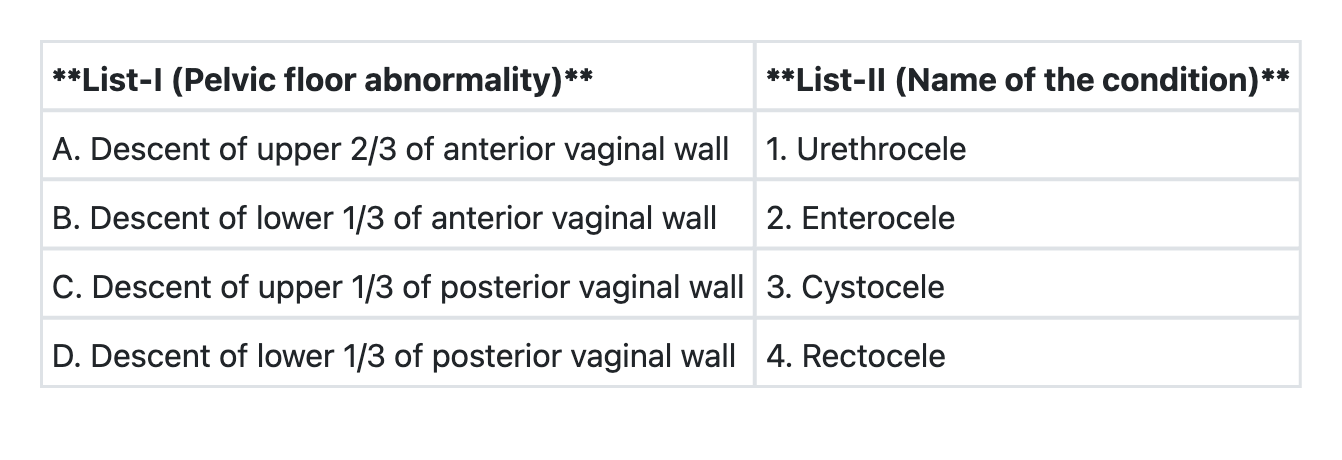
5 questionsMatch List-I with List-II and select the correct answer using the code given below the Lists:
In a lady with a regular 28-day menstrual cycle, what is the 'safe period'?
The risk of progression to endometrial cancer from simple hyperplasia without atypia is
Worldwide, which is the most commonly used copper-bearing intrauterine contraceptive device?
The following are the contra-indications to the use of combined oral contraceptive pills, except
UPSC-CMS 2010 - Obstetrics and Gynecology UPSC-CMS Practice Questions and MCQs
Question 61: Match List-I with List-II and select the correct answer using the code given below the Lists:
- A. A→4 B→1 C→2 D→3
- B. A→4 B→2 C→1 D→3
- C. A→3 B→2 C→1 D→4
- D. A→3 B→1 C→2 D→4 (Correct Answer)
Explanation: ***A→3 B→1 C→2 D→4*** - This option correctly matches each pelvic floor abnormality description with its corresponding condition. - **Cystocele** involves the descent of the bladder into the upper two-thirds of the anterior vaginal wall, **Urethrocele** describes the descent of the urethra into the lower one-third of the anterior vaginal wall, **Enterocele** refers to the descent of small bowel into the upper one-third of the posterior vaginal wall, and **Rectocele** involves the descent of the rectum into the lower one-third of the posterior vaginal wall. *A→4 B→1 C→2 D→3* - This option incorrectly matches the descent of the upper 2/3 of the anterior vaginal wall with a **rectocele** and the descent of the upper 1/3 of the posterior vaginal wall with a **cystocele**. - A **rectocele** involves the posterior vaginal wall, not the anterior, and a **cystocele** involves the anterior vaginal wall, not the posterior. *A→4 B→2 C→1 D→3* - This option incorrectly matches the descent of the upper 2/3 of the anterior vaginal wall with a **rectocele** and misidentifies other associations. - The pattern of descent and wall involvement for **urethrocele**, **enterocele**, and **cystocele** is not consistently maintained here according to the definitions. *A→3 B→2 C→1 D→4* - This option incorrectly associates the descent of the lower 1/3 of the anterior vaginal wall with an **enterocele**, and the descent of the upper 1/3 of the posterior vaginal wall with a **urethrocele**. - An **enterocele** involves the small bowel protruding into the posterior vaginal wall, and a **urethrocele** involves the urethra descending into the anterior vaginal wall.
Question 62: In a lady with a regular 28-day menstrual cycle, what is the 'safe period'?
- A. Initial 14 days
- B. Later 14 days
- C. First and last seven days (Correct Answer)
- D. First seven days only
Explanation: ***First and last seven days*** - In a typical 28-day cycle, **ovulation** usually occurs around day 14. Sperm can survive for up to 5 days, and the egg is viable for about 24 hours. Therefore, avoiding unprotected intercourse from approximately day 7 to day 19 would be considered within the fertile window. The "safe period" refers to days with a lower probability of conception. - The **first seven days** (including menstruation) and the **last seven days** (preceding the next menstrual period) are generally considered the least fertile times, as they are furthest from ovulation. *Initial 14 days* - This period includes the follicular phase, leading up to and including **ovulation**. - The **fertile window** typically encompasses several days before ovulation, the day of ovulation, and the day after, making the initial 14 days a high-risk period, not a safe one. *Later 14 days* - This period includes the **luteal phase** after ovulation has occurred. - While the latter part of this period (days 21-28) is generally less fertile, the days immediately following ovulation (around days 15-18) still carry a risk of conception if the egg is viable or if ovulation was delayed. *First seven days only* - While the first seven days are generally considered a **low-risk period**, relying solely on this neglects the increased risk shortly before and during ovulation. - This option only covers a portion of the "safe period" and does not account for the reduced fertility towards the end of the menstrual cycle.
Question 63: The risk of progression to endometrial cancer from simple hyperplasia without atypia is
- A. 8-10%
- B. 25-30%
- C. 1% (Correct Answer)
- D. 3-5%
Explanation: ***1%*** - The risk of **simple endometrial hyperplasia without atypia** progressing to endometrial cancer is very low, typically cited as less than 1%. - This low risk is why conservative management and surveillance are often sufficient for this type of hyperplasia. *8-10%* - This percentage is more indicative of the risk of progression for **complex endometrial hyperplasia without atypia**, which has a higher propensity for malignant transformation. - Simple hyperplasia without atypia carries a much lower risk due to its less abnormal glandular architecture and lack of cytologic atypia. *25-30%* - This value represents the risk of progression for **atypical endometrial hyperplasia (endometrial intraepithelial neoplasia)**, which is considered a precursor lesion to endometrial cancer. - The presence of **cytological atypia** significantly increases the risk of malignant transformation. *3-5%* - This risk range is typically associated with **complex endometrial hyperplasia without atypia**, which is higher than simple hyperplasia but considerably lower than atypical hyperplasia. - While it has abnormal architectural features, the absence of **cellular atypia** keeps the risk below that of atypical lesions.
Question 64: Worldwide, which is the most commonly used copper-bearing intrauterine contraceptive device?
- A. Copper-7
- B. GyneFix
- C. Copper T-200
- D. Copper T-380 (Correct Answer)
Explanation: ***Copper T-380*** - The **Copper T-380A (ParaGard)** is the most widely used and effective non-hormonal IUD globally. - Its **380 mm² copper surface area** provides high contraceptive efficacy for up to 10 years. *Copper-7* - This was an earlier generation copper IUD with a **smaller copper surface area** and a distinct 7-shaped design. - It had a higher expulsion rate and was **largely replaced** by more effective T-shaped devices. *GyneFix* - **GyneFix** is a frameless copper IUD consisting of copper sleeves on a surgical thread, which is knotted into the uterine fundus. - While effective, its market penetration and global usage are **significantly less** compared to the Copper T-380. *Copper T-200* - The **Copper T-200** was an earlier T-shaped copper IUD with **200 mm² of copper surface area**. - It had a **shorter lifespan** and lower efficacy compared to the T-380, leading to its obsolescence in many regions.
Question 65: The following are the contra-indications to the use of combined oral contraceptive pills, except
- A. bronchial asthma (Correct Answer)
- B. active viral hepatitis
- C. history of deep venous thrombosis
- D. breastfeeding
Explanation: ***bronchial asthma*** - **Bronchial asthma** is not a contraindication for the use of combined oral contraceptive pills (COCs). COCs do not worsen asthma symptoms or increase the risk of asthma exacerbations. - While some medications can interact with asthma treatment, COCs generally have no significant adverse effects on respiratory function or asthma management. *active viral hepatitis* - **Active viral hepatitis** is a contraindication because COCs are metabolized in the liver, and their use could further impair liver function in a patient with active inflammation. - The liver is crucial for metabolizing estrogens and progestins, and compromised liver function can lead to altered drug levels and increased risk of adverse effects. *history of deep venous thrombosis* - A **history of deep venous thrombosis (DVT)** is a significant contraindication due to the increased risk of **thromboembolism** associated with combined oral contraceptive pills. - Estrogen components in COCs can increase the synthesis of clotting factors and decrease natural anticoagulants, raising the risk of future thrombotic events. *breastfeeding* - **Breastfeeding**, especially during the first six weeks postpartum, is a relative contraindication for combined oral contraceptive pills. - Estrogen in COCs can reduce milk supply and potentially pass into breast milk, affecting the infant. Progestin-only contraceptives are generally preferred for breastfeeding mothers.
Pathology
1 questionsWhich tumour marker is most often elevated in ovarian granulosa cell tumour?
UPSC-CMS 2010 - Pathology UPSC-CMS Practice Questions and MCQs
Question 61: Which tumour marker is most often elevated in ovarian granulosa cell tumour?
- A. Alpha fetoprotein
- B. CA 125
- C. Inhibin (Correct Answer)
- D. Beta-HCG
Explanation: ***Inhibin*** - **Inhibin** is a polypeptide hormone produced by granulosa cells, making it a highly specific and sensitive marker for **granulosa cell tumors** of the ovary [1]. - Its levels correlate with tumor burden and can be used for monitoring treatment response and detecting recurrence [1]. *Alpha fetoprotein* - **Alpha-fetoprotein (AFP)** is a tumor marker more commonly associated with **yolk sac tumors (endodermal sinus tumors)**, which are a type of germ cell tumor, not granulosa cell tumors. - Elevated AFP can also be seen in hepatocellular carcinoma and some testicular tumors. *CA 125* - **CA 125** is the most widely used tumor marker for **epithelial ovarian cancer**, which is the most common type of ovarian cancer. - While it can be mildly elevated in other conditions, it is not specifically elevated in granulosa cell tumors. *Beta-HCG* - **Beta-human chorionic gonadotropin (β-HCG)** is primarily elevated in **gestational trophoblastic disease** (e.g., choriocarcinoma) and some germ cell tumors, such as dysgerminomas and embryonal carcinomas, if they have syncytiotrophoblastic elements [2]. - It is not a typical marker for granulosa cell tumors. **References:** [1] Kumar V, Abbas AK, et al.. Robbins and Cotran Pathologic Basis of Disease. 9th ed. The Female Genital Tract, pp. 1036-1037. [2] Kumar V, Abbas AK, et al.. Robbins and Cotran Pathologic Basis of Disease. 9th ed. The Female Genital Tract, pp. 1034-1036.
Pharmacology
1 questionsThe mechanism of action by which clomiphene citrate induces ovulation is
UPSC-CMS 2010 - Pharmacology UPSC-CMS Practice Questions and MCQs
Question 61: The mechanism of action by which clomiphene citrate induces ovulation is
- A. through the hypothalamic estrogenic effect
- B. through negative feedback on gonadotrophins
- C. through its anti-estrogenic effect (Correct Answer)
- D. through positive feedback on gonadotrophins
Explanation: ***Correct: Through its anti-estrogenic effect*** - **Clomiphene citrate** is a selective estrogen receptor modulator (SERM) that acts as an **estrogen antagonist** at the hypothalamus and pituitary gland - By blocking estrogen receptors, it prevents the hypothalamus from sensing circulating estrogen, thereby removing the **negative feedback** normally exerted by estrogen - This perceived low estrogen state triggers increased **GnRH secretion**, leading to elevated **FSH and LH release**, which stimulates follicular development and ovulation *Incorrect: Through the hypothalamic estrogenic effect* - Clomiphene citrate is an **anti-estrogen**, not an estrogen agonist at the hypothalamic level - An estrogenic effect would **enhance negative feedback**, inhibiting GnRH and gonadotropin release, thereby **suppressing** rather than inducing ovulation *Incorrect: Through negative feedback on gonadotrophins* - This is the opposite of clomiphene's mechanism - Clomiphene works by **blocking negative feedback**, not establishing it - By antagonizing estrogen receptors, it tricks the hypothalamus into perceiving low estrogen levels, leading to **increased** (not decreased) gonadotropin release *Incorrect: Through positive feedback on gonadotrophins* - While clomiphene ultimately results in increased gonadotropin release, it does so by **disrupting negative feedback**, not by directly creating positive feedback - True positive feedback occurs naturally during the late follicular phase when sustained high estrogen levels trigger the LH surge - Clomiphene's mechanism is distinct—it removes the brake (negative feedback) rather than adding an accelerator (positive feedback)