Anatomy
2 questionsConsider the following statements with reference to scalp : 1. The blood vessels lie within dense connective tissue. 2. The anterior scalp is supplied by supraorbital and supratrochlear vessels. 3. The lateral and posterior scalp is supplied by superficial temporal, posterior auricular and occipital arteries. Which of the statements given above are correct?
The transition between the stomach and duodenum is marked by
UPSC-CMS 2010 - Anatomy UPSC-CMS Practice Questions and MCQs
Question 31: Consider the following statements with reference to scalp : 1. The blood vessels lie within dense connective tissue. 2. The anterior scalp is supplied by supraorbital and supratrochlear vessels. 3. The lateral and posterior scalp is supplied by superficial temporal, posterior auricular and occipital arteries. Which of the statements given above are correct?
- A. 2 and 3 only
- B. 1 and 3 only
- C. 1, 2 and 3 (Correct Answer)
- D. 1 and 2 only
Explanation: ***1, 2 and 3*** - All three statements provide accurate anatomical details regarding the scalp's structure and blood supply. The specific arrangement of vessels within the **dense connective tissue** and the listed arterial branches are correct. - The scalp is known for its rich vascularity and its five distinct layers, with the **dense connective tissue** layer anchoring the vessels, and a broad arterial supply covering all regions. *2 and 3 only* - This option is incorrect because statement 1, regarding the blood vessels lying within **dense connective tissue**, is also a correct anatomical fact. - Omitting statement 1 overlooks a crucial structural characteristic of the scalp layers, specifically the second layer (C for connective tissue). *1 and 3 only* - This option is incorrect because statement 2, detailing the supply of the anterior scalp by **supraorbital** and **supratrochlear vessels**, is also accurate. - Excluding statement 2 means ignoring a key component of the arterial supply to the anterior region of the scalp. *1 and 2 only* - This option is incorrect because statement 3, which describes the blood supply to the lateral and posterior scalp by the **superficial temporal**, **posterior auricular**, and **occipital arteries**, is also correct. - Failing to include statement 3 results in an incomplete description of the scalp's extensive and varied arterial network.
Question 32: The transition between the stomach and duodenum is marked by
- A. vein of Mayo (Correct Answer)
- B. incisura
- C. hepatoduodenal ligament
- D. gastroduodenal artery
Explanation: The transition between the stomach and duodenum is marked by ***vein of Mayo*** - The **vein of Mayo** (also known as the **prepyloric vein**) is a consistent landmark located on the anterior surface of the **pylorus**, making it a reliable surgical indicator for the gastroduodenal junction. - Its presence signifies the anatomical boundary between the **stomach** and the **duodenum** (specifically, the pylorus and duodenal bulb). *incisura* - The **incisura angularis** is a prominent anatomical landmark on the lesser curvature of the stomach, representing the junction between the body and the pyloric antrum of the stomach. It is shown as a major division in the anatomy of the stomach [1]. - It is located within the stomach itself and does not mark the transition to the duodenum. *hepatoduodenal ligament* - The **hepatoduodenal ligament** is part of the lesser omentum that connects the liver to the duodenum. - While it is anatomically close, it is a peritoneal fold containing structures like the portal triad, not a direct landmark for the gastroduodenal junction. *gastroduodenal artery* - The **gastroduodenal artery** is a major artery that branches from the common hepatic artery and supplies portions of the stomach and duodenum. - It is an important blood vessel in the region but does not serve as an anatomical surface landmark for the transition between the stomach and duodenum.
ENT
1 questionsWhat is the most common indication of tracheostomy in a child?
UPSC-CMS 2010 - ENT UPSC-CMS Practice Questions and MCQs
Question 31: What is the most common indication of tracheostomy in a child?
- A. Laryngeal diphtheria
- B. Poliomyelitis
- C. Carcinoma of larynx
- D. Vocal cord paralysis (Correct Answer)
Explanation: ***Vocal cord paralysis*** - Among the options listed, **vocal cord paralysis** is the most appropriate answer as it remains a relevant pediatric indication for tracheostomy in current practice. - **Bilateral vocal cord paralysis** can cause significant airway obstruction requiring tracheostomy, especially in congenital cases or after cardiac surgery. - Note: In modern pediatric practice, the overall most common indications are **prolonged mechanical ventilation** and **congenital airway anomalies**, but among the specific causes listed here, vocal cord paralysis is the best answer. *Laryngeal diphtheria* - While **laryngeal diphtheria** historically was a common cause of pediatric tracheostomy due to pseudomembrane formation causing severe airway obstruction, its incidence has drastically decreased with **widespread immunization programs**. - In the pre-vaccination era, this was indeed a leading indication, but it is now rare in countries with effective vaccination coverage. *Poliomyelitis* - **Poliomyelitis** can affect respiratory muscles leading to ventilatory failure requiring tracheostomy, but with **global eradication efforts and vaccination**, it is now extremely rare. - This was a significant historical indication but is no longer relevant in most parts of the world. *Carcinoma of larynx* - **Laryngeal carcinoma** is predominantly an adult malignancy with peak incidence in the 6th-7th decades, associated with smoking and alcohol use. - It is **extremely rare in the pediatric population**, making it the least likely indication for tracheostomy in children among all the options listed.
Internal Medicine
1 questionsPriapism in a young male could occur because of
UPSC-CMS 2010 - Internal Medicine UPSC-CMS Practice Questions and MCQs
Question 31: Priapism in a young male could occur because of
- A. leukaemia (Correct Answer)
- B. carcinoid tumour of appendix
- C. testicular cancer
- D. penile cancer
Explanation: ***Leukaemia*** - In leukaemia, especially **myeloid leukaemia**, immature white blood cells can accumulate in the **corpus cavernosa**, leading to stasis and **venous occlusion**. [1] - This cellular congestion prevents venous outflow from the penis, causing a prolonged and **painful erection (priapism)**. *Carcinoid tumour of appendix* - A carcinoid tumour of the appendix is typically associated with **carcinoid syndrome**, which involves symptoms like flushing and diarrhoea. - It does **not directly cause priapism**, as its mediators (e.g., serotonin) do not typically induce this specific local vascular event. *Testicular cancer* - Testicular cancer primarily manifests as a **painless lump in the testis** and can cause symptoms related to metastasis, but **priapism is not a typical direct presenting symptom**. - While some cancers can cause paraneoplastic syndromes, testicular cancer is not associated with priapism. *Penile cancer* - Penile cancer typically presents as a **lesion, ulcer, or mass on the penis**, often associated with pain, bleeding, or discharge. - While it affects the penis, it does **not typically cause prolonged erections (priapism)**, but rather local tissue destruction or obstruction.
Pathology
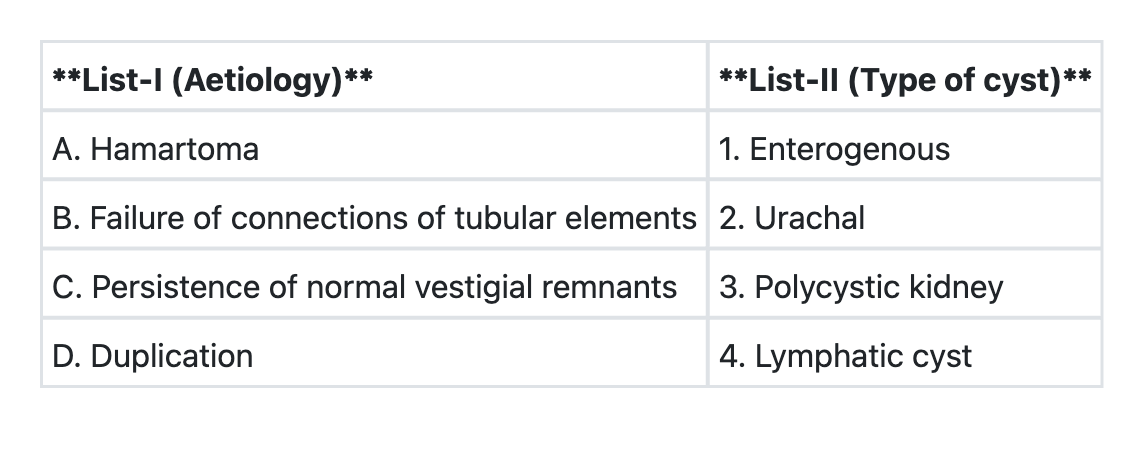
1 questionsMatch List-I with List-II and select the correct answer using the code given below the Lists:
UPSC-CMS 2010 - Pathology UPSC-CMS Practice Questions and MCQs
Question 31: Match List-I with List-II and select the correct answer using the code given below the Lists:
- A. A→3 B→4 C→1 D→2
- B. A→4 B→3 C→2 D→1 (Correct Answer)
- C. A→3 B→1 C→4 D→2
- D. A→2 B→4 C→1 D→3
Explanation: ***A→4 B→3 C→2 D→1*** - A **hamartoma** is a benign, focal malformation resembling a neoplasm, composed of mature cells and tissues normally found in the organ from which it arises, but growing in a disorganized mass. A **lymphatic cyst** (or lymphangioma/cystic hygroma), though often confused with a true neoplasm, is a congenital malformation of the lymphatic system, a type of hamartoma [1]. - **Polycystic kidney disease** is characterized by the formation of numerous cysts in the kidneys. One of the theories for its pathogenesis involves the failure of connections between collecting tubules and nephrons during renal development, leading to isolated segments that dilate to form cysts [2], [3]. - The **urachus** is an embryonic remnant of the allantois, connecting the fetal bladder to the umbilicus. If the urachus fails to involute completely after birth, it can persist as a patent or partially patent structure, leading to various **urachal anomalies**, including urachal cysts. - **Duplication** can lead to the formation of an **enterogenous cyst**, which is a congenital cyst lined by typical gastrointestinal mucosa. These cysts arise from developmental errors during embryogenesis where portions of the primitive gut tube become duplicated or sequestered. *A→3 B→4 C→1 D→2* - This option incorrectly associates hamartoma with polycystic kidney and duplication with urachal cysts. - **Polycystic kidney** is primarily due to defects in tubular connections, not hamartomas, and **urachal cysts** are remnants of vestigial structures, not duplications. *A→3 B→1 C→4 D→2* - This option incorrectly associates hamartoma with polycystic kidney and persistence of normal vestigial remnants with lymphatic cyst. - **Polycystic kidney** is not a hamartoma, and **lymphatic cysts** are not typical vestigial remnants but rather developmental malformations of the lymphatic system [1]. *A→2 B→4 C→1 D→3* - This option incorrectly associates hamartoma with urachal cysts and persistence of normal vestigial remnants with enterogenous cysts. - **Urachal cysts** are vestigial remnants, not hamartomas. **Enterogenous cysts** are a result of duplication, not persistence of normal vestigial remnants. **References:** [1] Kumar V, Abbas AK, et al.. Robbins and Cotran Pathologic Basis of Disease. 9th ed. Diseases of Infancy and Childhood, pp. 481-482. [2] Cross SS. Underwood's Pathology: A Clinical Approach. 6th ed. Common Clinical Problems From Diseases Of The Urinary And Male Genital Tracts, pp. 544-545. [3] Kumar V, Abbas AK, et al.. Robbins and Cotran Pathologic Basis of Disease. 9th ed. The Kidney, pp. 951-952.
Pediatrics
1 questionsWhat is the most common cause of gastric outlet obstruction in a 4-week-old baby?
UPSC-CMS 2010 - Pediatrics UPSC-CMS Practice Questions and MCQs
Question 31: What is the most common cause of gastric outlet obstruction in a 4-week-old baby?
- A. Foreign body
- B. Annular pancreas
- C. Duodenal atresia
- D. Congenital hypertrophic pyloric stenosis (Correct Answer)
Explanation: ***Congenital hypertrophic pyloric stenosis*** - This condition involves thickening of the **pyloric muscle**, leading to a narrowed outflow tract from the stomach. - It classically presents in infants around **2-6 weeks of age** with **projectile, non-bilious vomiting** and a palpable **olive-shaped mass** in the epigastrium. *Foreign body* - While possible, foreign body ingestion is an **uncommon cause** of gastric outlet obstruction in a 4-week-old infant. - Infants within this age range are typically **not mobile** or exploring their environment in a way that would lead to frequent foreign body ingestion. *Annular pancreas* - This is a rare congenital anomaly where pancreatic tissue completely encircles the **duodenum**, causing obstruction. - Although it can cause gastric outlet obstruction, it is **less common** than pyloric stenosis as the cause in this age group. *Duodenal atresia* - This condition is a complete blockage of the duodenum and typically presents with **bilious vomiting** within the **first 24-48 hours of life**. - The onset of symptoms in a 4-week-old, especially with non-bilious vomiting, makes duodenal atresia a less likely diagnosis.
Physiology
1 questionsIn pregnancy, there is a physiological increase of the
UPSC-CMS 2010 - Physiology UPSC-CMS Practice Questions and MCQs
Question 31: In pregnancy, there is a physiological increase of the
- A. cardiac output (Correct Answer)
- B. blood viscosity
- C. peripheral resistance of the blood vessels
- D. blood pressure in the third trimester
Explanation: ***cardiac output*** - **Cardiac output** increases significantly in pregnancy, by approximately 30-50%, to meet the increased metabolic demands of the growing fetus and maternal tissues. - This increase is primarily due to increases in both **heart rate** and **stroke volume**. *blood viscosity* - **Blood viscosity** actually decreases in pregnancy due to a greater increase in **plasma volume** compared to the increase in red blood cell mass, leading to hemodilution. - This reduction in viscosity can contribute to a lower peripheral vascular resistance. *peripheral resistance of the blood vessels* - **Peripheral resistance** typically decreases in pregnancy due to the vasodilatory effects of hormones like **progesterone** and the establishment of the low-resistance uteroplacental circulation. - This vasodilation helps accommodate the increased blood volume and cardiac output without a significant rise in blood pressure. *blood pressure in the third trimester* - **Blood pressure** usually decreases or remains stable in the first and second trimesters, with a slight rise towards pre-pregnancy levels in the third trimester. - A significant increase in blood pressure, especially in the third trimester, is *not* physiological and can indicate complications like **gestational hypertension** or **preeclampsia**.
Radiology
1 questionsA middle-aged man presents with a lower jaw swelling. Clinically, there is expansion of the left ramus and the X-ray mandible shows soap bubble appearance. What is the clinical diagnosis?
UPSC-CMS 2010 - Radiology UPSC-CMS Practice Questions and MCQs
Question 31: A middle-aged man presents with a lower jaw swelling. Clinically, there is expansion of the left ramus and the X-ray mandible shows soap bubble appearance. What is the clinical diagnosis?
- A. Aneurysmal bone cyst
- B. Odontogenic myxoma
- C. Ameloblastoma (Correct Answer)
- D. Keratocyst
Explanation: ***Ameloblastoma*** - Ameloblastoma is the most common odontogenic tumor, often presenting as a **slow-growing, expansile swelling** in the posterior mandible, as seen in this patient. - The classic **"soap bubble" or "honeycomb" radiographic appearance** is highly characteristic of ameloblastoma, reflecting its multilocular nature. *Aneurysmal bone cyst* - While an aneurysmal bone cyst can cause bony expansion, it typically presents with a **blood-filled lesion** and may not consistently show a "soap bubble" appearance unless it's very large and destructive. - Radiographically, it often appears as a **lytic lesion** rather than strictly multilocular. *Odontogenic myxoma* - Odontogenic myxoma can also cause jaw swelling and has a multilocular appearance, but it's often described as having a **"tennis racket" or "stepped ladder" trabeculation** pattern rather than clear "soap bubbles." - Its incidence is lower than ameloblastoma, making it less likely given the classic presentation. *Keratocyst* - An odontogenic keratocyst (OKC), now often referred to as a **keratocystic odontogenic tumor (KCOT)**, is primarily a cyst that can grow extensively and cause expansion. - Radiographically, it typically appears as a **well-defined, unilocular or multilocular radiolucency** but rarely has the classic "soap bubble" appearance as consistently as ameloblastoma.
Surgery
2 questionsA man falls astride a penetrating object. He develops retention of urine, perineal hematoma and bleeding from urinary meatus. The nature of injury would be
Renal carcinoma with solitary lung secondary is best treated by
UPSC-CMS 2010 - Surgery UPSC-CMS Practice Questions and MCQs
Question 31: A man falls astride a penetrating object. He develops retention of urine, perineal hematoma and bleeding from urinary meatus. The nature of injury would be
- A. intraperitoneal rupture of bladder
- B. rupture of bulbar urethra (Correct Answer)
- C. rupture of membranous urethra
- D. extraperitoneal rupture of bladder
Explanation: ***Rupture of bulbar urethra*** - An injury from falling astride a penetrating object, causing symptoms like **retention of urine**, **perineal hematoma**, and **bleeding from the urinary meatus**, is highly indicative of a **bulbar urethral rupture**. - The **bulbar urethra** is particularly vulnerable to crush injuries against the **pubic symphysis** in astride falls, leading to extravasation of urine and blood into the perineum. *Intraperitoneal rupture of bladder* - This typically occurs from a **direct blow to the lower abdomen** when the bladder is full, resulting in release of urine into the **peritoneal cavity**. - Symptoms would include generalized **abdominal pain**, **rebound tenderness**, and **peritonitis-like signs**, rather than localized perineal hematoma. *Rupture of membranous urethra* - A rupture of the **membranous urethra** is typically associated with **pelvic fractures** and is usually **above the urogenital diaphragm**. - While it can cause hematoma, the extravasation of urine and blood would more commonly track into the **retropubic space** and potentially the anterior abdominal wall, not primarily the perineum. *Extraperitoneal rupture of bladder* - This often results from **pelvic fractures** and is characterized by urine leaking into the **prevesical space**. - Symptoms include **suprapubic pain** and tenderness, but a perineal hematoma and meatal bleeding are less typical in isolation for this type of injury.
Question 32: Renal carcinoma with solitary lung secondary is best treated by
- A. chemotherapy
- B. surgery (Correct Answer)
- C. immunotherapy
- D. radiotherapy
Explanation: ***Surgery*** - For **renal cell carcinoma** with a **solitary lung metastasis**, surgical resection of both the primary tumor (nephrectomy) and the lung metastasis is often the preferred treatment and offers the best chance for long-term survival. - This approach is particularly effective when the patient has a good performance status, the primary tumor is controlled, and the metastasis is truly solitary and resectable. *Chemotherapy* - **Renal cell carcinoma** is classically considered **chemotherapy-resistant**, meaning traditional chemotherapy agents generally have limited efficacy. - While some newer targeted therapies and immunotherapies are used, conventional chemotherapy is not the first-line treatment for metastatic RCC, especially when surgical options are available. *Immunotherapy* - **Immunotherapy** (e.g., nivolumab, pembrolizumab) is a common treatment for advanced or metastatic renal cell carcinoma, particularly when surgery is not feasible or after recurrence. - However, for a **solitary resectable metastasis**, it is typically considered after surgery, or in cases where surgery is contraindicated, rather than as a primary curative approach. *Radiotherapy* - **Radiotherapy** has a limited role in the primary treatment of renal cell carcinoma due to its relative radioresistance, though it can be used for palliative purposes (e.g., pain control, brain metastases). - For a solitary lung metastasis, while **stereotactic body radiation therapy (SBRT)** might be considered in select cases where surgery is not possible, surgical resection remains the gold standard for resectable lesions.