Internal Medicine
3 questionsSerum calcitonin may be elevated in
Which one of the following is not a component of Charcot's triad?
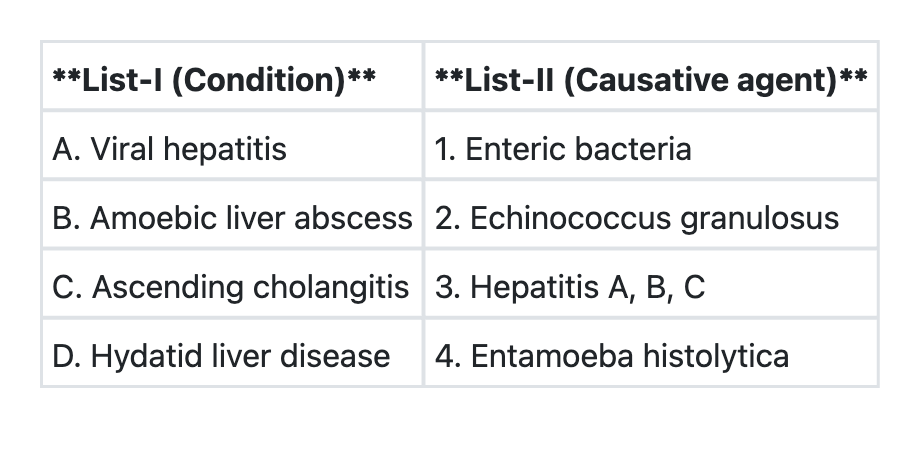
Match List-I with List-II and select the correct answer using the code given below the Lists:
UPSC-CMS 2010 - Internal Medicine UPSC-CMS Practice Questions and MCQs
Question 11: Serum calcitonin may be elevated in
- A. choriocarcinoma of ovary
- B. islet cell tumour of pancreas
- C. medullary carcinoma of thyroid (Correct Answer)
- D. carcinoid tumour of appendix
Explanation: ***medullary carcinoma of thyroid*** - **Medullary thyroid carcinoma (MTC)** originates from the **parafollicular C cells** of the thyroid gland, which physiologically produce and secrete **calcitonin**. - Therefore, MTC is a classic cause of significantly elevated serum **calcitonin** levels, used both as a diagnostic marker and for monitoring disease recurrence. *choriocarcinoma of ovary* - **Choriocarcinoma** is a germ cell tumor that typically produces **human chorionic gonadotropin (hCG)**, not calcitonin [3]. - Ovarian choriocarcinoma is a rare and highly aggressive tumor, and its primary tumor marker is **hCG** [3]. *islet cell tumour of pancreas* - **Islet cell tumors** of the pancreas (neuroendocrine tumors) typically produce hormones like **insulin, glucagon, somatostatin, or gastrin**, depending on their subtype [1], [2]. - While they are endocrine tumors, they do not originate from calcitonin-producing cells and thus generally do not elevate **calcitonin**. *carcinoid tumour of appendix* - **Carcinoid tumors**, especially those of the appendix, are **neuroendocrine tumors** that typically secrete **serotonin** and other vasoactive substances [1]. - These tumors are associated with **carcinoid syndrome** (flushing, diarrhea, bronchospasm) but do not produce **calcitonin** [1].
Question 12: Which one of the following is not a component of Charcot's triad?
- A. Fever
- B. Vomiting (Correct Answer)
- C. Pain
- D. Jaundice
Explanation: ***Vomiting*** - **Charcot's triad** consists of **right upper quadrant abdominal pain**, **fever**, and **jaundice**, which are classic signs of **acute cholangitis** [1]. - Vomiting is not considered one of the three classic components of Charcot's triad. *Fever* - **Fever** is a cardinal symptom of systemic inflammation and infection, a key component indicating the presence of an infectious process in the biliary tree. - It often accompanies the other two symptoms, pain and jaundice, to complete Charcot's triad in **acute cholangitis** [1]. *Pain* - **Right upper quadrant abdominal pain** is a critical component of Charcot's triad, arising from the inflammation and distension of the biliary tree due to obstruction and infection [1]. - This localized pain helps direct the diagnostic focus to the **liver and biliary system**. *Jaundice* - **Jaundice**, characterized by yellowing of the skin and eyes, results from the obstruction of bile flow leading to the accumulation of bilirubin in the bloodstream. - Its presence signifies **biliary obstruction**, often due to gallstones or strictures, which is a common precursor to cholangitis [1].
Question 13: Match List-I with List-II and select the correct answer using the code given below the Lists:
- A. A→1 B→2 C→3 D→4
- B. A→3 B→1 C→4 D→2
- C. A→3 B→4 C→1 D→2 (Correct Answer)
- D. A→2 B→4 C→1 D→3
Explanation: ***A→3 B→4 C→1 D→2*** - This option correctly matches each condition with its primary causative agent: **Viral hepatitis** with **Hepatitis A, B, C**; **Amoebic liver abscess** with **Entamoeba histolytica**; **Ascending cholangitis** with **Enteric bacteria**; and **Hydatid liver disease** with **Echinococcus granulosus**. - This mapping accurately reflects established medical knowledge regarding the etiology of these liver and biliary tract conditions. *A→1 B→2 C→3 D→4* - This option incorrectly associates viral hepatitis with enteric bacteria and amoebic liver abscess with Echinococcus granulosus, which are not the primary causes. - The link between ascending cholangitis and hepatitis viruses is also incorrect, as ascending cholangitis is typically bacterial. *A→3 B→1 C→4 D→2* - This option correctly matches viral hepatitis, but incorrectly attributes amoebic liver abscess to enteric bacteria and ascending cholangitis to Entamoeba histolytica. - The causative agent for amoebic liver abscess is *Entamoeba histolytica*, not enteric bacteria, and ascending cholangitis is caused by bacteria, not *Entamoeba histolytica*. *A→2 B→4 C→1 D→3* - This option incorrectly links viral hepatitis to Echinococcus granulosus and hydatid liver disease to hepatitis viruses. - Hydatid liver disease is caused by *Echinococcus granulosus*, and viral hepatitis is caused by hepatitis viruses, so these are mismatched.
Pathology
1 questionsAcinic cell carcinoma is found in
UPSC-CMS 2010 - Pathology UPSC-CMS Practice Questions and MCQs
Question 11: Acinic cell carcinoma is found in
- A. salivary glands (Correct Answer)
- B. breast
- C. thyroid
- D. stomach
Explanation: ***salivary glands*** - **Acinic cell carcinoma** is a rare malignant tumor that primarily arises in the **major salivary glands**, most commonly the **parotid gland** [1]. - Its name derives from its histologic resemblance to **serous acinar cells**, which are characteristic of salivary gland tissue. *breast* - While various carcinomas occur in the breast, **acinic cell carcinoma** is not a primary breast cancer type [2]. - Breast cancers originate from **ductal** or **lobular epithelial cells** [2]. *thyroid* - Thyroid cancers include **papillary**, **follicular**, **medullary**, and **anaplastic carcinomas**, which originate from thyroid follicular or parafollicular cells. - **Acinic cell carcinoma** is not a recognized type of thyroid malignancy. *stomach* - The stomach is susceptible to **adenocarcinomas**, particularly **intestinal** and **diffuse types**, as well as other less common tumors. - **Acinic cell carcinoma** is not found as a primary tumor in the stomach. **References:** [1] Kumar V, Abbas AK, et al.. Robbins and Cotran Pathologic Basis of Disease. 9th ed. Head and Neck, pp. 753-755. [2] Kumar V, Abbas AK, et al.. Robbins and Cotran Pathologic Basis of Disease. 9th ed. The Breast, pp. 1059-1060.
Pharmacology
1 questionsTreatment with Herceptin in breast cancer is indicated for
UPSC-CMS 2010 - Pharmacology UPSC-CMS Practice Questions and MCQs
Question 11: Treatment with Herceptin in breast cancer is indicated for
- A. Tumours with over-expressed HER2/C-erbB-2 protein (Correct Answer)
- B. PR receptor +ve tumours
- C. ER receptor +ve tumours
- D. Ki-67 stain +ve tumours
Explanation: **tumours with over-expressed C-erb B-2 protein** - **Herceptin** (trastuzumab) is a monoclonal antibody that specifically targets the **HER2/neu receptor**, which is encoded by the *ERBB2* gene. - Its efficacy depends on the **overexpression of C-erbB-2 protein** (also known as HER2/neu) on the surface of breast cancer cells, which indicates **HER2-positive breast cancer**. *K : 67 stain +ve tumours* - **Ki-67** is a proliferation marker that indicates the **growth fraction of a tumor**, and a positive stain suggests a rapidly dividing tumor. - While Ki-67 positivity is associated with more aggressive tumors, it does **not directly indicate suitability for Herceptin** treatment. *PR receptor +ve tumours* - Tumors positive for the **progesterone receptor (PR)** are typically treated with **hormonal therapies**, such as tamoxifen or aromatase inhibitors. - **PR positivity** does not indicate responsiveness to Herceptin, which targets the HER2 receptor. *ER receptor +ve tumours* - Tumors positive for the **estrogen receptor (ER)** are also treated with **hormonal therapies** due to their dependence on estrogen for growth. - Similarly to PR-positive tumors, **ER positivity** does not determine eligibility for Herceptin therapy.
Radiology
3 questionsPneumobilia can be seen in
'Double duct' sign is diagnostic of
Consider the following radiological signs : 1. Claw sign in barium enema 2. Apple core sign in barium enema 3. Multiple fluid levels with absent caecal gas in plain skiagram of abdomen 4. Single large fluid and air level in plain skiagram of abdomen Which of the above signs is/are suggestive of ileocolic intussusception?
UPSC-CMS 2010 - Radiology UPSC-CMS Practice Questions and MCQs
Question 11: Pneumobilia can be seen in
- A. acute pancreatitis
- B. Mirizzi's syndrome
- C. carcinoma gallbladder
- D. gallstone ileus (Correct Answer)
Explanation: ***gallstone ileus*** - **Gallstone ileus** is a mechanical small bowel obstruction caused by a large gallstone that has eroded through the gallbladder wall into the small intestine, forming a **cholecystoenteric fistula**. - The presence of the fistula allows **gas from the bowel to enter the biliary tree**, resulting in pneumobilia, which is a classic radiographic finding in this condition. *acute pancreatitis* - **Acute pancreatitis** is inflammation of the pancreas, often caused by gallstones or alcohol, but it does **not typically involve communication between the bowel and the biliary tree**. - While gallstones can cause pancreatitis, the condition itself does **not lead to gas in the biliary system**. *Mirizzi's syndrome* - **Mirizzi's syndrome** involves obstruction of the common hepatic duct due to extrinsic compression by a stone impacted in the cystic duct or gallbladder neck, and it **does not typically create a fistula with the bowel**. - Although inflammation can be severe, it usually **does not lead to pneumobilia** unless a rare fistulous connection to the bowel also occurs separately. *carcinoma gallbladder* - **Gallbladder carcinoma** is a malignancy that can obstruct the biliary system, but it **does not inherently cause a direct communication between the gastrointestinal tract and the biliary tree** to allow for gas entry. - While advanced cancer can cause fistulas, **pneumobilia is not a typical or early sign** of gallbladder carcinoma itself.
Question 12: 'Double duct' sign is diagnostic of
- A. hepatocellular carcinoma
- B. periampullary carcinoma (Correct Answer)
- C. gallbladder carcinoma
- D. Klatskin's carcinoma
Explanation: ***periampullary carcinoma*** - The **"double duct sign"** refers to the simultaneous dilation of both the **common bile duct** and the **pancreatic duct**. - This sign is highly suggestive of an obstruction at the **ampulla of Vater**, most commonly caused by **periampullary carcinoma**. *hepatocellular carcinoma* - **Hepatocellular carcinoma** primarily affects the liver parenchyma and typically does not cause simultaneous dilation of both the common bile and pancreatic ducts. - It more commonly presents with symptoms related to **liver dysfunction** or a palpable **liver mass**. *gallbladder carcinoma* - **Gallbladder carcinoma** can lead to bile duct obstruction, but it generally causes dilation of the **biliary tree** proximal to the obstruction, not simultaneous dilation of both the bile and pancreatic ducts. - The obstruction is usually located at the **cystic duct** or **common hepatic duct** due to direct tumor extension or nodal involvement. *Klatskin's carcinoma* - **Klatskin's tumor** is a type of **cholangiocarcinoma** located at the **bifurcation of the common hepatic duct**. - While it causes **biliary obstruction** and dilation of the intrahepatic ducts, it does not typically cause dilation of the pancreatic duct.
Question 13: Consider the following radiological signs : 1. Claw sign in barium enema 2. Apple core sign in barium enema 3. Multiple fluid levels with absent caecal gas in plain skiagram of abdomen 4. Single large fluid and air level in plain skiagram of abdomen Which of the above signs is/are suggestive of ileocolic intussusception?
- A. 1 only (Correct Answer)
- B. 3 only
- C. 1 and 2 only
- D. 1, 2, 3 and 4
Explanation: ***1 only*** - The **claw sign** in a barium enema is a classic radiological finding in **ileocolic intussusception**, where the intussusceptum indents the barium column, forming a characteristic claw-like appearance - This sign indicates the presence of the invaginated bowel segment within the larger bowel, as the barium passes around it - It is the most specific radiological sign for intussusception on contrast studies *3 only* - **Multiple fluid levels** with absent caecal gas on plain skiagram are indicative of **small bowel obstruction**, which can be caused by intussusception but is **not specific** to it - This finding does not pinpoint intussusception specifically and can occur with adhesions, hernias, or other causes of obstruction - Alone, this does not diagnose ileocolic intussusception *1 and 2 only* - While the **claw sign** (1) is specific to intussusception, the **apple core sign** (2) is characteristic of a **constricting colonic malignancy**, not intussusception - The apple core sign represents irregular narrowing of the bowel lumen due to an annular carcinoma - Including sign 2 makes this option incorrect for intussusception *1, 2, 3 and 4* - Only the **claw sign** (1) is specifically suggestive of intussusception - The **apple core sign** (2) indicates colonic carcinoma, not intussusception - **Multiple fluid levels with absent caecal gas** (3) indicate bowel obstruction but lack specificity - A **single large fluid and air level** (4) suggests gastric outlet obstruction or closed loop obstruction, not specifically intussusception
Surgery
2 questionsWhich of the following does not alter the T stage in breast cancer?
What is the most common hernia in females?
UPSC-CMS 2010 - Surgery UPSC-CMS Practice Questions and MCQs
Question 11: Which of the following does not alter the T stage in breast cancer?
- A. Pectoral muscle involvement
- B. Nipple retraction (Correct Answer)
- C. Skin ulceration
- D. Peau d'orange
Explanation: ***Nipple retraction*** - Nipple retraction, while a significant clinical sign that can indicate an underlying malignancy, does **not alter the T stage** (tumor size and extent) of breast cancer. - It is considered a local sign of tumor proximity or involvement but does not classify the tumor into a T4 category according to AJCC TNM staging. - Nipple retraction may be seen with various T stages and is **not a criterion for upstaging**. *Pectoral muscle involvement* - **Important note**: Involvement of the **pectoralis muscle alone does NOT alter T stage** according to current AJCC TNM classification. - Only **chest wall involvement** (ribs, intercostal muscles, serratus anterior) qualifies as **T4b**. - This is a common point of confusion, but pectoralis muscle is **not considered chest wall** for staging purposes. *Skin ulceration* - **Skin ulceration** directly reflects tumor invasion through the skin of the breast. - This finding is a criterion for classifying the tumor as **T4b**, indicating advanced local disease. - Clearly **alters the T stage** regardless of tumor size. *Peau d'orange* - **Peau d'orange** (orange peel appearance) is caused by obstruction of dermal lymphatics by tumor cells, leading to **skin edema**. - This sign is a criterion for classifying the tumor as **T4b** (edema of the skin including peau d'orange). - Clearly **alters the T stage** and indicates advanced local disease.
Question 12: What is the most common hernia in females?
- A. Femoral hernia
- B. Obturator hernia
- C. Inguinal hernia (Correct Answer)
- D. Spigelian hernia
Explanation: ***Inguinal hernia*** - **Inguinal hernias** are the most common type of hernia in females, accounting for approximately **70% of all hernias** in women. - While less common in females than males, inguinal hernias still represent the majority of hernias in the female population. - They occur through the **inguinal canal** and can be either indirect (through the deep inguinal ring) or direct (through Hesselbach's triangle). - Present as a **bulge in the groin** above the inguinal ligament. *Femoral hernia* - **Femoral hernias** are the second most common hernia in females, accounting for approximately 30% of hernias in women. - They have a **higher female-to-male ratio** compared to inguinal hernias (femoral hernias are more common in women than men relatively). - Occur through the **femoral canal** below the inguinal ligament, medial to the femoral vein. - Higher risk of **strangulation** due to the rigid boundaries of the femoral ring. - This option is incorrect because despite being relatively more common in females than males, femoral hernias are still **less common than inguinal hernias** in the female population overall. *Spigelian hernia* - A rare type of hernia occurring through the **Spigelian aponeurosis**, lateral to the rectus abdominis muscle. - Not specifically more common in females and represents a small fraction of all hernias. *Obturator hernia* - A very rare hernia passing through the **obturator foramen**. - More common in elderly, thin females but still extremely rare overall. - May present with **Howship-Romberg sign** (inner thigh pain on hip extension/rotation) due to obturator nerve compression.