Community Medicine
5 questionsSentinel centre for vaccine-preventable diseases does not provide information on
Consider the following statements regarding Vaccine Vial Monitor (VVM) on the vial of oral polio vaccine : The vaccine is not potent and should be discarded 1. if the colour of the small square within the circle is lighter in colour than that of the circle 2. if the small square within the circle is of the same colour as the circle 3. if the small square within the circle is darker in colour than the colour of the circle Which of the statements given above is/are correct?
Effective disinfection of a typhoid patient's faecal matter can be done with
What is the correct order of the steps in the rapid sand filtration process for water purification?
Monitoring of blood pressure comes under
UPSC-CMS 2010 - Community Medicine UPSC-CMS Practice Questions and MCQs
Question 91: Sentinel centre for vaccine-preventable diseases does not provide information on
- A. time trend
- B. incidence rates (Correct Answer)
- C. place distribution
- D. immunization
Explanation: ***Incidence rates*** - Sentinel surveillance centers typically focus on **monitoring trends** and **spatial distribution** of vaccine-preventable diseases, as well as immunization coverage. - They generally **do not provide population-wide incidence rates**, as this requires comprehensive, population-level data collection which is beyond their scope. *time trend* - Sentinel centers are crucial for tracking the **time trend** of vaccine-preventable diseases, allowing public health officials to observe patterns and changes over periods. - This information helps in understanding disease seasonality, effectiveness of vaccination campaigns, and early detection of **outbreaks**. *place distribution* - These centers provide valuable insights into the **geographical or spatial distribution** of vaccine-preventable diseases. - This helps in identifying **hotspots** or regions with higher disease activity, guiding targeted interventions. *immunization* - Sentinel surveillance also monitors aspects of **immunization coverage** and the effectiveness of vaccination programs. - Data from these centers can indicate gaps in vaccination and the impact of immunization strategies on disease burden.
Question 92: Consider the following statements regarding Vaccine Vial Monitor (VVM) on the vial of oral polio vaccine : The vaccine is not potent and should be discarded 1. if the colour of the small square within the circle is lighter in colour than that of the circle 2. if the small square within the circle is of the same colour as the circle 3. if the small square within the circle is darker in colour than the colour of the circle Which of the statements given above is/are correct?
- A. 1 only
- B. 2 and 3 (Correct Answer)
- C. 1 and 2
- D. 2 only
Explanation: ***2 and 3*** - A vaccine vial is considered **not potent and should be discarded** if the inner square is the **same color as or darker than** the outer circle, as this indicates **heat exposure** reducing vaccine efficacy. - **Statement 2** (same color) indicates the vaccine has reached the **discard point** due to cumulative heat exposure, and **statement 3** (darker color) indicates the vaccine is **beyond the discard point**, both requiring immediate disposal. - VVMs are crucial for ensuring **cold chain integrity**; the color change of the inner square relative to the outer circle signifies cumulative heat damage and loss of potency. *2 only* - While statement 2 correctly identifies that a vaccine should be discarded when the inner square is the **same color** as the outer circle, this option **omits statement 3**. - Statement 3 (darker inner square) also correctly indicates the vaccine should be discarded, making this option **incomplete**. *1 only* - This statement is **incorrect** because a **lighter inner square** compared to the outer circle indicates that the vaccine has been exposed to **minimal heat**, meaning the vaccine is **still potent and safe to use**. - A lighter inner square is the **ideal state** for a VVM, signifying a correctly maintained cold chain; the vaccine should **NOT be discarded** in this scenario. *1 and 2* - Statement 1 is **incorrect** because when the inner square is **lighter** than the outer circle, the vaccine remains **potent and should continue to be used**, not discarded. - Only statement 2 is correct in this combination, but statement 3 is also correct and should be included, making this option wrong.
Question 93: Effective disinfection of a typhoid patient's faecal matter can be done with
- A. 2% phenol
- B. 5% formalin
- C. 5% cresol
- D. 2% bleaching powder (Correct Answer)
Explanation: ***2% bleaching powder*** - **Bleaching powder** (calcium hypochlorite) is a strong oxidizing agent that effectively disinfects faecal matter by destroying microbial cell structures. - A **2% solution** provides sufficient concentration of free chlorine to kill *Salmonella Typhi* and other pathogens in faeces. *2% phenol* - While **phenol** is an antiseptic and disinfectant, a 2% solution may not be strong enough for the effective and rapid disinfection of heavily contaminated faecal matter. - **Phenol** acts by denaturing proteins and disrupting cell membranes, but higher concentrations or longer contact times are generally needed for spore-forming or highly resistant organisms, though *Salmonella Typhi* is not spore-forming. *5% formalin* - **Formalin** (a solution of formaldehyde) is a powerful disinfectant and fixative, but it is typically used for sterilizing medical equipment or preserving biological specimens. - Its **strong fumes** and irritating nature make it less suitable for routine, large-scale disinfection of faecal matter due to safety concerns and logistical challenges. *5% cresol* - **Cresol** is a phenolic disinfectant that is more potent than phenol and is effective against a broad spectrum of microorganisms. - While effective, **cresol** is typically used in higher concentrations (like 5%) for disinfecting surfaces or specific wastes, and its pungent odor and potential toxicity might make it a less practical choice for general faecal disinfection compared to bleaching powder.
Question 94: What is the correct order of the steps in the rapid sand filtration process for water purification?
- A. Alum mixing – flocculation – sedimentation – filtration (Correct Answer)
- B. Sedimentation – alum mixing – flocculation – filtration
- C. Alum mixing – sedimentation – flocculation – filtration
- D. Flocculation – alum mixing – sedimentation – filtration
Explanation: ***Alum mixing – flocculation – sedimentation – filtration*** - This sequence represents the established steps in conventional **rapid sand filtration**, where each stage plays a crucial role in removing impurities. - **Alum mixing** (coagulation) destabilizes particles, **flocculation** consolidates them, **sedimentation** removes larger flocs, and **filtration** traps remaining fine particles. *Sedimentation – alum mixing – flocculation – filtration* - **Sedimentation** occurs *after* coagulation and flocculation, as these processes are needed to create larger, settleable particles. - Starting with sedimentation before preparing the water for efficient particle removal would be ineffective. *Alum mixing – sedimentation – flocculation – filtration* - **Flocculation** (the gentle stirring to form larger flocs) must happen *after* alum mixing (coagulation) and *before* sedimentation. - Placing sedimentation before flocculation would lead to poor particle removal as the flocs would not have fully formed. *Flocculation – alum mixing – sedimentation – filtration* - **Alum mixing** (coagulation) is the initial step to destabilize particles, which then allows for effective flocculation. - Attempting flocculation before coagulation would be ineffective as the particles would not be prepared to aggregate.
Question 95: Monitoring of blood pressure comes under
- A. secondary prevention (Correct Answer)
- B. tertiary prevention
- C. primary prevention
- D. primordial prevention
Explanation: ***secondary prevention*** - **Secondary prevention** aims to halt the progression of a disease at an early stage, in presence of **risk factors** or asymptomatic disease. - Monitoring blood pressure helps detect **hypertension early**, allowing for intervention before organ damage develops. *tertiary prevention* - **Tertiary prevention** focuses on **reducing the impact of an established disease** and preventing complications or recurrence. - Examples include rehabilitation programs after a stroke or managing chronic conditions to improve quality of life. *primary prevention* - **Primary prevention** targets individuals who are currently **disease-free** to prevent the development of a disease. - Examples include **vaccination**, health education, and promoting a healthy lifestyle to avoid risk factors. *primordial prevention* - **Primordial prevention** aims to **prevent the development of risk factors** themselves in the first place, often at a societal level. - This involves policies and actions to improve socioeconomic conditions and promote healthy environments, such as campaigns against smoking or promoting access to healthy foods.
Microbiology
1 questionsConsider the following hepatitis viruses : 1. Hepatitis A 2. Hepatitis B 3. Hepatitis C 4. Hepatitis E Which of the above can be commonly transmitted through the faeco-oral route?
UPSC-CMS 2010 - Microbiology UPSC-CMS Practice Questions and MCQs
Question 91: Consider the following hepatitis viruses : 1. Hepatitis A 2. Hepatitis B 3. Hepatitis C 4. Hepatitis E Which of the above can be commonly transmitted through the faeco-oral route?
- A. 1 and 3 only
- B. 1 and 4 (Correct Answer)
- C. 2, 3 and 4
- D. 1, 2 and 3
Explanation: ***Correct Answer: 1 and 4*** * Hepatitis A virus (**HAV**) and Hepatitis E virus (**HEV**) are primarily transmitted via the **faecal-oral route**, typically through contaminated food or water. * These infections are often acute and self-limiting, causing symptoms like jaundice, fatigue, and nausea. * HAV is more common in areas with poor sanitation, while HEV often causes waterborne outbreaks, particularly in developing countries. *Incorrect: 1 and 3 only* * While **Hepatitis A** is transmitted faecal-orally, **Hepatitis C** is primarily transmitted through blood-to-blood contact, such as sharing needles or contaminated blood transfusions. * Hepatitis C rarely, if ever, spreads via the faecal-oral route. *Incorrect: 2, 3 and 4* * **Hepatitis B** and **Hepatitis C** are transmitted through parenteral routes (e.g., blood, sexual contact, perinatal transmission), not via the faecal-oral route. * Although Hepatitis E is faecal-orally transmitted, including B and C makes this option incorrect. *Incorrect: 1, 2 and 3* * **Hepatitis A** is transmitted faecal-orally, but **Hepatitis B** and **Hepatitis C** are primarily transmitted through blood and body fluids (parenteral route). * This option incorrectly includes Hepatitis B and C in the faecal-oral transmission category.
Pharmacology
4 questionsMatch List-I with List-II and select the correct answer using the code given below the Lists:
Which one of the following is an absolute contraindication for administration of killed vaccine?
Which one of the following vaccines is a killed vaccine?
Consider the following drugs : 1. Rifampicin 2. Dapsone 3. Clofazimine 4. Minocycline Which of the above drugs are used in the standard treatment of pauci-bacillary leprosy in adults?
UPSC-CMS 2010 - Pharmacology UPSC-CMS Practice Questions and MCQs
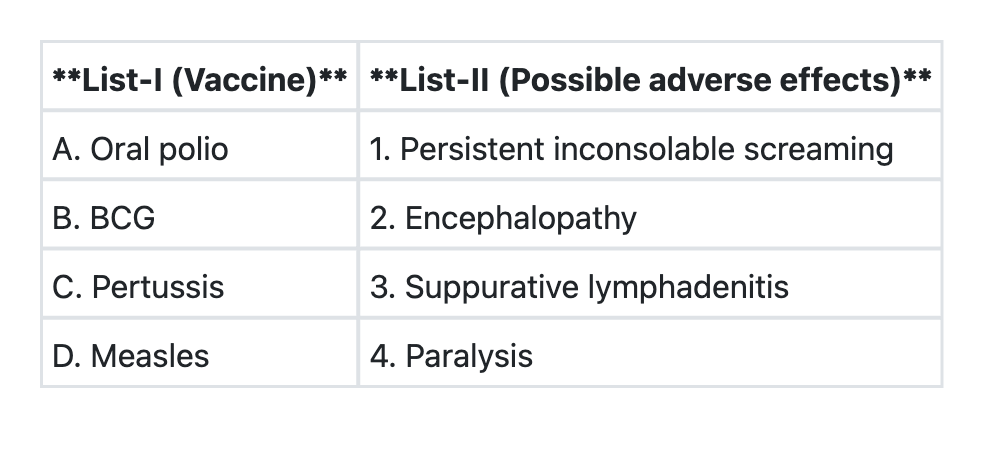
Question 91: Match List-I with List-II and select the correct answer using the code given below the Lists:
- A. A→4 B→3 C→1 D→2 (Correct Answer)
- B. A→3 B→4 C→1 D→2
- C. A→2 B→1 C→4 D→3
- D. A→1 B→2 C→3 D→4
Explanation: ***A→4 B→3 C→1 D→2*** - **Oral polio vaccine (OPV)** is a live attenuated vaccine, and a rare but serious adverse effect is vaccine-associated paralytic poliomyelitis (VAPP), which manifests as **paralysis**. - **BCG vaccine** (Bacillus Calmette-Guérin) is used against tuberculosis. A known adverse effect, particularly in immunocompromised individuals, is **suppurative lymphadenitis**, where regional lymph nodes become inflamed and may form abscesses. - **Pertussis vaccine** (whole-cell DTP) can cause reactions such as persistent inconsolable screaming, high fever, and, very rarely, encephalopathy. **Persistent inconsolable screaming** is a recognized adverse reaction to the pertussis component. - **Measles vaccine** is a live attenuated vaccine. While generally safe, rare severe adverse effects include **encephalopathy** (or encephalitis). *A→3 B→4 C→1 D→2* - This option incorrectly associates oral polio vaccine with suppurative lymphadenitis and BCG with paralysis, contradicting established vaccine adverse effects. - Oral polio has a risk of paralysis, not lymphadenitis, whereas BCG can cause lymphadenitis. *A→2 B→1 C→4 D→3* - This option incorrectly links oral polio to encephalopathy and BCG to persistent inconsolable screaming. - Encephalopathy is associated with measles or pertussis, and persistent screaming with pertussis, not oral polio or BCG. *A→1 B→2 C→3 D→4* - This option incorrectly attributes persistent inconsolable screaming to oral polio and encephalopathy to BCG. - Paralysis is a known complication of oral polio, and suppurative lymphadenitis is a key adverse effect of BCG.
Question 92: Which one of the following is an absolute contraindication for administration of killed vaccine?
- A. Hodgkin's disease
- B. Pregnancy
- C. Severe reaction to a previous dose (Correct Answer)
- D. Immunodeficiency
Explanation: ***Severe reaction to a previous dose*** * A **severe allergic reaction** (e.g., **anaphylaxis**) to a previous dose of any vaccine or its components is an **absolute contraindication** to further doses of that vaccine. * This is due to the potential for a life-threatening anaphylactic response upon re-exposure to the allergen. *Hodgkin's disease* * While Hodgkin's disease is a **malignancy** that can affect the immune system, it is generally considered a **precaution** or a reason to defer live vaccines, not an absolute contraindication for killed vaccines. * **Killed vaccines** are generally safe in immunocompromised patients, though their efficacy may be reduced. *Pregnancy* * **Pregnancy** is a contraindication for certain **live attenuated vaccines** (e.g., MMR, varicella) due to the theoretical risk of fetal infection. * However, most **killed vaccines** (e.g., inactivated influenza, tetanus, diphtheria, acellular pertussis) are **safe and often recommended** during pregnancy for maternal and fetal protection. *Immunodeficiency* * **Immunodeficiency** (e.g., HIV/AIDS, chemotherapy) is primarily a contraindication for **live attenuated vaccines**, as these can cause disseminated infection in immunocompromised individuals. * **Killed vaccines** are generally safe in immunocompromised individuals, although the **immune response may be suboptimal**, and repeat doses or higher doses may be necessary.
Question 93: Which one of the following vaccines is a killed vaccine?
- A. Mumps vaccine
- B. Yellow fever vaccine
- C. Rubella vaccine
- D. Hepatitis B vaccine (Correct Answer)
Explanation: ***Hepatitis B vaccine*** - The Hepatitis B vaccine is a **recombinant subunit vaccine** containing only the **hepatitis B surface antigen (HBsAg)** produced through genetic engineering. - It does **not contain live or killed viral particles**, making it distinct from traditional killed vaccines. - However, it is sometimes **grouped with inactivated vaccines** in broader classifications as it contains no live components and cannot cause infection. - Among the given options, this is the **only non-live vaccine**, making it the **best answer** in this context. *Mumps vaccine* - The mumps vaccine is a **live-attenuated vaccine**, containing a weakened form of the mumps virus. - Live-attenuated vaccines stimulate a strong, long-lasting immune response similar to natural infection. *Yellow fever vaccine* - The yellow fever vaccine is a **live-attenuated vaccine** prepared from the 17D strain of the yellow fever virus. - It induces robust and long-term immunity against yellow fever. *Rubella vaccine* - The rubella vaccine is a **live-attenuated vaccine**, containing a weakened form of the rubella virus. - It is typically administered as part of the **MMR (measles, mumps, rubella)** vaccine.
Question 94: Consider the following drugs : 1. Rifampicin 2. Dapsone 3. Clofazimine 4. Minocycline Which of the above drugs are used in the standard treatment of pauci-bacillary leprosy in adults?
- A. 1, 2 and 3
- B. 1 and 4
- C. 2, 3 and 4
- D. 1 and 2 only (Correct Answer)
Explanation: ***1 and 2 only*** - The **WHO standard treatment regimen** for **pauci-bacillary leprosy** in adults consists of only two drugs: **Rifampicin** and **Dapsone** [1]. - **Rifampicin 600 mg** is administered once monthly under supervision for 6 months, while **Dapsone 100 mg** is given daily for 6 months [3]. - This regimen is sufficient for PB leprosy, which has fewer bacilli and 1-5 skin lesions with no nerve involvement or only one nerve trunk involved [1], [2]. *1, 2 and 3* - This combination includes **Clofazimine**, which is part of the **multi-bacillary (MB) leprosy** regimen, not pauci-bacillary [2], [3]. - MB leprosy requires triple therapy (Rifampicin + Dapsone + Clofazimine) for 12 months due to higher bacterial load and more extensive disease. - Pauci-bacillary leprosy has a lower bacterial load and requires only a 6-month two-drug regimen [1]. *1 and 4* - **Minocycline** is used in **alternative regimens** for leprosy, particularly for patients with drug intolerance or in single-lesion PB leprosy (ROM regimen). - It is **not part of the standard first-line WHO treatment** for pauci-bacillary leprosy in adults. - The standard PB regimen requires **Rifampicin plus Dapsone**, not Rifampicin plus Minocycline. *2, 3 and 4* - This option misses **Rifampicin**, which is the **most crucial bactericidal drug** for all forms of leprosy (both PB and MB) [3]. - **Clofazimine** and **Minocycline** are not part of the standard PB leprosy regimen—Clofazimine is reserved for MB leprosy, and Minocycline is used only in alternative regimens. - Without Rifampicin, the treatment would be inadequate and risk development of drug resistance [3].