Abortions in the second trimester mainly occur due to
Abnormal foetal heart-rate patterns on electronic foetal monitoring include the following, except
B-Lynch stitch is applied on the uterus for the treatment of
A 20-year-old nulli-term primigravida is brought to the casualty with labour pains for last 24 hours and a hand prolapse. On examination, she has pulse 96/min, BP 120/80 mm Hg, and mild pallor. The abdominal examination reveals the uterine height at 32 weeks, the foetus in transverse lie and absent foetal heart sounds. On vaginal examination, the left arm of the foetus is prolapsed and the foetal ribs are palpable. The pelvis is adequate. What would be the best management option?
Regarding the use of a ventouse, which one of the following statements is not correct?
The presence of a retraction ring at the junction of upper and lower uterine segment in labour indicates
The indications of an elective caesarean section include all of the following, except
Match List-I with List-II and select the correct answer using the code given below: List-I (Obstetric Manoeuvres): A) Pinard's manoeuvre B) Lovset's manoeuvre C) Mauriceau-Smellie-Veit manoeuvre D) External cephalic version List-II (Indications/Purposes): 1) Conversion of breech to cephalic presentation 2) Delivery in breech presentation at term 3) Delivery of after-coming head in breech 4) Delivery of anterior shoulder and arms in breech Select the correct matching:
In the puerperium, which of the following hormonal changes are responsible for lactogenesis? 1. A sudden fall in the oestrogen levels after delivery 2. Reduction of prolactin inhibiting factor from the hypothalamus 3. Release of prolactin from the anterior pituitary 4. Release of oxytocin from the posterior pituitary Select the correct answer using the code given below :
Match List-I with List-II and select the correct answer using the code given below the Lists:
UPSC-CMS 2010 - Obstetrics and Gynecology UPSC-CMS Practice Questions and MCQs
Question 11: Abortions in the second trimester mainly occur due to
- A. congenital anomalies of the uterus
- B. retroflected gravid uterus
- C. congenital anomalies of the foetus (Correct Answer)
- D. hormonal deficiencies
Explanation: ***congenital anomalies of the foetus*** - Among the given options, **fetal congenital anomalies** (chromosomal abnormalities and structural malformations) are a significant cause of second-trimester pregnancy loss. - These anomalies often become apparent during routine prenatal screenings or ultrasounds performed in the second trimester, leading to spontaneous loss or termination. - **Note:** In clinical practice, **cervical incompetence** is actually the most common cause of second-trimester abortion, but it is not listed among the options in this question. *congenital anomalies of the uterus* - **Uterine anomalies** like septate or bicornuate uterus are more commonly associated with **recurrent first-trimester miscarriages** or **preterm labor** in the third trimester. - While they can contribute to pregnancy loss, they are less frequently the primary cause of second-trimester abortions compared to fetal anomalies. *retroflected gravid uterus* - A **retroflected gravid uterus** typically resolves spontaneously as the uterus grows and rises out of the pelvis by 12-14 weeks. - If it remains retroverted and becomes incarcerated, it can cause **pelvic pain** and **urinary retention**, but this is a very rare cause of miscarriage, especially in the second trimester. *hormonal deficiencies* - **Hormonal deficiencies**, such as insufficient **progesterone** production by the corpus luteum, are a more common cause of **first-trimester miscarriages**. - By the second trimester, the placenta has taken over progesterone production (by 8-10 weeks), making hormonal deficiencies a much less common cause of abortion during this period.
Question 12: Abnormal foetal heart-rate patterns on electronic foetal monitoring include the following, except
- A. tachycardia >170/minute lasting for 15 minutes
- B. bradycardia <120/minute lasting for 15 minutes
- C. late decelerations
- D. early decelerations (Correct Answer)
Explanation: ***Early decelerations*** - **Early decelerations** are considered a **benign finding** on electronic fetal monitoring, reflecting fetal head compression during contractions. - They tend to **mirror the contractions** and do not indicate fetal distress or hypoxia. *Tachycardia >170/minute lasting for 15 minutes* - Fetal **tachycardia** (heart rate >160 bpm) lasting for 10 minutes or more is considered an abnormal finding or baseline change. - A persistent fetal heart rate **>170 bpm for 15 minutes** or longer specifically indicates significant fetal tachycardia, which can be a sign of infection (e.g., chorioamnionitis), maternal fever, or fetal hypoxia. *Bradycardia <120/minute lasting for 15 minutes* - Fetal **bradycardia** (heart rate <110 bpm) lasting for 10 minutes or more is considered an abnormal finding or baseline change. - A fetal heart rate **<120 bpm lasting for 15 minutes** or longer, as specified, indicates significant fetal bradycardia, which can be associated with fetal hypoxia, cord compression, or placental insufficiency. *Late decelerations* - **Late decelerations** are a concerning sign of fetal distress, often indicative of **uteroplacental insufficiency** and fetal hypoxia. - They begin after the peak of the contraction and return to baseline after the contraction ends, reflecting a delayed fetal response to hypoxia.
Question 13: B-Lynch stitch is applied on the uterus for the treatment of
- A. incompetent os
- B. atonic PPH (Correct Answer)
- C. ruptured ulcerations
- D. bleeding from placental bed of placenta previa
Explanation: ***atonic PPH*** - The **B-Lynch stitch** is a **compression suture** applied surgically to the uterus to control severe **postpartum hemorrhage (PPH)** caused by **uterine atony**. - It works by mechanically compressing the uterus, thereby reducing blood flow and promoting uterine contraction, which is critical when the uterus fails to contract sufficiently after childbirth. *incompetent os* - An **incompetent cervical os** is typically managed with a **cervical cerclage**, a stitch placed around the cervix to prevent premature dilation during pregnancy. - The B-Lynch stitch is designed for uterine hemostasis, not cervical support. *ruptured ulcerations* - While bleeding might occur from **ruptured ulcerations**, this term is vague in an obstetrical context and does not apply to uterine bleeding specifically. - The B-Lynch stitch is used for severe uterine hemorrhage, most commonly due to atony, not general ulcerations which would require different treatment. *bleeding from placental bed of placenta previa* - **Placenta previa** bleeding often results from the placenta implanting over or near the cervix, which might require a **cesarean section** and careful placental removal. - While a B-Lynch stitch *could* be used as an adjunct in severe cases of PPH following placenta previa if atony develops, it is not the primary or typical treatment for bleeding *from the placental bed itself* which usually involves direct uterine incision or placental site hemostasis.
Question 14: A 20-year-old nulli-term primigravida is brought to the casualty with labour pains for last 24 hours and a hand prolapse. On examination, she has pulse 96/min, BP 120/80 mm Hg, and mild pallor. The abdominal examination reveals the uterine height at 32 weeks, the foetus in transverse lie and absent foetal heart sounds. On vaginal examination, the left arm of the foetus is prolapsed and the foetal ribs are palpable. The pelvis is adequate. What would be the best management option?
- A. External cephalic version
- B. Decapitation and delivering the baby vaginally (Correct Answer)
- C. Lower segment caesarean section
- D. Internal podalic version
Explanation: ***Decapitation and delivering the baby vaginally*** - With a **dead fetus in transverse lie** with **hand prolapse** and **24 hours of labor**, this represents **obstructed labor** requiring intervention. - **Decapitation** is the appropriate destructive procedure for transverse lie with shoulder presentation when the fetus is dead and vaginal delivery is feasible. - The **adequate pelvis** and **prolonged labor** (24 hours) suggest sufficient cervical dilation for vaginal delivery after decapitation. - **Foetal ribs palpable on vaginal examination** confirms adequate cervical dilation and access for the procedure. - Destructive operations are **preferred over LSCS** when the fetus is non-viable, as they avoid major abdominal surgery and its associated maternal morbidity (infection, hemorrhage, future uterine rupture risk). *Lower segment caesarean section* - While LSCS can deliver the dead fetus, it subjects the mother to **unnecessary major surgery** with higher morbidity when the fetus is already non-viable. - LSCS carries risks of **infection, hemorrhage, adhesions**, and **uterine scar complications** in future pregnancies. - When vaginal delivery is feasible after a destructive procedure, it is the preferred approach to minimize maternal trauma. *External cephalic version* - Absolutely **contraindicated** with a **dead fetus** and **hand prolapse** after 24 hours of labor. - ECV requires an **intact fetus**, adequate amniotic fluid, and is performed **before labor** or in early labor when the fetus is viable. - With established obstructed labor and fetal demise, ECV has no role. *Internal podalic version* - This procedure converts transverse or oblique lie to breech presentation to facilitate rapid vaginal delivery of a **viable second twin** or in acute situations. - It is **contraindicated** here due to **fetal demise**, **prolonged labor with potential cervical edema**, and high risk of **uterine rupture** in a primigravida with obstructed labor. - With a dead fetus, destructive procedures are safer than version and breech extraction.
Question 15: Regarding the use of a ventouse, which one of the following statements is not correct?
- A. The cup should be centrally placed on the vertex
- B. The largest size of the cup is preferred
- C. It can be applied when the cervix is incompletely dilated (Correct Answer)
- D. The maximum pressure should not exceed 0.8 kg/cm²
Explanation: ***It can be applied when the cervix is incompletely dilated*** - A **ventouse delivery** (vacuum extraction) should only be attempted when the cervix is **fully dilated** and effaced. - Applying a ventouse to an incompletely dilated cervix risks **cervical lacerations**, uterine rupture, and significant maternal and fetal trauma. *The cup should be centrally placed on the vertex* - Proper placement of the vacuum cup is crucial for effective traction and to minimize fetal injury. - The cup should be placed over the **flexion point** (posterior fontanelle) of the fetal head, ensuring strong suction and optimal force distribution. *The largest size of the cup is preferred* - Using the **largest appropriate size** cup for vacuum extraction helps distribute the traction force over a wider area of the fetal scalp. - This reduces the risk of **scalp trauma**, such as cephalhematoma and chignon formation, by minimizing concentrated pressure. *The maximum pressure should not exceed 0.8 kg/cm²* - Maintaining the vacuum pressure below **0.8 kg/cm²** (or 50-60 cmHg) is a safety guideline to prevent excessive pressure on the fetal scalp. - Higher pressures increase the risk of **scalp lacerations**, intracranial hemorrhage, and other fetal complications.
Question 16: The presence of a retraction ring at the junction of upper and lower uterine segment in labour indicates
- A. obstructed labour (Correct Answer)
- B. cervical dystocia
- C. precipitate labour
- D. prolonged labour
Explanation: ***Obstructed labour*** - A **pathological retraction ring (Bandl's ring)** forms when the upper uterine segment thickens and retracts, while the lower segment thins and distends due to **obstructed labour**. - This is distinct from the normal physiological retraction ring present in all labours—Bandl's ring is abnormally prominent, may be visible or palpable abdominally, and rises progressively higher. - This physical sign indicates an impending **uterine rupture** if the obstruction is not relieved and constitutes an obstetric emergency. *Cervical dystocia* - Refers to a cervix that fails to efface or dilate in the presence of adequate uterine contractions, but it does not directly cause the formation of a **pathological retraction ring**. - While it can lead to prolonged labour, the specific finding of a retraction ring at an abnormally high level points more directly to **obstruction**. *Precipitate labour* - Characterized by rapid labour lasting less than three hours from the onset of contractions to delivery. - It is the opposite of obstructed labour and does not involve the formation of a **pathological retraction ring**. *Prolonged labour* - Refers to labour that exceeds 20 hours for nulliparous women or 14 hours for multiparous women. - While obstructed labour can lead to prolonged labour, the presence of a **pathological retraction ring (Bandl's ring)** is a specific sign of obstruction, indicating a more severe and immediate threat than general prolongation.
Question 17: The indications of an elective caesarean section include all of the following, except
- A. cephalopelvic disproportion (Correct Answer)
- B. carcinoma cervix
- C. previous lower segment caesarean section
- D. placenta previa
Explanation: ***Cephalopelvic disproportion*** - **Cephalopelvic disproportion (CPD)** is a diagnosis made during labor when the fetal head cannot fit through the maternal pelvis, preventing vaginal delivery despite adequate contractions. - This condition is typically diagnosed *during* labor when there is **failure to progress**, making it an indication for an **emergency** or **intrapartum** cesarean section, not an elective one. *Carcinoma cervix* - **Cervical cancer** can obstruct the birth canal and is associated with a risk of excessive bleeding and tumor dissemination during vaginal delivery. - An **elective cesarean section** is indicated to avoid trauma to the tumor and prevent potential spread of cancer cells. *Previous lower segment caesarean section* - A history of a **previous lower segment cesarean section (LSCS)** carries a risk of **uterine rupture** in subsequent pregnancies, especially if attempting a **vaginal birth after cesarean (VBAC)**. - Many women (or their doctors) with a prior LSCS opt for a **repeat elective cesarean section** to mitigate this risk. *Placenta previa* - **Placenta previa** occurs when the placenta covers part or all of the cervix, blocking the birth canal. - Vaginal delivery is contraindicated due to the high risk of severe **hemorrhage** to both mother and fetus, making an **elective cesarean section** necessary.
Question 18: Match List-I with List-II and select the correct answer using the code given below: List-I (Obstetric Manoeuvres): A) Pinard's manoeuvre B) Lovset's manoeuvre C) Mauriceau-Smellie-Veit manoeuvre D) External cephalic version List-II (Indications/Purposes): 1) Conversion of breech to cephalic presentation 2) Delivery in breech presentation at term 3) Delivery of after-coming head in breech 4) Delivery of anterior shoulder and arms in breech Select the correct matching:
- A. A→4 B→1 C→3 D→2
- B. A→3 B→1 C→4 D→2
- C. A→2 B→4 C→3 D→1
- D. A→1 B→4 C→3 D→2 (Correct Answer)
Explanation: ***A→2 B→4 C→3 D→1*** - **Pinard's manoeuvre** (A) is used for **delivery in breech presentation at term** (2) by flexing the fetal knee and abducting the thigh to bring down extended legs. - This is the correct matching as each manoeuvre corresponds to its specific **obstetric indication**: **Lovset's** for shoulder delivery, **Mauriceau-Smellie-Veit** for after-coming head, and **External cephalic version** for presentation conversion. *A→4 B→1 C→3 D→2* - Incorrectly matches **Pinard's manoeuvre** to shoulder/arm delivery, which is actually the role of **Lovset's manoeuvre**. - **Lovset's manoeuvre** is mismatched to presentation conversion rather than its specific purpose of **delivering shoulders and arms** in breech presentation. *A→3 B→1 C→4 D→2* - **Pinard's manoeuvre** is wrongly matched to **after-coming head delivery**, which is specifically performed by **Mauriceau-Smellie-Veit manoeuvre**. - **Mauriceau-Smellie-Veit manoeuvre** is incorrectly matched to shoulder delivery instead of its actual purpose of **controlled delivery of the fetal head**. *A→1 B→4 C→3 D→2* - **Pinard's manoeuvre** is incorrectly matched to **presentation conversion**, which is performed **antepartum** by **External cephalic version**. - **External cephalic version** is wrongly matched to delivery during labor rather than its **prenatal** role in converting **breech to cephalic presentation**.
Question 19: In the puerperium, which of the following hormonal changes are responsible for lactogenesis? 1. A sudden fall in the oestrogen levels after delivery 2. Reduction of prolactin inhibiting factor from the hypothalamus 3. Release of prolactin from the anterior pituitary 4. Release of oxytocin from the posterior pituitary Select the correct answer using the code given below :
- A. 1, 2 and 3 (Correct Answer)
- B. 1 and 2 only
- C. 1 and 4
- D. 2, 3 and 4
Explanation: ***1, 2 and 3*** - **Lactogenesis** (milk production) critically depends on the **sudden drop in estrogen** after delivery, which removes the inhibitory effect on prolactin. - This, combined with the **release of prolactin from the anterior pituitary** (due to reduced **prolactin-inhibiting factor**, or dopamine, from the hypothalamus), stimulates the glandular cells in the breast to produce milk. *1 and 2 only* - This option correctly identifies the sudden fall in **estrogen** and reduction of **prolactin-inhibiting factor**'s influence but omits the direct action of **prolactin** release from the anterior pituitary, which is essential for milk synthesis. - While estrogen decline and reduced PIF are crucial, they lead to the **release of prolactin**, which is the direct stimulus for lactogenesis. *1 and 4* - While the sudden fall in **estrogen** is critical for initiating lactogenesis, **oxytocin** (released from the posterior pituitary) is primarily responsible for **milk ejection (let-down)**, not milk production (lactogenesis). - Oxytocin acts on myoepithelial cells to contract and expel milk, whereas prolactin stimulates milk synthesis. *2, 3 and 4* - This option correctly identifies the reduction of **prolactin-inhibiting factor** and the release of **prolactin**, which are essential for lactogenesis. However, it incorrectly includes **oxytocin**, which is involved in milk ejection, and misses the crucial role of the **fall in estrogen levels** that permits prolactin to act. - The elevated **estrogen levels during pregnancy** inhibit the action of prolactin, so their drop is a prerequisite for effective milk production.
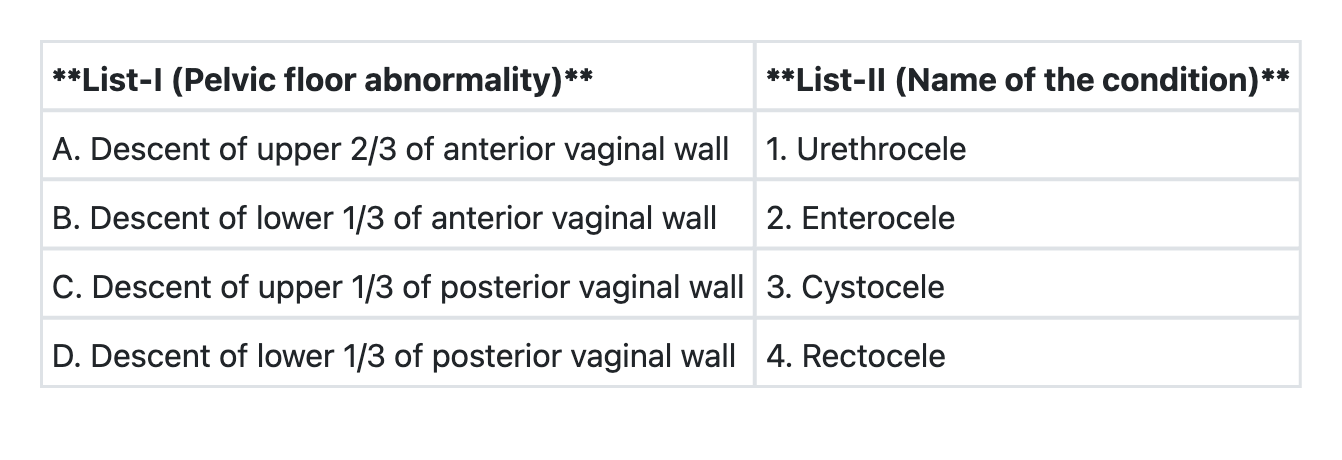
Question 20: Match List-I with List-II and select the correct answer using the code given below the Lists:
- A. A→4 B→1 C→2 D→3
- B. A→4 B→2 C→1 D→3
- C. A→3 B→2 C→1 D→4
- D. A→3 B→1 C→2 D→4 (Correct Answer)
Explanation: ***A→3 B→1 C→2 D→4*** - This option correctly matches each pelvic floor abnormality description with its corresponding condition. - **Cystocele** involves the descent of the bladder into the upper two-thirds of the anterior vaginal wall, **Urethrocele** describes the descent of the urethra into the lower one-third of the anterior vaginal wall, **Enterocele** refers to the descent of small bowel into the upper one-third of the posterior vaginal wall, and **Rectocele** involves the descent of the rectum into the lower one-third of the posterior vaginal wall. *A→4 B→1 C→2 D→3* - This option incorrectly matches the descent of the upper 2/3 of the anterior vaginal wall with a **rectocele** and the descent of the upper 1/3 of the posterior vaginal wall with a **cystocele**. - A **rectocele** involves the posterior vaginal wall, not the anterior, and a **cystocele** involves the anterior vaginal wall, not the posterior. *A→4 B→2 C→1 D→3* - This option incorrectly matches the descent of the upper 2/3 of the anterior vaginal wall with a **rectocele** and misidentifies other associations. - The pattern of descent and wall involvement for **urethrocele**, **enterocele**, and **cystocele** is not consistently maintained here according to the definitions. *A→3 B→2 C→1 D→4* - This option incorrectly associates the descent of the lower 1/3 of the anterior vaginal wall with an **enterocele**, and the descent of the upper 1/3 of the posterior vaginal wall with a **urethrocele**. - An **enterocele** involves the small bowel protruding into the posterior vaginal wall, and a **urethrocele** involves the urethra descending into the anterior vaginal wall.