UPSC-CMS 2010 — Microbiology
3 Previous Year Questions with Answers & Explanations
Autoclaving is a method of sterilization. The process involves heating by steam at
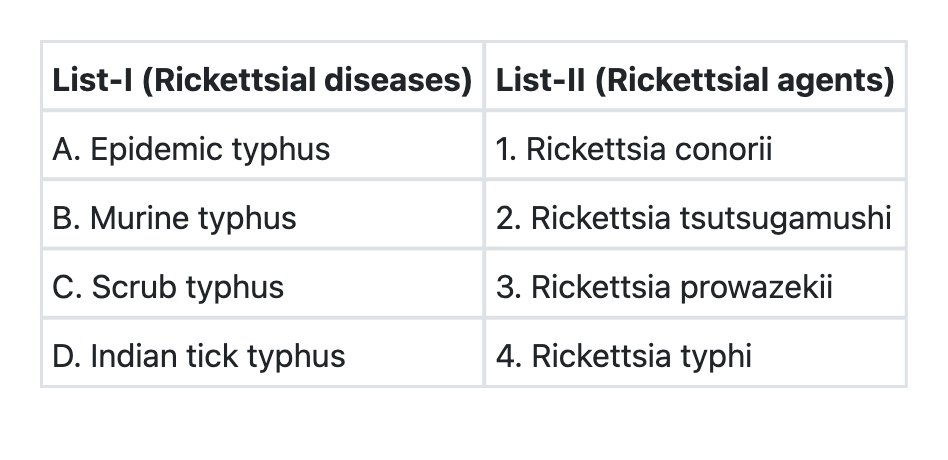
Match List-I with List-II and select the correct answer using the code given below the Lists:
Consider the following hepatitis viruses : 1. Hepatitis A 2. Hepatitis B 3. Hepatitis C 4. Hepatitis E Which of the above can be commonly transmitted through the faeco-oral route?
UPSC-CMS 2010 - Microbiology UPSC-CMS Practice Questions and MCQs
Question 1: Autoclaving is a method of sterilization. The process involves heating by steam at
- A. 10 lb pressure, 100 °C temperature for 10 minutes
- B. 20 lb pressure, 120 °C temperature for 20 minutes
- C. 15 lb pressure, 121 °C temperature for 15 minutes (Correct Answer)
- D. 25 lb pressure, 120 °C temperature for 25 minutes
Explanation: ***15 lb pressure, 121 °C temperature for 15 minutes*** - This is the **standard recommended parameter** for routine sterilization in an autoclave, ensuring the destruction of most pathogenic and non-pathogenic microorganisms, including spores. - The combination of **steam at 121°C** (equivalent to 15 psi) for at least 15 minutes provides efficient heat transfer and penetration required for effective sterilization. *10 lb pressure, 100 °C temperature for 10 minutes* - This temperature (100 °C) is used for **boiling** or pasteurization, which is generally not sufficient for complete sterilization as it may not kill highly resistant spores. - The **lower pressure and temperature** would likely not achieve the required sterility assurance level. *20 lb pressure, 120 °C temperature for 20 minutes* - While higher pressure can achieve sterilization, this is **not the standard parameter** used for typical autoclave sterilization. - The standard combination of 15 lb at 121°C is more commonly recommended and taught in medical curricula. *25 lb pressure, 120 °C temperature for 25 minutes* - This combination of **higher pressure and longer duration** would likely achieve sterilization, but it exceeds the minimum standard parameters. - While effective, it is not the most **efficient or commonly recommended** setting and could potentially lead to material degradation for some items.
Question 2: Match List-I with List-II and select the correct answer using the code given below the Lists:
- A. A→2 B→4 C→1 D→3
- B. A→1 B→4 C→3 D→2
- C. A→4 B→1 C→3 D→2
- D. A→3 B→4 C→2 D→1 (Correct Answer)
Explanation: ***A→3 B→4 C→2 D→1*** - **Epidemic typhus** is caused by *Rickettsia prowazekii*, primarily transmitted by the **human body louse**. - **Murine typhus** is caused by *Rickettsia typhi*, transmitted by **fleas typically found on rodents**. - **Scrub typhus** is caused by *Orientia tsutsugamushi* (formerly *Rickettsia tsutsugamushi*), transmitted by the bite of **chiggers (larval mites)**. - **Indian tick typhus** is a form of spotted fever group rickettsiosis, often caused by *Rickettsia conorii*, transmitted by **ticks.** *A→2 B→4 C→1 D→3* - This option incorrectly associates Epidemic typhus with *Rickettsia tsutsugamushi* and Indian tick typhus with *Rickettsia prowazekii*. - Epidemic typhus is caused by *Rickettsia prowazekii*, and *Rickettsia tsutsugamushi* causes Scrub typhus. *A→1 B→4 C→3 D→2* - This option incorrectly identifies *Rickettsia conorii* as the agent for Epidemic typhus and *Rickettsia tsutsugamushi* for Indian tick typhus. - *Rickettsia conorii* is associated with Mediterranean spotted fever (a form of tick typhus), and *Rickettsia tsutsugamushi* causes Scrub typhus. *A→4 B→1 C→3 D→2* - This option incorrectly matches Epidemic typhus with *Rickettsia typhi* and Scrub typhus with *Rickettsia prowazekii*. - *Rickettsia typhi* causes Murine typhus, and *Rickettsia prowazekii* causes Epidemic typhus.
Question 3: Consider the following hepatitis viruses : 1. Hepatitis A 2. Hepatitis B 3. Hepatitis C 4. Hepatitis E Which of the above can be commonly transmitted through the faeco-oral route?
- A. 1 and 3 only
- B. 1 and 4 (Correct Answer)
- C. 2, 3 and 4
- D. 1, 2 and 3
Explanation: ***Correct Answer: 1 and 4*** * Hepatitis A virus (**HAV**) and Hepatitis E virus (**HEV**) are primarily transmitted via the **faecal-oral route**, typically through contaminated food or water. * These infections are often acute and self-limiting, causing symptoms like jaundice, fatigue, and nausea. * HAV is more common in areas with poor sanitation, while HEV often causes waterborne outbreaks, particularly in developing countries. *Incorrect: 1 and 3 only* * While **Hepatitis A** is transmitted faecal-orally, **Hepatitis C** is primarily transmitted through blood-to-blood contact, such as sharing needles or contaminated blood transfusions. * Hepatitis C rarely, if ever, spreads via the faecal-oral route. *Incorrect: 2, 3 and 4* * **Hepatitis B** and **Hepatitis C** are transmitted through parenteral routes (e.g., blood, sexual contact, perinatal transmission), not via the faecal-oral route. * Although Hepatitis E is faecal-orally transmitted, including B and C makes this option incorrect. *Incorrect: 1, 2 and 3* * **Hepatitis A** is transmitted faecal-orally, but **Hepatitis B** and **Hepatitis C** are primarily transmitted through blood and body fluids (parenteral route). * This option incorrectly includes Hepatitis B and C in the faecal-oral transmission category.