UPSC-CMS 2010 — Internal Medicine
7 Previous Year Questions with Answers & Explanations
A patient presents with claudication in both buttocks and has impotence. The clinical examination reveals bruit over lower abdomen. What is the clinical diagnosis?
The normal ankle brachial pressure index (ABPI) is 1.0. A value of 0.8 suggests
Serum calcitonin may be elevated in
Which one of the following is not a component of Charcot's triad?
Match List-I with List-II and select the correct answer using the code given below the Lists:
Priapism in a young male could occur because of
Which one of the following is an autosomal recessive disease?
UPSC-CMS 2010 - Internal Medicine UPSC-CMS Practice Questions and MCQs
Question 1: A patient presents with claudication in both buttocks and has impotence. The clinical examination reveals bruit over lower abdomen. What is the clinical diagnosis?
- A. Bilateral iliofemoral occlusion
- B. Aortoiliac occlusion (Correct Answer)
- C. Bilateral iliac artery occlusion
- D. Bilateral femoropopliteal occlusion
Explanation: Aortoiliac occlusion - The triad of **buttock claudication**, **impotence**, and **absent or diminished femoral pulses** (often associated with an abdominal bruit) is classic for **Leriche syndrome**, which is caused by aortoiliac occlusion [2], [3]. - This occlusion impairs blood flow to both lower extremities and the internal iliac arteries, affecting erectile function [1]. Bilateral iliofemoral occlusion - While this would cause bilateral lower limb symptoms, it typically would not explain the **impotence** as clearly as an aortoiliac occlusion which affects the internal iliac arteries that supply the penis [2], [3]. - An iliofemoral occlusion is distal to the aorta, and the symptom complex provided points to a more **proximal lesion**. Bilateral iliac artery occlusion - This would cause similar symptoms to aortoiliac occlusion including **buttock claudication** and **impotence** [2]. - However, the presence of a **bruit over the lower abdomen** often indicates a more proximal lesion involving the aorta, making aortoiliac occlusion a more comprehensive diagnosis for these findings. Bilateral femoropopliteal occlusion - This would primarily cause **calf and thigh claudication**, less commonly buttock claudication, as the occlusion is more distal [1]. - **Impotence** is not a typical symptom of isolated femoropopliteal occlusion, as the internal iliac arteries are usually unaffected.
Question 2: The normal ankle brachial pressure index (ABPI) is 1.0. A value of 0.8 suggests
- A. impending gangrene
- B. presence of collaterals
- C. some degree of arterial obstruction (Correct Answer)
- D. good flow
Explanation: ***some degree of arterial obstruction*** - An **ABPI of 0.8** indicates a reduction in blood flow to the lower extremities compared to the upper limbs [1]. - This value is generally considered to signify **mild to moderate peripheral artery disease (PAD)**, suggesting the presence of arterial narrowing or obstruction [1]. *impending gangrene* - **Impending gangrene** or critical limb ischemia is typically associated with a much lower ABPI, usually **below 0.4** or even 0.3 [1]. - At an ABPI of 0.8, severe tissue damage and gangrene are not imminent, although careful monitoring is still warranted. *presence of collaterals* - While **collateral arteries** can develop in response to chronic arterial obstruction, an ABPI of 0.8 primarily reflects the overall net blood flow, which is still reduced despite collaterals [1]. - The presence of collaterals can actually help to maintain tissue viability and prevent more severe symptoms, but they don't normalize the ABPI in the presence of significant disease [1]. *good flow* - A value of **1.0 to 1.4** is generally considered a normal ABPI, indicating good arterial flow. - An ABPI of **0.8 is significantly below normal** and suggests impaired rather than good blood flow [1].
Question 3: Serum calcitonin may be elevated in
- A. choriocarcinoma of ovary
- B. islet cell tumour of pancreas
- C. medullary carcinoma of thyroid (Correct Answer)
- D. carcinoid tumour of appendix
Explanation: ***medullary carcinoma of thyroid*** - **Medullary thyroid carcinoma (MTC)** originates from the **parafollicular C cells** of the thyroid gland, which physiologically produce and secrete **calcitonin**. - Therefore, MTC is a classic cause of significantly elevated serum **calcitonin** levels, used both as a diagnostic marker and for monitoring disease recurrence. *choriocarcinoma of ovary* - **Choriocarcinoma** is a germ cell tumor that typically produces **human chorionic gonadotropin (hCG)**, not calcitonin [3]. - Ovarian choriocarcinoma is a rare and highly aggressive tumor, and its primary tumor marker is **hCG** [3]. *islet cell tumour of pancreas* - **Islet cell tumors** of the pancreas (neuroendocrine tumors) typically produce hormones like **insulin, glucagon, somatostatin, or gastrin**, depending on their subtype [1], [2]. - While they are endocrine tumors, they do not originate from calcitonin-producing cells and thus generally do not elevate **calcitonin**. *carcinoid tumour of appendix* - **Carcinoid tumors**, especially those of the appendix, are **neuroendocrine tumors** that typically secrete **serotonin** and other vasoactive substances [1]. - These tumors are associated with **carcinoid syndrome** (flushing, diarrhea, bronchospasm) but do not produce **calcitonin** [1].
Question 4: Which one of the following is not a component of Charcot's triad?
- A. Fever
- B. Vomiting (Correct Answer)
- C. Pain
- D. Jaundice
Explanation: ***Vomiting*** - **Charcot's triad** consists of **right upper quadrant abdominal pain**, **fever**, and **jaundice**, which are classic signs of **acute cholangitis** [1]. - Vomiting is not considered one of the three classic components of Charcot's triad. *Fever* - **Fever** is a cardinal symptom of systemic inflammation and infection, a key component indicating the presence of an infectious process in the biliary tree. - It often accompanies the other two symptoms, pain and jaundice, to complete Charcot's triad in **acute cholangitis** [1]. *Pain* - **Right upper quadrant abdominal pain** is a critical component of Charcot's triad, arising from the inflammation and distension of the biliary tree due to obstruction and infection [1]. - This localized pain helps direct the diagnostic focus to the **liver and biliary system**. *Jaundice* - **Jaundice**, characterized by yellowing of the skin and eyes, results from the obstruction of bile flow leading to the accumulation of bilirubin in the bloodstream. - Its presence signifies **biliary obstruction**, often due to gallstones or strictures, which is a common precursor to cholangitis [1].
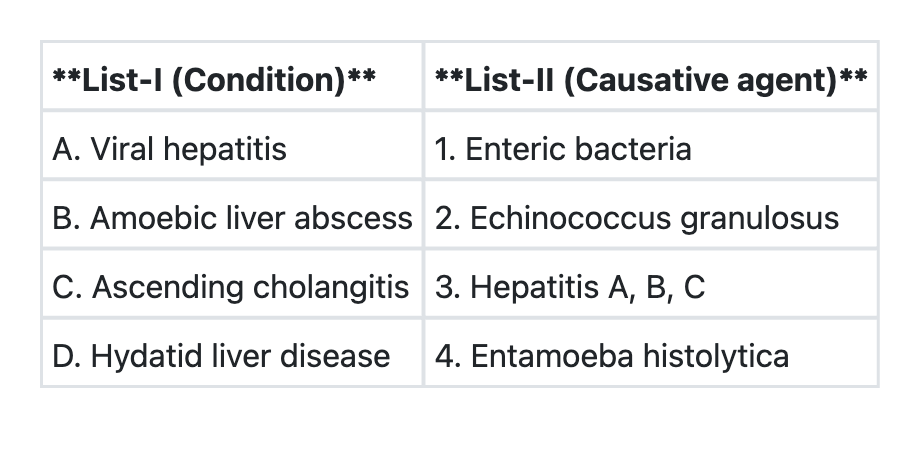
Question 5: Match List-I with List-II and select the correct answer using the code given below the Lists:
- A. A→1 B→2 C→3 D→4
- B. A→3 B→1 C→4 D→2
- C. A→3 B→4 C→1 D→2 (Correct Answer)
- D. A→2 B→4 C→1 D→3
Explanation: ***A→3 B→4 C→1 D→2*** - This option correctly matches each condition with its primary causative agent: **Viral hepatitis** with **Hepatitis A, B, C**; **Amoebic liver abscess** with **Entamoeba histolytica**; **Ascending cholangitis** with **Enteric bacteria**; and **Hydatid liver disease** with **Echinococcus granulosus**. - This mapping accurately reflects established medical knowledge regarding the etiology of these liver and biliary tract conditions. *A→1 B→2 C→3 D→4* - This option incorrectly associates viral hepatitis with enteric bacteria and amoebic liver abscess with Echinococcus granulosus, which are not the primary causes. - The link between ascending cholangitis and hepatitis viruses is also incorrect, as ascending cholangitis is typically bacterial. *A→3 B→1 C→4 D→2* - This option correctly matches viral hepatitis, but incorrectly attributes amoebic liver abscess to enteric bacteria and ascending cholangitis to Entamoeba histolytica. - The causative agent for amoebic liver abscess is *Entamoeba histolytica*, not enteric bacteria, and ascending cholangitis is caused by bacteria, not *Entamoeba histolytica*. *A→2 B→4 C→1 D→3* - This option incorrectly links viral hepatitis to Echinococcus granulosus and hydatid liver disease to hepatitis viruses. - Hydatid liver disease is caused by *Echinococcus granulosus*, and viral hepatitis is caused by hepatitis viruses, so these are mismatched.
Question 6: Priapism in a young male could occur because of
- A. leukaemia (Correct Answer)
- B. carcinoid tumour of appendix
- C. testicular cancer
- D. penile cancer
Explanation: ***Leukaemia*** - In leukaemia, especially **myeloid leukaemia**, immature white blood cells can accumulate in the **corpus cavernosa**, leading to stasis and **venous occlusion**. [1] - This cellular congestion prevents venous outflow from the penis, causing a prolonged and **painful erection (priapism)**. *Carcinoid tumour of appendix* - A carcinoid tumour of the appendix is typically associated with **carcinoid syndrome**, which involves symptoms like flushing and diarrhoea. - It does **not directly cause priapism**, as its mediators (e.g., serotonin) do not typically induce this specific local vascular event. *Testicular cancer* - Testicular cancer primarily manifests as a **painless lump in the testis** and can cause symptoms related to metastasis, but **priapism is not a typical direct presenting symptom**. - While some cancers can cause paraneoplastic syndromes, testicular cancer is not associated with priapism. *Penile cancer* - Penile cancer typically presents as a **lesion, ulcer, or mass on the penis**, often associated with pain, bleeding, or discharge. - While it affects the penis, it does **not typically cause prolonged erections (priapism)**, but rather local tissue destruction or obstruction.
Question 7: Which one of the following is an autosomal recessive disease?
- A. Retinitis pigmentosa
- B. Vitamin D resistant rickets
- C. Cystic fibrosis (Correct Answer)
- D. Neurofibromatosis
Explanation: ***Cystic fibrosis*** - **Cystic fibrosis** is caused by mutations in the **CFTR gene**, leading to defective chloride transport and thick, sticky mucus. - It is inherited in an **autosomal recessive pattern**, meaning an individual must inherit two copies of the mutated gene (one from each parent) to develop the disease. *Retinitis pigmentosa* - **Retinitis pigmentosa** is a group of inherited eye disorders, and while some forms are X-linked or autosomal dominant, a significant portion are also inherited in an **autosomal recessive pattern**. - However, it's not exclusively autosomal recessive, making cystic fibrosis a more definitive answer in this context. *Vitamin D resistant rickets* - **Vitamin D resistant rickets**, also known as **X-linked hypophosphatemic rickets**, is primarily inherited in an **X-linked dominant pattern**. - It is characterized by impaired renal phosphate reabsorption and skeletal abnormalities despite normal vitamin D levels. *Neurofibromatosis* - **Neurofibromatosis type 1 (NF1)** and **Neurofibromatosis type 2 (NF2)** are both inherited in an **autosomal dominant pattern**. - NF1 is characterized by **café-au-lait spots**, **neurofibromas**, and optical gliomas, while NF2 involves **bilateral vestibular schwannomas**.