The cut-off standard for defining low birth-weight babies in India is considered to be
Sentinel centre for vaccine-preventable diseases does not provide information on
Consider the following statements regarding Vaccine Vial Monitor (VVM) on the vial of oral polio vaccine : The vaccine is not potent and should be discarded 1. if the colour of the small square within the circle is lighter in colour than that of the circle 2. if the small square within the circle is of the same colour as the circle 3. if the small square within the circle is darker in colour than the colour of the circle Which of the statements given above is/are correct?
Effective disinfection of a typhoid patient's faecal matter can be done with
What is the correct order of the steps in the rapid sand filtration process for water purification?
Monitoring of blood pressure comes under
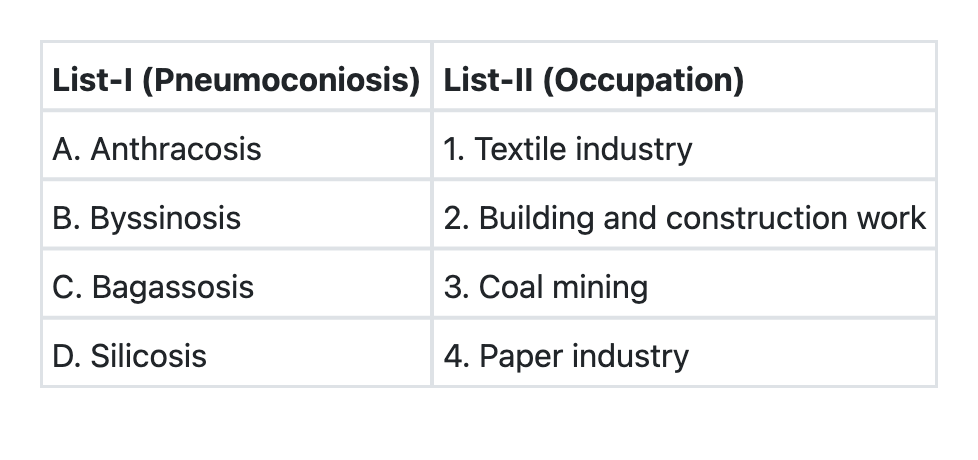
Match List-I with List-II and select the correct answer using the code given below the Lists: List-I (Pneumoconioses): A. Anthracosis B. Byssinosis C. Bagassosis D. Silicosis List-II (Occupational Exposures): 1. Textile industry 2. Coal mining 3. Building and construction work 4. Paper industry Codes:
In healthcare settings, a series of meetings where individuals work within small groups to arrive at a plan of action for addressing health problems or implementing interventions is called
Consider the following strategies pertaining to National Anti-Malaria Programme: 1. Early case detection and prompt treatment with ACT (Artemisinin Combination Therapy) 2. Indoor Residual Spraying (IRS) in areas with API ≥2 3. Distribution and promotion of Long Lasting Insecticidal Nets (LLINs) Which of the above strategies is/are being used in India?
Which is the correct sequence in increasing order for crude birthrates in the countries named herewith?
UPSC-CMS 2010 - Community Medicine UPSC-CMS Practice Questions and MCQs
Question 11: The cut-off standard for defining low birth-weight babies in India is considered to be
- A. 1500 gm
- B. 2000 gm
- C. 2800 gm
- D. 2500 gm (Correct Answer)
Explanation: ***Correct: 2500 gm*** - A birth weight of less than **2500 grams** (2.5 kg) is the standard international definition for **low birth weight (LBW)**, which is also adopted in India. - This threshold is crucial for identifying infants at higher risk of morbidity and mortality. *Incorrect: 1500 gm* - This weight typically defines **very low birth weight (VLBW)**, indicating a more severe degree of prematurity or growth restriction. - While significant, it is a subcategory of low birth weight, not the general cut-off for LBW. *Incorrect: 2000 gm* - This weight is considered **moderately low birth weight** and falls within the broader category of LBW (less than 2500 g). - It does not represent the universal cut-off for defining low birth weight itself. *Incorrect: 2800 gm* - A birth weight of 2800 grams (2.8 kg) is considered **normal birth weight** and does not fall under the definition of low birth weight. - Infants weighing 2800 grams are generally considered to be of healthy weight at birth.
Question 12: Sentinel centre for vaccine-preventable diseases does not provide information on
- A. time trend
- B. incidence rates (Correct Answer)
- C. place distribution
- D. immunization
Explanation: ***Incidence rates*** - Sentinel surveillance centers typically focus on **monitoring trends** and **spatial distribution** of vaccine-preventable diseases, as well as immunization coverage. - They generally **do not provide population-wide incidence rates**, as this requires comprehensive, population-level data collection which is beyond their scope. *time trend* - Sentinel centers are crucial for tracking the **time trend** of vaccine-preventable diseases, allowing public health officials to observe patterns and changes over periods. - This information helps in understanding disease seasonality, effectiveness of vaccination campaigns, and early detection of **outbreaks**. *place distribution* - These centers provide valuable insights into the **geographical or spatial distribution** of vaccine-preventable diseases. - This helps in identifying **hotspots** or regions with higher disease activity, guiding targeted interventions. *immunization* - Sentinel surveillance also monitors aspects of **immunization coverage** and the effectiveness of vaccination programs. - Data from these centers can indicate gaps in vaccination and the impact of immunization strategies on disease burden.
Question 13: Consider the following statements regarding Vaccine Vial Monitor (VVM) on the vial of oral polio vaccine : The vaccine is not potent and should be discarded 1. if the colour of the small square within the circle is lighter in colour than that of the circle 2. if the small square within the circle is of the same colour as the circle 3. if the small square within the circle is darker in colour than the colour of the circle Which of the statements given above is/are correct?
- A. 1 only
- B. 2 and 3 (Correct Answer)
- C. 1 and 2
- D. 2 only
Explanation: ***2 and 3*** - A vaccine vial is considered **not potent and should be discarded** if the inner square is the **same color as or darker than** the outer circle, as this indicates **heat exposure** reducing vaccine efficacy. - **Statement 2** (same color) indicates the vaccine has reached the **discard point** due to cumulative heat exposure, and **statement 3** (darker color) indicates the vaccine is **beyond the discard point**, both requiring immediate disposal. - VVMs are crucial for ensuring **cold chain integrity**; the color change of the inner square relative to the outer circle signifies cumulative heat damage and loss of potency. *2 only* - While statement 2 correctly identifies that a vaccine should be discarded when the inner square is the **same color** as the outer circle, this option **omits statement 3**. - Statement 3 (darker inner square) also correctly indicates the vaccine should be discarded, making this option **incomplete**. *1 only* - This statement is **incorrect** because a **lighter inner square** compared to the outer circle indicates that the vaccine has been exposed to **minimal heat**, meaning the vaccine is **still potent and safe to use**. - A lighter inner square is the **ideal state** for a VVM, signifying a correctly maintained cold chain; the vaccine should **NOT be discarded** in this scenario. *1 and 2* - Statement 1 is **incorrect** because when the inner square is **lighter** than the outer circle, the vaccine remains **potent and should continue to be used**, not discarded. - Only statement 2 is correct in this combination, but statement 3 is also correct and should be included, making this option wrong.
Question 14: Effective disinfection of a typhoid patient's faecal matter can be done with
- A. 2% phenol
- B. 5% formalin
- C. 5% cresol
- D. 2% bleaching powder (Correct Answer)
Explanation: ***2% bleaching powder*** - **Bleaching powder** (calcium hypochlorite) is a strong oxidizing agent that effectively disinfects faecal matter by destroying microbial cell structures. - A **2% solution** provides sufficient concentration of free chlorine to kill *Salmonella Typhi* and other pathogens in faeces. *2% phenol* - While **phenol** is an antiseptic and disinfectant, a 2% solution may not be strong enough for the effective and rapid disinfection of heavily contaminated faecal matter. - **Phenol** acts by denaturing proteins and disrupting cell membranes, but higher concentrations or longer contact times are generally needed for spore-forming or highly resistant organisms, though *Salmonella Typhi* is not spore-forming. *5% formalin* - **Formalin** (a solution of formaldehyde) is a powerful disinfectant and fixative, but it is typically used for sterilizing medical equipment or preserving biological specimens. - Its **strong fumes** and irritating nature make it less suitable for routine, large-scale disinfection of faecal matter due to safety concerns and logistical challenges. *5% cresol* - **Cresol** is a phenolic disinfectant that is more potent than phenol and is effective against a broad spectrum of microorganisms. - While effective, **cresol** is typically used in higher concentrations (like 5%) for disinfecting surfaces or specific wastes, and its pungent odor and potential toxicity might make it a less practical choice for general faecal disinfection compared to bleaching powder.
Question 15: What is the correct order of the steps in the rapid sand filtration process for water purification?
- A. Alum mixing – flocculation – sedimentation – filtration (Correct Answer)
- B. Sedimentation – alum mixing – flocculation – filtration
- C. Alum mixing – sedimentation – flocculation – filtration
- D. Flocculation – alum mixing – sedimentation – filtration
Explanation: ***Alum mixing – flocculation – sedimentation – filtration*** - This sequence represents the established steps in conventional **rapid sand filtration**, where each stage plays a crucial role in removing impurities. - **Alum mixing** (coagulation) destabilizes particles, **flocculation** consolidates them, **sedimentation** removes larger flocs, and **filtration** traps remaining fine particles. *Sedimentation – alum mixing – flocculation – filtration* - **Sedimentation** occurs *after* coagulation and flocculation, as these processes are needed to create larger, settleable particles. - Starting with sedimentation before preparing the water for efficient particle removal would be ineffective. *Alum mixing – sedimentation – flocculation – filtration* - **Flocculation** (the gentle stirring to form larger flocs) must happen *after* alum mixing (coagulation) and *before* sedimentation. - Placing sedimentation before flocculation would lead to poor particle removal as the flocs would not have fully formed. *Flocculation – alum mixing – sedimentation – filtration* - **Alum mixing** (coagulation) is the initial step to destabilize particles, which then allows for effective flocculation. - Attempting flocculation before coagulation would be ineffective as the particles would not be prepared to aggregate.
Question 16: Monitoring of blood pressure comes under
- A. secondary prevention (Correct Answer)
- B. tertiary prevention
- C. primary prevention
- D. primordial prevention
Explanation: ***secondary prevention*** - **Secondary prevention** aims to halt the progression of a disease at an early stage, in presence of **risk factors** or asymptomatic disease. - Monitoring blood pressure helps detect **hypertension early**, allowing for intervention before organ damage develops. *tertiary prevention* - **Tertiary prevention** focuses on **reducing the impact of an established disease** and preventing complications or recurrence. - Examples include rehabilitation programs after a stroke or managing chronic conditions to improve quality of life. *primary prevention* - **Primary prevention** targets individuals who are currently **disease-free** to prevent the development of a disease. - Examples include **vaccination**, health education, and promoting a healthy lifestyle to avoid risk factors. *primordial prevention* - **Primordial prevention** aims to **prevent the development of risk factors** themselves in the first place, often at a societal level. - This involves policies and actions to improve socioeconomic conditions and promote healthy environments, such as campaigns against smoking or promoting access to healthy foods.
Question 17: Match List-I with List-II and select the correct answer using the code given below the Lists: List-I (Pneumoconioses): A. Anthracosis B. Byssinosis C. Bagassosis D. Silicosis List-II (Occupational Exposures): 1. Textile industry 2. Coal mining 3. Building and construction work 4. Paper industry Codes:
- A. A→3 B→2 C→1 D→4
- B. A→4 B→1 C→3 D→2
- C. A→2 B→1 C→4 D→3 (Correct Answer)
- D. A→1 B→4 C→3 D→2
Explanation: ***Correct: A→2 B→1 C→4 D→3*** - This option correctly matches each pneumoconiosis with its primary occupational exposure. - **Anthracosis (A→2)**: Associated with **coal mining** - caused by inhalation of coal dust leading to "black lung disease" - **Byssinosis (B→1)**: Associated with **textile industry** - caused by cotton dust exposure, presents as "Monday fever" - **Bagassosis (C→4)**: Associated with **paper industry** - caused by moldy sugarcane bagasse (fibrous residue) used in paper production - **Silicosis (D→3)**: Associated with **building and construction work** - caused by crystalline silica dust from stone, sand, and concrete *Incorrect: A→3 B→2 C→1 D→4* - Incorrectly matches **Anthracosis** with construction and **Byssinosis** with coal mining - **Byssinosis** is specifically linked to cotton dust in textiles, not coal mining *Incorrect: A→4 B→1 C→3 D→2* - Incorrectly associates **Anthracosis** with paper industry and **Bagassosis** with coal mining - **Anthracosis** results from coal dust, not paper production *Incorrect: A→1 B→4 C→3 D→2* - Incorrectly matches **Anthracosis** with textiles and **Byssinosis** with paper industry - **Anthracosis** is "black lung" from coal, and **Byssinosis** is from cotton dust, not paper
Question 18: In healthcare settings, a series of meetings where individuals work within small groups to arrive at a plan of action for addressing health problems or implementing interventions is called
- A. group discussion (Correct Answer)
- B. role play
- C. focus groups
- D. workshop
Explanation: ***group discussion*** - In the context of health education methods, **group discussion** refers to a participatory technique where individuals work collaboratively in small groups through a series of meetings to analyze health problems and develop action plans. - This method emphasizes **collective decision-making**, consensus building, and shared responsibility for planning and implementing health interventions. - Group discussions in healthcare settings are characterized by their **action-oriented approach** focused on problem-solving and intervention planning. *role play* - **Role play** is a simulation-based learning technique where participants enact specific roles or scenarios to practice communication skills, patient interactions, or clinical situations. - It is primarily a **training and skill development tool**, not designed for systematic planning or developing action plans for real health interventions. *focus groups* - **Focus groups** are qualitative research tools used to gather in-depth information about perceptions, attitudes, beliefs, and opinions from a selected group of participants. - Their primary purpose is **data collection and exploration** of perspectives rather than formulating and implementing action plans for health problems. *workshop* - A **workshop** is an intensive educational and training session that focuses on skill-building, knowledge transfer, and hands-on learning in specific subject areas. - While workshops may include group activities and problem-solving components, the term typically emphasizes **structured teaching and learning** rather than the continuous collaborative planning process described in the question.
Question 19: Consider the following strategies pertaining to National Anti-Malaria Programme: 1. Early case detection and prompt treatment with ACT (Artemisinin Combination Therapy) 2. Indoor Residual Spraying (IRS) in areas with API ≥2 3. Distribution and promotion of Long Lasting Insecticidal Nets (LLINs) Which of the above strategies is/are being used in India?
- A. 2 and 3 only
- B. 1, 2 and 3 (Correct Answer)
- C. 1 and 2 only
- D. 1 only
Explanation: ***1, 2 and 3*** - The **National Anti-Malaria Programme (NAMP)** in India utilizes all three strategies as core components for malaria control and elimination. - **Early case detection and prompt treatment with ACT** are crucial for reducing the parasite reservoir and preventing severe disease. **Indoor Residual Spraying (IRS)** is used for vector control, especially in high-burden areas (API ≥2), and **Long Lasting Insecticidal Nets (LLINs)** provide personal protection against mosquito bites. *2 and 3 only* - This option is incorrect because it excludes **early case detection and prompt treatment with ACT**, which is a fundamental and critical strategy in malaria control. - Effective **case management** is essential for reducing transmission and morbidity/mortality, alongside vector control methods like IRS and LLINs. *1 and 2 only* - This option is incorrect as it omits the **distribution and promotion of Long Lasting Insecticidal Nets (LLINs)**, which are a highly effective and widely implemented tool for preventing mosquito bites and reducing malaria transmission, particularly in endemic areas. - **LLINs** are a cost-effective intervention promoting personal protection, empowering communities in malaria prevention efforts. *1 only* - This option is incorrect because relying solely on **early case detection and prompt treatment** is insufficient for comprehensive malaria control. - Effective malaria control requires a multi-pronged approach that also incorporates **vector control strategies** like IRS and LLINs to reduce human-vector contact.
Question 20: Which is the correct sequence in increasing order for crude birthrates in the countries named herewith?
- A. India, Japan, Sri Lanka, Nepal
- B. India, Japan, Nepal, Sri Lanka
- C. Sri Lanka, Japan, Nepal, India
- D. Japan, Sri Lanka, India, Nepal (Correct Answer)
Explanation: ***Japan, Sri Lanka, India, Nepal*** - This sequence correctly orders the given countries from the lowest to the highest **crude birth rate**. - Japan consistently has one of the lowest birth rates globally due to an aging population and socio-economic factors. Sri Lanka and India follow with moderate birth rates, while Nepal generally has a higher birth rate compared to the others, influenced by factors like rural populations and access to healthcare. *India, Japan, Sri Lanka, Nepal* - This option incorrectly places **India first**, when its birth rate is significantly higher than Japan's and Sri Lanka's. - **Japan's birth rate** is notably lower than India's and Sri Lanka's, making this sequence incorrect. *India, Japan, Nepal, Sri Lanka* - This sequence is incorrect as it places **India first** and has an incorrect relative order between Nepal and Sri Lanka compared to their actual birth rates. - **Japan's birth rate** is the lowest among these countries, so it should be at the beginning of an increasing order, not after India. *Sri Lanka, Japan, Nepal, India* - This option incorrectly places **Sri Lanka first** and misrepresents the relative positions of Japan, Nepal, and India in terms of birth rates. - **Japan has the lowest birth rate** among the listed countries, so it should precede Sri Lanka in an increasing order.