A patient presents to the emergency department with pain and distension of abdomen and absolute constipation. What is the investigation of choice ?
What is the investigation of choice in a patient with blunt abdominal trauma with hematuria ?
Which one of the following is the treatment of choice in a child with inguinal hernia ?
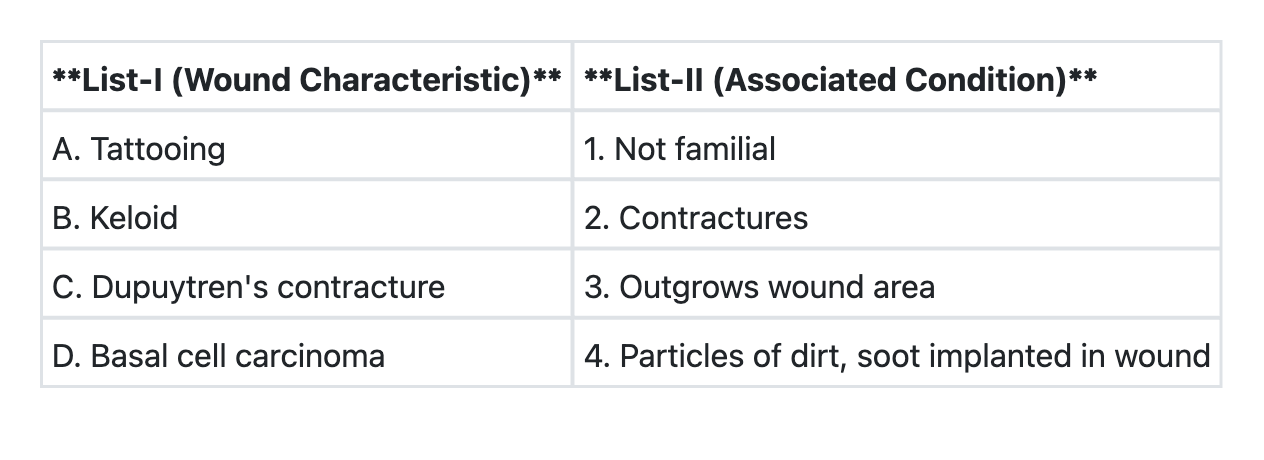
Match List-I with List-II and select the correct answer using the code given below the Lists: (Refer to the image for List-I and List-II)
Which of the following is the best indicator of prognosis of soft tissue sarcoma?
Lympho-venous anastomosis is done for
Which one of the following statements is not correct regarding thoracic outlet syndrome?
UPSC-CMS 2009 - Surgery UPSC-CMS Practice Questions and MCQs
Question 11: A patient presents to the emergency department with pain and distension of abdomen and absolute constipation. What is the investigation of choice ?
- A. Plain X-ray abdomen (Erect) (Correct Answer)
- B. Ultrasonography
- C. Barium meal follow-through
- D. Colonoscopy
Explanation: ***Plain X-ray abdomen (Erect)*** - An erect plain X-ray of the abdomen is the initial and often diagnostic investigation for **bowel obstruction**, revealing **dilated bowel loops** and **air-fluid levels**. - It helps confirm the presence of obstruction and can sometimes indicate its location and severity, though it does not provide information about the cause. *Ultrasonography* - While ultrasound can detect **bowel dilation** and **peristalsis**, it is limited in visualizing the entire bowel and cannot reliably differentiate between various causes of obstruction. - It is more useful for assessing **extraluminal pathology** or **fluid collections** but less effective as a primary diagnostic tool for bowel obstruction. *Barium meal follow-through* - This study involves oral **barium administration** and serial X-rays to visualize the small bowel, but it is **contraindicated** in suspected bowel obstruction due to the risk of exacerbating the obstruction or causing **barium impaction**. - Its primary role is in evaluating chronic or partial obstructions, or malabsorption, not acute presentations with complete obstruction. *Colonoscopy* - **Colonoscopy** is an invasive procedure primarily used for diagnosis and treatment of **colonic pathology**, such as polyps, strictures, or bleeding. - It is **contraindicated** in acute, complete bowel obstruction due to the risk of **perforation** and is not the initial diagnostic choice for acute abdominal pain and absolute constipation.
Question 12: What is the investigation of choice in a patient with blunt abdominal trauma with hematuria ?
- A. Ultrasonography of abdomen
- B. Intravenous urogram
- C. Contrast enhanced computed tomography (Correct Answer)
- D. Retrograde urogram
Explanation: ***Contrast enhanced computed tomography*** - **Ureteral and renal injuries** are best evaluated using **CT with intravenous contrast**, which offers detailed anatomical information. - In cases of **blunt abdominal trauma with hematuria**, **CT with contrast** is the imaging modality of choice to assess for injuries to the urinary tract. *Ultrasonography of abdomen* - While useful in some abdominal injuries, **ultrasonography** does not provide sufficient detail for precise evaluation of the **renal parenchyma, collecting system, or ureteral integrity** in trauma. - It is often used as an initial screening tool but less effective than CT for confirming and staging urinary tract injuries. *Intravenous urogram* - An **intravenous urogram (IVU)** can identify some urinary tract injuries but is **less sensitive and specific** than modern CT scans. - It also provides **less anatomical detail** of associated soft tissue and vascular injuries compared to CT. *Retrograde urogram* - A **retrograde urogram** primarily visualizes the **lower urinary tract** (ureters and bladder) by injecting contrast directly into the ureters. - It is **invasive** and not the first-line investigation for **blunt abdominal trauma with hematuria**, especially for evaluating the kidneys themselves.
Question 13: Which one of the following is the treatment of choice in a child with inguinal hernia ?
- A. Shouldice operation
- B. Lichtenstein repair
- C. Herniotomy alone (Correct Answer)
- D. Bassini's repair
Explanation: ***Herniotomy alone*** - In children, an **inguinal hernia** is typically an **indirect hernia** resulting from a persistent **patent processus vaginalis**. - **Herniotomy alone** (ligation and excision of the hernia sac) is sufficient because the posterior wall of the inguinal canal is usually strong and does not require reinforcement. *Shouldice operation* - The **Shouldice operation** is a **fascial repair** technique involving multiple layers of the posterior inguinal wall. - It is primarily used in **adults** for direct inguinal hernias or recurrent hernias, where the posterior wall is weakened. *Lichtenstein repair* - The **Lichtenstein repair** is a **tension-free mesh repair** method commonly performed in adults. - It involves placing a prosthetic mesh to reinforce the posterior wall of the inguinal canal, which is unnecessary and potentially problematic in growing children. *Bassini's repair* - **Bassini's repair** is a **tissue-based repair** that involves approximating the conjoined tendon to the inguinal ligament. - Like other adult repair techniques, it is associated with higher tension and risks of recurrence in adults due to underlying tissue weakness, and is not suitable for the physiological anatomy of a pediatric inguinal hernia.
Question 14: Match List-I with List-II and select the correct answer using the code given below the Lists: (Refer to the image for List-I and List-II)
- A. A→2 B→3 C→4 D→1
- B. A→3 B→4 C→1 D→2
- C. A→4 B→1 C→2 D→3 (Correct Answer)
- D. A→1 B→2 C→3 D→4
Explanation: ***A→4, B→1, C→2, D→3*** **Correct Matching:** **Tattooing (A) → Foreign particles like dirt, soot (4)** - Tattooing refers to permanent skin discoloration caused by **foreign pigment insertion** into the dermis - Commonly occurs accidentally after trauma with **dirt, soot, gunpowder, or other foreign particles** - The particles become embedded in the skin causing permanent discoloration **Keloid (B) → Outgrows boundaries of original wound (1)** - A keloid is a **prominent raised scar** that extends beyond the margins of the original injury - Results from excessive collagen deposition during abnormal wound healing - **Key feature**: Growth exceeds the boundaries of the original wound area **Dupuytren's contracture (C) → Contractures (2)** - Progressive fibrosis of the **palmar fascia** leading to finger contractures - Causes permanent flexion deformity, typically affecting the ring and little fingers - Results in functional limitation due to **contracture formation** **Basal cell carcinoma (D) → Not familial (3)** - Most common skin malignancy, typically **sporadic** rather than familial - Associated with UV exposure, fair skin, and immunosuppression - Unlike some other cancers, **typically not inherited** in familial patterns *Incorrect Options:* *A→2, B→3, C→4, D→1* - Incorrectly matches tattooing with contractures and Dupuytren's with foreign particles *A→3, B→4, C→1, D→2* - Incorrectly matches tattooing with non-familial trait and keloid with foreign particles *A→1, B→2, C→3, D→4* - Incorrectly matches tattooing with outgrowing boundaries and basal cell carcinoma with foreign particles
Question 15: Which of the following is the best indicator of prognosis of soft tissue sarcoma?
- A. Tumour size
- B. Nodal metastasis
- C. Histological type
- D. Tumour grade (Correct Answer)
Explanation: ***Tumour grade*** - **Tumor grade** quantifies the degree of cellular differentiation, mitotic activity, and necrosis within the tumor, reflecting its aggressive potential. - A **higher tumor grade** is directly associated with a poorer prognosis, increased risk of local recurrence, and distant metastasis in soft tissue sarcomas. *Tumour size* - While larger tumor size (e.g., >5 cm) is generally associated with a worse prognosis, it is primarily a factor in **staging**, not the most critical prognostic indicator. - **Tumor grade** provides more fundamental information about the biological aggressiveness of the tumor cells regardless of their current size. *Nodal metastasis* - **Nodal metastasis** in soft tissue sarcomas is relatively uncommon (less than 5% of cases) compared to carcinomas, and its presence is a significant negative prognostic factor. - However, because it is rare, it doesn't serve as the *primary* indicator for the majority of sarcoma patients, where tumor grade is more universally applicable. *Histological type* - The **histological type** (e.g., liposarcoma, leiomyosarcoma) helps classify the sarcoma, but different subtypes can have a wide range of biological behavior. - While certain types may have a generally better or worse prognosis, the **grade** *within* that histological type is a more precise predictor of individual patient outcomes.
Question 16: Lympho-venous anastomosis is done for
- A. Cystic hygroma
- B. Malignant lymphoedema
- C. Lymphoid cyst
- D. Filarial lymphoedema (Correct Answer)
Explanation: ***Filarial lymphoedema*** - **Lympho-venous anastomosis (LVA)** is a microsurgical technique used to bypass damaged lymphatic vessels and directly connect lymphatic channels to small veins. This procedure is primarily effective in treating **lymphedema due to lymphatic obstruction**, such as that caused by filarial infection. - In **filarial lymphoedema**, the lymphatic obstruction leads to accumulation of lymph fluid. LVA helps to restore lymphatic drainage, reducing limb swelling and improving symptoms, particularly in the early stages of the disease. *Cystic hygroma* - A **cystic hygroma** is a congenital lymphatic malformation, typically treated by surgical excision, sclerotherapy, or laser ablation. - It involves abnormally dilated lymphatic spaces and doesn't usually benefit from LVA, as the primary issue is malformation rather than obstruction requiring a bypass. *Malignant lymphoedema* - **Malignant lymphoedema** (secondary to cancer or its treatment) is often complicated by active tumor burden, radiation fibrosis, or extensive nodal involvement. - While LVA might be considered in carefully selected cases, its efficacy can be limited due to underlying cancer and the diffuse nature of the lymphatic damage, making it a less common primary indication compared to filarial lymphedema. *Lymphoid cyst* - A **lymphoid cyst** is a localized collection of lymph, often treated by aspiration, sclerotherapy, or surgical excision. - It is not a widespread lymphatic drainage disorder that would necessitate a bypass procedure like lympho-venous anastomosis.
Question 17: Which one of the following statements is not correct regarding thoracic outlet syndrome?
- A. Resection of First rib is effective treatment
- B. It is associated with Horner's syndrome
- C. Radial nerve is involved (Correct Answer)
- D. It is a rare condition
Explanation: ***Radial nerve is involved*** - Thoracic outlet syndrome (TOS) primarily involves compression of the **brachial plexus** (specifically the lower trunk C8-T1), subclavian artery, or subclavian vein. - The **radial nerve** is derived from the posterior cord (C5-T1) of the brachial plexus, but the classic presentation of TOS does not typically involve isolated or predominant radial nerve symptoms. Instead, TOS symptoms more commonly affect the **ulnar nerve distribution** (C8-T1) due to compression of the lower trunk of the brachial plexus. *Resection of First rib is effective treatment* - **First rib resection** is a well-established surgical treatment option for thoracic outlet syndrome, aiming to decompress the neurovascular structures. - This procedure alleviates pressure on the **brachial plexus** and **subclavian vessels**, leading to symptom improvement in many patients. *It is associated with Horner's syndrome* - **Horner's syndrome** can be associated with thoracic outlet pathology, particularly tumors like **Pancoast tumors**, which can compress the sympathetic chain at the thoracic outlet. - While not a direct feature of typical TOS, conditions affecting the thoracic outlet region can impact the **cervical sympathetic ganglion** leading to Horner's syndrome (ptosis, miosis, anhidrosis). *It is a rare condition* - Thoracic outlet syndrome is generally considered a **relatively rare condition**, although its true incidence might be underestimated due to diagnostic challenges. - It is often a diagnosis of exclusion, requiring careful clinical evaluation and imaging to rule out other causes of **neck, shoulder, and arm pain**.