Biochemistry
2 questionsThe milk of which of the following contains the least amount of calcium?
Among the following, which has the highest quantity of retinol (Vitamin A) activity per 100 g of fruit?
UPSC-CMS 2009 - Biochemistry UPSC-CMS Practice Questions and MCQs
Question 71: The milk of which of the following contains the least amount of calcium?
- A. Cow
- B. Buffalo
- C. Human (Correct Answer)
- D. Goat
Explanation: ***Human*** - **Human breast milk** contains the lowest concentration of calcium compared to the milk of other mammals listed. - This is physiologically appropriate as infants absorb calcium very efficiently from human milk, and higher concentrations are not necessary. *Cow* - **Cow's milk** has a significantly higher calcium content than human milk, which is suitable for the rapid growth of calf bones. - The **calcium-to-phosphorus ratio** in cow's milk is also different, which can affect absorption and metabolism in infants. *Buffalo* - **Buffalo milk** generally has an even higher calcium content than cow's milk. - It is known for its **richness in nutrients** and higher fat and protein content, contributing to its denser consistency. *Goat* - **Goat's milk** has a calcium content that is higher than human milk, though often slightly less than cow's milk. - Its calcium is absorbed relatively well, but its overall composition is still very different from human milk, particularly in terms of **protein and micronutrient balance**.
Question 72: Among the following, which has the highest quantity of retinol (Vitamin A) activity per 100 g of fruit?
- A. Papaya
- B. Tomato
- C. Ripe Mango (Correct Answer)
- D. Orange
Explanation: ***Ripe Mango*** - **Ripe mangoes** are an excellent source of **beta-carotene**, which the body converts into **retinol (Vitamin A)**. - They contain approximately **1,262 µg retinol activity equivalents (RAE)** per 100 g, which is significantly higher than the other options listed. - While fruits contain provitamin A carotenoids rather than preformed retinol, mangoes provide the highest **Vitamin A activity** among these choices. *Papaya* - While papaya does contain **beta-carotene**, its concentration is much lower (approximately **47 µg RAE/100 g**). - It is a good source of Vitamin C and other antioxidants, but not the leading source of Vitamin A among these fruits. *Tomato* - Tomatoes are rich in **lycopene**, another carotenoid, but it is not converted to **retinol** as beta-carotene is. - They have low overall **Vitamin A activity** (approximately **42 µg RAE/100 g**) compared to mangoes. *Orange* - Oranges are primarily known for their high content of **Vitamin C** and are poor sources of **Vitamin A**. - Their Vitamin A activity is minimal (approximately **11 µg RAE/100 g**), with primary carotenoids being **beta-cryptoxanthin** and **zeaxanthin**, which contribute less to Vitamin A activity.
Community Medicine
6 questionsFor a screening test, 90% specificity means that 90% of non-diseased persons will give a
Berksonian bias is a selection bias which occurs in
According to International Health Regulations, there is no risk of spread of yellow fever if the Aedes aegypti index is kept at
During the process of chlorination of water, the disinfecting action of chlorine is due to the formation of
Kata thermometer is used for recording :
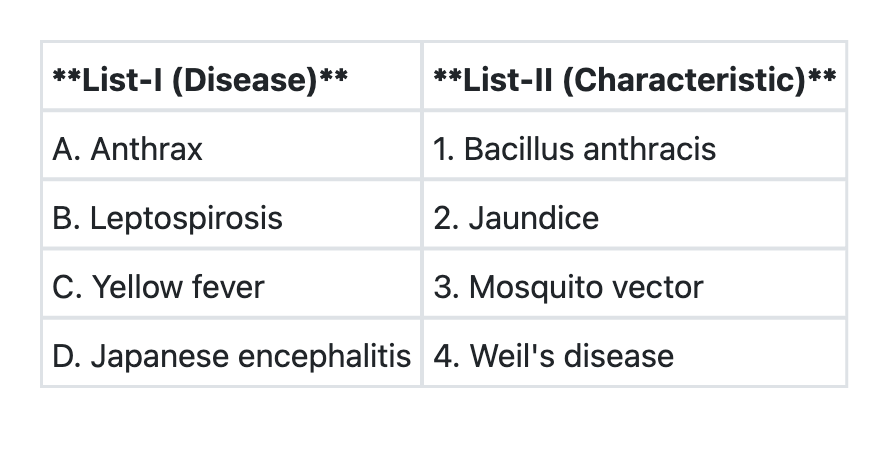
Match List-I with List-II and select the correct answer using the code given below the Lists:
UPSC-CMS 2009 - Community Medicine UPSC-CMS Practice Questions and MCQs
Question 71: For a screening test, 90% specificity means that 90% of non-diseased persons will give a
- A. False negative result
- B. True positive result
- C. True negative result (Correct Answer)
- D. False positive result
Explanation: ***True negative result*** - **Specificity** is defined as the proportion of **true negatives** among individuals **without the disease**. - A 90% specificity means that 90% of healthy individuals will correctly test negative for the disease. *False negative result* - A **false negative** occurs when a diseased person tests negative, which is related to the concept of **sensitivity**, not specificity. - This would imply missing actual cases of the disease. *True positive result* - A **true positive** occurs when a diseased person tests positive, which is also related to **sensitivity**. - This indicates accurate detection of the disease in affected individuals. *False positive result* - A **false positive** occurs when a non-diseased person inappropriately tests positive. - If 90% of non-diseased persons give a negative result (true negative), then 10% would give a **false positive result**.
Question 72: Berksonian bias is a selection bias which occurs in
- A. Hospital based studies (Correct Answer)
- B. Natural exposure studies
- C. Community based studies
- D. Laboratory based studies
Explanation: ***Hospital based studies*** - **Berksonian bias** is a type of **selection bias** that occurs when the study population is drawn from a hospital or clinical setting. - This can lead to an artificially inflated or deflated association between risk factors and diseases, as hospital patients often have multiple health conditions or risk factors not representative of the general population. *Natural exposure studies* - These studies observe populations exposed to a factor naturally, without intervention, and are less prone to selection bias related to hospital admission. - While other biases can occur, **Berksonian bias** specifically relates to admission criteria for healthcare facilities. *Community based studies* - **Community-based studies** aim to recruit participants from the general population, making them less susceptible to **Berksonian bias** compared to hospital-based studies. - They strive for a more representative sample, reducing the selection pressures seen in clinical settings. *Laboratory based studies* - **Laboratory studies** typically use controlled environments and experimental designs, often involving cell cultures or animal models. - They are generally not subject to **Berksonian bias**, which is specific to human population studies drawing from clinical settings.
Question 73: According to International Health Regulations, there is no risk of spread of yellow fever if the Aedes aegypti index is kept at
- A. 2-4%
- B. 5-7%
- C. 8-10%
- D. below 1% (Correct Answer)
Explanation: ***below 1%*** - The **International Health Regulations (IHR)** specify that a **house index** (percentage of houses infested with *Aedes aegypti* larvae) of **below 1%** is considered sufficient to prevent the spread of yellow fever. - Maintaining this low index is crucial for controlling potential outbreaks in endemic or receptive areas. *2-4%* - An *Aedes aegypti* index in this range (2-4%) indicates a **moderate risk** of yellow fever transmission, as the vector population is still significant enough to facilitate spread. - This level is **above the recommended threshold** for effective prevention according to IHR. *5-7%* - An index between 5-7% signifies an **elevated risk** of yellow fever transmission, indicating a substantial presence of the vector population. - At this level, there is a **high probability** of ongoing or impending disease outbreaks. *8-10%* - An *Aedes aegypti* index of 8-10% represents a **very high risk** of yellow fever spread, suggesting an widespread vector presence. - This range indicates a **strong potential for rapid and extensive disease transmission**.
Question 74: During the process of chlorination of water, the disinfecting action of chlorine is due to the formation of
- A. Hypochlorous acid and hypochlorite ions (Correct Answer)
- B. Chlorine gas only
- C. Hydrochloric acid only
- D. Hypochlorous acid only
Explanation: ***Hypochlorous acid and hypochlorite ions*** - When **chlorine gas** (Cl2) is added to water, it rapidly reacts to form **hypochlorous acid (HOCl)** and **hydrochloric acid (HCl)**. - Hypochlorous acid then partially dissociates into **hypochlorite ions (OCl-)** depending on the pH of the water; both HOCl and OCl- are potent disinfectants, with HOCl being 80-100 times more effective. *Chlorine gas only* - While chlorine gas is the starting material for chlorination, it is not the primary disinfectant in water. - Chlorine gas reacts with water to form other active disinfectant compounds; it does not directly act as a disinfectant at significant levels in water treatment. *Hydrochloric acid only* - **Hydrochloric acid (HCl)** is a byproduct of the reaction of chlorine with water, but it is not the active disinfecting agent. - HCl contributes to the lowering of pH but does not possess the strong antimicrobial properties of hypochlorous acid or hypochlorite ions. *Hypochlorous acid only* - **Hypochlorous acid (HOCl)** is indeed a very strong disinfectant and a critical component of water chlorination. - However, in typical water treatment pH ranges, a significant proportion of HOCl also dissociates into **hypochlorite ions (OCl-)**, which also contribute to the disinfecting action, making the combined effect the primary mechanism.
Question 75: Kata thermometer is used for recording :
- A. Relative humidity of the air
- B. Mean radiant temperature
- C. Low air velocities (Correct Answer)
- D. Maximum and minimum temperature
Explanation: ***Low air velocities*** - A **Kata thermometer** is a specialized alcohol thermometer designed to measure **cooling power** and **air velocity** in various environments. - It works by being heated to a specific temperature and then measuring the time it takes to cool down, which is influenced by air movement. *Relative humidity of the air* - **Relative humidity** is typically measured using a **psychrometer** (a wet-bulb and dry-bulb thermometer) or a **hygrometer**. - The Kata thermometer does not directly measure humidity; rather, humidity can indirectly influence its cooling rate. *Mean radiant temperature* - **Mean radiant temperature** is measured using a **globe thermometer**, which uses a temperature sensor inside a black globe. - The Kata thermometer is not designed for this purpose, as it primarily assesses air movement and cooling power. *Maximum and minimum temperature* - **Maximum and minimum temperatures** are typically recorded by a **Six's thermometer** or conventional mercury/alcohol thermometers. - While a Kata thermometer has a temperature scale, its primary use is not for simple maximum/minimum readings but for measuring air velocity and cooling.
Question 76: Match List-I with List-II and select the correct answer using the code given below the Lists:
- A. A→1 B→4 C→2 D→3
- B. A→1 B→2 C→4 D→3 (Correct Answer)
- C. A→4 B→3 C→2 D→1
- D. A→1 B→2 C→3 D→4
Explanation: ***A→1 B→2 C→4 D→3*** - This option correctly matches each disease with its primary characteristic: **Anthrax** is caused by *Bacillus anthracis*, **Leptospirosis** is known as **Weil's disease** (in its severe form), **Yellow fever** causes **jaundice** (hence the name "yellow"), and **Japanese encephalitis** is transmitted by **mosquito vector** (Culex species). - All pairings are medically accurate and represent the most distinctive features of each disease. *A→1 B→4 C→2 D→3* - While it correctly links **Anthrax** to *Bacillus anthracis* and **Japanese encephalitis** to **mosquito vector**, it makes critical errors with the middle two diseases. - **B→4** incorrectly pairs **Leptospirosis** with **jaundice** - while jaundice can occur in severe leptospirosis, this is not its defining characteristic or eponym (that would be Weil's disease). - **C→2** incorrectly pairs **Yellow fever** with **Weil's disease** - these are completely unrelated; Yellow fever is a flavivirus infection characterized by jaundice, not Weil's disease (which is leptospirosis). *A→4 B→3 C→2 D→1* - This option contains multiple fundamental errors in disease-characteristic matching. - **A→4** incorrectly pairs **Anthrax** with **jaundice** - Anthrax typically presents with cutaneous lesions (eschar), pulmonary, or GI symptoms, not jaundice. - **B→3** incorrectly pairs **Leptospirosis** with **mosquito vector** - Leptospirosis is transmitted through contact with water/soil contaminated with infected animal urine, not by mosquitoes. - The other pairings are also incorrect, making this option entirely wrong. *A→1 B→2 C→3 D→4* - This option correctly links **Anthrax** to *Bacillus anthracis* and **Leptospirosis** to **Weil's disease**, but makes errors in the last two pairings. - **C→3** incorrectly pairs **Yellow fever** with **mosquito vector** - while Yellow fever IS transmitted by mosquitoes (Aedes aegypti), this ignores that option 3 should go with Japanese encephalitis, and Yellow fever's most distinctive feature is jaundice (option 4). - **D→4** incorrectly pairs **Japanese encephalitis** with **jaundice** - JE is a neurological infection without jaundice as a primary feature.
Obstetrics and Gynecology
2 questionsVaccines that can be safely given during pregnancy are the following except
Which of the following is not an absolute contraindication for insertion of intrauterine device (IUD) ?
UPSC-CMS 2009 - Obstetrics and Gynecology UPSC-CMS Practice Questions and MCQs
Question 71: Vaccines that can be safely given during pregnancy are the following except
- A. Rubella (Correct Answer)
- B. Influenza
- C. Pneumococcus
- D. Tetanus
Explanation: ***Rubella*** - The **rubella vaccine** is a **live attenuated vaccine** and is **contraindicated in pregnancy** due to the theoretical risk of congenital rubella syndrome, although no cases have been reported from vaccination during pregnancy. - Women should be vaccinated *before* pregnancy or postpartum, and advised to avoid conception for at least four weeks after vaccination. *Influenza* - The **inactivated influenza vaccine** is highly recommended during **any trimester of pregnancy** to protect both the mother and the newborn from severe influenza-related complications. - Pregnancy alters the immune system and cardiopulmonary function, increasing the risk of severe illness from influenza. *Pneumococcus* - The **pneumococcal polysaccharide vaccine (PPSV23)** and **pneumococcal conjugate vaccine (PCV13)** are considered **safe for pregnant women** who meet the indications for vaccination (e.g., chronic medical conditions). - These vaccines provide protection against serious invasive pneumococcal diseases. *Tetanus* - The **tetanus toxoid, reduced diphtheria toxoid, and acellular pertussis (Tdap) vaccine** is **recommended during each pregnancy**, preferably between 27 and 36 weeks gestation. - It provides critical protection against **pertussis** for the newborn and tetanus immunity for the mother.
Question 72: Which of the following is not an absolute contraindication for insertion of intrauterine device (IUD) ?
- A. Severe dysmenorrhea (Correct Answer)
- B. Puerperal sepsis
- C. Pelvic tuberculosis
- D. Endometrial cancer
Explanation: ***Severe dysmenorrhea*** - While IUDs (especially copper IUDs) can exacerbate **dysmenorrhea** and **menorrhagia** in some women, it is not an absolute contraindication for insertion. Progestin-releasing IUDs can even improve dysmenorrhea. - The decision to insert an IUD in a patient with severe dysmenorrhea requires careful consideration of the **type of IUD** and potential benefits versus risks, but it is not an outright medical barrier. *Puerperal sepsis* - **Puerperal sepsis** indicates an active infection of the genital tract following childbirth. - Inserting an IUD into an infected uterus carries a high risk of worsening the infection, potentially leading to **septic shock** or **pelvic inflammatory disease (PID)**. *Pelvic tuberculosis* - **Pelvic tuberculosis** is a chronic inflammatory infection of the reproductive organs. - The presence of active pelvic tuberculosis makes the uterus and surrounding tissues highly susceptible to further infection or exacerbation of the existing disease with IUD insertion, leading to severe complications and **abscess formation**. *Endometrial cancer* - **Endometrial cancer** is a malignancy of the uterine lining. - Inserting an IUD into a uterus with cancer could potentially **disseminate cancer cells**, complicate treatment, or mask the progression of the disease.