Obstetrics and Gynecology
9 questionsThe "fern pattern" of cervical mucus seen in the first half of menstrual cycle is because of
Match the diseases in List-I with their respective incubation periods in List-II and select the correct answer using the code given below:
Polycystic ovarian syndrome is associated with the following except
Match List-I with List-II and select the correct answer using the code given below the Lists:

Match List-I with List-II and select the correct answer using the code given below the Lists:

The most appropriate management of a 32 weeks pregnant lady with carcinoma cervix stage IIb is.
Safe period is calculated by
Which of the following is not related to the use of Levonorgestrel releasing intra-uterine contraceptive device ?
Combined oral pills protect the woman against all except
UPSC-CMS 2009 - Obstetrics and Gynecology UPSC-CMS Practice Questions and MCQs
Question 51: The "fern pattern" of cervical mucus seen in the first half of menstrual cycle is because of
- A. Low mucoprotein level (Correct Answer)
- B. Low sodium chloride level
- C. High sodium chloride level
- D. High mucoprotein level
Explanation: ***Low mucoprotein level*** - The **fern pattern** is formed by the crystallization of **sodium chloride** in the presence of **estrogen** and a relatively **low mucoprotein content** in cervical mucus. - During the proliferative phase, high estrogen levels increase the fluid and electrolyte content relative to mucoproteins, facilitating this distinct crystallization. - **Key concept**: While both high NaCl and low mucoprotein are present, it is the **low mucoprotein** that is the distinguishing factor allowing crystallization to occur. *Low sodium chloride level* - A low sodium chloride level would lead to **less crystallization**, not the characteristic fern pattern. - The presence of sodium chloride is crucial for forming the crystalline structure. *High sodium chloride level* - While sodium chloride is indeed **elevated during the follicular phase** and necessary for ferning, this alone is not the defining reason for the fern pattern. - Sodium chloride is present throughout the menstrual cycle; the key factor is the **reduced mucoprotein** that allows unimpeded crystallization. - Both high NaCl AND low mucoprotein work together, but the **low mucoprotein is the distinguishing feature** that permits the crystallization to manifest as ferning. *High mucoprotein level* - A high mucoprotein level would **interfere with the crystallization** of sodium chloride, preventing the formation of a clear fern pattern. - This occurs during the luteal phase when progesterone increases mucoproteins, inhibiting ferning.
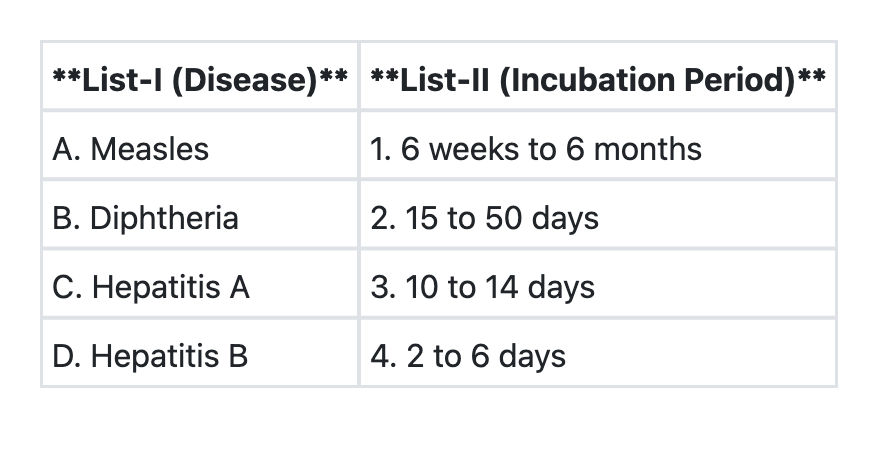
Question 52: Match the diseases in List-I with their respective incubation periods in List-II and select the correct answer using the code given below:
- A. A→4 B→3 C→2 D→1
- B. A→1 B→4 C→3 D→2
- C. A→1 B→2 C→3 D→4 (Correct Answer)
- D. A→3 B→4 C→2 D→1
Explanation: ***A→1 B→2 C→3 D→4*** - This option correctly matches **Measles (A)** with **10-14 days (1)**, which is the accurate incubation period for this **paramyxovirus infection**. - It properly pairs **Diphtheria (B)** with **2-6 days (2)**, reflecting the typical incubation period for **Corynebacterium diphtheriae**. - **Hepatitis A (C)** is correctly matched with **15-50 days (3)**, consistent with the incubation period of this **hepatotropic picornavirus**. - **Hepatitis B (D)** is correctly matched with **6 weeks-6 months (4)**, reflecting the prolonged incubation period of this **hepadnavirus**. *A→3 B→4 C→2 D→1* - This option incorrectly assigns **Measles** to **15-50 days**, which is far too long for this **viral exanthem** that typically manifests within **10-14 days**. - It also mismatches **Diphtheria** with **6 weeks-6 months**, when this **bacterial infection** has a much shorter incubation period of **2-6 days**. *A→4 B→3 C→2 D→1* - This option incorrectly assigns **Measles** to **6 weeks-6 months**, which is excessively long for this **acute viral infection**. - It also misplaces **Hepatitis A** to **2-6 days**, when its actual incubation period is much longer at **15-50 days**. *A→1 B→4 C→3 D→2* - This option correctly matches **Measles** with **10-14 days** but incorrectly assigns **Diphtheria** to **6 weeks-6 months** instead of the correct **2-6 days**. - It also mismatches **Hepatitis B** to **2-6 days**, when it actually has a much longer incubation period of **6 weeks-6 months**.
Question 53: Polycystic ovarian syndrome is associated with the following except
- A. Obesity
- B. Infertility
- C. Endometrial hyperplasia
- D. Ovarian carcinoma (Correct Answer)
Explanation: ***Ovarian carcinoma*** - While polycystic ovarian syndrome (PCOS) increases the risk of **endometrial hyperplasia** and subsequently **endometrial carcinoma** due to unopposed estrogen, it is **not directly associated with an increased risk of ovarian carcinoma**. - Ovarian carcinoma is a distinct entity with different risk factors, and PCOS does not typically predispose to it. *Obesity* - **Obesity**, particularly central obesity, is highly prevalent in women with PCOS, affecting many metabolic and hormonal aspects of the syndrome. - It contributes to **insulin resistance**, which is a key feature of PCOS and exacerbates its symptoms. *Infertility* - **Anovulation** or oligo-ovulation, a hallmark of PCOS, directly leads to **infertility** in many affected women. - The hormonal imbalances in PCOS interfere with normal follicular development and ovulation. *Endometrial hyperplasia* - The **unopposed estrogen stimulation** resulting from chronic anovulation in PCOS leads to continuous endometrial proliferation without regular shedding. - This persistent stimulation increases the risk of developing **endometrial hyperplasia**, which can be a precursor to endometrial carcinoma.
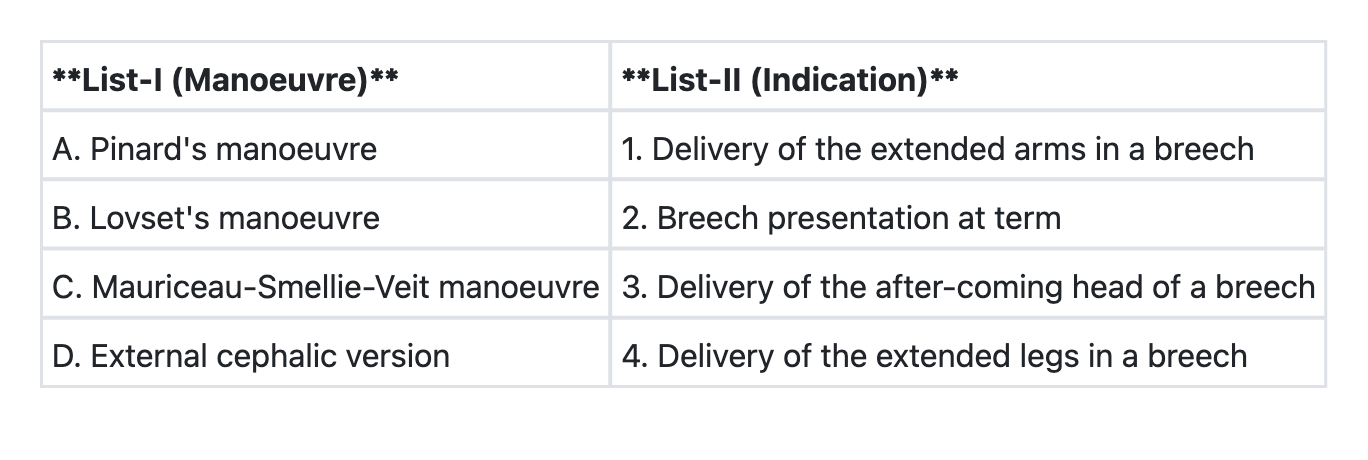
Question 54: Match List-I with List-II and select the correct answer using the code given below the Lists:
- A. A→1 B→2 C→3 D→4
- B. A→4 B→3 C→2 D→1 (Correct Answer)
- C. A→3 B→4 C→1 D→2
- D. A→4 B→1 C→2 D→3
Explanation: **List Mapping:** - List-I: A = Pinard's maneuver, B = Lovset's maneuver, C = Mauriceau-Smellie-Veit maneuver, D = External cephalic version - List-II: 1 = Breech presentation at term, 2 = After-coming head, 3 = Extended arms, 4 = Extended legs ***A→4 B→3 C→2 D→1*** - This is the **correct matching** of each maneuver to its primary indication. - **Pinard's maneuver (A→4)** is used for delivery of **extended legs** in breech presentation by flexing the legs at the knee. - **Lovset's maneuver (B→3)** is used for delivery of **extended arms** in breech by rotating the fetus. - **Mauriceau-Smellie-Veit maneuver (C→2)** is used for controlled delivery of the **after-coming head** in breech. - **External cephalic version (D→1)** is performed to convert **breech presentation at term** to cephalic presentation. *A→1 B→2 C→3 D→4* - This incorrectly matches Pinard's maneuver with breech at term (should be a conversion procedure, not delivery technique). - Lovset's is incorrectly matched with after-coming head instead of extended arms. - Mauriceau-Smellie-Veit is incorrectly matched with extended arms instead of after-coming head. - External cephalic version is incorrectly matched with extended legs instead of breech at term. *A→3 B→4 C→1 D→2* - This incorrectly matches Pinard's with extended arms (Lovset's indication). - Lovset's is incorrectly matched with extended legs (Pinard's indication). - Mauriceau-Smellie-Veit is incorrectly matched with breech at term (ECV indication). - External cephalic version is incorrectly matched with after-coming head (Mauriceau-Smellie-Veit indication). *A→4 B→1 C→2 D→3* - While Pinard's maneuver (A→4) is correctly matched with extended legs, the other matches are incorrect. - Lovset's is incorrectly matched with breech at term instead of extended arms. - External cephalic version is incorrectly matched with extended arms instead of breech at term. - Only Mauriceau-Smellie-Veit (C→2) is correctly matched with after-coming head.
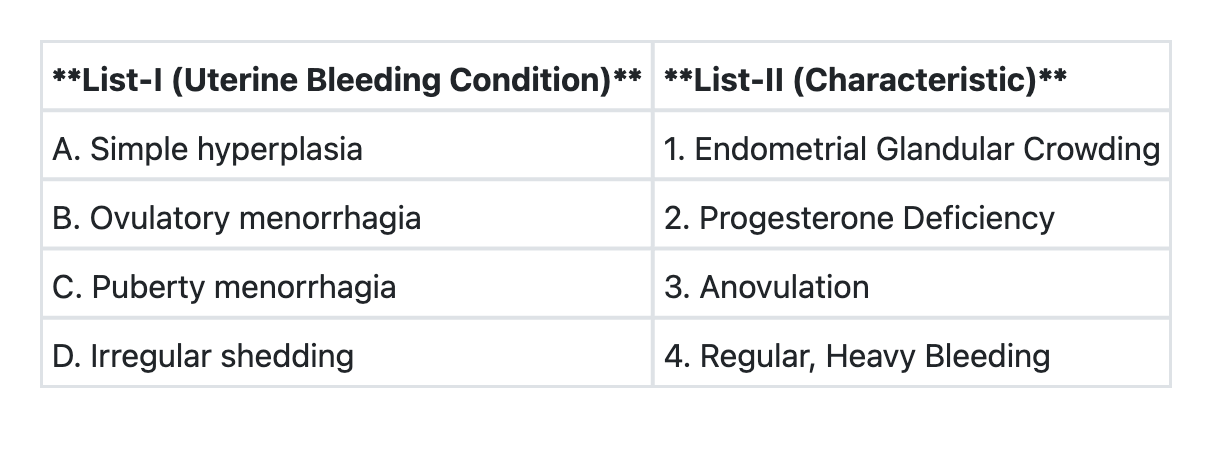
Question 55: Match List-I with List-II and select the correct answer using the code given below the Lists:
- A. A→1 B→2 C→3 D→4
- B. A→2 B→1 C→4 D→3
- C. A→3 B→4 C→1 D→2 (Correct Answer)
- D. A→4 B→3 C→2 D→1
Explanation: ***A→3 B→4 C→1 D→2*** **Correct Matching:** - **A. Simple hyperplasia → 3. Estrogen stimulation**: Simple (cystic) hyperplasia results from **continuous estrogen stimulation without sufficient progesterone opposition**. Unopposed estrogen leads to endometrial proliferation and glandular changes. - **B. Ovulatory menorrhagia → 4. Regular, heavy bleeding**: Ovulatory menorrhagia represents **regular, cyclical heavy menstrual bleeding** where ovulation occurs normally, implying intact hypothalamic-pituitary-ovarian axis with normal hormonal cyclicity but excessive blood loss (>80 mL per cycle). - **C. Puberty menorrhagia → 1. Anovulation**: Puberty menorrhagia is frequently linked to **anovulation** in adolescent girls due to immature hypothalamic-pituitary-ovarian axis. This leads to unopposed estrogen, irregular endometrial buildup, and erratic shedding. - **D. Irregular shedding → 2. Progesterone deficiency**: Irregular shedding results from **inadequate progesterone** in the luteal phase, causing incomplete and prolonged breakdown of the secretory endometrium over 7-14 days instead of organized menstruation. *Incorrect Option A→1 B→2 C→3 D→4* - Incorrectly links simple hyperplasia to anovulation (simple hyperplasia is primarily due to estrogen stimulation) - Incorrectly links ovulatory menorrhagia to progesterone deficiency (ovulatory cycles have adequate progesterone by definition) - Incorrectly links puberty menorrhagia to estrogen stimulation (the mechanism is anovulation leading to unopposed estrogen) - Incorrectly links irregular shedding to regular heavy bleeding (irregular shedding involves prolonged, irregular bleeding) *Incorrect Option A→2 B→1 C→4 D→3* - Incorrectly links simple hyperplasia to progesterone deficiency (while related, the primary cause is estrogen stimulation) - Incorrectly links ovulatory menorrhagia to anovulation (these are contradictory - ovulatory means ovulation is occurring) - Incorrectly links puberty menorrhagia to regular heavy bleeding (puberty menorrhagia is typically irregular due to anovulation) - Incorrectly links irregular shedding to estrogen stimulation (irregular shedding is specifically due to progesterone deficiency) *Incorrect Option A→4 B→3 C→2 D→1* - Incorrectly links simple hyperplasia to regular heavy bleeding (simple hyperplasia may cause irregular bleeding, not regular) - Incorrectly links ovulatory menorrhagia to estrogen stimulation (ovulatory menorrhagia has normal hormonal balance with both estrogen and progesterone) - Incorrectly links puberty menorrhagia to progesterone deficiency (the root cause is anovulation, which then leads to hormone imbalance) - Incorrectly links irregular shedding to anovulation (irregular shedding occurs despite ovulation, due to inadequate progesterone)
Question 56: The most appropriate management of a 32 weeks pregnant lady with carcinoma cervix stage IIb is.
- A. Observation and follow-up
- B. Chemo-radiation followed by labour induction and vaginal delivery
- C. Labour induction, vaginal delivery followed by radio-therapy
- D. Cesarean delivery followed by chemoradiation (Correct Answer)
Explanation: ***Cesarean delivery followed by chemoradiation*** - For **stage IIb carcinoma cervix** at 32 weeks gestation, **cesarean delivery** is the safest option to deliver the baby while avoiding trauma to the tumor and potential dissemination. - Subsequently, **chemoradiation** is the standard treatment for stage IIb cervical cancer, ensuring optimal maternal oncologic outcome. *Observation and follow-up* - This approach is **inappropriate** for stage IIb cervical cancer in pregnancy, as it delays definitive treatment and allows for disease progression. - Such an aggressive cancer requires **prompt intervention** for the best maternal prognosis. *Chemo-radiation followed by labour induction and vaginal delivery* - **Chemoradiation during pregnancy** is harmful to the fetus, especially beyond the first trimester. - A **vaginal delivery** in the presence of cervical cancer carries a high risk of hemorrhage and tumor dissemination, making it contraindicated. *Labour induction, vaginal delivery followed by radio-therapy* - **Labour induction and vaginal delivery** are contraindicated due to risks of hemorrhage, tumor spread, and potential obstruction from the tumor. - While radiotherapy would follow, the mode of delivery poses significant risks to the mother.
Question 57: Safe period is calculated by
- A. Length of luteal phase
- B. Length of menstrual cycle (Correct Answer)
- C. Date of ovulation
- D. Duration of menstrual flow
Explanation: ***Length of menstrual cycle*** - The **"safe period"** or **rhythm method** of contraception relies on estimating the fertile window by tracking the length of the menstrual cycle. - Ovulation typically occurs around day 14 of a 28-day cycle, and the fertile window includes the days leading up to and immediately after ovulation, which is determined by the overall cycle length. *Length of luteal phase* - The **luteal phase** is relatively constant in most women, lasting about **14 days**, irrespective of the overall cycle length. - While it's part of the menstrual cycle, its length alone does not provide enough information to calculate the fertile window for overall "safe period" estimation. *Date of ovulation* - The **date of ovulation** is a crucial component in determining the fertile window but is a specific point within the cycle, not the overall calculation method for the "safe period." - Methods to predict ovulation (e.g., basal body temperature, ovulation predictor kits) help identify the fertile window but are not how the cyclic "safe period" is initially calculated for planning purposes. *Duration of menstrual flow* - The **duration of menstrual flow** (usually 3-7 days) is highly variable among individuals and has no direct correlation with the timing of ovulation or the fertile window. - It marks the beginning of a new cycle but does not help in identifying the fertile days for natural family planning.
Question 58: Which of the following is not related to the use of Levonorgestrel releasing intra-uterine contraceptive device ?
- A. Reduction of pain and dysmenorrhoea in endometriosis and adenomyosis
- B. Amenorrhoea in 50% of cases
- C. Inhibition of ovulation (Correct Answer)
- D. Reduction of blood loss
Explanation: ***Inhibition of ovulation*** - Levonorgestrel-releasing IUDs primarily act by thickening cervical mucus, thinning the **endometrium**, and creating a local inflammatory reaction that impairs sperm viability and fertilization. - While some systemic absorption of levonorgestrel occurs, it is generally **insufficient to consistently inhibit ovulation**, unlike higher-dose hormonal contraceptives. *Reduction of pain and dysmenorrhoea in endometriosis and adenomyosis* - The **local release of levonorgestrel** directly in the uterus helps to thin the endometrial lining, reducing prostaglandin production and mitigating pain associated with conditions like endometriosis and adenomyosis. - This local hormonal effect suppresses the growth of ectopic endometrial tissue and decreases uterine contractions, leading to a significant reduction in pain. *Amenorrhoea in 50% of cases* - The **endometrial thinning** caused by continuous levonorgestrel release often leads to a significant decrease in menstrual bleeding, and in about 50% of users, this results in complete amenorrhoea over time. - This effect is beneficial for women with heavy menstrual bleeding or dysmenorrhoea. *Reduction of blood loss* - Levonorgestrel-releasing IUDs are well-known for their efficacy in treating **heavy menstrual bleeding (menorrhagia)**. - The progestin causes significant atrophy and thinning of the endometrium, reducing the amount of tissue shed during menstruation and thus **decreasing blood loss**.
Question 59: Combined oral pills protect the woman against all except
- A. Pelvic inflammatory disease
- B. Venous thromboembolism (Correct Answer)
- C. Benign breast disease
- D. Menorrhagia
Explanation: ***Venous thromboembolism*** - Combined oral contraceptives (COCs) contain estrogen, which increases the synthesis of **coagulation factors**, elevating the risk of **venous thromboembolism (VTE)**. - While the absolute risk is low, it is a known serious side effect and COCs do not protect against it; rather, they can increase its likelihood. *Pelvic inflammatory disease* - **Combined oral pills** can reduce the risk of **pelvic inflammatory disease (PID)** by thickening cervical mucus, which acts as a barrier to ascending infections. - They also decrease menstrual flow and endometrial proliferation, making the uterus less hospitable to infection. *Benign breast disease* - Combined oral contraceptives have been shown to **reduce the incidence of benign breast diseases**, such as fibrocystic changes and fibroadenomas. - This protective effect is thought to be related to the hormonal regulation provided by the pills. *Menorrhagia* - COCs are commonly used to treat **menorrhagia (heavy menstrual bleeding)** as they regulate the menstrual cycle and reduce the amount and duration of bleeding. - The progestin component thins the endometrial lining, leading to lighter periods.
Radiology
1 questionsWhich of these can be used for uterine artery embolization for fibroid uterus?
UPSC-CMS 2009 - Radiology UPSC-CMS Practice Questions and MCQs
Question 51: Which of these can be used for uterine artery embolization for fibroid uterus?
- A. Polyvinyl alcohol (Correct Answer)
- B. Methylene blue
- C. Ethacridine lactate
- D. Polyglactin
Explanation: **Polyvinyl alcohol** - **Polyvinyl alcohol (PVA)** particles are commonly used as embolization material in **uterine artery embolization (UAE)** for fibroids. - These particles create **permanent occlusion** of the small arteries supplying the fibroids, leading to their shrinkage. *Methylene blue* - **Methylene blue** is a dye used for diagnostic purposes (e.g., to identify fistulas) and as an **antiseptic**, not for embolization. - It does not have the physical properties required to achieve arterial occlusion. *Ethacridine lactate* - **Ethacridine lactate** is an **antiseptic** and **abortifacient**, primarily used in second-trimester abortions. - It is not used as an embolization agent for fibroids. *Polyglactin* - **Polyglactin** is a commonly used material for **absorbable sutures** (e.g., Vicryl). - It is designed to be absorbed by the body over time and is not suitable for **permanent arterial occlusion** in embolization procedures.