Internal Medicine
2 questionsConsider the following statements: 1. The placenta is usually located in the upper uterine segment. 2. The placenta is usually located in the lower uterine segment. 3. The placenta is usually located in the fundus. 4. The placenta is usually located in the anterior uterine wall. Which one of the statements given above are correct ?
Which one of the following investigations is considered to be "Gold standard" technique for diagnosis of arterial occlusive disease ?
UPSC-CMS 2009 - Internal Medicine UPSC-CMS Practice Questions and MCQs
Question 31: Consider the following statements: 1. The placenta is usually located in the upper uterine segment. 2. The placenta is usually located in the lower uterine segment. 3. The placenta is usually located in the fundus. 4. The placenta is usually located in the anterior uterine wall. Which one of the statements given above are correct ?
- A. 1, 3 and 4
- B. 1 and 3 only (Correct Answer)
- C. 1, 2 and 3
- D. 2 and 3 only
Explanation: ***1 and 3 only*** - The placenta typically implants in the **upper uterine segment** and often extends to the **fundus**, providing a robust blood supply and optimal conditions for fetal growth. - An implantation in the **upper uterine segment** or **fundus** ensures that as the uterus grows, the placenta moves away from the cervix, reducing the risk of placenta previa. *1, 3 and 4* - While the placenta can be located in the **anterior uterine wall**, this is not a universal characteristic as it can also be posterior, lateral, or even fundal. - The core locations for healthy placental implantation are the **upper uterine segment** and **fundus**, which are accurately captured in statements 1 and 3. *1, 2 and 3* - The statement that the placenta is usually located in the **lower uterine segment** (statement 2) is incorrect; this location is associated with **placenta previa**, a complication [1]. - Healthy placental implantation avoids the **lower uterine segment** to prevent issues during labour and delivery. *2 and 3 only* - This option incorrectly states that the placenta is usually located in the **lower uterine segment** (statement 2), which is generally considered abnormal. - While location in the **fundus** (statement 3) is correct, combining it with an incorrect primary location makes this option invalid.
Question 32: Which one of the following investigations is considered to be "Gold standard" technique for diagnosis of arterial occlusive disease ?
- A. Duplex imaging
- B. Doppler ultrasound blood flow detection
- C. Treadmill
- D. Digital Subtraction Angiography (DSA) (Correct Answer)
Explanation: ***Digital Subtraction Angiography (DSA)*** - **DSA** remains the gold standard for diagnosing arterial occlusive disease as it provides **high-resolution images** of the arterial lumen, accurately depicting stenoses and occlusions [1]. - It allows for precise localization and quantification of arterial lesions, which is crucial for treatment planning, especially for **interventional procedures** [1]. *Duplex imaging* - While useful for screening and follow-up, **duplex ultrasound** is operator-dependent and may not always provide the detailed anatomical information required for definitive diagnosis or pre-procedural planning, especially in complex cases. - It assesses blood flow and vessel patency but can be limited by factors such as patient body habitus, calcification, and bowel gas. *Doppler ultrasound blood flow detection* - **Doppler ultrasound** is an excellent tool for assessing blood flow characteristics and detecting changes indicative of arterial disease, but it provides less anatomical detail compared to angiography. - It is often used for **screening** and monitoring, but it does not offer the precise visualization of the arterial lumen needed to be a gold standard for diagnosis. *Treadmill* - A **treadmill test** (exercise stress test) is used to assess the functional impact of arterial occlusive disease, particularly **intermittent claudication**, by measuring the ankle-brachial index (ABI) after exertion. - It is a physiological test that indicates the presence and severity of flow-limiting lesions, but it does not provide anatomical information about the location or nature of the arterial occlusion.
Obstetrics and Gynecology
4 questionsThe maximum chances of HIV infection being transmitted to the fetus/infant in an HIV infected mother are during
Which one of the following statements is not correct about obstetric cholestasis ?
What is the most commonly observed fetal effect in women receiving magnesium sulphate therapy for pre-eclampsia/eclampsia ?
Spiegelberg's criteria for diagnosis of ovarian pregnancy include the following except
UPSC-CMS 2009 - Obstetrics and Gynecology UPSC-CMS Practice Questions and MCQs
Question 31: The maximum chances of HIV infection being transmitted to the fetus/infant in an HIV infected mother are during
- A. During labour (Correct Answer)
- B. Third trimester
- C. First trimester
- D. During breast feeding
Explanation: ***During labour*** - The **highest risk** of mother-to-child HIV transmission occurs during labor and delivery due to the infant's exposure to maternal blood and genital secretions. - The process of passing through the **birth canal** can lead to inoculation with HIV-infected cells and viral particles. *Third trimester* - While some transmission can occur in the third trimester, the risk is significantly **lower** than during labor. - The placenta generally provides a barrier, though there's a risk of **transplacental passage** if the placental integrity is compromised. *First trimester* - The **lowest risk** of HIV transmission occurs during the first trimester. - The developing fetus is relatively protected by the placenta, and the viral load in maternal blood might be lower compared to later stages without intervention. *During breast feeding* - **Breastfeeding** is a known route of HIV transmission, but its risk is generally **lower per exposure** compared to labor and delivery, especially if the mother is on antiretroviral therapy. - The risk is **cumulative** over the duration of breastfeeding.
Question 32: Which one of the following statements is not correct about obstetric cholestasis ?
- A. It results in pruritus without rash
- B. Associated with markedly high bilirubin and raised liver enzymes (Correct Answer)
- C. It is an indication of termination of pregnancy at 37 weeks
- D. Risk of recurrence is high in future pregnancies
Explanation: ***Associated with markedly high bilirubin and raised liver enzymes*** - While **elevated liver enzymes** (aminotransferases) and slightly **raised bilirubin** can occur in obstetric cholestasis, a **markedly high bilirubin** level is more characteristic of other severe liver conditions or acute liver failure, not typical obstetric cholestasis. - The primary biochemical markers for diagnosis are **elevated serum bile acids** (usually >10 μmol/L), with secondary increases in liver enzymes, but bilirubin levels are rarely "markedly high." *It results in pruritus without rash* - **Pruritus without a rash** is the hallmark symptom of obstetric cholestasis, often worsening at night and affecting the palms and soles. - This symptom is due to the accumulation of **bile acids** in the skin. *It is an indication of termination of pregnancy at 37 weeks* - **Planned delivery** at 37-38 weeks is a common management strategy for obstetric cholestasis to reduce the risk of **fetal complications**, such as stillbirth. - This timing is chosen to balance fetal maturity with the risk of ongoing exposure to elevated bile acids. *Risk of recurrence is high in future pregnancies* - Obstetric cholestasis has a significant **recurrence rate**, often exceeding 60-70%, in subsequent pregnancies. - This high recurrence rate suggests a genetic predisposition to the condition.
Question 33: What is the most commonly observed fetal effect in women receiving magnesium sulphate therapy for pre-eclampsia/eclampsia ?
- A. Intestinal obstruction
- B. Variability in fetal heart rate pattern
- C. Cerebral palsy
- D. Respiratory depression (Correct Answer)
Explanation: ***Respiratory depression*** - Magnesium sulfate readily crosses the placenta, leading to elevated magnesium levels in the fetus, which can cause **central nervous system depression** and **respiratory depression** at birth. - This is the **most commonly observed fetal effect**, manifesting as neonatal hypermagnesemia with respiratory compromise, hypotonia, and decreased reflexes. - The effect is due to magnesium's role as a **neuromuscular blocker**, reducing acetylcholine release at the neuromuscular junction. *Intestinal obstruction* - There is no direct link between maternal magnesium sulfate therapy and an increased risk of **fetal intestinal obstruction**. - Intestinal obstruction in neonates is typically associated with **structural anomalies** or conditions like meconium ileus, not magnesium exposure. *Variability in fetal heart rate pattern* - While magnesium sulfate can cause **decreased fetal heart rate variability** as a monitoring finding, this is not the "most commonly observed fetal effect." - Decreased variability is a **transient monitoring change** during therapy, whereas respiratory depression is a direct clinical effect observed at birth. - The question asks for the most common **fetal effect**, and respiratory depression at delivery is more clinically significant and commonly encountered. *Cerebral palsy* - Magnesium sulfate is actually used as a **neuroprotective agent** in preterm births to **reduce the risk of cerebral palsy**. - It does not cause cerebral palsy; rather, it provides fetal neuroprotection when given for preterm labor <32 weeks gestation.
Question 34: Spiegelberg's criteria for diagnosis of ovarian pregnancy include the following except
- A. Gestational sac must occupy the position of ovary
- B. Gestational sac is connected with infundibulopelvic ligament (Correct Answer)
- C. Ovarian tissue should be present in the wall of gestational sac on histopathology
- D. Tube on the affected side must be intact
Explanation: ***Gestational sac is connected with infundibulopelvic ligament*** - Spiegelberg's criteria define specific conditions for diagnosing **ovarian pregnancy**, and a connection to the infundibulopelvic ligament is **not one of them**. - This criterion is associated more with **tubal pregnancies** or other ectopic locations rather than an ovarian implantation. *Gestational sac must occupy the position of ovary* - This is a key criterion by Spiegelberg, indicating that the **pregnancy is located within the ovary** itself, which is essential for diagnosis. - The macroscopic observation of the gestational sac within the ovarian borders is crucial in differentiating it from other ectopic sites. *Ovarian tissue should be present in the wall of gestational sac on histopathology* - This is also a fundamental Spiegelberg criterion, confirming the ovarian origin through **histopathological examination**. - The presence of **ovarian stroma** or **follicular structures** within the sac wall histologically proves ovarian implantation. *Tube on the affected side must be intact* - This criterion ensures that the **fallopian tube is not involved** in the pregnancy, ruling out a tubal ectopic pregnancy. - An intact tube supports the diagnosis of an ovarian pregnancy by excluding the most common site of ectopic gestation.
Surgery
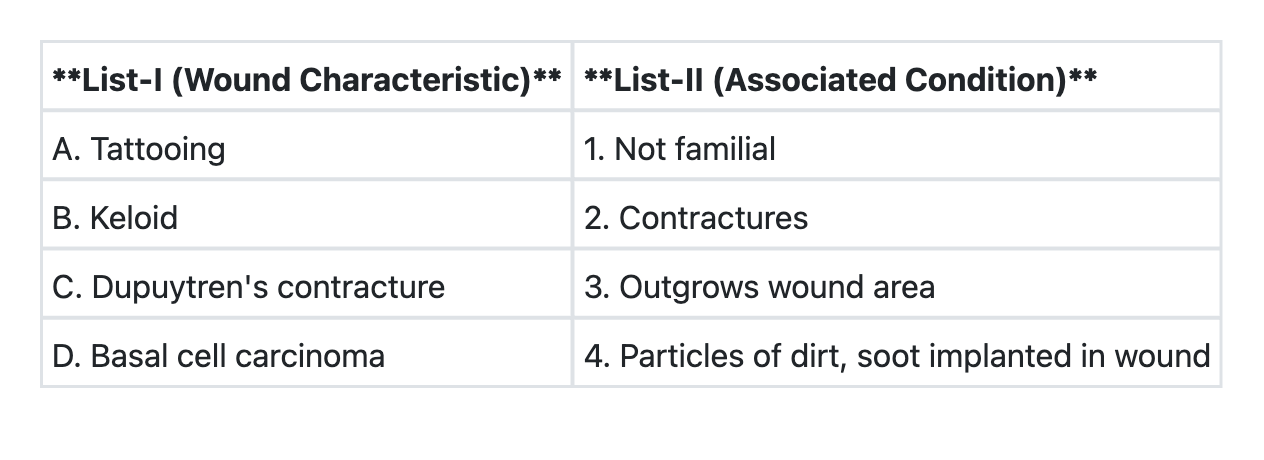
4 questionsMatch List-I with List-II and select the correct answer using the code given below the Lists: (Refer to the image for List-I and List-II)
Which of the following is the best indicator of prognosis of soft tissue sarcoma?
Lympho-venous anastomosis is done for
Which one of the following statements is not correct regarding thoracic outlet syndrome?
UPSC-CMS 2009 - Surgery UPSC-CMS Practice Questions and MCQs
Question 31: Match List-I with List-II and select the correct answer using the code given below the Lists: (Refer to the image for List-I and List-II)
- A. A→2 B→3 C→4 D→1
- B. A→3 B→4 C→1 D→2
- C. A→4 B→1 C→2 D→3 (Correct Answer)
- D. A→1 B→2 C→3 D→4
Explanation: ***A→4, B→1, C→2, D→3*** **Correct Matching:** **Tattooing (A) → Foreign particles like dirt, soot (4)** - Tattooing refers to permanent skin discoloration caused by **foreign pigment insertion** into the dermis - Commonly occurs accidentally after trauma with **dirt, soot, gunpowder, or other foreign particles** - The particles become embedded in the skin causing permanent discoloration **Keloid (B) → Outgrows boundaries of original wound (1)** - A keloid is a **prominent raised scar** that extends beyond the margins of the original injury - Results from excessive collagen deposition during abnormal wound healing - **Key feature**: Growth exceeds the boundaries of the original wound area **Dupuytren's contracture (C) → Contractures (2)** - Progressive fibrosis of the **palmar fascia** leading to finger contractures - Causes permanent flexion deformity, typically affecting the ring and little fingers - Results in functional limitation due to **contracture formation** **Basal cell carcinoma (D) → Not familial (3)** - Most common skin malignancy, typically **sporadic** rather than familial - Associated with UV exposure, fair skin, and immunosuppression - Unlike some other cancers, **typically not inherited** in familial patterns *Incorrect Options:* *A→2, B→3, C→4, D→1* - Incorrectly matches tattooing with contractures and Dupuytren's with foreign particles *A→3, B→4, C→1, D→2* - Incorrectly matches tattooing with non-familial trait and keloid with foreign particles *A→1, B→2, C→3, D→4* - Incorrectly matches tattooing with outgrowing boundaries and basal cell carcinoma with foreign particles
Question 32: Which of the following is the best indicator of prognosis of soft tissue sarcoma?
- A. Tumour size
- B. Nodal metastasis
- C. Histological type
- D. Tumour grade (Correct Answer)
Explanation: ***Tumour grade*** - **Tumor grade** quantifies the degree of cellular differentiation, mitotic activity, and necrosis within the tumor, reflecting its aggressive potential. - A **higher tumor grade** is directly associated with a poorer prognosis, increased risk of local recurrence, and distant metastasis in soft tissue sarcomas. *Tumour size* - While larger tumor size (e.g., >5 cm) is generally associated with a worse prognosis, it is primarily a factor in **staging**, not the most critical prognostic indicator. - **Tumor grade** provides more fundamental information about the biological aggressiveness of the tumor cells regardless of their current size. *Nodal metastasis* - **Nodal metastasis** in soft tissue sarcomas is relatively uncommon (less than 5% of cases) compared to carcinomas, and its presence is a significant negative prognostic factor. - However, because it is rare, it doesn't serve as the *primary* indicator for the majority of sarcoma patients, where tumor grade is more universally applicable. *Histological type* - The **histological type** (e.g., liposarcoma, leiomyosarcoma) helps classify the sarcoma, but different subtypes can have a wide range of biological behavior. - While certain types may have a generally better or worse prognosis, the **grade** *within* that histological type is a more precise predictor of individual patient outcomes.
Question 33: Lympho-venous anastomosis is done for
- A. Cystic hygroma
- B. Malignant lymphoedema
- C. Lymphoid cyst
- D. Filarial lymphoedema (Correct Answer)
Explanation: ***Filarial lymphoedema*** - **Lympho-venous anastomosis (LVA)** is a microsurgical technique used to bypass damaged lymphatic vessels and directly connect lymphatic channels to small veins. This procedure is primarily effective in treating **lymphedema due to lymphatic obstruction**, such as that caused by filarial infection. - In **filarial lymphoedema**, the lymphatic obstruction leads to accumulation of lymph fluid. LVA helps to restore lymphatic drainage, reducing limb swelling and improving symptoms, particularly in the early stages of the disease. *Cystic hygroma* - A **cystic hygroma** is a congenital lymphatic malformation, typically treated by surgical excision, sclerotherapy, or laser ablation. - It involves abnormally dilated lymphatic spaces and doesn't usually benefit from LVA, as the primary issue is malformation rather than obstruction requiring a bypass. *Malignant lymphoedema* - **Malignant lymphoedema** (secondary to cancer or its treatment) is often complicated by active tumor burden, radiation fibrosis, or extensive nodal involvement. - While LVA might be considered in carefully selected cases, its efficacy can be limited due to underlying cancer and the diffuse nature of the lymphatic damage, making it a less common primary indication compared to filarial lymphedema. *Lymphoid cyst* - A **lymphoid cyst** is a localized collection of lymph, often treated by aspiration, sclerotherapy, or surgical excision. - It is not a widespread lymphatic drainage disorder that would necessitate a bypass procedure like lympho-venous anastomosis.
Question 34: Which one of the following statements is not correct regarding thoracic outlet syndrome?
- A. Resection of First rib is effective treatment
- B. It is associated with Horner's syndrome
- C. Radial nerve is involved (Correct Answer)
- D. It is a rare condition
Explanation: ***Radial nerve is involved*** - Thoracic outlet syndrome (TOS) primarily involves compression of the **brachial plexus** (specifically the lower trunk C8-T1), subclavian artery, or subclavian vein. - The **radial nerve** is derived from the posterior cord (C5-T1) of the brachial plexus, but the classic presentation of TOS does not typically involve isolated or predominant radial nerve symptoms. Instead, TOS symptoms more commonly affect the **ulnar nerve distribution** (C8-T1) due to compression of the lower trunk of the brachial plexus. *Resection of First rib is effective treatment* - **First rib resection** is a well-established surgical treatment option for thoracic outlet syndrome, aiming to decompress the neurovascular structures. - This procedure alleviates pressure on the **brachial plexus** and **subclavian vessels**, leading to symptom improvement in many patients. *It is associated with Horner's syndrome* - **Horner's syndrome** can be associated with thoracic outlet pathology, particularly tumors like **Pancoast tumors**, which can compress the sympathetic chain at the thoracic outlet. - While not a direct feature of typical TOS, conditions affecting the thoracic outlet region can impact the **cervical sympathetic ganglion** leading to Horner's syndrome (ptosis, miosis, anhidrosis). *It is a rare condition* - Thoracic outlet syndrome is generally considered a **relatively rare condition**, although its true incidence might be underestimated due to diagnostic challenges. - It is often a diagnosis of exclusion, requiring careful clinical evaluation and imaging to rule out other causes of **neck, shoulder, and arm pain**.