UPSC-CMS 2009 — Community Medicine
25 Previous Year Questions with Answers & Explanations
For a screening test, 90% specificity means that 90% of non-diseased persons will give a
Berksonian bias is a selection bias which occurs in
According to International Health Regulations, there is no risk of spread of yellow fever if the Aedes aegypti index is kept at
During the process of chlorination of water, the disinfecting action of chlorine is due to the formation of
Kata thermometer is used for recording :
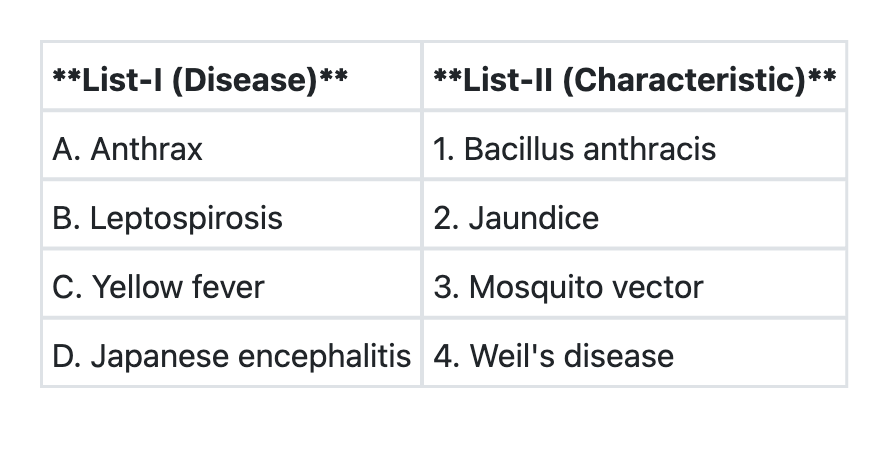
Match List-I with List-II and select the correct answer using the code given below the Lists:
Consider the following : 1. Land filling for source reduction. 2. Vaccination of pigs in the risk area. 3. Immunization of children in risk area. Which of the above are the recommended control strategies for Japanese Encephalitis ?
In a community with one lakh population, 20,000 slides were examined in a particular year. Out of these 100 were positive for malarial parasite. What is the Annual Parasite Incidence (API) in this community ?
Amniocentesis in early pregnancy for genetic disorders is a kind of
Which one of the following is a correct combination regarding Indian population?
UPSC-CMS 2009 - Community Medicine UPSC-CMS Practice Questions and MCQs
Question 1: For a screening test, 90% specificity means that 90% of non-diseased persons will give a
- A. False negative result
- B. True positive result
- C. True negative result (Correct Answer)
- D. False positive result
Explanation: ***True negative result*** - **Specificity** is defined as the proportion of **true negatives** among individuals **without the disease**. - A 90% specificity means that 90% of healthy individuals will correctly test negative for the disease. *False negative result* - A **false negative** occurs when a diseased person tests negative, which is related to the concept of **sensitivity**, not specificity. - This would imply missing actual cases of the disease. *True positive result* - A **true positive** occurs when a diseased person tests positive, which is also related to **sensitivity**. - This indicates accurate detection of the disease in affected individuals. *False positive result* - A **false positive** occurs when a non-diseased person inappropriately tests positive. - If 90% of non-diseased persons give a negative result (true negative), then 10% would give a **false positive result**.
Question 2: Berksonian bias is a selection bias which occurs in
- A. Hospital based studies (Correct Answer)
- B. Natural exposure studies
- C. Community based studies
- D. Laboratory based studies
Explanation: ***Hospital based studies*** - **Berksonian bias** is a type of **selection bias** that occurs when the study population is drawn from a hospital or clinical setting. - This can lead to an artificially inflated or deflated association between risk factors and diseases, as hospital patients often have multiple health conditions or risk factors not representative of the general population. *Natural exposure studies* - These studies observe populations exposed to a factor naturally, without intervention, and are less prone to selection bias related to hospital admission. - While other biases can occur, **Berksonian bias** specifically relates to admission criteria for healthcare facilities. *Community based studies* - **Community-based studies** aim to recruit participants from the general population, making them less susceptible to **Berksonian bias** compared to hospital-based studies. - They strive for a more representative sample, reducing the selection pressures seen in clinical settings. *Laboratory based studies* - **Laboratory studies** typically use controlled environments and experimental designs, often involving cell cultures or animal models. - They are generally not subject to **Berksonian bias**, which is specific to human population studies drawing from clinical settings.
Question 3: According to International Health Regulations, there is no risk of spread of yellow fever if the Aedes aegypti index is kept at
- A. 2-4%
- B. 5-7%
- C. 8-10%
- D. below 1% (Correct Answer)
Explanation: ***below 1%*** - The **International Health Regulations (IHR)** specify that a **house index** (percentage of houses infested with *Aedes aegypti* larvae) of **below 1%** is considered sufficient to prevent the spread of yellow fever. - Maintaining this low index is crucial for controlling potential outbreaks in endemic or receptive areas. *2-4%* - An *Aedes aegypti* index in this range (2-4%) indicates a **moderate risk** of yellow fever transmission, as the vector population is still significant enough to facilitate spread. - This level is **above the recommended threshold** for effective prevention according to IHR. *5-7%* - An index between 5-7% signifies an **elevated risk** of yellow fever transmission, indicating a substantial presence of the vector population. - At this level, there is a **high probability** of ongoing or impending disease outbreaks. *8-10%* - An *Aedes aegypti* index of 8-10% represents a **very high risk** of yellow fever spread, suggesting an widespread vector presence. - This range indicates a **strong potential for rapid and extensive disease transmission**.
Question 4: During the process of chlorination of water, the disinfecting action of chlorine is due to the formation of
- A. Hypochlorous acid and hypochlorite ions (Correct Answer)
- B. Chlorine gas only
- C. Hydrochloric acid only
- D. Hypochlorous acid only
Explanation: ***Hypochlorous acid and hypochlorite ions*** - When **chlorine gas** (Cl2) is added to water, it rapidly reacts to form **hypochlorous acid (HOCl)** and **hydrochloric acid (HCl)**. - Hypochlorous acid then partially dissociates into **hypochlorite ions (OCl-)** depending on the pH of the water; both HOCl and OCl- are potent disinfectants, with HOCl being 80-100 times more effective. *Chlorine gas only* - While chlorine gas is the starting material for chlorination, it is not the primary disinfectant in water. - Chlorine gas reacts with water to form other active disinfectant compounds; it does not directly act as a disinfectant at significant levels in water treatment. *Hydrochloric acid only* - **Hydrochloric acid (HCl)** is a byproduct of the reaction of chlorine with water, but it is not the active disinfecting agent. - HCl contributes to the lowering of pH but does not possess the strong antimicrobial properties of hypochlorous acid or hypochlorite ions. *Hypochlorous acid only* - **Hypochlorous acid (HOCl)** is indeed a very strong disinfectant and a critical component of water chlorination. - However, in typical water treatment pH ranges, a significant proportion of HOCl also dissociates into **hypochlorite ions (OCl-)**, which also contribute to the disinfecting action, making the combined effect the primary mechanism.
Question 5: Kata thermometer is used for recording :
- A. Relative humidity of the air
- B. Mean radiant temperature
- C. Low air velocities (Correct Answer)
- D. Maximum and minimum temperature
Explanation: ***Low air velocities*** - A **Kata thermometer** is a specialized alcohol thermometer designed to measure **cooling power** and **air velocity** in various environments. - It works by being heated to a specific temperature and then measuring the time it takes to cool down, which is influenced by air movement. *Relative humidity of the air* - **Relative humidity** is typically measured using a **psychrometer** (a wet-bulb and dry-bulb thermometer) or a **hygrometer**. - The Kata thermometer does not directly measure humidity; rather, humidity can indirectly influence its cooling rate. *Mean radiant temperature* - **Mean radiant temperature** is measured using a **globe thermometer**, which uses a temperature sensor inside a black globe. - The Kata thermometer is not designed for this purpose, as it primarily assesses air movement and cooling power. *Maximum and minimum temperature* - **Maximum and minimum temperatures** are typically recorded by a **Six's thermometer** or conventional mercury/alcohol thermometers. - While a Kata thermometer has a temperature scale, its primary use is not for simple maximum/minimum readings but for measuring air velocity and cooling.
Question 6: Match List-I with List-II and select the correct answer using the code given below the Lists:
- A. A→1 B→4 C→2 D→3
- B. A→1 B→2 C→4 D→3 (Correct Answer)
- C. A→4 B→3 C→2 D→1
- D. A→1 B→2 C→3 D→4
Explanation: ***A→1 B→2 C→4 D→3*** - This option correctly matches each disease with its primary characteristic: **Anthrax** is caused by *Bacillus anthracis*, **Leptospirosis** is known as **Weil's disease** (in its severe form), **Yellow fever** causes **jaundice** (hence the name "yellow"), and **Japanese encephalitis** is transmitted by **mosquito vector** (Culex species). - All pairings are medically accurate and represent the most distinctive features of each disease. *A→1 B→4 C→2 D→3* - While it correctly links **Anthrax** to *Bacillus anthracis* and **Japanese encephalitis** to **mosquito vector**, it makes critical errors with the middle two diseases. - **B→4** incorrectly pairs **Leptospirosis** with **jaundice** - while jaundice can occur in severe leptospirosis, this is not its defining characteristic or eponym (that would be Weil's disease). - **C→2** incorrectly pairs **Yellow fever** with **Weil's disease** - these are completely unrelated; Yellow fever is a flavivirus infection characterized by jaundice, not Weil's disease (which is leptospirosis). *A→4 B→3 C→2 D→1* - This option contains multiple fundamental errors in disease-characteristic matching. - **A→4** incorrectly pairs **Anthrax** with **jaundice** - Anthrax typically presents with cutaneous lesions (eschar), pulmonary, or GI symptoms, not jaundice. - **B→3** incorrectly pairs **Leptospirosis** with **mosquito vector** - Leptospirosis is transmitted through contact with water/soil contaminated with infected animal urine, not by mosquitoes. - The other pairings are also incorrect, making this option entirely wrong. *A→1 B→2 C→3 D→4* - This option correctly links **Anthrax** to *Bacillus anthracis* and **Leptospirosis** to **Weil's disease**, but makes errors in the last two pairings. - **C→3** incorrectly pairs **Yellow fever** with **mosquito vector** - while Yellow fever IS transmitted by mosquitoes (Aedes aegypti), this ignores that option 3 should go with Japanese encephalitis, and Yellow fever's most distinctive feature is jaundice (option 4). - **D→4** incorrectly pairs **Japanese encephalitis** with **jaundice** - JE is a neurological infection without jaundice as a primary feature.
Question 7: Consider the following : 1. Land filling for source reduction. 2. Vaccination of pigs in the risk area. 3. Immunization of children in risk area. Which of the above are the recommended control strategies for Japanese Encephalitis ?
- A. 1 only
- B. 2 and 3 only (Correct Answer)
- C. 1, 2 and 3
- D. 1 and 2 only
Explanation: ***2 and 3 only*** - **Immunization of children** in risk areas is the **primary recommended control strategy** for Japanese Encephalitis, as children are particularly vulnerable to severe encephalitis and long-term neurological sequelae from JEV infection. Human vaccination is endorsed by WHO and forms the backbone of JE control programs. - **Vaccination of pigs**: While pigs act as **amplifying hosts** for JEV, **pig vaccination is NOT routinely recommended** by WHO or most national programs due to practical challenges (high turnover of pig populations, cost-effectiveness issues). However, some older guidelines and regional programs have included this as a supplementary strategy in specific contexts. *1 only* - **Landfilling for source reduction** is a method for **solid waste disposal** and is NOT a recommended strategy for Japanese Encephalitis control. - JE vectors (**Culex tritaeniorhynchus mosquitoes**) breed primarily in **rice paddies, irrigation channels, and stagnant water bodies**, not in areas affected by solid waste. - Appropriate environmental management would focus on **water management** in agricultural areas, not landfilling. *1, 2 and 3* - This option incorrectly includes **landfilling**, which is not a recognized JE control strategy. - Landfilling does not target the breeding sites of Culex mosquitoes that transmit JE. *1 and 2 only* - This option incorrectly includes **landfilling** and critically omits **human immunization**, which is the most important and universally recommended control measure. - Human vaccination provides direct protection and is the cornerstone of JE prevention in endemic areas.
Question 8: In a community with one lakh population, 20,000 slides were examined in a particular year. Out of these 100 were positive for malarial parasite. What is the Annual Parasite Incidence (API) in this community ?
- A. 2
- B. 0.5
- C. 1 (Correct Answer)
- D. 5
Explanation: ***Correct Answer: 1*** The **Annual Parasite Incidence (API)** is a key epidemiological indicator for malaria surveillance, defined as the number of **confirmed positive malaria cases per 1,000 population per year**. **Formula:** API = (Number of positive cases / Total population) × 1,000 **Calculation:** - Population = 1,00,000 (one lakh) - Positive cases = 100 - API = (100 / 1,00,000) × 1,000 = **1** The number of slides examined (20,000) is relevant for calculating the **Slide Positivity Rate (SPR)** but not directly used in the API calculation. *Incorrect: 2* - This would be correct if there were 200 positive cases in the same population - Represents double the actual API *Incorrect: 0.5* - This would be correct if there were only 50 positive cases in the population - Represents half the actual API *Incorrect: 5* - This would result from incorrectly using the number of slides examined (20,000) as the denominator instead of the total population (1,00,000) - Confuses SPR calculation methodology with API calculation
Question 9: Amniocentesis in early pregnancy for genetic disorders is a kind of
- A. secondary prevention
- B. tertiary prevention
- C. primary prevention (Correct Answer)
- D. primordial prevention
Explanation: ***primary prevention*** - **Primary prevention** aims to *prevent disease from occurring* in the first place by reducing exposure to risk factors and preventing the birth of affected individuals - Amniocentesis in early pregnancy is a **prenatal diagnostic test** that detects genetic disorders in the fetus (who is at risk but not yet diseased) - The goal is to *prevent the occurrence* of genetic disease in the population by enabling informed reproductive decisions and preventing the birth of severely affected infants - This is classified as primary prevention because it **prevents the disease from manifesting** in the community *secondary prevention* - **Secondary prevention** focuses on *early detection and treatment* of disease in individuals who are already affected but asymptomatic - Examples include cancer screening (mammography, Pap smear), hypertension screening, and diabetes screening in adults - Amniocentesis is NOT secondary prevention because the fetus is not yet "diseased" – testing occurs before disease manifestation to prevent it *tertiary prevention* - **Tertiary prevention** aims to *reduce complications* and disability from established, symptomatic disease - Focuses on rehabilitation, preventing progression, and improving quality of life after disease has occurred - Examples include physiotherapy after stroke, insulin therapy for diabetes, and cardiac rehabilitation *primordial prevention* - **Primordial prevention** addresses *underlying determinants* of disease by preventing risk factors from developing in the population - Involves broad public health policies, environmental modifications, and socioeconomic interventions - Examples include tobacco control policies, promoting healthy urban design, and reducing environmental pollution
Question 10: Which one of the following is a correct combination regarding Indian population?
- A. Blood group AB 20%; Rh negative 15%
- B. Blood group A 40%; Rh positive 80%
- C. Blood group O 40%; Rh negative 7% (Correct Answer)
- D. Blood group B 33%; Rh positive 99%
Explanation: ***Blood group O 40%; Rh negative 7%*** - In the Indian population, **Blood group O** is indeed the most common, accounting for approximately **30-40%** of the population. - The prevalence of **Rh-negative** individuals in India is relatively low, typically around **5-7%**, making this combination accurate. *Blood group AB 20%; Rh negative 15%* - **Blood group AB** is the least common blood group, typically less than **10%** in the Indian population, making 20% an overestimation. - **Rh negative** prevalence of 15% is significantly higher than the reported figures for India, which are usually around 5-7%. *Blood group A 40%; Rh positive 80%* - While **Blood group A** is common, 40% might be slightly higher than some estimates, which often place it closer to 20-25%. - **Rh positive** prevalence in India is much higher than 80%, typically around **93-95%**, making 80% an underestimation. *Blood group B 33%; Rh positive 99%* - **Blood group B** is also very common in India, often around 30-35%, so 33% is a reasonable estimate. - However, **Rh positive** prevalence of 99% is an overestimation; the actual prevalence is closer to **93-95%**.