Anatomy
2 questionsWhich of the following structures is not a boundary of Calot's triangle shown in the given image?
Identify the marked structure in the image.

NEET-PG 2019 - Anatomy NEET-PG Practice Questions and MCQs
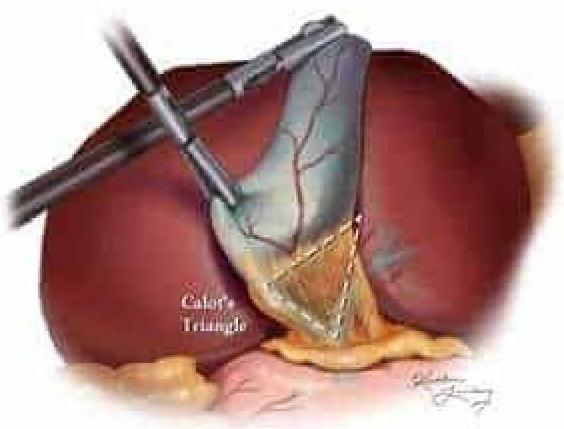
Question 81: Which of the following structures is not a boundary of Calot's triangle shown in the given image?
- A. Common hepatic duct
- B. Cystic duct
- C. Inferior surface of the liver
- D. Gallbladder (Correct Answer)
Explanation: ***Gallbladder*** - The image depicts **Calot's triangle**, which is an important anatomical landmark in gallbladder surgery. The gallbladder itself is located within this region, but it is not one of the defined boundaries of the triangle. - While central to the anatomy shown, the **gallbladder** is surrounded by the structures that form the triangle's boundaries rather than bounding it itself. *Common hepatic duct* - The **common hepatic duct** forms the medial boundary of Calot's triangle. - This duct is formed by the union of the right and left hepatic ducts and carries bile from the liver. *Cystic duct* - The **cystic duct** forms the lateral (or inferior) boundary of Calot's triangle. - This duct connects the gallbladder to the common hepatic duct. *Inferior surface of the liver* - The **inferior surface of the liver** forms the superior boundary of Calot's triangle. - Specifically, this refers to the edge of the right lobe of the liver at the base of the gallbladder fossa.
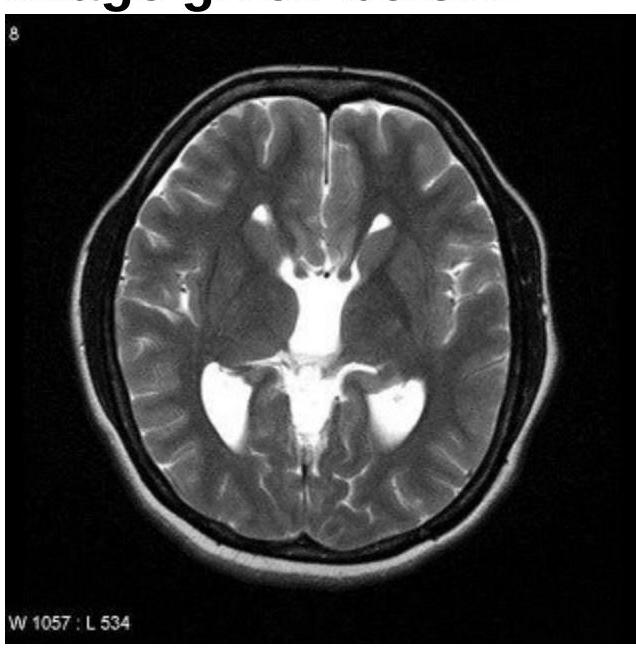
Question 82: Identify the marked structure in the image.
- A. Cerebrum
- B. Brain stem
- C. Corpus callosum
- D. Cerebellum (Correct Answer)
Explanation: ***Cerebellum*** - The image points to the distinct, posterior inferior structure of the brain, characterized by its **folia** and arbour-vitae-like internal structure, which is the cerebellum. - The cerebellum is primarily involved in **motor control**, including coordination, precision, and accurate timing. *Cerebrum* - The cerebrum is the **largest part of the brain**, located superiorly, responsible for higher functions like thought, voluntary movement, and sensory processing. - It consists of two hemispheres connected by the corpus callosum and is characterized by its **gyri** and **sulci**. *Brain stem* - The brain stem is located inferior to the cerebrum and anterior to the cerebellum, connecting the cerebrum and cerebellum to the **spinal cord**. - It controls vital functions such as **breathing**, heart rate, and sleep, and is composed of the midbrain, pons, and medulla oblongata. *Corpus callosum* - The corpus callosum is a large, C-shaped nerve fiber bundle located deep within the brain, under the cerebral cortex. - Its primary function is to **connect the two cerebral hemispheres**, facilitating communication between them.
Anesthesiology
1 questionsIV administration of which anesthetic drug is most painful among the following?
NEET-PG 2019 - Anesthesiology NEET-PG Practice Questions and MCQs
Question 81: IV administration of which anesthetic drug is most painful among the following?
- A. Propofol (Correct Answer)
- B. Ketamine
- C. Etomidate
- D. Methohexital
Explanation: ***Propofol*** - **Propofol** is notoriously known for causing **significant pain on injection** due to its formulation with **soybean oil emulsion** and its direct irritation of venous free nerve endings. - This pain is often described as a **burning sensation** and can be severe enough to require pre-treatment with lidocaine or administering it in a larger vein. *Methohexital* - While **methohexital** can cause localized pain and sometimes **thrombophlebitis** during intravenous administration, it is generally considered less painful than propofol. - It is a **barbiturate** and its discomfort is typically related to its alkaline pH and potential for venous irritation. *Ketamine* - **Ketamine** typically causes **minimal pain on injection** when administered intravenously. - Its mechanism of action as an **NMDA receptor antagonist** does not generally involve direct irritation of venous endothelium in the same way as propofol. *Etomidate* - **Etomidate**, like methohexital, can cause some **pain and irritation on injection**, and poses a risk of **thrombophlebitis**. - However, the severity of pain is generally **less pronounced** compared to the distinct and often intense burning sensation associated with propofol.
Community Medicine
1 questionsWhich of the following is not an epidemiological indicator?
NEET-PG 2019 - Community Medicine NEET-PG Practice Questions and MCQs
Question 81: Which of the following is not an epidemiological indicator?
- A. None of the options (Correct Answer)
- B. ABER
- C. Annual falciparum incidence
- D. Annual parasite index
Explanation: ***None of the options*** - All listed options—**ABER (Annual Blood Examination Rate)**, **Annual parasite index**, and **Annual falciparum incidence**—are indeed widely recognized and utilized **epidemiological indicators**, particularly in the context of malaria surveillance and control. - As such, there is no option presented that is *not* an epidemiological indicator. *ABER* - **ABER (Annual Blood Examination Rate)** is an epidemiological indicator used to assess the annual number of blood smears examined per 1000 population. - It helps to measure the **intensity of surveillance** and case detection efforts in a given area for diseases like malaria. *Annual parasite index* - The **Annual Parasite Index (API)** is an epidemiological indicator that measures the number of confirmed malaria cases per 1000 population per year. - It is crucial for assessing **malaria endemicity** and the burden of the disease in a specific region. *Annual falciparum incidence* - **Annual falciparum incidence** is an epidemiological indicator specifically tracking the number of *Plasmodium falciparum* malaria cases per 1000 population per year. - This indicator is essential for monitoring the **severity and transmission of the most dangerous form of malaria**.
Dermatology
1 questionsA patient presents with painful vesicular eruptions on one side of the body. What is the most likely diagnosis based on the clinical image?

NEET-PG 2019 - Dermatology NEET-PG Practice Questions and MCQs
Question 81: A patient presents with painful vesicular eruptions on one side of the body. What is the most likely diagnosis based on the clinical image?
- A. Herpes zoster (Correct Answer)
- B. Smallpox
- C. Chickenpox
- D. Atopic dermatitis
Explanation: ***Herpes zoster*** - The image displays characteristic **vesicular lesions** grouped together on an erythematous base, typically following a **dermatomal distribution**, which is classic for herpes zoster (shingles). - These lesions often cause significant pain and are due to the **reactivation of the varicella-zoster virus**. *Smallpox* - Smallpox lesions are typically **deep-seated, firm, round pustules** that are all in the same stage of development. - While smallpox also features vesicular lesions, their appearance and distribution are distinct from the clustered, dermatomal pattern seen in the image. *Chickenpox* - Chickenpox presents as a generalized rash with lesions at **various stages of development** (macules, papules, vesicles, scabs), often described as a "dewdrop on a rose petal." - Unlike the localized, dermatomal pattern of herpes zoster, chickenpox lesions are typically **widespread** over the body. *Atopic dermatitis* - Atopic dermatitis typically manifests as **erythematous, scaly, intensely itchy patches or plaques**, often in areas like the flexural creases. - It does not present with the characteristic **vesicular, grouped lesions in a dermatomal pattern** seen in the image.
Internal Medicine
4 questionsWhat are the essential major blood culture criteria for diagnosing infective endocarditis?
Which type of cardiomyopathy is associated with alcohol abuse?
Identify the cardiac condition represented in the image.

MRP2 associated with which of the following?
NEET-PG 2019 - Internal Medicine NEET-PG Practice Questions and MCQs
Question 81: What are the essential major blood culture criteria for diagnosing infective endocarditis?
- A. Single positive culture of Coxiella burnetii (Correct Answer)
- B. Single positive culture of Corynebacterium species
- C. Both HACEK and Coxiella cultures
- D. Single positive culture of HACEK group
Explanation: ***Single positive culture of Coxiella burnetii*** - A single positive blood culture for **Coxiella burnetii** or **anti-phase I IgG antibody titer > 1:800** is considered a major criterion for infective endocarditis due to its highly pathogenic nature in this context [1], [2]. - This organism is a known cause of **culture-negative endocarditis**, and specific serology or molecular tests are often required for diagnosis [1]. *Single positive culture of Corynebacterium species* - **Corynebacterium species** are often considered **contaminants** in blood cultures, especially *Corynebacterium jeikeium*, and typically require multiple positive cultures, often from different sites, to be considered significant pathogens for infective endocarditis [2]. - A single positive culture of these organisms alone is generally insufficient to meet major diagnostic criteria for endocarditis [2]. *Both HACEK and Coxiella cultures* - While both **HACEK organisms** and **Coxiella burnetii** can cause endocarditis, the combination of both is not a specific major criterion in itself. - The diagnostic criteria address each organism individually [2]. *Single positive culture of HACEK group* - **HACEK organisms** (**H**aemophilus, **A**ggregatibacter, **C**ardiobacterium, **E**ikenella, **K**ingella) are well-known causes of endocarditis, but usually require **two separate positive blood cultures** for infective endocarditis major criteria [2]. - A single positive culture of a HACEK organism is typically classified as a minor criterion unless other supporting evidence is present.
Question 82: Which type of cardiomyopathy is associated with alcohol abuse?
- A. Hypertrophic cardiomyopathy
- B. Dilated cardiomyopathy (Correct Answer)
- C. Pericarditis
- D. Myocarditis
Explanation: ### Dilated cardiomyopathy - Chronic **alcohol abuse** is a well-established cause of **dilated cardiomyopathy**, leading to weakening and enlargement of the ventricles [1]. - This condition results in impaired systolic function and can cause **heart failure** [1]. *Hypertrophic cardiomyopathy* - This condition is primarily characterized by **pathological thickening of the heart muscle**, often genetic, and is not directly caused by alcohol abuse. - It leads to issues with relaxation and filling of the heart, rather than dilation and weakness. *Pericarditis* - **Pericarditis** is the inflammation of the sac surrounding the heart (pericardium), most commonly caused by viral infections, autoimmune diseases, or injury. - It is not directly linked to alcohol abuse as a primary cause. *Myocarditis* - **Myocarditis** is the inflammation of the heart muscle, often triggered by viral infections, autoimmune reactions, or certain medications. - While heavy alcohol use can weaken the heart, myocarditis is primarily an inflammatory process not directly caused by alcohol.
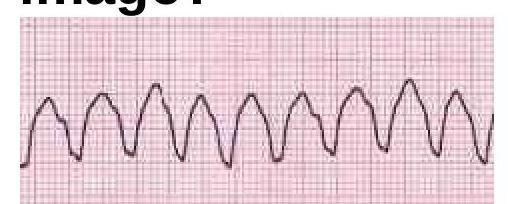
Question 83: Identify the cardiac condition represented in the image.
- A. Atrial fibrillation
- B. Atrial flutter
- C. Ventricular tachycardia (Correct Answer)
- D. Supraventricular tachycardia
Explanation: ***Ventricular tachycardia*** - The image displays a **wide, regular QRS complex tachycardia**, which is characteristic of **ventricular tachycardia (VT)**. - The QRS complexes are broad and bizarre, originating from an ectopic focus within the ventricles. *Atrial fibrillation* - **Atrial fibrillation** is characterized by an **irregularly irregular rhythm** with the absence of distinct P waves and varying R-R intervals. - The rhythm shown in the image is regular, which rules out atrial fibrillation. *Atrial flutter* - **Atrial flutter** typically presents with a "sawtooth" pattern of **flutter waves** in specific leads (e.g., II, III, aVF) and a regular or irregular ventricular response, often with a 2:1 or 3:1 block. - The image does not show these characteristic flutter waves. *Supraventricular tachycardia* - **Supraventricular tachycardia (SVT)** usually presents with a **narrow QRS complex** (unless there's an underlying bundle branch block) and a regular rhythm, originating from above the ventricles. - The QRS complexes in the image are wide, indicating a ventricular origin, not supraventricular.
Question 84: MRP2 associated with which of the following?
- A. Rotor syndrome
- B. Dubin-Johnson syndrome (Correct Answer)
- C. Crigler-Najjar syndrome
- D. Gilbert syndrome
Explanation: No changes were made to the original explanation because the available references provided insufficient evidence to support the specific claims about the MRP2 gene and the characteristic 'dark liver' appearance of Dubin-Johnson syndrome. While the references discuss hyperbilirubinemia and mentions Gilbert and Crigler-Najjar syndromes [1], they do not explicitly detail the MRP2 mutation or the pathology of Dubin-Johnson and Rotor syndromes necessary for high-accuracy medical citation [2].
Pediatrics
1 questionsBimanual grip is seen at what age?
NEET-PG 2019 - Pediatrics NEET-PG Practice Questions and MCQs
Question 81: Bimanual grip is seen at what age?
- A. 5 months
- B. 7 months
- C. 4 months
- D. 6 months (Correct Answer)
Explanation: ***6 months*** - **Bimanual grip**, which involves using both hands to grasp an object, typically develops around **6 months of age**. - This milestone marks the ability to bring objects to the midline and use both hands cooperatively. *4 months* - At **4 months**, infants typically start to reach for objects with one hand but do not yet consistently demonstrate a coordinated **bimanual grip**. - They are more likely to swipe at objects or grasp with a **primitive palmar grasp** in one hand. *5 months* - While infants at **5 months** show increasing dexterity and may bring objects to the midline, a full, consistent **bimanual grip** is usually not yet firmly established. - They are moving towards this skill but have not fully mastered it. *7 months* - By **7 months**, infants have typically refined their grasping skills, including transferring objects from hand to hand and using a **bimanual grip**. - This age is usually past the initial emergence of this specific skill.