Biochemistry
1 questionsWhich of the following statements regarding mitochondrial DNA is FALSE?
NEET-PG 2019 - Biochemistry NEET-PG Practice Questions and MCQs
Question 131: Which of the following statements regarding mitochondrial DNA is FALSE?
- A. Double stranded
- B. Inherited from mother
- C. High mutation rate
- D. All respiratory proteins are synthesized within the mitochondria (Correct Answer)
Explanation: ***All respiratory proteins are synthesized within the mitochondria.*** - While mitochondrial DNA (mtDNA) encodes some proteins essential for the **electron transport chain** (respiratory proteins), not all respiratory proteins are synthesized within the mitochondria. - Many crucial respiratory proteins are encoded by **nuclear DNA** and imported into the mitochondria from the cytoplasm. *Double stranded* - **Mitochondrial DNA (mtDNA)** is a **double-stranded**, circular molecule, similar to bacterial chromosomes. - This structure provides stability and allows for efficient replication within the organelle. *Inherited from mother* - Mitochondria and their DNA are exclusively inherited from the **mother** during fertilization, as sperm primarily contributes nuclear DNA. - This **maternal inheritance pattern** is a key feature of mtDNA and is used in tracing ancestry. *High mutation rate* - mtDNA has a significantly **higher mutation rate** compared to nuclear DNA due to several factors, including lack of robust repair mechanisms and exposure to reactive oxygen species. - This contributes to the rapid evolution of mtDNA and its use in **population genetics** studies.
Community Medicine
1 questionsWhich type of study determines the odds ratio?
NEET-PG 2019 - Community Medicine NEET-PG Practice Questions and MCQs
Question 131: Which type of study determines the odds ratio?
- A. Case control (Correct Answer)
- B. Cohort
- C. Cross sectional
- D. RCT
Explanation: ***Case control*** - **Case-control studies** compare individuals with a disease (cases) to individuals without the disease (controls) and look back in time to identify previous exposures. - The **odds ratio** is the primary measure of association used in case-control studies, quantifying the odds of exposure among cases versus controls. *Cohort* - **Cohort studies** follow groups of individuals over time, some exposed to a risk factor and some not, to determine the incidence of a disease. - They typically determine **relative risk**, which is the ratio of incidence rates in exposed versus unexposed groups. *Cross sectional* - **Cross-sectional studies** assess the prevalence of disease and exposure at a single point in time. - They primarily measure **prevalence** and can be used to calculate a **prevalence odds ratio**, but they do not establish temporality between exposure and outcome. *RCT* - **Randomized controlled trials (RCTs)** are interventional studies where participants are randomly assigned to an intervention or control group to determine the effectiveness of a treatment or exposure. - The main measure of effect in RCTs is often the **relative risk reduction**, **absolute risk reduction**, or **number needed to treat**, rather than the odds ratio for observational exposure.
Internal Medicine
2 questionsTrue about decorticate rigidity:
Most characteristic cardiovascular defect seen in Rubella-
NEET-PG 2019 - Internal Medicine NEET-PG Practice Questions and MCQs
Question 131: True about decorticate rigidity:
- A. Flexion of lower limbs & extension of upper limbs
- B. Rigidity is less pronounced than decerebrate rigidity (Correct Answer)
- C. Removal of cerebral cortex and basal ganglia
- D. None of the options
Explanation: ***Rigidity is less pronounced than decerebrate rigidity*** - **Decorticate rigidity** indicates damage above the **red nucleus**, disrupting descending inhibitory pathways from the cortex. [1] - While reflecting serious brain injury, it is generally considered a **less severe prognosis** than decerebrate rigidity because the red nucleus and some rubrospinal tract functions remain intact. *Flexion of lower limbs & extension of upper limbs* - **Decorticate rigidity** typically presents with **flexion of the upper limbs** (adduction, internal rotation, elbow flexion, wrist flexion), and **extension of the lower limbs** (adduction, extension, internal rotation) [1]. - This characteristic posture, often described as "mummy baby" or "posture of salvation," is due to uninhibited activity of the **rubrospinal tract** and the absence of cortical input [1]. *Removal of cerebral cortex and basal ganglia* - **Decorticate rigidity** results from lesions that interrupt the descending pathways **above the red nucleus** (e.g., in the cerebral hemispheres or internal capsule) [1]. - This specifically means the **cerebral cortex** is "removed" in terms of its functional input, but the basal ganglia are within the affected region. *None of the options* - This option is incorrect because the statement about decorticate rigidity being **less pronounced than decerebrate rigidity** is accurate. - The other clinical description and neurological basis are distinct from true decorticate rigidity.
Question 132: Most characteristic cardiovascular defect seen in Rubella-
- A. Patent ductus arteriosus (Correct Answer)
- B. Coarctation of the aorta
- C. Ventricular septal defect
- D. Pulmonary artery stenosis
Explanation: ***Patent ductus arteriosus*** - **Patent ductus arteriosus (PDA)** is the most characteristic cardiovascular defect associated with congenital rubella syndrome [1]. - The rubella virus can interfere with the normal closure of the **ductus arteriosus** during fetal development [1]. *Coarctation of the aorta* - **Coarctation of the aorta** is a narrowing of the aorta and is not typically linked to congenital rubella syndrome [1]. - It is often associated with syndromes like **Turner syndrome** or bicuspid aortic valve, which are not mentioned here [1]. *Ventricular septal defect* - **Ventricular septal defects (VSDs)** are common congenital heart defects, but they are not specifically characteristic of congenital rubella [1]. - VSDs are more frequently associated with conditions like **Down syndrome** or can occur in isolation [1]. *Pulmonary artery stenosis* - While **pulmonary artery stenosis** can occur as a congenital heart defect, it is less commonly the primary cardiovascular manifestation of congenital rubella syndrome. - **Peripheral pulmonary artery stenosis** can be seen in rubella, but PDA is the most characteristic overarching defect [1].
Orthopaedics
1 questionsA 25-year-old male presents with localized pain in the tibia and swelling. Imaging reveals a bone abscess. Identify the condition.

NEET-PG 2019 - Orthopaedics NEET-PG Practice Questions and MCQs
Question 131: A 25-year-old male presents with localized pain in the tibia and swelling. Imaging reveals a bone abscess. Identify the condition.
- A. Brodie abscess (Correct Answer)
- B. Osteoid osteoma
- C. Intracortical hemangioma
- D. Chondromyxoid fibroma
Explanation: ***Brodie abscess*** - A Brodie abscess is a **subacute or chronic osteomyelitis** characterized by a well-circumscribed, **radiolucent lesion** (an abscess cavity) often surrounded by a zone of **sclerosis**, representing the body's attempt to wall off the infection. - The presentation of localized pain and swelling in the tibia, with imaging revealing a bone abscess, is consistent with this condition, which is a common form of localized osteomyelitis. *Osteoid osteoma* - This is a **benign bone tumor** characterized by a small, radiolucent nidus surrounded by a large area of **sclerotic bone**. The pain from an osteoid osteoma is typically **worse at night** and dramatically relieved by NSAIDs. - While it can cause localized pain and swelling, the imaging features of a distinct abscess cavity are not characteristic of an osteoid osteoma. *Intracortical hemangioma* - An intracortical hemangioma is a **rare benign vascular lesion** within the cortex of a bone. - Imaging typically shows a **lytic lesion** with a characteristic **"honeycomb" or "sunburst" appearance**, not a well-defined abscess. *Chondromyxoid fibroma* - This is a rare, **benign cartilaginous tumor** that usually presents as an **eccentric lytic lesion** in the metaphysis of long bones, often with a scalloped border and sclerotic rim. - While it can cause localized pain and swelling, the imaging appearance of an abscess with sclerotic margins is not typical of a chondromyxoid fibroma.
Pathology
1 questionsA blood grouping test shows clumping with Anti-A serum, clumping with Anti-B serum, and no clumping in the control. What blood group does this indicate?
NEET-PG 2019 - Pathology NEET-PG Practice Questions and MCQs
Question 131: A blood grouping test shows clumping with Anti-A serum, clumping with Anti-B serum, and no clumping in the control. What blood group does this indicate?
- A. A
- B. B
- C. O
- D. AB (Correct Answer)
Explanation: ***AB*** - The results show **clumping with both Anti-A and Anti-B serum**, indicating the presence of both A and B antigens on the red blood cells. - The absence of clumping in the control confirms that the **agglutination with Anti-A and Anti-B is due to specific antigen-antibody reactions**, not nonspecific agglutination. - Blood group AB individuals have both A and B antigens on their RBCs and no anti-A or anti-B antibodies in their serum. *A* - Blood group A would show **clumping with Anti-A serum only** and no clumping with Anti-B serum. - This is incorrect because the sample shows clumping with both antisera. *B* - Blood group B would show **clumping with Anti-B serum only** and no clumping with Anti-A serum. - This is incorrect because the sample shows clumping with both antisera. *O* - Blood group O would show **no clumping with either Anti-A or Anti-B serum**, as it lacks both A and B antigens. - This is incorrect because the sample clearly shows clumping with both Anti-A and Anti-B sera.
Pediatrics
1 questionsWhat should be the correct treatment for a 14-year-old child with newly diagnosed Juvenile Rheumatoid Arthritis?
NEET-PG 2019 - Pediatrics NEET-PG Practice Questions and MCQs
Question 131: What should be the correct treatment for a 14-year-old child with newly diagnosed Juvenile Rheumatoid Arthritis?
- A. DMARDs with a short course of steroids (Correct Answer)
- B. Only NSAIDs
- C. DMARDs after initial treatment with NSAIDs
- D. Monotherapy with TNF inhibitors
- E. Long-term high-dose corticosteroid therapy
Explanation: ***DMARDs with a short course of steroids*** - For **newly diagnosed rheumatoid arthritis** in children (juvenile idiopathic arthritis), the primary goal is to **control inflammation** and prevent joint damage with **disease-modifying antirheumatic drugs (DMARDs)**. - A **short course of corticosteroids** is often used as a **bridging therapy** to rapidly reduce inflammation while the DMARDs take effect. - This approach ensures **early aggressive treatment** to prevent joint damage while minimizing long-term steroid exposure. *Incorrect: Only NSAIDs* - **NSAIDs** alone provide **symptomatic relief** but do not alter the course of the disease or prevent joint damage in rheumatoid arthritis. - Relying solely on NSAIDs can lead to **progressive joint erosion** and functional impairment. *Incorrect: DMARDs after initial treatment with NSAIDs* - While NSAIDs can be used for initial symptom control, delaying **DMARD initiation** is generally not recommended as it allows for continued joint inflammation and potential damage. - Early and aggressive treatment with DMARDs is crucial for **optimizing long-term outcomes** and preserving joint function. *Incorrect: Monotherapy with TNF inhibitors* - **TNF inhibitors** are potent **biologic DMARDs** and are typically considered for patients who have **failed conventional DMARDs** (e.g., methotrexate). - They are not usually the **first-line monotherapy** for treatment-naive rheumatoid arthritis due to their cost, potential side effects, and the availability of other effective options. *Incorrect: Long-term high-dose corticosteroid therapy* - **Prolonged corticosteroid use** at high doses is associated with significant side effects including growth suppression, osteoporosis, increased infection risk, and cushingoid features. - While steroids are useful as **bridging therapy** for a short duration, long-term high-dose use is avoided in pediatric patients whenever possible.
Physiology
1 questionsWhat is the PRIMARY mechanism by which Interleukin-1 (IL-1) induces fever?
NEET-PG 2019 - Physiology NEET-PG Practice Questions and MCQs
Question 131: What is the PRIMARY mechanism by which Interleukin-1 (IL-1) induces fever?
- A. Stimulates antibody production
- B. Inhibits inflammation
- C. Endogenous pyrogen (Correct Answer)
- D. Activates complement cascade
Explanation: ***Endogenous pyrogen*** - **IL-1** is a potent **endogenous pyrogen** that acts directly on the **hypothalamus**, the body's thermoregulatory center. - It stimulates the production of **prostaglandin E2 (PGE2)** in the hypothalamus, which then resets the body's thermoregulatory set point to a higher temperature, leading to fever. *Stimulates antibody production* - While IL-1 can have broader immune functions and can influence B cell activity, its **primary role in fever** production is not through antibody stimulation. - Antibody production is a function of **B lymphocytes** and is primarily driven by antigen presentation and T cell help. *Inhibits inflammation* - **IL-1** is a key **pro-inflammatory cytokine** that promotes inflammation, rather than inhibiting it. - It induces the expression of various adhesion molecules and inflammatory mediators, contributing to the inflammatory response. *Activates complement cascade* - The **complement cascade** is a part of the innate immune system, typically activated by **antigen-antibody complexes** (classical pathway) or **microbial surfaces** (alternative and lectin pathways). - While IL-1 plays a role in overall immune responses, its direct mechanism for inducing fever does not primarily involve activating the complement system.
Surgery
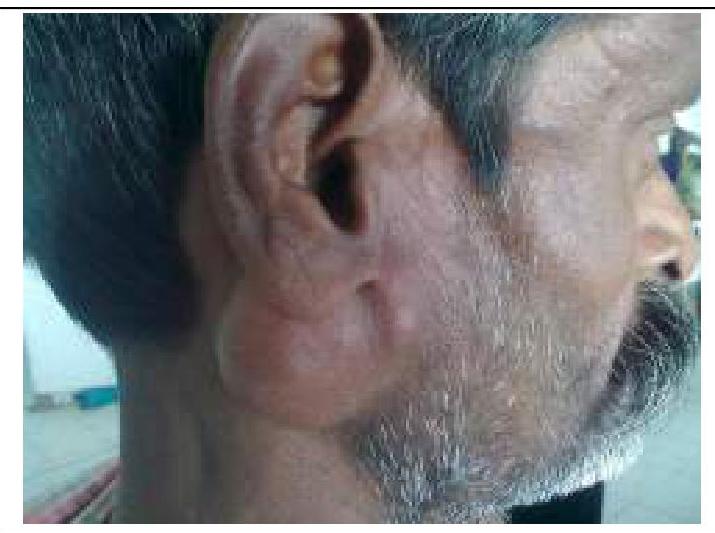
2 questionsWhat is the most likely diagnosis for the parotid mass with mixed consistency shown in the image?

Identify the surgical instrument based on its characteristics: a small, triangular blade used for precise incisions.
NEET-PG 2019 - Surgery NEET-PG Practice Questions and MCQs
Question 131: What is the most likely diagnosis for the parotid mass with mixed consistency shown in the image?
- A. Pleomorphic adenoma (Correct Answer)
- B. Sebaceous cyst
- C. Dermoid cyst
- D. None of the options
Explanation: ***Pleomorphic adenoma*** - The **mixed consistency** of the parotid mass indicates a **benign tumor**, predominantly of epithelial and mesenchymal origin, typical of pleomorphic adenomas. - This type of tumor is usually **pain-free** and can exhibit a **soft** and **firm** texture on examination [1]. *Sebaceous cyst* - Typically presents as a **smooth, fluctuant nodule** and usually has a **firm consistency** rather than mixed. - Generally not seen as a parotid mass; usually found on the skin in areas with sebaceous glands. *Dermoid cyst* - Generally presents as a **well-defined, soft, and mobile mass**, not commonly associated with mixed consistency. - Often contains **keratin** and has a more homogenous consistency rather than the mixed characteristics of pleomorphic adenoma. *All* - As not all options are suitable for the description of a **mixed consistency parotid mass**, this option is incorrect. - Only **pleomorphic adenoma** aligns with the specific clinical presentation detailed in the question [1]. **References:** [1] Kumar V, Abbas AK, et al.. Robbins and Cotran Pathologic Basis of Disease. 9th ed. Head and Neck, pp. 751-753.
Question 132: Identify the surgical instrument based on its characteristics: a small, triangular blade used for precise incisions.
- A. Blade no. 15
- B. Blade no. 10
- C. Blade no. 11 (Correct Answer)
- D. Blade no. 12
Explanation: ***Blade no. 11*** - This blade has a **triangular shape** with a strong, pointed tip, making it ideal for **stab incisions** and precise, short cuts. - Its design allows for sharp, accurate penetration, often used in procedures requiring **minimal tissue disruption**. *Blade no. 15* - This is a small, curved blade, primarily used for **fine, precise cuts** in superficial tissues. - Its small size and rounded belly make it suitable for tasks like excising skin lesions or making incisions in delicate areas, not for triangular stab incisions. *Blade no. 10* - The No. 10 blade has a **large, curved cutting edge** and is generally used for making large incisions in skin and muscle. - It is not designed for precise, triangular stab incisions, but rather for broader, sweeping cuts. *Blade no. 12* - This blade is **sickle-shaped** with the cutting edge on the inside curve, used primarily for mucogingival surgery or removing sutures. - Its unique shape allows it to get into tight spaces and cut from a different angle, but it does not have a triangular tip for precise stab incisions.