Anatomy
1 questionsStructure derived from first pharyngeal arch:
NEET-PG 2019 - Anatomy NEET-PG Practice Questions and MCQs
Question 121: Structure derived from first pharyngeal arch:
- A. Levator palatini
- B. Buccinator
- C. Stylohyoid
- D. Anterior belly of digastric (Correct Answer)
Explanation: ***Anterior belly of digastric*** - The **first pharyngeal arch** (mandibular arch) gives rise to the muscles of mastication, including the **anterior belly of the digastric muscle**. Others are the **mylohyoid muscle**, and the **tensor tympani** and **tensor veli palatini muscles**. - Its nerve supply is the **mandibular nerve (V3)**, which is the nerve of the first pharyngeal arch. *Levator palatini* - The **levator palatini muscle** is derived from the **fourth pharyngeal arch**. - It is innervated by the **pharyngeal plexus**, which contains fibers from the **vagus nerve (CN X)** (nerve of the fourth arch). *Buccinator* - The **buccinator muscle** is derived from the **second pharyngeal arch** (hyoid arch). - It is innervated by the **facial nerve (CN VII)**, which is the nerve of the second pharyngeal arch. *Stylohyoid* - The **stylohyoid muscle** is derived from the **second pharyngeal arch** (hyoid arch). - It is innervated by the **facial nerve (CN VII)**, which is the nerve of the second pharyngeal arch.
Biochemistry
2 questionsWhich of the following statements regarding mitochondrial DNA is FALSE?
In Wilson’s disease, which of the following substances is excreted in lower amounts in the urine?
NEET-PG 2019 - Biochemistry NEET-PG Practice Questions and MCQs
Question 121: Which of the following statements regarding mitochondrial DNA is FALSE?
- A. Double stranded
- B. Inherited from mother
- C. High mutation rate
- D. All respiratory proteins are synthesized within the mitochondria (Correct Answer)
Explanation: ***All respiratory proteins are synthesized within the mitochondria.*** - While mitochondrial DNA (mtDNA) encodes some proteins essential for the **electron transport chain** (respiratory proteins), not all respiratory proteins are synthesized within the mitochondria. - Many crucial respiratory proteins are encoded by **nuclear DNA** and imported into the mitochondria from the cytoplasm. *Double stranded* - **Mitochondrial DNA (mtDNA)** is a **double-stranded**, circular molecule, similar to bacterial chromosomes. - This structure provides stability and allows for efficient replication within the organelle. *Inherited from mother* - Mitochondria and their DNA are exclusively inherited from the **mother** during fertilization, as sperm primarily contributes nuclear DNA. - This **maternal inheritance pattern** is a key feature of mtDNA and is used in tracing ancestry. *High mutation rate* - mtDNA has a significantly **higher mutation rate** compared to nuclear DNA due to several factors, including lack of robust repair mechanisms and exposure to reactive oxygen species. - This contributes to the rapid evolution of mtDNA and its use in **population genetics** studies.
Question 122: In Wilson’s disease, which of the following substances is excreted in lower amounts in the urine?
- A. Phosphotyrosine
- B. Methyl- Histidine (Correct Answer)
- C. Phosphorus
- D. Serine
Explanation: **Important Note:** In Wilson's disease with Fanconi syndrome (proximal renal tubular dysfunction), most substances show **increased** urinary excretion, not decreased. This question appears to test knowledge of what is NOT characteristically elevated. ***Methyl-Histidine*** (Most appropriate answer) - **Methyl-histidine** (3-methylhistidine) is a marker of **muscle protein breakdown** and is not directly affected by the renal tubular dysfunction in Wilson's disease - Unlike phosphate, amino acids, and glucose which are pathologically increased in urine due to Fanconi syndrome, methyl-histidine excretion remains **normal** or is unrelated to copper-induced renal damage - This represents the substance least affected by Wilson's disease pathology *Phosphorus* (Actually INCREASED, not decreased) - **Medically incorrect as stated**: Phosphorus (phosphate) is actually **INCREASED** in urine in Wilson's disease, not decreased - Fanconi syndrome causes **renal phosphate wasting**, leading to hyperphosphaturia and resultant hypophosphatemia - This is a characteristic feature of proximal tubular dysfunction *Serine* (INCREASED due to aminoaciduria) - **Serine** and other amino acids show **generalized aminoaciduria** in Wilson's disease due to impaired proximal tubular reabsorption - Urinary serine is **elevated**, not decreased *Phosphotyrosine* - A phosphorylated amino acid involved in cell signaling, not routinely measured clinically - Not characteristically implicated in Wilson's disease urinary patterns
Community Medicine
1 questionsWhich health center is located in the remotest area for planning and management of health schemes?
NEET-PG 2019 - Community Medicine NEET-PG Practice Questions and MCQs
Question 121: Which health center is located in the remotest area for planning and management of health schemes?
- A. Anganwadi
- B. Block centre
- C. Sub-centre (Correct Answer)
- D. PHC
Explanation: ***Sub-centre*** - A **sub-centre** is the most peripheral and first contact point between the primary healthcare system and the community, usually located in the **remotest areas**. - It serves a population of 3,000-5,000 (3,000 in tribal/hilly areas). - It plays a crucial role in the planning and management of various health schemes at the grassroots level, focusing on basic healthcare services like immunization, antenatal care, and health education. *Anganwadi* - An **Anganwadi** is part of the Integrated Child Development Services (ICDS) program, primarily focusing on nutritional and preschool education services for children and expectant/nursing mothers. - While important for community welfare, it is not a health center under the formal healthcare delivery system. *Block centre* - A **Block centre** (Community Health Centre/CHC) serves a larger population of approximately 80,000-120,000 people at the block level. - It provides secondary healthcare and referral services but is not the remotest point of contact for basic healthcare planning. *PHC* - A **Primary Health Centre (PHC)** serves a population of about 20,000-30,000 people and is located at the intermediate level between sub-centres and CHCs. - While PHCs coordinate health scheme management, they are not positioned in the remotest areas—sub-centres occupy that role.
Microbiology
1 questionsWhat is the primary method for diagnosing Pneumocystis jirovecii pneumonia?
NEET-PG 2019 - Microbiology NEET-PG Practice Questions and MCQs
Question 121: What is the primary method for diagnosing Pneumocystis jirovecii pneumonia?
- A. Sputum microscopy
- B. Chest X-ray findings
- C. Bronchoalveolar lavage (BAL) (Correct Answer)
- D. Serum beta-D-glucan assay
Explanation: ***Bronchoalveolar lavage (BAL)*** - **BAL** is the **gold standard** and **primary definitive method** for diagnosing *Pneumocystis jirovecii* pneumonia (PJP), with **sensitivity of 90-99%** and high specificity. - It involves bronchoscopy with lavage of the affected lung segments, allowing direct visualization and sampling of organisms using stains like **Gomori methenamine silver (GMS)**, **Giemsa**, or **immunofluorescence**. - BAL is particularly important in **immunocompromised patients** (HIV/AIDS, transplant recipients, chemotherapy patients) where definitive diagnosis is crucial for treatment decisions. - Though invasive, it remains the **most reliable diagnostic method** when PJP is suspected, especially when non-invasive methods are negative or inconclusive. *Sputum microscopy* - **Induced sputum microscopy** is a useful **initial non-invasive screening method**, but has **limited sensitivity (50-60%)** compared to BAL. - Many PJP patients cannot produce adequate sputum samples, and negative results do not exclude the diagnosis. - When positive, it can guide early treatment, but **negative sputum requires proceeding to BAL** for definitive diagnosis in high-suspicion cases. *Serum beta-D-glucan assay* - The **serum beta-D-glucan assay** is a **highly sensitive supportive marker** for PJP (sensitivity 90-95%), detecting fungal cell wall components. - However, it is an **indirect test** that cannot differentiate PJP from other fungal infections (*Candida*, *Aspergillus*). - Used as an **adjunctive diagnostic tool** rather than a primary definitive method, particularly helpful in risk stratification. *Chest X-ray findings* - **Chest X-ray** typically shows **bilateral interstitial infiltrates** in a "ground-glass" pattern, but findings are **non-specific** and can be normal in early disease. - Radiographic findings support clinical suspicion but **cannot provide definitive diagnosis** without microbiological confirmation. - Useful for initial assessment and monitoring treatment response, not for primary diagnosis.
Obstetrics and Gynecology
1 questionsHormone predominantly secreted after 14 days that acts on the endometrium is?
NEET-PG 2019 - Obstetrics and Gynecology NEET-PG Practice Questions and MCQs
Question 121: Hormone predominantly secreted after 14 days that acts on the endometrium is?
- A. Progesterone (Correct Answer)
- B. Estrogen
- C. LH
- D. FSH
Explanation: ***Progesterone*** - After **ovulation** (around day 14 of a typical 28-day cycle), the **corpus luteum** forms and begins secreting large amounts of progesterone. - Progesterone's primary role is to prepare the **endometrium** for potential implantation by making it secretory and vascularized. *Estrogen* - Estrogen levels are highest during the **proliferative phase** (days 1-14), promoting endometrial growth and thickening. - While present after day 14, its predominant role shifts to preparing the uterus, but not as the *main* hormone secreted to support the post-ovulatory endometrium. *LH (Luteinizing Hormone)* - LH is crucial for triggering **ovulation** itself, with a surge occurring just before day 14. - After ovulation, LH levels decrease and its primary role is not direct endometrial modification. *FSH (Follicle-Stimulating Hormone)* - FSH is primarily active in the **follicular phase** (days 1-14), stimulating ovarian follicle growth. - Its levels decrease after ovulation, and it does not directly regulate endometrial changes in the post-ovulatory period.
Pathology
1 questionsWhich one of the following is an autosomal recessive disorder?
NEET-PG 2019 - Pathology NEET-PG Practice Questions and MCQs
Question 121: Which one of the following is an autosomal recessive disorder?
- A. Albinism (Correct Answer)
- B. Marfan’s syndrome
- C. Neurofibromatosis-1
- D. Huntington's disease
Explanation: ***Albinism*** - **Albinism** is an **autosomal recessive disorder** characterized by a partial or complete lack of melanin pigment in the skin, hair, and eyes [1], [2]. - This condition is inherited when an individual receives **two copies of the defective gene**, one from each parent [1]. *Huntington's disease* - **Huntington's disease** is an **autosomal dominant disorder**, meaning only one copy of the mutated gene is sufficient to cause the disease. - It is characterized by progressive neurodegeneration, leading to uncontrolled movements, cognitive decline, and psychiatric problems. *Marfan's syndrome* - **Marfan's syndrome** is an **autosomal dominant disorder** affecting connective tissue, primarily impacting the skeletal, ocular, and cardiovascular systems. - It results from a mutation in the **FBN1 gene** which encodes for fibrillin-1, a component of elastic fibers. *Neurofibromatosis-1* - **Neurofibromatosis type 1 (NF1)** is an **autosomal dominant disorder** caused by a mutation in the NF1 gene, leading to the growth of tumors along nerves. - Clinical features include **café-au-lait spots**, neurofibromas, and Lisch nodules. **References:** [1] Kumar V, Abbas AK, et al.. Robbins and Cotran Pathologic Basis of Disease. 9th ed. Genetic Disorders, pp. 150-151. [2] Cross SS. Underwood's Pathology: A Clinical Approach. 6th ed. (Basic Pathology) introduces the student to key general principles of pathology, both as a medical science and as a clinical activity with a vital role in patient care. Part 2 (Disease Mechanisms) provides fundamental knowledge about the cellular and molecular processes involved in diseases, providing the rationale for their treatment. Part 3 (Systematic Pathology) deals in detail with specific diseases, with emphasis on the clinically important aspects., pp. 119-120.
Pharmacology
2 questionsWhat is the primary mechanism by which colchicine exerts its anti-inflammatory effects in acute gout?
What is the PRIMARY vascular function of PGI2 (prostacyclin)?
NEET-PG 2019 - Pharmacology NEET-PG Practice Questions and MCQs
Question 121: What is the primary mechanism by which colchicine exerts its anti-inflammatory effects in acute gout?
- A. Acts by inhibiting neutrophil migration (Correct Answer)
- B. Acts primarily as a uricosuric agent
- C. Is the first-line treatment for chronic gout management
- D. Has no effect on microtubule function
Explanation: ***Acts by inhibiting neutrophil migration*** - Colchicine primarily functions by **disrupting microtubule formation** in neutrophils, which impairs their chemotaxis and migration to sites of inflammation. - This inhibition of neutrophil activity is crucial in dampening the **inflammatory response** triggered by uric acid crystals in acute gout. *Acts primarily as a uricosuric agent* - While other medications like **probenecid** are uricosuric and increase uric acid excretion, colchicine does not have this primary mechanism of action. - Its main anti-inflammatory effect is independent of uric acid metabolism or excretion. *Is the first-line treatment for chronic gout management* - Colchicine is effective for **acute gout attacks** and as a prophylactic against attacks during initiation of urate-lowering therapy. - However, **allopurinol** and **febuxostat** are the first-line treatments for chronic gout because they reduce uric acid production. *Has no effect on microtubule function* - This statement is incorrect; colchicine's entire mechanism of action is dependent on its ability to **bind to tubulin** and inhibit microtubule polymerization. - This disruption of microtubules is responsible for its anti-inflammatory effects and also its common side effects.
Question 122: What is the PRIMARY vascular function of PGI2 (prostacyclin)?
- A. Promotes platelet aggregation and causes vasoconstriction
- B. Acts primarily as a bronchoconstrictor
- C. Stimulates inflammatory cell chemotaxis
- D. Inhibits platelet aggregation and causes vasodilation (Correct Answer)
Explanation: ***Inhibits platelet aggregation and causes vasodilation*** - **PGI2 (prostacyclin)** is a potent **vasodilator** that relaxes smooth muscle in blood vessels, increasing blood flow. - It also effectively **inhibits platelet aggregation**, preventing the formation of blood clots. *Promotes platelet aggregation and causes vasoconstriction* - This describes the primary actions of **thromboxane A2 (TXA2)**, not PGI2. - TXA2 is produced by platelets and plays a key role in **hemostasis** by constricting blood vessels and promoting platelet clumping. *Acts primarily as a bronchoconstrictor* - While some prostaglandins can affect bronchial tone, **PGI2's primary vascular role** is vasodilation and anti-aggregation. - **Leukotrienes** and certain **prostaglandins (e.g., PGD2, PGF2α)** are more classically associated with bronchoconstriction. *Stimulates inflammatory cell chemotaxis* - This is primarily a function of other inflammatory mediators such as **leukotriene B4 (LTB4)** and **C5a anaphylatoxin**. - While other eicosanoids can indirectly influence inflammation, **PGI2's main actions** are vascular and anti-platelet.
Surgery
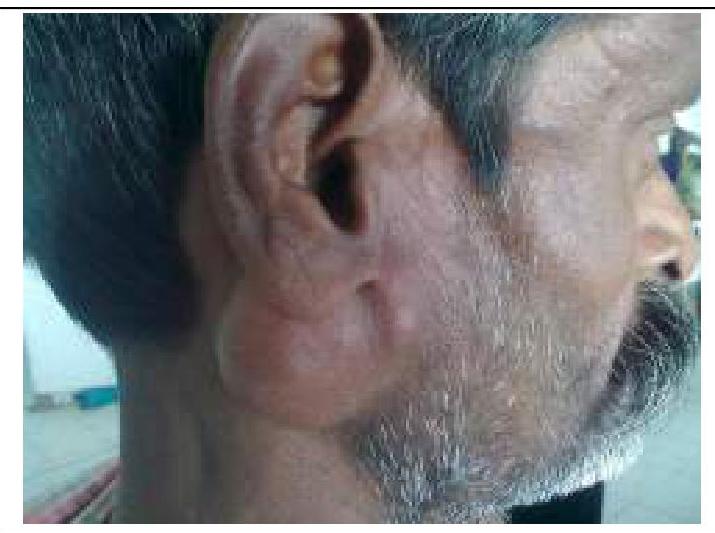
1 questionsWhat is the most likely diagnosis for the parotid mass with mixed consistency shown in the image?

NEET-PG 2019 - Surgery NEET-PG Practice Questions and MCQs
Question 121: What is the most likely diagnosis for the parotid mass with mixed consistency shown in the image?
- A. Pleomorphic adenoma (Correct Answer)
- B. Sebaceous cyst
- C. Dermoid cyst
- D. None of the options
Explanation: ***Pleomorphic adenoma*** - The **mixed consistency** of the parotid mass indicates a **benign tumor**, predominantly of epithelial and mesenchymal origin, typical of pleomorphic adenomas. - This type of tumor is usually **pain-free** and can exhibit a **soft** and **firm** texture on examination [1]. *Sebaceous cyst* - Typically presents as a **smooth, fluctuant nodule** and usually has a **firm consistency** rather than mixed. - Generally not seen as a parotid mass; usually found on the skin in areas with sebaceous glands. *Dermoid cyst* - Generally presents as a **well-defined, soft, and mobile mass**, not commonly associated with mixed consistency. - Often contains **keratin** and has a more homogenous consistency rather than the mixed characteristics of pleomorphic adenoma. *All* - As not all options are suitable for the description of a **mixed consistency parotid mass**, this option is incorrect. - Only **pleomorphic adenoma** aligns with the specific clinical presentation detailed in the question [1]. **References:** [1] Kumar V, Abbas AK, et al.. Robbins and Cotran Pathologic Basis of Disease. 9th ed. Head and Neck, pp. 751-753.