Anatomy
1 questionsNerve injured in Frey’s syndrome is:
NEET-PG 2019 - Anatomy NEET-PG Practice Questions and MCQs
Question 101: Nerve injured in Frey’s syndrome is:
- A. Auriculotemporal Nerve (Correct Answer)
- B. Great auricular nerve
- C. Lingual Nerve
- D. Inferior alveolar nerve
Explanation: ***Auriculotemporal Nerve*** - Frey's syndrome (also known as **auriculotemporal syndrome**) results from damage and aberrant regeneration of the **auriculotemporal nerve**. - This leads to **sweating and flushing** in the pre-auricular and temporal regions in response to salivary stimuli (e.g., eating). *Great auricular nerve* - The great auricular nerve primarily provides **sensory innervation** to the skin over the parotid gland, mastoid process, and auricle. - While it can be injured during parotid surgery, its damage typically causes **sensory deficits** (numbness) rather than gustatory sweating. *Lingual Nerve* - The lingual nerve provides **general sensation** and **taste** to the anterior two-thirds of the tongue and innervates the submandibular and sublingual glands. - Injury to this nerve leads to issues with **taste and sensation of the tongue**, not gustatory sweating in the face. *Inferior alveolar nerve* - The inferior alveolar nerve provides **sensory innervation** to the lower teeth and lower lip, and its mental branch supplies the chin. - Damage to this nerve is typically associated with **numbness or altered sensation** in the lower dental arch, lip, and chin, not Frey's syndrome.
Anesthesiology
1 questionsIV administration of which anesthetic drug is most painful among the following?
NEET-PG 2019 - Anesthesiology NEET-PG Practice Questions and MCQs
Question 101: IV administration of which anesthetic drug is most painful among the following?
- A. Propofol (Correct Answer)
- B. Ketamine
- C. Etomidate
- D. Methohexital
Explanation: ***Propofol*** - **Propofol** is notoriously known for causing **significant pain on injection** due to its formulation with **soybean oil emulsion** and its direct irritation of venous free nerve endings. - This pain is often described as a **burning sensation** and can be severe enough to require pre-treatment with lidocaine or administering it in a larger vein. *Methohexital* - While **methohexital** can cause localized pain and sometimes **thrombophlebitis** during intravenous administration, it is generally considered less painful than propofol. - It is a **barbiturate** and its discomfort is typically related to its alkaline pH and potential for venous irritation. *Ketamine* - **Ketamine** typically causes **minimal pain on injection** when administered intravenously. - Its mechanism of action as an **NMDA receptor antagonist** does not generally involve direct irritation of venous endothelium in the same way as propofol. *Etomidate* - **Etomidate**, like methohexital, can cause some **pain and irritation on injection**, and poses a risk of **thrombophlebitis**. - However, the severity of pain is generally **less pronounced** compared to the distinct and often intense burning sensation associated with propofol.
Internal Medicine
3 questionsWhich of the following statements about deep venous thrombosis (DVT) is incorrect?
In which condition are solitary lytic lesions typically seen?
Type of sensation lost on same side of Brown Sequard syndrome?
NEET-PG 2019 - Internal Medicine NEET-PG Practice Questions and MCQs
Question 101: Which of the following statements about deep venous thrombosis (DVT) is incorrect?
- A. Mostly bilateral (Correct Answer)
- B. Most common clinically presents as pain and tenderness in calf
- C. Some cases may directly present as pulmonary thromboembolism
- D. Clinical assessment highly reliable
Explanation: ***Mostly bilateral*** - DVT is typically **unilateral**, affecting one limb [2]. Bilateral DVT is less common, making this statement incorrect [2]. - The symptoms of **pain, swelling, and tenderness** are usually localized to one leg [1]. *Most common clinically presents as pain and tenderness in calf* - **Calf pain and tenderness** are common clinical presentations of DVT, especially in the lower extremities [1]. - Other common signs include **swelling, warmth, and redness** in the affected leg [1]. *Some cases may directly present as pulmonary thromboembolism* - A significant concern with DVT is that a **clot can dislodge** and travel to the lungs, causing a **pulmonary embolism (PE)**, which can be the initial presentation [1]. - PE is a potentially life-threatening complication and may present with **dyspnea, chest pain, and hemoptysis**. *Clinical assessment highly reliable* - **Clinical assessment alone is not highly reliable** for diagnosing DVT due to its variable and often non-specific presentation [2]. - A definitive diagnosis usually requires objective diagnostic tests such as **compression ultrasonography** or **D-dimer assay** [3].
Question 102: In which condition are solitary lytic lesions typically seen?
- A. Atherosclerosis
- B. Multiple myeloma (Correct Answer)
- C. Mitral stenosis
- D. Osteosarcoma
Explanation: ***Multiple myeloma*** - **Solitary lytic lesions**, also known as **"punched-out" lesions**, are a classic radiographic finding in multiple myeloma due to **plasma cell proliferation** in the bone [1]. - Patients often have **elevated serum proteins** and show signs of **renal impairment** and anemia, alongside these bone lesions [1]. *Atherosclerosis* - Primarily affects **blood vessels**, leading to plaque formation, and does not cause **lytic bone lesions**. - Clinical manifestations focus on **cardiovascular disease** rather than bone abnormalities. *Mitral stenosis* - Affects the **heart valves** and results in **heart failure** symptoms rather than causing lytic lesions in bones. - Clinical findings include **dyspnea** and signs of **pulmonary congestion**, which are unrelated to bone pathology. *Osteoblast* - Osteoblasts are **bone-forming cells**, and while they may be involved in certain bone diseases, they do not create **solitary lytic lesions**. - Lytic lesions typically arise from **osteoclast activity** or **tumor infiltration**, not from osteoblastic processes [1].
Question 103: Type of sensation lost on same side of Brown Sequard syndrome?
- A. Loss of pain sensation
- B. Loss of touch sensation
- C. Loss of proprioception (Correct Answer)
- D. Loss of temperature sensation
Explanation: ***Loss of proprioception*** - In **Brown-Séquard syndrome**, the lesion on one side of the spinal cord interrupts the **dorsal columns** on the same side, which carry **proprioception** and vibration sense [1]. - This results in the loss of **fine touch and proprioception** ipsilateral to the lesion [1]. *Loss of pain sensation* - **Pain and temperature sensations** are carried by the **spinothalamic tracts**, which cross in the spinal cord one or two levels above their entry [1]. - Therefore, a lesion in **Brown-Séquard syndrome** typically causes a loss of pain and temperature sensation **contralateral** to the lesion, starting a few segments below the injury [1]. *Loss of touch sensation* - **Crude touch** (non-discriminative touch) is carried by the spinothalamic tract, crossing to the contralateral side. - **Fine touch** (discriminative touch) is carried by the dorsal columns, which ascend ipsilaterally and cross in the medulla, leading to ipsilateral loss of fine touch in Brown-Séquard syndrome [1]. This option is too general, as fine touch is lost but crude touch involves a different pathway. *Loss of temperature sensation* - Similar to pain sensation, **temperature sensation** is carried by the **spinothalamic tracts** and crosses over in the spinal cord [1]. - This leads to a loss of temperature sensation **contralateral** to the lesion below the level of injury in **Brown-Séquard syndrome** [1].
Microbiology
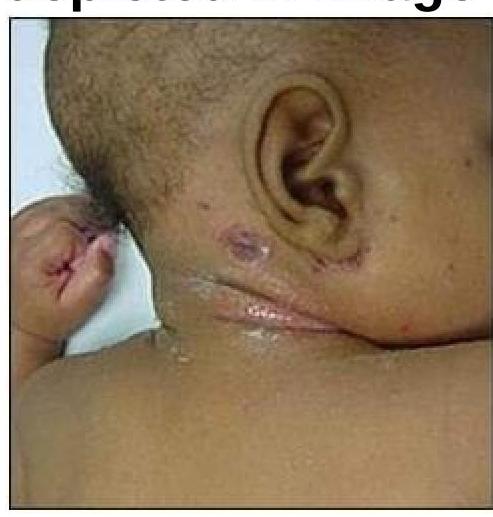
1 questionsWhat is the causative organism for the condition depicted in the image?

NEET-PG 2019 - Microbiology NEET-PG Practice Questions and MCQs
Question 101: What is the causative organism for the condition depicted in the image?
- A. Staphylococci (Correct Answer)
- B. Candidal infection
- C. Streptococcus
- D. Actinomycetes
Explanation: ***Staphylococci*** - The image shows **impetigo** with **crusted lesions**, consistent with **_Staphylococcus aureus_** infection. - **Staphylococcus aureus** is a major causative organism of impetigo, particularly **bullous impetigo**, and commonly produces the characteristic **honey-colored crusts** seen in non-bullous forms as well. - This superficial bacterial skin infection is highly contagious and responds well to topical or systemic antibiotics. *Candidal infection* - **Candidal infections** (e.g., candidiasis) typically present as **erythematous patches** with satellite lesions, or white plaques in mucosal areas, which is not consistent with the image. - This fungal infection is often seen in immunocompromised individuals or in warm, moist skin folds, not as crusted superficial lesions. *Streptococcus* - While **_Streptococcus pyogenes_** can also cause impetigo (especially non-bullous impetigo), the clinical presentation in the image is most consistent with **staphylococcal infection**. - Streptococcal infections may present similarly but can also cause other conditions like cellulitis or erysipelas with distinct features. *Actinomycetes* - **Actinomycosis** is a rare, chronic bacterial infection that forms **abscesses and sinus tracts**, often with "sulfur granules," which is distinct from the superficial skin lesions shown. - This infection usually involves deeper tissues and presents as a chronic, indolent infection, unlike the acute superficial presentation of impetigo.
Obstetrics and Gynecology
4 questionsThe major contributor to amniotic fluid after 20 weeks of gestation is:
Day 20 of menstrual cycle falls under which phase?
A patient with recurrent abortion is diagnosed to have antiphospholipid syndrome. What will be the treatment?
Nuchal translucency in USG can be detected at_____weeks of gestation.
NEET-PG 2019 - Obstetrics and Gynecology NEET-PG Practice Questions and MCQs
Question 101: The major contributor to amniotic fluid after 20 weeks of gestation is:
- A. Fetal urine (Correct Answer)
- B. Fetal skin
- C. Ultrafiltrate of maternal plasma
- D. Fluid from fetal lungs
Explanation: ***Fetal urine*** - After **20 weeks of gestation**, the **fetal kidneys** are fully functional, and fetal urination becomes the primary source of amniotic fluid. - This contribution is crucial for the **volume of amniotic fluid** and plays a vital role in **fetal lung development** by allowing the fetus to "breathe" the fluid. *Ultrafiltrate of maternal plasma* - While an ultrafiltrate of maternal plasma contributes to the early amniotic fluid volume, its significance diminishes as the **fetal kidneys mature** past 20 weeks. - This source primarily provides water and dissolved solutes, but not a substantial volume. *Fluid from fetal lungs* - Fluid produced by the fetal lungs also contributes to amniotic fluid, but its volume is considerably smaller than that from **fetal urine**, especially after 20 weeks. - It mainly includes pulmonary surfactants and other specific proteins important for lung maturation. *Fetal skin* - Before **keratinization** of the fetal skin (around 20-22 weeks), the skin is permeable and allows for transepidermal fluid transport, contributing to amniotic fluid. - However, once **keratinization** is complete, the skin becomes impermeable, and its contribution to amniotic fluid becomes negligible.
Question 102: Day 20 of menstrual cycle falls under which phase?
- A. Menstrual phase
- B. Follicular phase
- C. Ovulation phase
- D. Luteal phase (Correct Answer)
Explanation: ***Luteal phase*** - The **luteal phase** typically starts after ovulation, around day 14, and lasts until menstruation begins, usually day 28 of a 28-day cycle. Therefore, **day 20 falls squarely within this phase**. - During this phase, the **corpus luteum** forms and produces **progesterone**, preparing the uterus for potential pregnancy. *Menstrual phase* - The **menstrual phase** is the period of shedding of the uterine lining, typically occurring from **day 1 to day 5** of the menstrual cycle. - Day 20 is well past this phase, during which bleeding and low hormone levels are characteristic. *Follicular phase* - The **follicular phase** starts on day 1 of menstruation and lasts until ovulation, usually around **day 13-14** in a 28-day cycle. - During this phase, follicles mature under the influence of **FSH** and **estrogen** levels rise. Day 20 is beyond this period. *Ovulation phase* - The **ovulation phase** is a short period, typically around **day 14** of a 28-day cycle, when the mature egg is released from the ovary. - This phase is brief and marks the transition from the follicular to the luteal phase, so day 20 is considerably after ovulation.
Question 103: A patient with recurrent abortion is diagnosed to have antiphospholipid syndrome. What will be the treatment?
- A. Aspirin alone
- B. Aspirin, Low molecular weight Heparin, and Prednisolone
- C. No treatment required
- D. Aspirin and Low molecular weight Heparin (Correct Answer)
Explanation: ***Aspirin and Low molecular weight Heparin*** - The combination of **low-dose aspirin (75-100 mg daily)** and **low molecular weight heparin (LMWH)** is the **standard of care** for pregnant women with antiphospholipid syndrome (APS) to prevent recurrent pregnancy loss. - **Aspirin** inhibits platelet aggregation and reduces thrombosis, while **LMWH** provides anticoagulation to prevent placental thrombosis and improve pregnancy outcomes. - This combination has been shown to **increase live birth rates** from approximately 40% (untreated) to **70-80%** in women with APS. *Aspirin alone* - While aspirin is part of the treatment regimen, **aspirin monotherapy is insufficient** for preventing recurrent pregnancy loss in patients with established APS. - Randomized controlled trials have demonstrated that adding heparin to aspirin **significantly improves live birth rates** compared to aspirin alone. *Aspirin, Low molecular weight Heparin, and Prednisolone* - **Corticosteroids (prednisolone)** are **not recommended** as routine treatment for recurrent pregnancy loss in APS patients due to potential maternal complications (gestational diabetes, hypertension, infection) and fetal risks. - Corticosteroids might be considered only in specific cases with coexisting autoimmune conditions (e.g., SLE), but they are **not first-line therapy** for APS-related pregnancy loss. *No treatment required* - **Antiphospholipid syndrome (APS)** is a significant cause of recurrent pregnancy loss due to placental thrombosis and impaired placental function. - **Untreated APS** carries a **high risk** (>70%) of pregnancy loss, along with increased risks of fetal growth restriction, preeclampsia, and preterm delivery, making treatment **essential** for a successful pregnancy outcome.
Question 104: Nuchal translucency in USG can be detected at_____weeks of gestation.
- A. 11-13 weeks (Correct Answer)
- B. 18-20 weeks
- C. 8-10 weeks
- D. 20-22 weeks
Explanation: ***11-13 weeks*** - Nuchal translucency (NT) is a **first-trimester ultrasound marker** used for screening for chromosomal abnormalities like **Down syndrome**. - The optimal window for accurate measurement is between **11 weeks 0 days and 13 weeks 6 days** of gestation, or when the crown-rump length (CRL) is between 45 mm and 84 mm. *18-20 weeks* - This period is typically dedicated to the **anomaly scan** or **mid-pregnancy scan**, which focuses on detecting structural abnormalities in the fetus. - While other markers like **nuchal fold thickness** can be assessed later, the diagnostic value of Nuchal Translucency is decreased by this time. *8-10 weeks* - At this early stage, the fetus is generally **too small** for accurate and consistent measurement of the nuchal translucency. - The nuchal translucency itself might not be fully developed or easily distinguishable for precise measurement. *20-22 weeks* - By this gestational age, the **nuchal translucency has usually resolved** or is no longer a reliable marker for chromosomal screening. - This period is well beyond the recommended window for NT measurement, making it unsuitable for this specific screening test.