Flask shaped ulcers in colon are caused by:-
A neonate was found to have cataract, deafness and cardiac defects. Which group of viruses was the mother infected with?
Flask-shaped ulcers in the intestine are caused by which of the following?
A person working in an abattoir presented with malignant pustule on hand. What is the causative agent?
A 9-year-old child presented to OPD with complaints of high-grade fever, vomiting, and one episode of seizure. CSF examination was done and Gram staining of the culture showed lanceolate-shaped gram-positive diplococci. What is the probable causative agent?
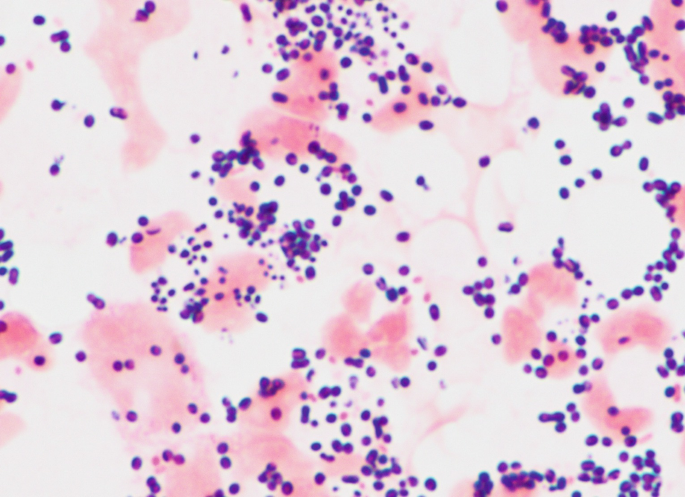
Rubella is caused by
A 35 year old man presented with dry cough and rusty colored sputum. He has a history of eating in a Chinese restaurant very often with consumption of crabs. What is the probable causative agent in this condition?
The following culture medium is used for the isolation of: (NEET Pattern 2019)

CSF gram stain of a child suffering with meningitis is shown below. What is the causative agent? (NEET Pattern 2019)

NEET-PG 2019 - Microbiology NEET-PG Practice Questions and MCQs
Question 11: Flask shaped ulcers in colon are caused by:-
- A. Entamoeba histolytica (Correct Answer)
- B. Giardia lamblia
- C. Enterobius vermicularis
- D. H. Pylori
Explanation: ***Entamoeba histolytica*** - *Entamoeba histolytica* is a protozoan parasite that invades the **colonic mucosa**, leading to characteristic **flask-shaped ulcers**. - These ulcers are formed as the trophozoites penetrate the epithelium and spread laterally through the submucosa, creating a narrow neck at the mucosal surface and a wider base below. *Giardia lamblia* - *Giardia lamblia* causes **giardiasis**, primarily affecting the **small intestine** and leading to malabsorption and diarrhea. - It typically does not cause invasive disease or ulcer formation in the colon, instead, it attaches to the intestinal villi. *Enterobius vermicularis* - *Enterobius vermicularis* is an intestinal nematode (pinworm) that causes **enterobiasis**, commonly manifesting as **perianal itching**, especially at night. - It is a non-invasive parasite and does not cause ulcers in the colon. *H. Pylori* - *H. pylori* is a bacterium primarily associated with infections of the **stomach** and **duodenum**, causing gastritis, peptic ulcers, and increasing the risk of gastric cancer. - It does not colonize the colon or cause flask-shaped ulcers.
Question 12: A neonate was found to have cataract, deafness and cardiac defects. Which group of viruses was the mother infected with?
- A. Togaviridae family (includes Rubella virus) (Correct Answer)
- B. Flaviviridae family (includes Zika virus)
- C. Bunyaviridae family (includes Rift Valley fever virus)
- D. Arenaviridae family (includes Lassa fever virus)
Explanation: ***Togaviridae family (includes Rubella virus)*** - The classic triad of **congenital rubella syndrome (CRS)** includes **cataracts**, **deafness**, and **cardiac defects** (e.g., patent ductus arteriosus, pulmonary artery stenosis). - Rubella virus is a member of the **Togaviridae family** and causes significant fetal damage if the mother is infected during the first trimester. *Flaviviridae family (includes Zika virus)* - While congenital Zika syndrome can cause severe birth defects, it is primarily associated with **microcephaly**, intracranial calcifications, and ocular abnormalities, not typically the classic rubella triad. - **Deafness** and **linear cataracts** are not characteristic features of congenital Zika infection. *Bunyaviridae family (includes Rift Valley fever virus)* - Rift Valley fever virus is primarily transmitted by mosquitoes and causes **febrile illness** in humans and livestock, with potential for **hemorrhagic fever** or **encephalitis**. - It is not known to cause congenital abnormalities resembling cataracts, deafness, and cardiac defects in neonates. *Arenaviridae family (includes Lassa fever virus)* - Lassa fever virus causes a severe **hemorrhagic fever** in humans, primarily through contact with infected rodents or person-to-person transmission. - It is not associated with congenital malformations such as cataracts, deafness, and cardiac defects.
Question 13: Flask-shaped ulcers in the intestine are caused by which of the following?
- A. TB
- B. Giardia
- C. Entamoeba histolytica (Correct Answer)
- D. Typhoid
Explanation: ***Entamoeba histolytica*** - *Entamoeba histolytica* is a protozoan that causes **amoebiasis**, which is characterized by **flask-shaped (bottle-shaped) ulcers** in the colon - this is the **pathognomonic feature** of intestinal amoebiasis. - The trophozoites invade the intestinal mucosa and submucosa, creating a **narrow neck at the mucosal surface** and a **wider base in the submucosa**, giving them their unique flask-like appearance. - These ulcers are most commonly found in the **cecum and ascending colon**. *TB* - Intestinal tuberculosis typically causes **transverse ulcers** (perpendicular to the bowel axis) due to lymphatic spread and caseous necrosis, often in the ileocecal region. - These ulcers are usually associated with **granulomas** and acid-fast bacilli, which are histologically distinct from flask-shaped ulcers. *Giardia* - *Giardia lamblia* (or *intestinalis*) is a flagellate that causes **giardiasis**, primarily adhering to the small intestinal villi and causing malabsorption and diarrhea. - It is **non-invasive** and does not penetrate the intestinal wall or cause ulcer formation; its pathology is mainly due to **mucosal inflammation** and villous blunting. *Typhoid* - Typhoid fever, caused by *Salmonella Typhi*, commonly leads to **longitudinal ulcers** (parallel to the bowel axis) in the **Peyer's patches** of the ileum due to bacterial invasion and necrosis of lymphoid tissue. - These ulcers may perforate but do not present with the flask-shaped morphology characteristic of amoebiasis.
Question 14: A person working in an abattoir presented with malignant pustule on hand. What is the causative agent?
- A. Clostridium botulinum
- B. Bacillus anthracis (Correct Answer)
- C. Streptococcus pyogenes
- D. Clostridium perfringens
Explanation: **Bacillus anthracis** - The presence of a **malignant pustule** on the hand, especially in an individual working in an **abattoir** (exposure to animals/animal products), is highly characteristic of **cutaneous anthrax**. - **Bacillus anthracis** is a **spore-forming bacterium** that causes anthrax, and the cutaneous form typically presents as a painless ulcer that develops into a black eschar. *Clostridium botulinum* - This bacterium causes **botulism**, a severe **neuroparalytic disease** characterized by flaccid paralysis. - It does not cause cutaneous lesions like a malignant pustule and is typically associated with **food poisoning** or wound infections leading to toxin production. *Streptococcus pyogenes* - This bacterium is a common cause of various infections, including **strep throat**, **impetigo**, **erysipelas**, and **necrotizing fasciitis**. - While it can cause skin infections, it does not typically present as a "malignant pustule" with the characteristic eschar seen in anthrax. *Clostridium perfringens* - This bacterium is a common cause of **gas gangrene** (myonecrosis) and **food poisoning**. - While it can cause severe tissue infections, it does not present as a malignant pustule.
Question 15: A 9-year-old child presented to OPD with complaints of high-grade fever, vomiting, and one episode of seizure. CSF examination was done and Gram staining of the culture showed lanceolate-shaped gram-positive diplococci. What is the probable causative agent?
- A. Haemophilus influenzae
- B. Streptococcus agalactiae
- C. Neisseria meningitidis
- D. Streptococcus pneumoniae (Correct Answer)
Explanation: ***Streptococcus pneumoniae*** - The description of **lanceolate-shaped gram-positive diplococci** in CSF is characteristic of *S. pneumoniae*. - This bacterium is a common cause of **bacterial meningitis** in children and can present with high fever, vomiting, and seizures. *Haemophilus influenzae* - This is a **gram-negative coccobacillus**, which would appear as small, pleomorphic rods rather than lanceolate-shaped diplococci on Gram stain. - While it causes meningitis, its Gram stain morphology is distinct from *S. pneumoniae*. *Streptococcus agalactiae* - *S. agalactiae* (Group B Streptococcus) is a **gram-positive coccus**, but it typically appears in **chains** and is a major cause of neonatal meningitis, not usually in a 9-year-old child. - Its morphology on Gram stain would not be described as lanceolate diplococci. *Neisseria meningitidis* - *N. meningitidis* is a **gram-negative diplococcus** and would appear as kidney-bean shaped or flattened paired cocci, not gram-positive. - Though a common cause of meningitis, the Gram stain morphology described rules it out.
Question 16: Rubella is caused by
- A. Paramyxovirus
- B. Orthomyxovirus
- C. Togavirus (Correct Answer)
- D. Flavivirus
Explanation: ***Correct Answer: Togavirus*** - Rubella virus is classified under the genus *Rubivirus* within the family **Togaviridae** - Togaviruses are **enveloped, positive-sense, single-stranded RNA viruses** - Rubella causes German measles, characterized by mild fever and maculopapular rash - Important for congenital rubella syndrome when infection occurs during pregnancy *Incorrect: Paramyxovirus* - This family includes viruses like **measles (rubeola)** and **mumps** - Paramyxoviruses are enveloped, negative-sense, single-stranded RNA viruses - Different structural and genetic characteristics from rubella virus *Incorrect: Orthomyxovirus* - This family primarily consists of **influenza viruses** (types A, B, and C) - Orthomyxoviruses are enveloped, **negative-sense, segmented** RNA viruses - The segmented genome distinguishes them from rubella virus *Incorrect: Flavivirus* - This family includes **dengue virus**, **yellow fever virus**, and **Zika virus** - While flaviviruses are also enveloped, positive-sense, single-stranded RNA viruses, they belong to the family *Flaviviridae*, not Togaviridae - Different envelope proteins and replication strategies distinguish them from rubella virus
Question 17: A 35 year old man presented with dry cough and rusty colored sputum. He has a history of eating in a Chinese restaurant very often with consumption of crabs. What is the probable causative agent in this condition?
- A. Pneumocystis jirovecii
- B. Paragonimus westermani (Correct Answer)
- C. Strongyloides stercoralis
- D. Diphyllobothrium latum
Explanation: ***Paragonimus westermani*** - The key clinical features are **dry cough**, **rusty-colored sputum**, and a history of consuming **crabs**. These are classic indicators of **paragonimiasis**. - *Paragonimus westermani* is a **lung fluke** acquired by eating undercooked freshwater crabs or crayfish. *Pneumocystis jirovecii* - This fungus typically causes pneumonia in **immunocompromised individuals**, like those with HIV/AIDS. - While it can cause a dry cough, **rusty-colored sputum** is not a characteristic sign, and there's no mention of immunocompromise. *Strongyloides stercoralis* - This parasite primarily causes **gastrointestinal symptoms** (e.g., abdominal pain, diarrhea) and can lead to cutaneous manifestations (larva currens). - While lung involvement can occur in severe cases (hyperinfection), it does not typically present with **rusty sputum** or a direct association with crab consumption. *Diphyllobothrium latum* - This is the **fish tapeworm**, acquired by eating undercooked freshwater fish. - It primarily causes **gastrointestinal symptoms** such as abdominal pain and diarrhea, and is known for causing **vitamin B12 deficiency** leading to megaloblastic anemia, not pulmonary symptoms.
Question 18: The following culture medium is used for the isolation of: (NEET Pattern 2019)
- A. Listeria
- B. Legionella (Correct Answer)
- C. Escherichia
- D. Campylobacter
Explanation: ***Legionella*** - The image displays growth on **buffered charcoal yeast extract (BCYE) agar**, which is the selective medium for the isolation of *Legionella* species. - *Legionella* requires **L-cysteine** and **iron salts** for growth, which are provided in BCYE agar, making it distinctively well-suited for its isolation. *Listeria* - *Listeria* species are typically isolated on selective media such as Oxford agar or PALCAM agar, which contain **antibiotics** and **chromogenic substrates** to differentiate them from other bacteria. - While *Listeria* can grow on general purpose media, BCYE agar is not the primary selective medium for its isolation. *Escherichia* - **Escherichia coli** is a common fecal coliform that grows readily on various non-selective media like blood agar and selective/differential media such as MacConkey agar (lactose fermenter with pink colonies) or eosin methylene blue (EMB) agar (green metallic sheen colonies). - BCYE agar is not a standard medium for *Escherichia* isolation, as it lacks the necessary components for its optimal differentiation and growth. *Campylobacter* - **Campylobacter** species are **microaerophilic** and require specialized selective media like **Campy-BAP (Campylobacter Blood Agar Plate)**, Skirrow's medium, or CCDA (cefoperazone charcoal deoxycholate agar). - These media contain antibiotics to inhibit normal flora and are incubated in a microaerophilic atmosphere; BCYE agar is not used for *Campylobacter* isolation.
Question 19: CSF gram stain of a child suffering with meningitis is shown below. What is the causative agent? (NEET Pattern 2019)
- A. Streptococcus pneumoniae
- B. H. influenzae (Correct Answer)
- C. Klebsiella pneumoniae
- D. Staphylococcus aureus
Explanation: ***H. Influenzae*** - The image shows **Gram-negative rods or coccobacillary forms**, which are characteristic of *Haemophilus influenzae*. - *H. influenzae* is a common cause of **bacterial meningitis** in children, particularly before the widespread use of vaccines. *Streptococcus pneumoniae* - This bacterium would appear as **Gram-positive cocci** in pairs or short chains, which is not consistent with the image. - *Streptococcus pneumoniae* is also a common cause of meningitis but has a distinct morphological appearance. *Klebsiella pneumonia* - While *Klebsiella pneumoniae* is a Gram-negative rod, it is typically a larger, more plump rod, and less commonly a cause of **pediatric meningitis** compared to *H. influenzae*. - The morphology in the image, particularly the coccobacillary appearance, is more typical of *Haemophilus*. *Staphylococcus aureus* - This bacterium would appear as **Gram-positive cocci** in grape-like clusters, which clearly differs from the Gram-negative rods/coccobacillary forms seen in the image. - *Staphylococcus aureus* can cause meningitis, especially in cases of head trauma or neurosurgery, but its morphology is distinct.