Internal Medicine
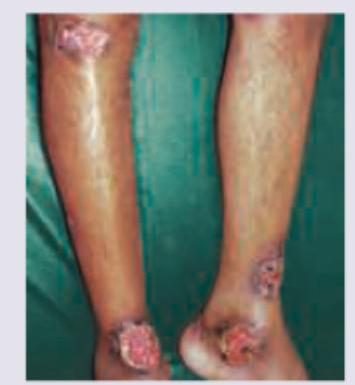
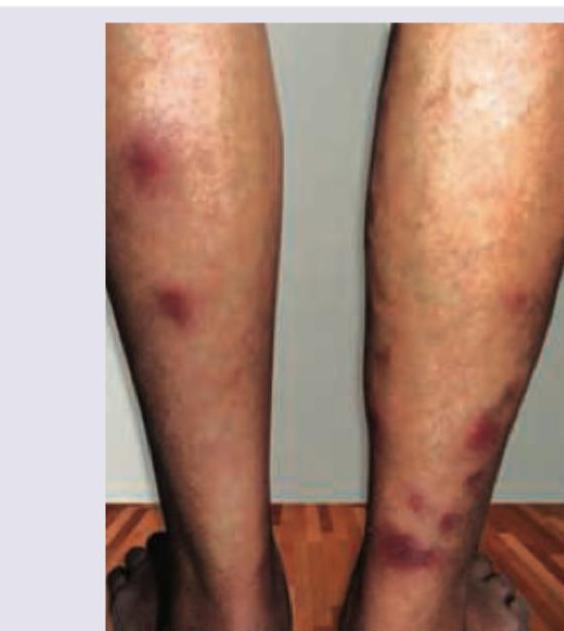
3 questionsA 40-year-old woman with history of progressive shortness of breath has lesions on her legs as shown. HbA1C of the patient is 5.8%. Lipid profile shows serum cholesterol 175 mg%. What is the diagnosis? (Recent NEET Pattem 2016-17)

The EEG of the patient shows which of the following? (Recent NEET Pattern 2016-17)

The EEG of a 16-year-old boy with early morning involuntary movements of hands in his sleep noticed by parents, was performed. Immunization is complete. What does EEG show? (Recent NEET Pattern 2016-17)

NEET-PG 2017 - Internal Medicine NEET-PG Practice Questions and MCQs
Question 71: A 40-year-old woman with history of progressive shortness of breath has lesions on her legs as shown. HbA1C of the patient is 5.8%. Lipid profile shows serum cholesterol 175 mg%. What is the diagnosis? (Recent NEET Pattem 2016-17)
- A. Necrobiosis lipidoica diabeticorum
- B. Xanthoma
- C. Carotenemia
- D. Erythema nodosum (Correct Answer)
Explanation: ***Erythema Nodosum*** - The image shows **tender, red nodules** primarily on the shins, consistent with the characteristic presentation of erythema nodosum. - While exact values for **HbA1c** and **cholesterol** don't directly diagnose this, erythema nodosum is often associated with systemic conditions, and the patient's progressive shortness of breath prompts further investigation into potential underlying causes. *Necrobiosis lipoidica diabeticorum* - This condition presents as **well-demarcated, yellow-brown patches** with a waxy or atrophic center, often with telangiectasias, not the acute tender nodules seen here. - Although it is associated with **diabetes**, the patient's HbA1c (5.8%) is within the prediabetic range, not typically indicative of established diabetes that commonly precedes significant necrobiosis lipoidica. *Xanthoma* - Xanthomas are **yellowish plaques or nodules** caused by lipid deposits in the skin, which can vary in appearance depending on the type (e.g., eruptive, tendinous, planar). - While hyperlipidemia can cause xanthomas, the patient's **normal cholesterol level** (175 mg%) makes this diagnosis less likely, and the lesions in the image are more erythematous and nodular than typical xanthomas. *Carotenemia* - **Carotenemia** is characterized by a harmless **yellow-orange discoloration of the skin**, particularly on the palms and soles, caused by excessive intake of carotene-rich foods. - This condition does not present with discrete, erythematous nodules as depicted in the image.
Question 72: The EEG of the patient shows which of the following? (Recent NEET Pattern 2016-17)
- A. Burst suppression pattern (Correct Answer)
- B. Rademecker complex
- C. 3/sec spike and slow wave pattern
- D. 4-6 Hz Polyspike
Explanation: ***Burst suppression pattern*** - The EEG shows periods of high amplitude, mixed-frequency **bursts of activity** alternating with periods of **relative electrical silence** (suppression). - This pattern is often seen in conditions like severe **hypoxic-ischemic encephalopathy**, deep **anesthesia**, or severe brain injury. *Rademecker complex* - This refers to periodic trifasic complexes, often associated with subacute sclerosing panencephalitis (SSPE), which is a **slow viral infection** of the brain. - The complexes are typically **bilateral, synchronous, and repetitive**, not characterized by alternating bursts and suppression. *3/sec spike and slow wave pattern* - This pattern is characteristic of **absence seizures (petit mal epilepsy)**, where there are generalized, synchronous 3 Hz spike-and-wave discharges. - The image does not show continuous, rhythmic 3 Hz activity but rather alternating periods of activity and flat-lining. *4-6 Hz Polyspike* - Polyspikes are a series of two or more spikes or sharp waves clustered together, often associated with **myoclonic seizures** or other generalized epilepsies. - While there are some sharp waves in the burst phases, the overall pattern is dominated by the distinct periods of suppression, not continuous polyspike activity.
Question 73: The EEG of a 16-year-old boy with early morning involuntary movements of hands in his sleep noticed by parents, was performed. Immunization is complete. What does EEG show? (Recent NEET Pattern 2016-17)
- A. Juvenile myoclonic epilepsy (Correct Answer)
- B. SSPE
- C. Benign rolandic epilepsy
- D. Huntington chorea
Explanation: ***Juvenile myoclonic epilepsy*** - The EEG shows generalized **polyspike-and-slow-wave discharges**, which are characteristic of juvenile myoclonic epilepsy (JME), especially when associated with early morning myoclonus. - The clinical presentation of a **16-year-old boy** with **involuntary movements of hands in his sleep** (suggesting myoclonic jerks), particularly in the morning, is highly consistent with JME. *SSPE* - Subacute sclerosing panencephalitis (SSPE) typically presents with characteristic EEG patterns like **Radermacker complexes** or **periodic complexes**, which are not seen here. - Clinical features of SSPE include progressive cognitive decline, myoclonus, and other neurological deficits, usually following a measles infection, which are not described. *Benign rolandic epilepsy* - Benign rolandic epilepsy (BRE) is characterized by **centrotemporal spikes** on EEG, often exacerbated by sleep, and presents with focal seizures affecting the face and mouth. - The generalized polyspike-and-slow-wave pattern and the clinical description of hand myoclonus do not fit the profile of BRE. *Huntington chorea* - Huntington's chorea is a **neurodegenerative genetic disorder** characterized by involuntary movements (chorea), cognitive decline, and psychiatric problems. - EEG findings in Huntington's chorea are often non-specific or show generalized slowing, and it is not an epilepsy syndrome with specific high-amplitude epileptiform discharges like those seen.
Pediatrics
5 questionsWhich of the following is correct about the image shown? (Recent NEET Pattern 2016-17)

Comment on the diagnosis of this child, presenting with eye swelling. (Recent NEET Pattern 2016-17)

Neonate born at 34 weeks with premature rupture of membranes develops respiratory distress. CXR was performed. All are considered in differential diagnosis except:

Preterm child on cow milk due to death of mother is having blood in stools. X-ray abdomen was done. Diagnosis is:

Which of the following is the best diagnosis of this neonate who is excessively hungry, warm with flushed skin?

NEET-PG 2017 - Pediatrics NEET-PG Practice Questions and MCQs
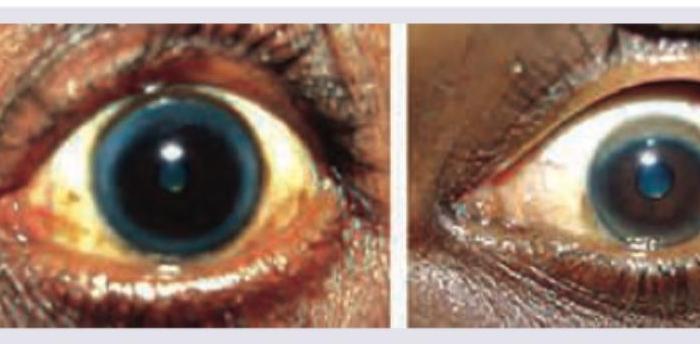
Question 71: Which of the following is correct about the image shown? (Recent NEET Pattern 2016-17)
- A. A = Arcus senilis, B = Kayser-Fleischer ring
- B. A = Kayser Fleischer ring, B = Arcus senilis (Correct Answer)
- C. A = Arcus senilis, B = Hudson-Stahli line
- D. A = Hudson-Stahli line, B = Arcus senilis
Explanation: ***A = Kayser Fleischer ring, B = Arcus senilis*** - Image A displays a **Kayser-Fleischer ring**, a greenish-brown ring in the periphery of the cornea, characteristic of **Wilson's disease** due to copper deposition. - Image B shows **arcus senilis**, a milky-white or grayish ring around the cornea, which is a **common age-related change** due to lipid deposits, and can appear at any age. *A = Arcus senilis, B = Kayser-Fleischer ring* - This option incorrectly identifies the lesions; the ring in image A is associated with copper deposition, not lipid deposition. - The ring in image B is clearly a common lipid ring often seen in older individuals, contrasting with the distinct appearance of a Kayser-Fleischer ring. *A = Arcus senilis, B = Hudson-Stahli line* - Image A does not show arcus senilis; its color and location are consistent with copper deposition. - Image B does not depict a Hudson-Stahli line, which is a thin, brownish-linear deposit of iron in the corneal epithelium, typically horizontal and not circumferential. *A = Hudson-Stahli line, B = Arcus senilis* - Image A's appearance, as a circumferential greenish-brown deposit, is not consistent with a linear Hudson-Stahli line. - While image B correctly identifies arcus senilis, the identification of A as a Hudson-Stahli line is incorrect.
Question 72: Comment on the diagnosis of this child, presenting with eye swelling. (Recent NEET Pattern 2016-17)
- A. Chloroma
- B. Neuroblastoma (Correct Answer)
- C. Wilms tumor
- D. Ameloblastoma
Explanation: ***Neuroblastoma*** - The image shows **periorbital ecchymosis** and **proptosis** in a child, which are classic signs of orbital metastatic neuroblastoma, often referred to as "raccoon eyes." - The abdominal scar suggests a prior surgery, possibly for removal of the primary tumor, which is typically found in the **adrenal gland** or **sympathetic ganglia**. *Chloroma* - **Chloromas** (also known as granulocytic sarcomas) are extramedullary manifestations of myeloid leukemia, presenting as solid tumors composed of myeloid blast cells. - While they can appear in the orbit and mimic proptosis, the presence of bilateral periorbital ecchymosis ("raccoon eyes") is more characteristic of neuroblastoma metastasis. *Wilms tumor* - **Wilms tumor** is a kidney cancer, typically presenting as an **abdominal mass** and occasionally with hypertension or hematuria. - Ocular manifestations, such as proptosis, are extremely **rare** and do not typically involve periorbital ecchymosis. *Ameloblastoma* - An **ameloblastoma** is a benign but locally aggressive tumor of odontogenic (tooth-forming) origin, primarily affecting the **jawbones**. - It does not metastasize to the orbit and would not present with periorbital swelling or ecchymosis.
Question 73: Neonate born at 34 weeks with premature rupture of membranes develops respiratory distress. CXR was performed. All are considered in differential diagnosis except:
- A. Congenital pneumonia
- B. Hyaline membrane disease
- C. Congenital alveolar proteinosis
- D. Tetralogy of Fallot (Correct Answer)
Explanation: ***Tetralogy of Fallot*** - **Tetralogy of Fallot** is a **cyanotic congenital heart defect** characterized by VSD, pulmonary stenosis, right ventricular hypertrophy, and overriding aorta. - It presents primarily with **cyanosis** (not respiratory distress) and would show **normal or oligemic lung fields** on CXR, not the diffuse parenchymal lung disease patterns seen in RDS, pneumonia, or alveolar proteinosis. - **Not part of the differential diagnosis** for a preterm neonate with PROM presenting with respiratory distress and lung infiltrates on imaging. *Congenital pneumonia* - This is a significant concern in a neonate born prematurely with **premature rupture of membranes (PROM)**, as ascending infection is a known risk factor. - Chest X-ray findings can include **diffuse hazy infiltrates** or **patchy consolidation**, consistent with infections. - Would be considered in the differential diagnosis. *Hyaline membrane disease* - Also known as **respiratory distress syndrome (RDS)**, this is common in **premature infants at 34 weeks** due to **surfactant deficiency**. - The chest X-ray typically shows **diffuse reticulogranular ground-glass opacities** and **air bronchograms**. - Most common cause of respiratory distress in preterm neonates and a key differential. *Congenital alveolar proteinosis* - This is a rare genetic disorder where **surfactant proteins accumulate in the alveoli**, leading to impaired gas exchange and respiratory distress. - Chest X-ray findings often include **diffuse alveolar infiltrates** or consolidation, which can resemble other neonatal lung diseases. - Though rare, must be considered in the differential for neonatal respiratory distress.
Question 74: Preterm child on cow milk due to death of mother is having blood in stools. X-ray abdomen was done. Diagnosis is:
- A. Rigler sign (Correct Answer)
- B. Double bubble appearance
- C. Claw sign
- D. Bird of prey sign
Explanation: ***Rigler sign*** - Rigler sign (also called **double wall sign**) refers to **visualization of both sides of the bowel wall** on X-ray due to **free intraperitoneal air (pneumoperitoneum)**, indicating bowel perforation. - In the clinical context of a **preterm infant on cow milk with bloody stools**, this presentation is highly suggestive of **Necrotizing Enterocolitis (NEC) with perforation**. - The X-ray shows Rigler sign as evidence of pneumoperitoneum, a serious complication of NEC requiring urgent surgical intervention. - **Key NEC radiological findings** include: pneumatosis intestinalis (intramural gas), portal venous gas, and pneumoperitoneum (Rigler sign) in cases with perforation. *Double bubble appearance* - This sign shows **two distinct air-filled structures** (distended stomach and duodenum) on abdominal X-ray, indicating **duodenal obstruction** from duodenal atresia or annular pancreas. - Not associated with bloody stools or NEC in preterm infants. *Claw sign* - The claw sign is seen in **intussusception**, where the bowel telescopes into itself, creating a soft tissue mass with a crescent-shaped gas pattern. - Typically occurs in older infants (6-18 months), not preterm neonates, and presents differently from NEC. *Bird of prey sign* - This sign is associated with **sigmoid or cecal volvulus**, showing a distended bowel loop with a beak-like configuration. - Represents large bowel obstruction, not the typical presentation of a preterm infant with feeding intolerance and bloody stools from NEC.
Question 75: Which of the following is the best diagnosis of this neonate who is excessively hungry, warm with flushed skin?
- A. Neonatal thyrotoxicosis (Correct Answer)
- B. Neonatal lupus
- C. Congenital hypothyroidism
- D. Progeria
Explanation: ***Neonatal thyrotoxicosis*** - The image shows a neonate with **exophthalmos** and signs of being **hypermetabolic** (excessively hungry, warm, flushed skin), all consistent with hyperthyroidism. - This condition occurs when **maternal thyroid-stimulating immunoglobulins** cross the placenta, causing transient hyperthyroidism in the newborn. *Neonatal lupus* - Neonatal lupus is primarily characterized by **congenital heart block** and **dermatological manifestations** (e.g., erythematous annular lesions) but does not typically present with severe metabolic hyperactivity or exophthalmos as seen here. - It is caused by the transplacental passage of maternal autoantibodies (anti-Ro/SSA and anti-La/SSB). *Congenital hypothyroidism* - Congenital hypothyroidism would present with symptoms opposite to those described, such as **lethargy**, **poor feeding**, **cold and mottled skin**, and **constipation**. - Physical features often include a **puffy face**, **macroglossia**, and an **umbilical hernia**. *Progeria* - Progeria is a rare genetic disorder characterized by **accelerated aging** that typically manifests later in infancy or early childhood with features like **alopecia**, **thin skin**, and **skeletal abnormalities**, which are not depicted or described as primary symptoms here. - It does not cause the acute signs of hypermetabolism seen in neonatal thyrotoxicosis.
Radiology
2 questionsCT abdomen shows: (Recent NEET Pattern 2016-17)

X-ray skull shows: (Recent NEET Pattern 2016-17)

NEET-PG 2017 - Radiology NEET-PG Practice Questions and MCQs
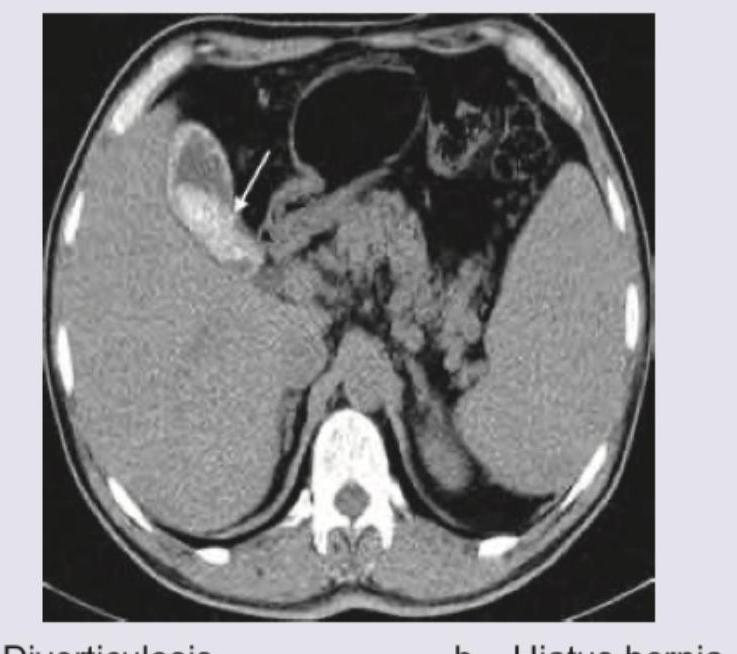
Question 71: CT abdomen shows: (Recent NEET Pattern 2016-17)
- A. Diverticulosis (Correct Answer)
- B. Hiatus hernia
- C. Gallstones
- D. Acute pancreatitis
Explanation: ***Diverticulosis*** - The image shows an out-pouching of the colonic wall (indicated by the white arrow), characteristic of a **diverticulum**. - **Diverticulosis** refers to the presence of multiple such diverticula, often seen in the colon on CT scans. *Hiatus hernia* - A hiatus hernia involves the protrusion of the **stomach** through the **esophageal hiatus** of the diaphragm into the chest cavity. - This image does not show any gastric organ extending above the diaphragm. *Gallstones* - Gallstones are calcified deposits found within the **gallbladder**, appearing as bright, high-density structures. - The structure indicated by the arrow is clearly an out-pouching of the bowel wall, not a calcified stone within the gallbladder. *Acute pancreatitis* - Acute pancreatitis is characterized by **inflammation of the pancreas**, often visible as pancreatic enlargement, peripancreatic fat stranding, and fluid collections. - The image does not show any signs suggestive of pancreatic inflammation or changes in the pancreas itself.
Question 72: X-ray skull shows: (Recent NEET Pattern 2016-17)
- A. Multiple myeloma
- B. Histiocytosis-X
- C. Letterer-Siwe disease
- D. Silver-beaten appearance (Correct Answer)
Explanation: ***Silver-beaten appearance*** - The image shows a skull with multiple **gyral impressions** on the inner table, giving it a **bumpy**, 'silver-beaten' or 'copper-beaten' appearance. - This pattern is classically associated with **chronically increased intracranial pressure**, which causes the brain's convolutions to press against the skull. *Multiple myeloma* - Multiple myeloma typically presents with multiple, sharply demarcated **"punched-out" lytic lesions** in the skull, not diffuse gyral impressions. - These lesions often lack a sclerotic rim and are more discrete than the pattern seen here. *Histiocytosis-X* - Histiocytosis-X (now called Langerhans cell histiocytosis) can cause lytic skull lesions, often described as **"beveled edge"** or geographically distributed lesions. - While it can cause osteolytic bone destruction, it does not typically produce the widespread, uniform gyral impressions of a silver-beaten skull. *Letterer-Siwe disease* - Letterer-Siwe disease is an aggressive, disseminated form of **Langerhans cell histiocytosis** affecting infants. - While it can cause bone lesions, including in the skull, it typically manifests as generalized lytic lesions rather than the "silver-beaten" pattern indicative of chronic elevated intracranial pressure.