Anatomy
1 questionsAll of the following layers are pierced by the needle shown below except:

NEET-PG 2017 - Anatomy NEET-PG Practice Questions and MCQs
Question 51: All of the following layers are pierced by the needle shown below except:
- A. Supraspinous ligament
- B. Inter-spinous ligament
- C. Ligamentum flavum
- D. Ligamentum denticulatum (Correct Answer)
Explanation: ***Ligamentum denticulatum*** - The **ligamentum denticulatum** is an internal structure of the spinal cord (specifically, pia mater extensions) and is not pierced during an LP, which targets the subarachnoid space. - It functions to suspend the spinal cord within the dura mater and is not in the pathway of the needle during a lumbar puncture. *Supraspinous ligament* - This ligament is the **first major ligament** encountered posterior to the spinous processes in the midline and must be pierced by the needle during a lumbar puncture. - It runs along the tips of the spinous processes. *Inter-spinous ligament* - Located between the spinous processes, this ligament is encountered **after the supraspinous ligament** and must be pierced during a lumbar puncture to reach deeper structures. - It connects adjacent spinous processes. *Ligamentum flavum* - This ligament is rich in elastic fibers and is pierced **before entering the epidural space** on the way to the subarachnoid space. - Its piercing is often felt as a distinct "pop" or "give" by the clinician performing the lumbar puncture.
General Medicine
2 questionsA 79-year-old male presented to the emergency department after a facial trauma. The patient had Parkinson's disease and atrial fibrillation and was on treatment with acetylsalicylic acid for AF. The image shows? (Recent NEET Pattern 2016-17)

Identify the lesion. (Recent NEET Pattern 2016-17)

NEET-PG 2017 - General Medicine NEET-PG Practice Questions and MCQs
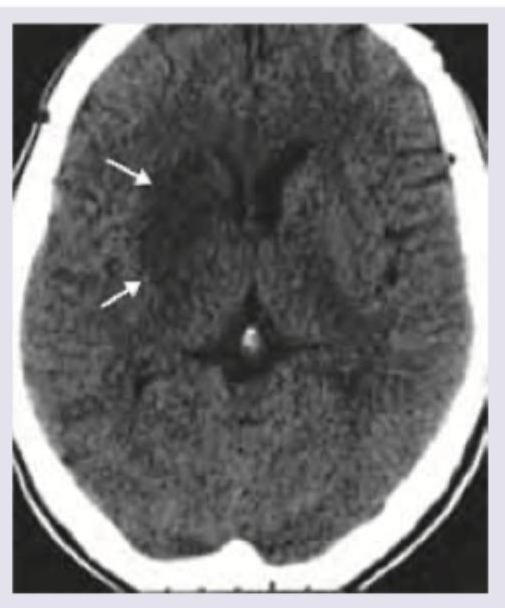
Question 51: A 79-year-old male presented to the emergency department after a facial trauma. The patient had Parkinson's disease and atrial fibrillation and was on treatment with acetylsalicylic acid for AF. The image shows? (Recent NEET Pattern 2016-17)
- A. Hydrocephalus
- B. Pneumocephalus (Correct Answer)
- C. Intraventricular bleed
- D. Subarachnoid hemorrhage
Explanation: ***Pneumocephalus*** - The image clearly shows **intracranial air** (dark areas within the brain parenchyma and ventricles, indicated by arrows) following facial trauma, consistent with **pneumocephalus**. - **Pneumocephalus** often results from fractures of the skull base or paranasal sinuses, especially after trauma, allowing air to enter the intracranial space. *Hydrocephalus* - **Hydrocephalus** involves enlargement of the **ventricles** due to an accumulation of cerebrospinal fluid, which would appear as dark, but *fluid-filled* spaces, not air-filled. - No signs of significantly dilated ventricles are observed; instead, distinct air pockets are visible, which look black on CT. *Intraventricular bleed* - An **intraventricular bleed** would appear as **hyperdense (bright)** material (blood) within the ventricles on a CT scan, which is not seen here. - The appearance of the abnormalities is **hypodense (black)**, indicating air, not blood. *Subarachnoid hemorrhage* - **Subarachnoid hemorrhage** is characterized by **hyperdense (bright)** blood filling the subarachnoid spaces, particularly the sulci and basal cisterns. - The image displays **hypodense** areas consistent with air within the brain, not diffuse bright areas of blood in the subarachnoid space.
Question 52: Identify the lesion. (Recent NEET Pattern 2016-17)
- A. Right supranuclear lesion (Correct Answer)
- B. Left supranuclear lesion
- C. Right infranuclear lesion
- D. Left infranuclear lesion
Explanation: ***Right supranuclear lesion*** - The image shows **forehead sparing** with weakness predominantly in the lower face on the viewer's left side (patient's right side). This pattern is characteristic of a **supranuclear lesion**, where the contralateral motor cortex lesion affects the lower facial muscles more significantly due to bilateral innervation of the upper facial muscles. - Since the facial weakness is on the **right side of the face** (the lower part of her face is sagging to the left, indicating right-sided weakness), the lesion is in the contralateral (left) motor cortex or its descending pathways, leading to a right-sided supranuclear facial palsy. *Left supranuclear lesion* - A left supranuclear lesion would cause **right-sided facial weakness** affecting primarily the lower face, with forehead sparing. The image shows weakness on the patient's right side, meaning the lesion is on the contralateral side, which is the left motor cortex. Therefore, while the weakness is on the right side of the face, the lesion itself is on the contralateral left side, making this option incorrect as it specifies the lesion on the same side as the observed weakness. - Supranuclear lesions affecting the left side of the brain would manifest as right-sided facial weakness. *Right infranuclear lesion* - An **infranuclear lesion** (e.g., Bell's palsy) would affect the **entire half of the face**, including the forehead, leading to an inability to wrinkle the forehead on the affected side. This is not observed in the image, as the forehead appears somewhat spared. - An infranuclear lesion on the right would cause complete paralysis of the **right half of the face**, affecting both upper and lower facial muscles. *Left infranuclear lesion* - A left infranuclear lesion would present as **complete paralysis** of the **entire left side of the face**, including the forehead and eye closure. The image clearly demonstrates **forehead sparing** and weakness primarily affecting the lower face, ruling out an infranuclear lesion. - This type of lesion would involve the facial nerve itself after it exits the brainstem, leading to ipsilateral weakness of all facial muscles.
Internal Medicine
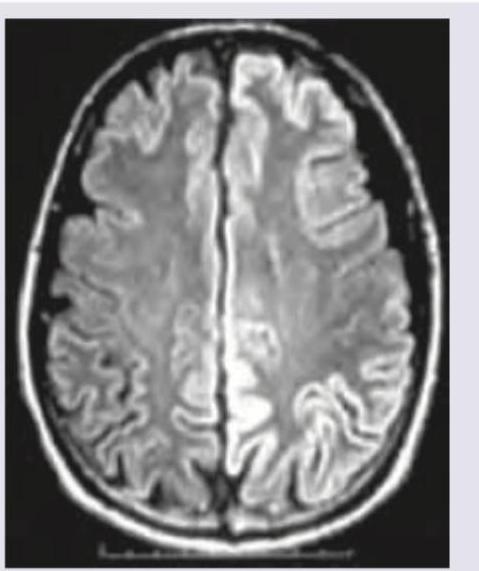
3 questionsMRI was performed on a 35-year-old man with progressive myoclonus and apathy. What is the diagnosis? (Recent NEET Pattern 2016-17)

A 35-year-old woman presents with thunderclap headache. NCCT was done. All are true about the condition except:

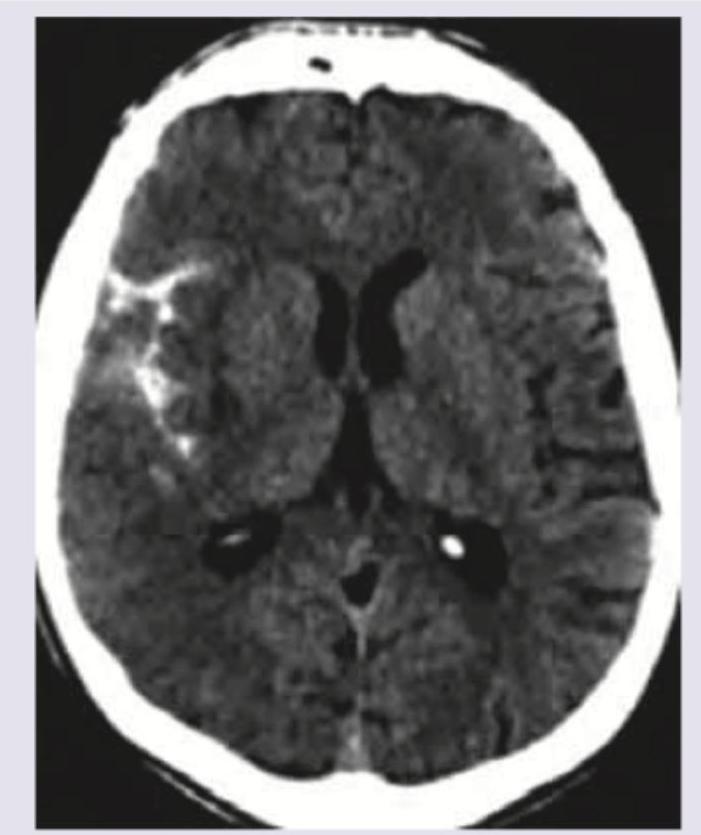
A 50-year-old hypertensive patient develops sudden onset drooping of right face and hemiplegia. What is the diagnosis?

NEET-PG 2017 - Internal Medicine NEET-PG Practice Questions and MCQs
Question 51: MRI was performed on a 35-year-old man with progressive myoclonus and apathy. What is the diagnosis? (Recent NEET Pattern 2016-17)
- A. Herpes simplex encephalitis
- B. SSPE
- C. Mesial temporal sclerosis
- D. Prion disease (Correct Answer)
Explanation: ***Prion disease*** - The MRI shows **cortical ribboning** (hyperintensity in the cortex) and possible signal changes in the basal ganglia, which are characteristic findings in prion diseases such as **Creutzfeldt-Jakob disease (CJD)**. - The clinical presentation of **progressive myoclonus** (sudden, involuntary muscle jerks) and **apathy** (lack of emotion or motivation), especially in a relatively young individual (35 years old), is highly suggestive of CJD or another prion disease. *Herpes simplex encephalitis* - This typically presents with **fever, headache, and focal neurological deficits**, often affecting the **temporal lobes**. - While it can cause FLAIR hyperintensities, it usually begins acutely with more prominent edema and may have hemorrhagic components, and myoclonus is not a primary defining symptom. *SSPE* - **Subacute sclerosing panencephalitis (SSPE)** is a rare, fatal, progressive brain disorder caused by the **measles virus**, primarily affecting children and young adults. - While it can cause progressive neurological deterioration and cognitive decline, myoclonus is often a late feature, and MRI findings often show **white matter demyelination** in later stages, which is not the predominant finding here. *Mesial temporal sclerosis* - This condition is characterized by **atrophy and signal changes in the hippocampus and amygdala** on MRI, typically associated with **temporal lobe epilepsy**. - While it can cause cognitive issues, it usually does not account for widespread cortical ribboning or prominent myoclonus in this age group, and the image does not specifically highlight mesial temporal lobe changes.
Question 52: A 35-year-old woman presents with thunderclap headache. NCCT was done. All are true about the condition except:
- A. Hyponatremia
- B. Prolonged QT interval
- C. Most common cause of death is rebleeding (Correct Answer)
- D. Nimodipine is drug of choice
Explanation: The image provided appears to be a **Non-Contrast CT (NCCT) scan of the brain**, showing a **hyperdense area** in the right hemisphere, consistent with **subarachnoid hemorrhage (SAH)** given the context of a "thunderclap headache." Thunderclap headache is a classic symptom of SAH. ***Most common cause of death is rebleeding*** - While rebleeding is a **serious complication** and contributes significantly to morbidity and mortality in SAH patients, the most common cause of death following SAH, particularly in the acute phase, is often related to the **initial hemorrhage** itself, such as **brain herniation**, or **early hydrocephalus** and **vasospasm-induced cerebral ischemia**. - **Vasospasm**, leading to **delayed cerebral ischemia (DCI)**, is a major cause of death and disability in SAH survivors, but the question asks about the "most common cause of death," which in many cases is the immediate devastating effect of the initial bleed or its early complications rather than rebleeding alone. *Hyponatremia* - **Hyponatremia** is a common electrolyte imbalance seen in patients with SAH, often due to **Syndrome of Inappropriate Antidiuretic Hormone (SIADH)** or **Cerebral Salt Wasting (CSW)**. - Therefore, the statement that hyponatremia occurs is **true** for this condition. *Prolonged QT interval* - **Cardiac abnormalities**, including **ECG changes** such as **QT prolongation**, T-wave inversion, and ST depression, are frequently observed after SAH due to **autonomic nervous system dysfunction** and catecholamine release. - Therefore, the presence of a prolonged QT interval is **true** for this condition. *Nimodipine is drug of choice* - **Nimodipine** is a **calcium channel blocker** widely used in SAH patients to **prevent or reduce the severity of cerebral vasospasm** and associated delayed cerebral ischemia. - It is currently the **drug of choice** for this indication in SAH, making this statement **true**.
Question 53: A 50-year-old hypertensive patient develops sudden onset drooping of right face and hemiplegia. What is the diagnosis?
- A. MCA area hemorrhage (Correct Answer)
- B. ACA area infarction
- C. ACA area hemorrhage
- D. MCA area infarction
Explanation: ***MCA area hemorrhage*** - The **hyperdense lesion** on CT scan indicates **acute hemorrhage** in the MCA territory, which correlates with the sudden onset right facial droop and hemiplegia. - **Hypertension** is the most common risk factor for primary **intracerebral hemorrhage**, and MCA territory involvement typically causes contralateral face and arm weakness. *MCA area infarction* - **Infarctions** appear as **hypodense (dark) areas** on CT scan, not hyperdense lesions as described in this case. - While MCA infarction can cause similar clinical symptoms, the imaging findings clearly show hemorrhage rather than ischemic changes. *ACA area infarction* - **ACA infarction** typically presents with **leg weakness** more prominent than face/arm weakness, as the ACA supplies the medial motor cortex for lower limbs. - The imaging shows a **hyperdense hemorrhage**, not the **hypodense appearance** characteristic of infarction. *ACA area hemorrhage* - **ACA territory hemorrhage** would affect the **frontal lobe**, causing symptoms like leg weakness, **abulia** (lack of motivation), and urinary incontinence. - The clinical presentation of **facial droop and hemiplegia** involving face and arm is more characteristic of **MCA involvement** rather than ACA territory.
Pediatrics
2 questionsA 2-year-old epileptic child with developmental delay presents to emergency with fever for the last two days. NCCT shows:

Comment on the diagnosis based on the image shown below. (Recent NEET Pattern 2016-17)

NEET-PG 2017 - Pediatrics NEET-PG Practice Questions and MCQs
Question 51: A 2-year-old epileptic child with developmental delay presents to emergency with fever for the last two days. NCCT shows:
- A. Subdural hemorrhage
- B. Arnold-Chiari malformation
- C. Schizencephaly
- D. Lissencephaly (Correct Answer)
Explanation: ***Lissencephaly*** - The image shows a **smooth brain surface** with **absent or reduced gyri and sulci**, which is characteristic of lissencephaly. - This condition is often associated with **developmental delay** and **epilepsy**, consistent with the child's presentation. *Subdural hemorrhage* - A subdural hemorrhage would appear as a **crescent-shaped collection of blood** between the dura mater and arachnoid mater. - The image does not demonstrate any such blood collection. *Arnold-Chiari malformation* - Arnold-Chiari malformation involves the downward displacement of the **cerebellar tonsils** into the foramen magnum. - While it can cause neurological symptoms, the primary finding in the image is a smooth cerebral cortex, not cerebellar displacement. *Schizencephaly* - Schizencephaly is characterized by **clefts or slits in the cerebral hemispheres** that extend from the pial surface to the ventricles. - The image shows a smooth brain surface rather than distinct full-thickness clefts.
Question 52: Comment on the diagnosis based on the image shown below. (Recent NEET Pattern 2016-17)
- A. Proteus syndrome
- B. Plexiform neurofibromatosis (Correct Answer)
- C. Rhabdomyosarcoma
- D. Malignant fibrous histiocytosis
Explanation: ***Plexiform neurofibromatosis*** - The image exhibits significant facial disfigurement with **nodular and soft tissue overgrowth**, particularly around the eye and midface, consistent with a **plexiform neurofibroma**. - This presentation is a classic feature of **Neurofibromatosis Type 1 (NF1)**, where plexiform neurofibromas can be extensive and cause severe cosmetic and functional issues. *Proteus syndrome* - Proteus syndrome is characterized by **asymmetric overgrowth** of various tissues including bone, skin, and fat, often leading to patchy or mosaic patterns of disproportionate growth. - While it involves overgrowth, the specific appearance in the image with its nodular, bag-like masses is more typical of plexiform neurofibroma than the broader, more generalized overgrowth seen in Proteus syndrome. *Rhabdomyosarcoma* - Rhabdomyosarcoma is a **malignant tumor of skeletal muscle**, typically presenting as a rapidly growing mass. - The lesions in the image appear more chronic and diffuse, lacking the aggressive, distinct tumoral characteristics of a typical rhabdomyosarcoma. *Malignant fibrous histiocytosis* - Malignant fibrous histiocytosis (now often classified under **undifferentiated pleomorphic sarcoma**) is a **high-grade soft tissue sarcoma** primarily affecting older adults, typically presenting as a rapidly enlarging mass. - Similar to rhabdomyosarcoma, this is a distinct malignant tumor and does not match the diffuse, chronic, and somewhat benign-appearing overgrowth seen in the picture.
Radiology
2 questionsWhich of the following is correct about the NCCT shown below? (Recent NEET Pattern 2016-17)

All are true about CNS malformation shown below except:

NEET-PG 2017 - Radiology NEET-PG Practice Questions and MCQs
Question 51: Which of the following is correct about the NCCT shown below? (Recent NEET Pattern 2016-17)
- A. Acute ischemic stroke
- B. Acute hemorrhagic stroke
- C. Subarachnoid hemorrhage
- D. Intraparenchymal hemorrhage (Correct Answer)
Explanation: ***Intraparenchymal hemorrhage*** - The image shows a **hyperdense (bright)** lesion within the brain parenchyma, indicated by the arrows. This appearance on non-contrast CT (NCCT) is characteristic of **acute hemorrhage** (blood) within the brain tissue. - The location and morphology are consistent with blood accumulating directly within the brain substance rather than in the subarachnoid space or as a diffuse cerebral edema. *Acute ischemic stroke* - An **acute ischemic stroke** on NCCT typically appears as a **hypodense (darker)** area due to **edema** and cell death, usually after several hours. The lesion shown in the image is hyperdense. - Early signs of acute ischemic stroke (within the first few hours) can include subtle changes like loss of gray-white matter differentiation or hyperdense vessel signs, but not a distinct hyperdense parenchymal lesion as seen here. *Acute hemorrhagic stroke* - While technically a hemorrhagic stroke, this option is too broad. Hemorrhagic stroke encompasses both intraparenchymal hemorrhage and subarachnoid hemorrhage. - The specific location of the blood within the brain tissue, as opposed to solely in the subarachnoid space, makes "intraparenchymal hemorrhage" a more precise diagnosis. *Subarachnoid hemorrhage* - **Subarachnoid hemorrhage (SAH)** would appear as hyperdensity (blood) in the **sulci, fissures**, and **basal cisterns** surrounding the brain, not within the brain parenchyma itself. - The image clearly shows the lesion within the brain tissue, not in the subarachnoid spaces.
Question 52: All are true about CNS malformation shown below except:
- A. Large posterior fossa (Correct Answer)
- B. Herniation of cerebellar tonsil
- C. Herniation of cerebellar vermis
- D. Association with myelomeningocele
Explanation: ***Large posterior fossa*** - The image shown, consistent with a **Chiari II malformation**, typically features a **small posterior fossa**, not a large one. - A small posterior fossa contributes to the crowding and herniation of cerebellar structures through the foramen magnum. *Herniation of cerebellar tonsil* - **Chiari II malformation** is characterized by the **downward displacement of the cerebellar tonsils** through the foramen magnum. - This herniation can lead to obstruction of CSF flow and associated neurological symptoms. *Herniation of cerebellar vermis* - The image suggests a **Chiari II malformation**, which involves the **caudal displacement of the cerebellar vermis** and fourth ventricle into the spinal canal. - This is a hallmark feature distinguishing it from other Chiari malformations. *Association with myelomeningocele* - **Chiari II malformation** has a strong and consistent association with **myelomeningocele**, a severe form of spina bifida. - Most patients with myelomeningocele will also have a Chiari II malformation, indicating a common developmental origin.