Anatomy
2 questionsWhat is the name of the marked blood vessel shown in brain circulation?

What is the name of the marked blood vessel in the Circle of Willis?

NEET-PG 2017 - Anatomy NEET-PG Practice Questions and MCQs
Question 41: What is the name of the marked blood vessel shown in brain circulation?
- A. Middle cerebral artery
- B. Posterior communicating artery (Correct Answer)
- C. Internal carotid artery
- D. Anterior communicating artery
Explanation: ***Posterior communicating artery*** - The arrow points to a vessel connecting the **anterior circulation** (internal carotid artery system) with the **posterior circulation** (vertebrobasilar system) within the **Circle of Willis**. - This specific location and function are characteristic of the **posterior communicating artery**, which typically arises from the internal carotid and joins the posterior cerebral artery. *Middle cerebral artery* - The middle cerebral artery is a large artery that branches off the **internal carotid artery** and typically extends laterally and superiorly to supply a large part of the **cerebral hemispheres**. - It would appear more prominent and more laterally positioned, not forming a direct "communicating" link in the central Circle of Willis as shown. *Internal carotid artery* - The internal carotid artery ascends from the neck into the skull and bifurcates into the **anterior and middle cerebral arteries**. - While visible in the image, the arrow is pointing to a smaller anastomotic branch, not the main trunk of the internal carotid artery. *Anterior communicating artery* - The **anterior communicating artery** connects the two **anterior cerebral arteries** at the anterior aspect of the Circle of Willis. - This is a distinct location from that indicated by the arrow, which shows a vessel connecting anterior to posterior circulation, not linking the two anterior cerebral arteries.
Question 42: What is the name of the marked blood vessel in the Circle of Willis?
- A. Middle cerebral artery
- B. Posterior communicating artery (Correct Answer)
- C. Internal carotid artery
- D. Posterior cerebral artery
Explanation: ***Posterior communicating artery*** - The image displays the Circle of Willis, and the vessel marked with 'X' is connecting the **internal carotid artery** (which branches into the middle and anterior cerebral arteries) to the **posterior cerebral artery**. - This connecting artery is the **posterior communicating artery**, an essential component of the Circle of Willis, ensuring collateral blood flow to the brain. *Middle cerebral artery* - The **middle cerebral artery** branches off the internal carotid artery and typically extends laterally into the Sylvian fissure, supplying a large part of the lateral cerebral cortex. - The marked vessel is clearly connecting proximal arteries within the Circle of Willis, not extending into the cerebral cortex peripherally. *Internal carotid artery* - The **internal carotid artery** enters the skull and gives rise to several branches, including the middle cerebral artery and the posterior communicating artery. - While it's part of the supply to the Circle of Willis, the 'X' points specifically to the **communicating segment** connecting the anterior and posterior circulations, not the main trunk of the internal carotid. *Posterior cerebral artery* - The **posterior cerebral artery** is formed by the bifurcation of the basilar artery and supplies the occipital lobe and parts of the temporal lobe. - The marked vessel is connecting to the posterior cerebral artery, but it is not the posterior cerebral artery itself; rather, it is the vessel **communicating** with it from the anterior circulation.
General Medicine
1 questionsAll of the following statements regarding this image are true except:

NEET-PG 2017 - General Medicine NEET-PG Practice Questions and MCQs
Question 41: All of the following statements regarding this image are true except:
- A. Defect occurs usually between tenia coli and the blood vessel entering colonic wall
- B. They are a result of tractional force
- C. Most common site for this defect is sigmoid colon
- D. High fiber diet will reduce the incidence of this defect (Correct Answer)
Explanation: **_High fiber diet will reduce the incidence of this defect_** - This statement is **false**. High fiber intake is generally recommended for preventing diverticular disease and not for their treatment in this case. - While fiber can reduce the incidence of diverticulosis, it does not apply to the *defect itself*, which refers to existing diverticula. *Defect occurs usually between tenia coli and the blood vessel entering colonic wall* - This statement is **true**. Diverticula commonly arise at points where **colonic blood vessels** penetrate the muscular layers, creating weak spots. - These areas are anatomically predisposed to herniation due to the passage of **vasa recta** through the muscularis propria. *They are a result of tractional force* - This statement is **true**. Diverticula are generally classified as **false diverticula** (pseudodiverticula) because they are formed by the herniation of mucosa and submucosa through defects in the muscularis. - This herniation is primarily caused by **increased intraluminal pressure** working against the weakened colonic wall, rather than external traction. *Most common site for this defect is sigmoid colon* - This statement is **true**. The **sigmoid colon** is the most common site for diverticular disease due to its narrow lumen and higher intraluminal pressure. - This region experiences the greatest stress during fecal transit, predisposing it to the formation of these outpouchings.
Radiology
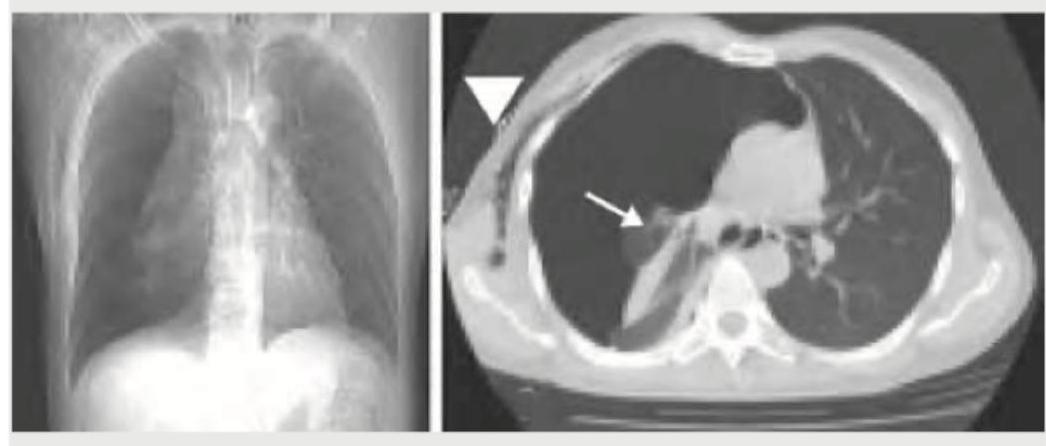
7 questionsAn 18-year-old boy is brought to the hospital with difficulty in breathing after a bar fight. What does the given CT chest show?
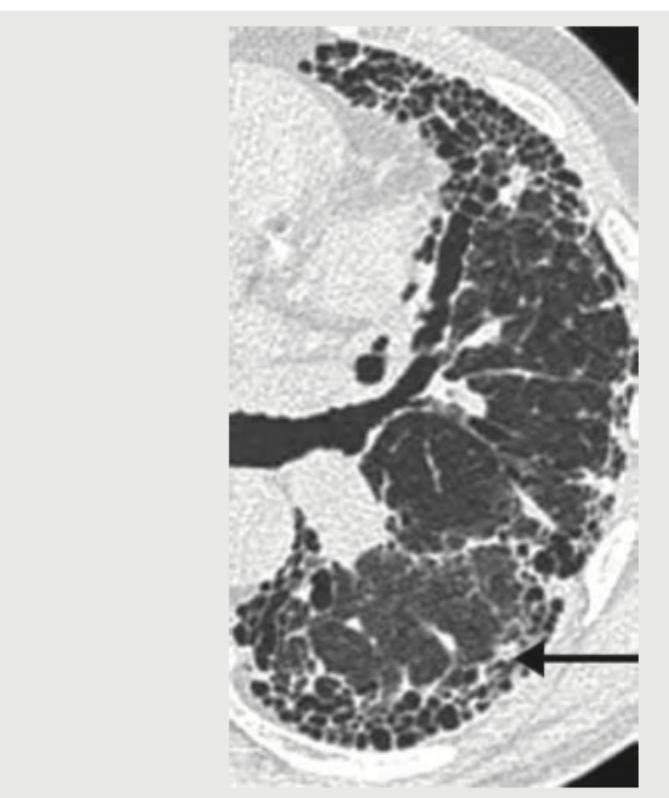
The lung parenchyma on CT chest shown below is best described as:
A cement slab fell on the chest of a 20-year-old construction worker. The arrow in the given CT chest points to:
A 25-year-old patient underwent surgery for scoliosis correction. 5 days post-operatively he develops voluminous bilious vomiting. The given CT abdomen shows:
Excretory urogram in a two-year-old child with recurrent UTI shows:

What is the radiological sign that could best describe this image?

A 26-year-old construction worker with a previous history of recurrent kidney stones presents with flank pain. What is the radiological sign demonstrated in the IVP image shown below?

NEET-PG 2017 - Radiology NEET-PG Practice Questions and MCQs
Question 41: An 18-year-old boy is brought to the hospital with difficulty in breathing after a bar fight. What does the given CT chest show?
- A. Pneumothorax (Correct Answer)
- B. Consolidation
- C. Pulmonary contusion
- D. Haemothorax
Explanation: ***Pneumothorax*** - The CT image shows a clear **absence of lung parenchyma** extending to the chest wall, with a visible **visceral pleural line** separated from the parietal pleura. This indicates air in the pleural space, which is characteristic of a pneumothorax. - The patient presenting with **difficulty in breathing** after a bar fight (implying trauma) is consistent with a **traumatic pneumothorax**. *Consolidation* - **Consolidation** appears as a region of increased attenuation (whitening) on CT, usually with **air bronchograms**, indicating filling of alveolar spaces, which is not seen here. - While it can cause difficulty breathing, it results from infection or inflammation, not typically direct trauma creating an empty space like in the image. *Pulmonary contusion* - **Pulmonary contusion** would appear as areas of **ground-glass opacity** or **consolidation** within the lung parenchyma due to bleeding and edema, without a significant collapse of the lung. - The image distinctly shows a collapsed lung with a clear air-filled pleural space, not parenchymal injury. *Haemothorax* - A **hemothorax** would show a **fluid collection** (appearing white or grey) in the pleural space, often layering dependently, which is not the primary finding on this image where an air-filled space is prominent. - While a traumatic event could lead to both pneumothorax and hemothorax (**hemopneumothorax**), the most striking feature evident here is the air within the pleural cavity causing lung collapse.
Question 42: The lung parenchyma on CT chest shown below is best described as:
- A. Honey comb pattern
- B. Signet ring pattern
- C. Crazy pavement pattern (Correct Answer)
- D. Mosaic pattern
Explanation: ***Crazy pavement pattern*** - The image distinctly shows a combination of **ground-glass opacities** and superimposed **interlobular septal thickening**, which together create the characteristic "crazy paving" appearance. - This pattern is most commonly associated with **pulmonary alveolar proteinosis**, but can also be seen in conditions like ARDS, PCP pneumonia, and lipoid pneumonia. *Honey comb pattern* - This pattern involves the presence of multiple, clustered, thick-walled **cysts** of varying sizes, typically subpleural, which are a sign of **end-stage lung fibrosis**. - While there are cystic changes in the image, the predominant finding includes ground-glass opacities and septal thickening rather than pure end-stage fibrotic changes. *Signet ring pattern* - A signet ring pattern is classically seen in **bronchiectasis**, where a dilated bronchus is paired with its accompanying smaller pulmonary artery, resembling a signet ring. - The image does not show clearly dilated bronchi adjacent to pulmonary arteries; instead, it displays diffuse parenchymal changes. *Mosaic pattern* - The mosaic pattern refers to areas of differing lung attenuation, often due to **air trapping** (causing dark areas) or areas of **perfusion abnormalities** (creating lighter areas), common in conditions like small airway disease or chronic thromboembolic disease. - While there is some heterogeneity, the specific combination of ground-glass and septal thickening is more accurately described as crazy paving.
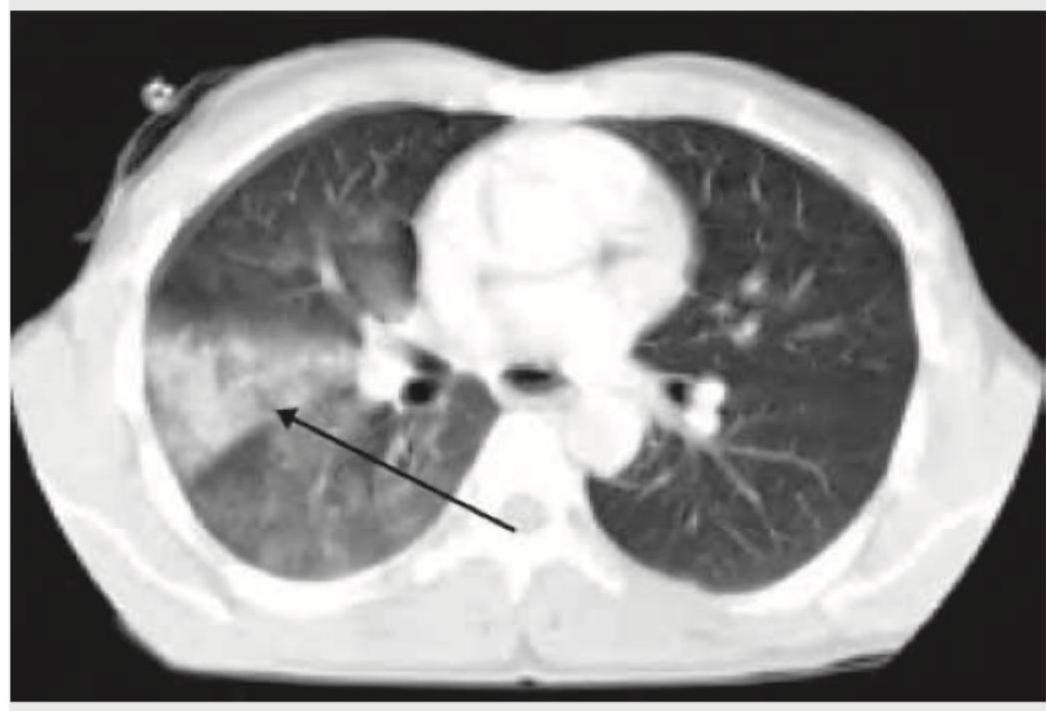
Question 43: A cement slab fell on the chest of a 20-year-old construction worker. The arrow in the given CT chest points to:
- A. Lung contusion (Correct Answer)
- B. ARDS
- C. Diaphragmatic rupture
- D. Pneumothorax
Explanation: ***Lung contusion*** - The image shows an area of **ground-glass opacity** and **consolidation** within the lung parenchyma, consistent with **hemorrhage and edema** caused by blunt force trauma. - This finding, combined with the history of the cement slab falling on the chest, is highly suggestive of a **lung contusion**. *ARDS* - **ARDS** (Acute Respiratory Distress Syndrome) is a clinical syndrome characterized by widespread **inflammatory lung injury**, typically presenting as bilateral infiltrates on imaging. - While it can manifest with similar CT findings, ARDS is a **diagnosis of exclusion** and requires specific clinical criteria (e.g., severe hypoxemia, exclusion of cardiac failure) not provided in the question. *Diaphragmatic rupture* - A **diaphragmatic rupture** involves a tear in the diaphragm, which would appear on CT as a discontinuity of the diaphragm or **herniation of abdominal contents** into the thoracic cavity. - The image does not show any signs of diaphragmatic discontinuity or organ herniation. *Pneumothorax* - A **pneumothorax** is the presence of air in the pleural space, which would be visible as a collection of **dark air outside the lung parenchyma**, often with a visible pleural line and collapse of the lung. - The CT scan shows parenchymal changes rather than a collection of air in the pleural space.
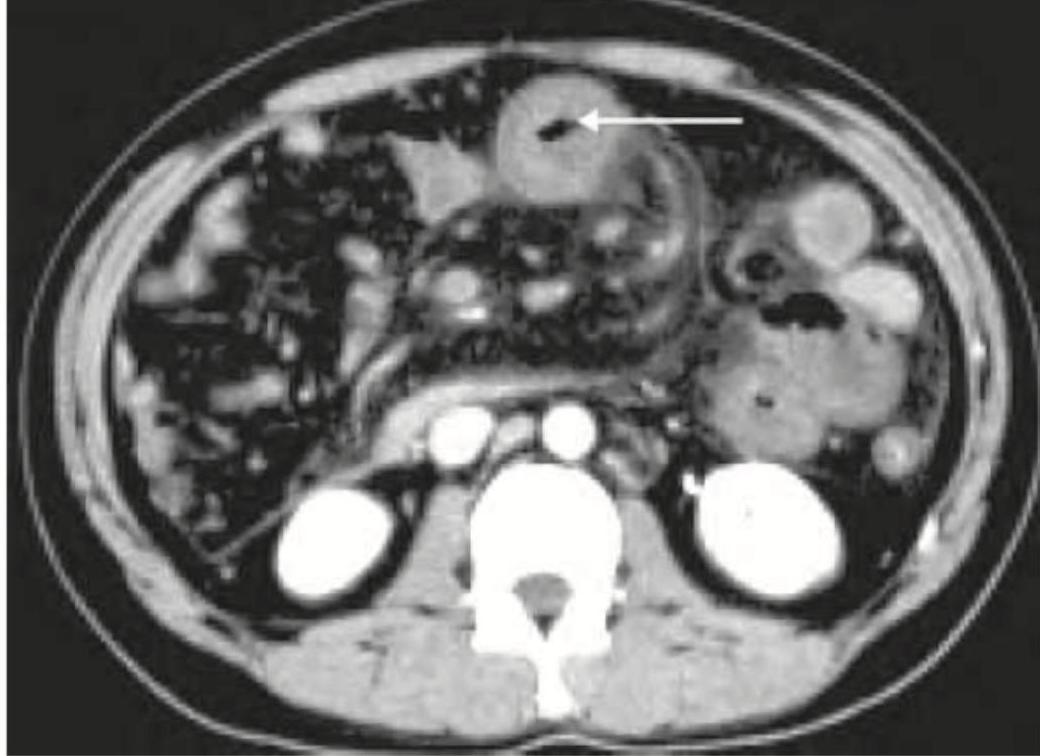
Question 44: A 25-year-old patient underwent surgery for scoliosis correction. 5 days post-operatively he develops voluminous bilious vomiting. The given CT abdomen shows:
- A. Paralytic ileus
- B. SMA syndrome (Correct Answer)
- C. Pneumoperitoneum
- D. Paravertebral abscess
Explanation: ***SMA syndrome*** - The CT image shows significant **duodenal distention** proximal to the **superior mesenteric artery (SMA)**, characteristic of SMA syndrome. The arrow points to the **compressed third part of the duodenum** between the SMA and the aorta. - This condition is often seen post-scoliosis correction surgery due to rapid **spinal extension**, which can decrease the **aortomesenteric angle** and compress the duodenum, leading to **bilious vomiting**. *Paralytic ileus* - While ileus can cause vomiting and bowel distension, it typically involves **diffuse gaseous distension** of both small and large bowels without a discrete point of obstruction like the compressed duodenum seen here. - The clinical presentation of paralytic ileus post-operatively is more often characterized by generalized **absent bowel sounds** and abdominal distension, rather than specific bilious vomiting from high obstruction. *Pneumoperitoneum* - This refers to the presence of **free air in the abdominal cavity**, usually indicating a **visceral perforation**. - The provided CT image does not show any evidence of free air, and the presenting symptom of bilious vomiting is more indicative of obstruction. *Paravertebral abscess* - A paravertebral abscess would appear as a **fluid collection adjacent to the spine**, which is not depicted on this CT scan. - Clinical symptoms would likely include **fever, severe localized back pain**, and possibly neurological deficits, differing from the purely obstructive symptoms described.
Question 45: Excretory urogram in a two-year-old child with recurrent UTI shows:
- A. Drooping water lily sign (Correct Answer)
- B. Horse shoe kidney
- C. Flower vase kidney
- D. Duplication of kidney
Explanation: ***Drooping water lily sign*** - This sign is characteristic of a **duplex collecting system** with a **dilated, obstructed upper pole ureter** and calyx, typically associated with an **ectopic ureterocele**. - The displaced lower pole calyces are pushed laterally and inferiorly by the dilated upper pole system, creating the appearance of a "drooping lily" or "drooping flower." - In children with recurrent UTIs, this finding indicates an underlying anatomical anomaly—specifically an **obstructed upper pole moiety in a duplex kidney**—which predisposes to stasis and infection. - **Most specific sign** for this condition on excretory urogram. *Horse shoe kidney* - A **horseshoe kidney** is a congenital fusion anomaly where the two kidneys are fused (usually at lower poles) across the midline. - Characteristic IVU findings include medially oriented lower poles, high ureteric insertion, and abnormal renal axis. - Does not cause the drooping lily appearance or typically present with recurrent UTI in this pattern. *Flower vase kidney* - **Flower vase sign** is a recognized radiological finding describing the appearance of **infundibular stenosis**, where the calyx is dilated but the infundibulum (connecting neck) is narrowed, resembling a flower vase. - This is a different entity from the drooping lily sign and represents focal obstruction at the infundibulum level rather than upper pole obstruction in a duplex system. - Not associated with the clinical scenario of recurrent UTI in a child with duplex kidney anomaly. *Duplication of kidney* - While a **duplex collecting system** (duplicated collecting system) is indeed present in this condition, this is a descriptive anatomical term rather than a specific radiological sign. - The **drooping water lily sign** is the more precise and specific descriptor for the characteristic IVU appearance of an obstructed upper pole moiety in a duplex kidney. - "Duplication" alone does not convey the specific pathology (obstruction) causing the recurrent UTIs.
Question 46: What is the radiological sign that could best describe this image?
- A. Cobra head sign (Correct Answer)
- B. Rim sign
- C. Fish hook bladder
- D. Soap bubble
Explanation: ***Cobra head sign*** - This sign is seen in the setting of a **ureterocele**, which is a cystic dilatation of the intravesical (within the bladder) portion of the ureter. - On intravenous urography (IVU) or retrograde pyelography, the dilated ureterocele appears as a filling defect within the bladder, outlined by contrast, creating the characteristic "cobra head" or "spring onion" appearance. *Rim sign* - The **rim sign** is typically associated with **renal calculi** (kidney stones). - It refers to a thin rim of soft tissue or gas surrounding a radiolucent stone, which can sometimes be seen on CT scans. *Fish hook bladder* - This term describes the shape of the bladder in cases of **benign prostatic hyperplasia (BPH)**. - Due to the enlarged prostate elevating and distorting the bladder base, the contrast-filled bladder appears elongated and curved, resembling a fish hook on a cystogram. *Soap bubble* - The "soap bubble" appearance is often used to describe **multiloculated cystic masses** or certain types of tumors, particularly in bone lesions (e.g., aneurysmal bone cyst, fibrous dysplasia). - It refers to multiple small, rounded lucencies giving a bubbly or multicystic appearance on imaging.
Question 47: A 26-year-old construction worker with a previous history of recurrent kidney stones presents with flank pain. What is the radiological sign demonstrated in the IVP image shown below?
- A. Rim sign (Correct Answer)
- B. Ring sign
- C. Egg in cup appearance
- D. Sun burst appearance
Explanation: ***Rim sign*** - The image shows a **calcified rim around a radiolucent (non-calcified) center**, which is characteristic of a **calcium oxalate monohydrate stone** on an intravenous pyelogram (IVP). - This sign is also known as the **"lucent-centered calculus"** or **"target sign"** and indicates a partially calcified stone. *Ring sign* - The **ring sign** can refer to various appearances in medical imaging, often indicating a **ring-enhancing lesion** on CT or MRI, which is not applicable to a kidney stone on IVP. - In renal imaging, a ring sign might describe a collection of contrast medium around a tumor or cyst, but not typically a stone with a radiolucent center. *Egg in cup appearance* - This sign is typically associated with **osteochondroma or enchondroma** lesions in bone imaging, where the cartilage cap creates a "cup" for the medullary bone to grow into. - It is not a recognized sign for kidney stones. *Sun burst appearance* - The **sun burst appearance** is characteristic of certain **bone tumors**, particularly **osteosarcoma**, where new bone forms perpendicular to the bone surface. - This description does not apply to the radiological features of kidney stones on IVP.