Anatomy
2 questionsWhich nerve marked as X innervates the Aortic Arch?

Which of the following is correct about the type of neuron shown below?

NEET-PG 2017 - Anatomy NEET-PG Practice Questions and MCQs
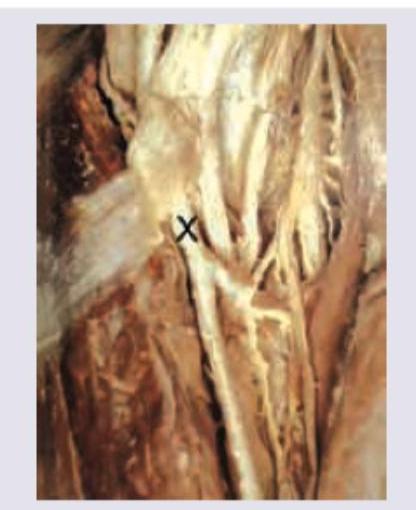
Question 331: Which nerve marked as X innervates the Aortic Arch?
- A. Carotid sinus nerve
- B. Inferior cervical cardiac nerve
- C. Superior cervical cardiac nerve
- D. Aortic depressor nerve (Correct Answer)
Explanation: ***Aortic depressor nerve*** - The nerve marked as X in the diagram directly innervates the **aortic baroreceptors** located in the aortic arch. - This nerve is also known as the **aortic depressor nerve**, a branch of the vagus nerve (CN X), which transmits sensory information about blood pressure from the aortic arch to the central nervous system. *Carotid sinus nerve* - The carotid sinus nerve (also known as Hering's nerve) innervates the **carotid sinus and carotid body**, which are located at the bifurcation of the common carotid artery. - This nerve transmits sensory information from the carotid baroreceptors and chemoreceptors, distinct from the aortic arch. *Inferior cervical cardiac nerve* - The inferior cervical cardiac nerve is a **sympathetic nerve** that originates from the inferior cervical ganglion and innervates the heart. - It does not primarily innervate the aortic arch baroreceptors; its function is related to cardiac rate and contractility. *Superior cervical cardiac nerve* - Similar to the inferior cervical cardiac nerve, the superior cervical cardiac nerve is a **sympathetic nerve** originating from the superior cervical ganglion. - It primarily contributes to the cardiac plexus and innervates the heart, not specifically the aortic arch baroreceptors.
Question 332: Which of the following is correct about the type of neuron shown below?
- A. Bipolar neuron
- B. Unipolar cell
- C. Pseudo-unipolar cell (Correct Answer)
- D. All of the above
Explanation: ***Pseudo-unipolar cell*** - The image shows a neuron with a **single process** emerging from the cell body that then **divides into two branches** (one leading to dendrites and the other to the axon terminal), which is characteristic of a pseudo-unipolar neuron. - These neurons are typically found in **sensory ganglia**, such as the dorsal root ganglia, where they transmit sensory information. *Bipolar neuron* - A bipolar neuron has **two distinct processes** extending from the cell body: one axon and one dendrite. - Examples include neurons found in the **retina** and **olfactory epithelium**. *Unipolar cell* - A unipolar neuron has a **single process** extending from the cell body, which serves as both the dendrite and the axon. - These are typically found in **invertebrates**, though the term can sometimes be confusingly used for pseudo-unipolar neurons in some contexts. *All of the above* - This is incorrect because the neuron depicted specifically matches the morphology of a pseudo-unipolar cell, not all the listed types. - Each neuron type has distinct morphological features (number of poles/processes from the cell body).
General Medicine
1 questionsA head trauma patient is shown below. Diagnosis is?

NEET-PG 2017 - General Medicine NEET-PG Practice Questions and MCQs
Question 331: A head trauma patient is shown below. Diagnosis is?
- A. Decorticate rigidity
- B. Decerebrate rigidity (Correct Answer)
- C. Acute dystonia
- D. Catatonia
Explanation: ***Decerebrate rigidity*** - The image shows **extension and internal rotation of the arms** with pronation, and **extension of the legs** with plantar flexion. This posture is characteristic of decerebrate rigidity. - This posturing indicates severe damage to the **brainstem**, specifically below the red nucleus, which is a more ominous sign than decorticate posturing. *Decorticate rigidity* - Decorticate rigidity would present with **flexion of the arms** at the elbows and wrists (to the core), adduction of the shoulders, and extension of the lower limbs. - This posturing is typically due to damage to the **corticospinal tracts above the red nucleus** (e.g., cerebral hemispheres, internal capsule, thalamus). *Acute dystonia* - Acute dystonia involves sustained or repetitive muscle contractions leading to **twisting and repetitive movements** or abnormal fixed postures. - It often affects specific muscle groups, such as the neck (torticollis), eyes (oculogyric crisis), or trunk, and is not typically a generalized rigidity pattern seen in head trauma as extensively as shown. *Catatonia* - Catatonia is a neuropsychiatric syndrome characterized by a variety of motor or behavioral abnormalities, including **immobility, mutism, stupor, waxy flexibility, and negativism**. - While it can involve abnormal posturing, it is a conscious state often associated with psychiatric conditions or general medical conditions, and doesn't manifest as the specific brainstem-related rigidity evident in the image.
Physiology
7 questionsWhich of the following is correct about the pressure volume loop of left ventricle?

Which of the following is correct about the point marked $Z$ on the cardiac cycle?

The pressure-volume loop of left ventricle tracing of the patient indicates:

Which of the following dissociation curve mentioned is for myoglobin?

Which protein is responsible for the effect shown in RBC marked as $X$ ?

Identify the modality of intercellular communication shown below.

The following skeletal muscle recording shows presence of: (Recent NEET Pattern 2016-17)

NEET-PG 2017 - Physiology NEET-PG Practice Questions and MCQs
Question 331: Which of the following is correct about the pressure volume loop of left ventricle?
- A. 1 to 2 indicates isovolumetric relaxation
- B. 2 to 3 indicates ventricular diastole
- C. Aortic valve opens at 2 (Correct Answer)
- D. Pulmonic valve opens at 3
Explanation: ***Aortic valve opens at 2*** - Point 2 marks the moment when **left ventricular pressure exceeds aortic pressure**, causing the aortic valve to open. - This is the transition point between **isovolumetric contraction** (1→2) and **ventricular ejection** (2→3). - From point 2 onwards, blood is actively ejected from the left ventricle into the aorta during **systole**. *1 to 2 indicates isovolumetric relaxation* - The phase from point 1 to point 2 shows an increase in **pressure at constant volume**, which represents **isovolumetric contraction**, not relaxation. - During **isovolumetric contraction**, both the mitral and aortic valves are closed, and the ventricle contracts without changing volume, building up pressure. - **Isovolumetric relaxation** occurs from point 3 to point 4, where pressure drops at constant volume after the aortic valve closes. *2 to 3 indicates ventricular diastole* - The period from point 2 to point 3 represents **ventricular ejection**, which is part of **ventricular systole**, not diastole. - During this phase, the aortic valve is open, and blood is being ejected from the left ventricle into the aorta while ventricular volume decreases. - **Ventricular diastole** includes isovolumetric relaxation (3→4) and ventricular filling (4→1). *Pulmonic valve opens at 3* - Point 3 represents the **closure of the aortic valve** at the end of ventricular ejection, not its opening. - The **pulmonic valve** is part of the right ventricular circuit, not the left ventricle; it opens during right ventricular ejection into the pulmonary artery. - This question specifically addresses the **left ventricular** pressure-volume loop.
Question 332: Which of the following is correct about the point marked $Z$ on the cardiac cycle?
- A. Mitral valve opens
- B. Tricuspid valve opens
- C. Aortic valve opens (Correct Answer)
- D. Mid systolic click
Explanation: ***Aortic valve opens*** - At point Z, the **left ventricular pressure (LVP)** curve (solid red line) intersects and surpasses the **aortic pressure (AP)** curve (dashed line), marking the moment the **aortic valve opens** and blood begins to be ejected into the aorta. - This event signifies the transition from **isovolumetric contraction** to rapid **ventricular ejection phase** during systole. *Mitral valve opens* - The **mitral valve opens** during diastole, when the **left ventricular pressure (LVP)** falls below the **left atrial pressure (LAP)**, allowing ventricular filling. - This event would typically occur much later in the cardiac cycle, around point 5 or 6, after the aortic valve closes. *Tricuspid valve opens* - The **tricuspid valve opens** during diastole when the right ventricular pressure falls below the right atrial pressure. This event is not directly depicted for the left side of the heart in this Wigger's diagram. - It plays a role in right heart filling and is not related to the events occurring at point Z in the left heart cycle. *Mid systolic click* - A **mid-systolic click** is typically associated with **mitral valve prolapse**, occurring during mid-systole as the mitral leaflets prolapse into the left atrium. - Point Z represents the beginning of ejection, not a valvular abnormality.
Question 333: The pressure-volume loop of left ventricle tracing of the patient indicates:
- A. Systolic dysfunction
- B. Diastolic dysfunction (Correct Answer)
- C. Decreased atrial compliance
- D. Increased atrial compliance
Explanation: ***Diastolic dysfunction*** - The pressure-volume loop for the patient is shifted to the **left and upward** relative to the control loop, indicating higher left ventricular pressure for a given volume during diastole. - The **end-diastolic pressure-volume relationship (EDPVR)**, shown by the lower right curve, is steeper for the patient, meaning the ventricle is **stiffer or less compliant** during filling. *Systolic dysfunction* - Systolic dysfunction would be characterized by a **reduced stroke volume** (narrower loop horizontally) and a **lower ejection fraction**, often accompanied by a shift to the right due to increased end-diastolic volume. - The **end-systolic pressure-volume relationship (ESPVR)**, which represents contractility, would be shifted downwards and to the right in systolic dysfunction, indicating impaired contractility. *Decreased atrial compliance* - Decreased atrial compliance would primarily affect **atrial pressures** and the force of atrial contraction, which might indirectly impact ventricular filling, but is not directly represented by the ventricular pressure-volume loop's morphology in this manner. - The primary indicator of atrial compliance is often via atrial pressure-volume relationships or specific atrial function studies, not the ventricular loop's overall shift. *Increased atrial compliance* - Increased atrial compliance would allow the atria to accommodate more volume at lower pressures, potentially *improving* ventricular filling if the ventricle itself is compliant, but it would not explain the **elevated ventricular diastolic pressures** seen in the patient's tracing. - This condition would typically lead to lower atrial pressures, which is the opposite of what would contribute to the observed ventricular diastolic dysfunction.
Question 334: Which of the following dissociation curve mentioned is for myoglobin?
- A. Green (Correct Answer)
- B. Purple
- C. Red
- D. None
Explanation: ***Green*** - The **green curve** represents **myoglobin**, which has a much higher affinity for oxygen than hemoglobin. It binds oxygen at very low partial pressures and releases it only when oxygen levels are significantly depleted, as in active muscle tissue. - Myoglobin's dissociation curve is typically **hyperbolic** due to its single oxygen-binding site, reflecting its role in oxygen storage rather than transport. *Purple* - The **purple curve** represents normal **hemoglobin**, which exhibits a **sigmoidal** shape due to its **cooperative binding** of oxygen. This allows hemoglobin to efficiently load oxygen in the lungs and unload it in tissues. - Hemoglobin has a lower oxygen affinity than myoglobin and is designed for oxygen transport, adapting its binding based on oxygen partial pressure. *Red* - The **red curve** likely represents a **right-shifted hemoglobin dissociation curve**, indicating **decreased oxygen affinity**. This shift facilitates oxygen unloading to tissues. - Right shifts occur due to increased temperature, decreased pH (Bohr effect), increased 2,3-DPG, or increased CO₂. These physiological adaptations help deliver more oxygen to metabolically active tissues. *None* - This option is incorrect because the **green curve** clearly represents the characteristic oxygen dissociation curve for myoglobin.
Question 335: Which protein is responsible for the effect shown in RBC marked as $X$ ?
- A. Band 3 protein (Correct Answer)
- B. Spectrin
- C. Glycophorin
- D. Ankyrin
Explanation: ***Band 3 protein*** - The image indicates that **X** facilitates the exchange of **bicarbonate (HCO₃⁻)** out of the red blood cell and **chloride (Cl⁻)** into the red blood cell, a process known as the **chloride shift** or **Hamburger phenomenon**. - This specific transporter is the **Band 3 anion exchanger 1 (AE1)**, also known as **Band 3 protein**, which is crucial for maintaining electrical neutrality during CO₂ transport. - **Band 3 protein** is the most abundant membrane protein in RBCs and accounts for approximately **25% of RBC membrane protein**. *Spectrin* - Spectrin is a **cytoskeletal protein** that forms a structural network on the inner surface of the RBC membrane. - It provides **mechanical stability and flexibility** to RBCs but does not participate in anion exchange. - Defects in spectrin cause hereditary spherocytosis and elliptocytosis. *Glycophorin* - Glycophorins are **surface glycoproteins** that carry many of the carbohydrate groups on the RBC surface. - They play roles in **membrane stability and blood group antigens** (MN blood group system). - They do not function as anion exchangers or transporters for bicarbonate/chloride. *Ankyrin* - Ankyrin is an **anchoring protein** that links the cytoskeletal protein spectrin to Band 3 protein. - It provides **structural support** and maintains membrane integrity but does not transport ions. - Ankyrin deficiency can cause hereditary spherocytosis.
Question 336: Identify the modality of intercellular communication shown below.
- A. Paracrine (Correct Answer)
- B. Autocrine
- C. Synaptic
- D. Gap junction
Explanation: ***Paracrine*** - The image shows a **signaling cell** releasing **signaling molecules** (red dots) into the extracellular space, which then act on a nearby **target cell**. This local signaling is characteristic of paracrine communication. - In **paracrine signaling**, the molecules travel short distances through the interstitial fluid to influence neighboring cells, without entering the bloodstream. *Autocrine* - In **autocrine signaling**, a cell releases signaling molecules that then act on **receptors on the same cell** that produced them. The image clearly depicts communication between two different cells. - The signaling molecules are shown moving from one cell (signaling cell) to another distinct cell (target cell), rather than acting back on the originating cell. *Synaptic* - **Synaptic signaling** involves specialized structures called **synapses** where neurons transmit signals using **neurotransmitters** across a synaptic cleft to a target cell (another neuron, muscle cell, or gland cell). The image does not show a neuronal structure or a synapse. - This type of communication is highly specific to the nervous system and involves electrical impulses followed by chemical transmission, which is not represented here. *Gap junction* - **Gap junction communication** involves direct passage of signaling molecules between adjacent cells through specialized protein channels called **gap junctions**. - The image depicts signaling molecules being released into the extracellular space and binding to receptors on the target cell, rather than passing directly between the cytoplasms of two cells.
Question 337: The following skeletal muscle recording shows presence of: (Recent NEET Pattern 2016-17)
- A. A = Twitch, B = Summation, C = Incomplete tetanus, D = Complete tetanus (Correct Answer)
- B. A = Summation, B = Twitch, C = Complete tetanus, D = Incomplete tetanus
- C. A = Twitch, B = Incomplete tetanus, C = Summation, D = Complete tetanus
- D. A = Incomplete tetanus, B = Complete tetanus, C = Twitch, D = Summation
Explanation: ***A = Twitch, B = Summation, C = Incomplete tetanus, D = Complete tetanus*** - **A** shows a single muscle contraction and relaxation in response to a single stimulus, which is characteristic of a **twitch**. - **B** shows responses to multiple stimuli delivered before complete relaxation, resulting in increasing tension but still peaks and troughs, indicative of **summation**. - **C** represents **incomplete tetanus** (also known as unfused tetanus), where rapid stimulation causes successive contractions to build upon each other, but the muscle partially relaxes between stimuli, creating a jagged peak. - **D** illustrates **complete tetanus** (or fused tetanus), where very rapid, continuous stimulation prevents any relaxation between stimuli, leading to a sustained, smooth maximal contraction.