Internal Medicine
3 questionsA patient presents with abdominal pain, diarrhea and weight loss. He gives past history of pulmonary TB. Barium film of the patient indicates which of the following condition?

All of the following statements regarding this picture are true except:

A 32-year-old woman with a history of multiple hamartomas scattered throughout the small intestine presents to a physician for follow-up. All are true about her diagnosis except?

NEET-PG 2017 - Internal Medicine NEET-PG Practice Questions and MCQs
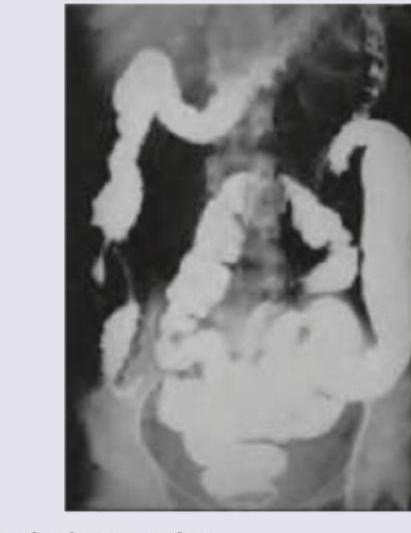
Question 141: A patient presents with abdominal pain, diarrhea and weight loss. He gives past history of pulmonary TB. Barium film of the patient indicates which of the following condition?
- A. Intestinal obstruction
- B. Intestinal perforation
- C. Pulled up cecum (Correct Answer)
- D. Diverticulum formation
Explanation: ***Pulled up cecum*** - The barium study shows an **abnormally high position** of the cecum, often caused by **adhesions** or **inflammatory processes** from previous infections like TB. - The **String sign of Kantor** (narrowed bowel segments appearing as thin strings) indicates **inflammatory bowel involvement**, commonly seen in **TB enteritis** or **Crohn's disease**. *Intestinal obstruction* - Would show **dilated bowel loops** proximal to the obstruction with **air-fluid levels** and minimal contrast passage beyond the blockage. - The radiological findings described (pulled up cecum and string sign) do not indicate mechanical obstruction. *Intestinal perforation* - Would demonstrate **extraluminal contrast leak** into the peritoneal cavity on barium study, which is not present here. - Clinical presentation would be **acute peritonitis** with severe pain and signs of sepsis, not chronic symptoms. *Diverticulum formation* - Would show **sac-like outpouchings** (diverticula) from the bowel wall, which are **not visualized** on this barium study. - The described findings of **string sign** and **cecal displacement** are inconsistent with diverticular disease.
Question 142: All of the following statements regarding this picture are true except:
- A. False diverticulum
- B. They are a result of tractional force (Correct Answer)
- C. Most common site for this defect is sigmoid colon
- D. High fiber diet will reduce the incidence of this defect
- E. Asymptomatic in majority of cases
Explanation: **They are a result of tractional force** - Diverticula as visualized in the image are **pulsion diverticula**, formed due to increased intraluminal pressure pushing the mucosa through weak points in the muscular wall. - **Traction diverticula** are true diverticula involving all layers of the bowel wall, and are typically caused by inflammation or scarring pulling the bowel wall outwards (e.g., in tuberculosis or histoplasmosis near the esophagus), which is not the mechanism for colonic diverticula shown. *False diverticulum* - The image depicts multiple outpouchings, which are characteristic of **false diverticula** (pseudodiverticula). - These diverticula involve only the **mucosa and submucosa** herniating through the muscular layer, lacking a complete muscular coat. *Most common site for this defect is sigmoid colon* - **Colonic diverticula** are most commonly found in the **sigmoid colon** due to its smaller diameter and higher intraluminal pressure, which predisposes it to outpouching. - The characteristic appearance of multiple small outpouchings in the image suggests colonic diverticulosis, consistent with the sigmoid colon being the primary location. *High fiber diet will reduce the incidence of this defect* - A **low-fiber diet** is considered a major risk factor for developing diverticulosis, as it leads to harder stools and increased intraluminal pressure. - Conversely, a **high-fiber diet** promotes softer stools, reduces intracolonic pressure, and is therefore believed to **reduce the incidence** and progression of diverticular disease. *Asymptomatic in majority of cases* - **Diverticulosis** (the presence of diverticula) is asymptomatic in approximately **70-80% of cases**. - Most patients are diagnosed incidentally during colonoscopy or imaging performed for other reasons. - Only a minority develop complications such as diverticulitis, bleeding, or perforation.
Question 143: A 32-year-old woman with a history of multiple hamartomas scattered throughout the small intestine presents to a physician for follow-up. All are true about her diagnosis except?
- A. STK-11 gene mutation
- B. Polyps in jejunum
- C. Morbidity due to intestinal obstruction
- D. Autosomal recessive (Correct Answer)
Explanation: ***Autosomal recessive*** - Peutz-Jeghers syndrome is inherited in an **autosomal dominant** pattern, not autosomal recessive. This mode of inheritance means that only one copy of the altered gene in each cell is sufficient to cause the disorder. - Approximately 50% of cases are caused by a new **STK11 gene mutation**, while the other 50% are inherited from an affected parent. *STK-11 gene mutation* - **Peutz-Jeghers syndrome** is caused by a germline mutation in the **STK11 (LKB1) gene**, which is a tumor suppressor gene. - This mutation leads to the development of hamartomatous polyps throughout the gastrointestinal tract and an increased risk of various cancers. *Polyps in jejunum* - The hamartomatous polyps in Peutz-Jeghers syndrome can occur anywhere in the gastrointestinal tract, but they are most common in the **small intestine**, including the jejunum. - While they can also be found in the entire GI tract, they are notably present in the jejunum. *Morbidity due to intestinal obstruction* - A common complication and source of morbidity in Peutz-Jeghers syndrome is **intestinal obstruction**, often due to **intussusception** caused by the polyps. - Other gastrointestinal complications include bleeding and abdominal pain.
Radiology
1 questionsThe given IVU shows:

NEET-PG 2017 - Radiology NEET-PG Practice Questions and MCQs
Question 141: The given IVU shows:
- A. Hydronephrosis
- B. Horseshoe kidney (Correct Answer)
- C. Polycystic kidney
- D. Duplication of collecting system
Explanation: ***Horse shoe kidney*** - The IVU image clearly shows both kidneys are **fused at their lower poles**, forming a 'U' shape across the midline, characteristic of a **horseshoe kidney**. - This fusion often results in the kidneys lying lower in the abdomen and can cause anatomical variations in the **collecting system and vasculature**, as hinted by the lower position and altered calyces. *Hydronephrosis* - **Hydronephrosis** would manifest as **dilatation of the renal pelvis and calyces** due to urine outflow obstruction. - While horseshoe kidneys can be prone to hydronephrosis due to their abnormal anatomy, the primary finding here is the fusion, not significant dilatation. *Polycystic kidney* - **Polycystic kidney disease** would present with multiple **cysts replacing normal kidney parenchyma**, leading to enlarged, typically non-functioning kidneys. - The image does not show multiple fluid-filled sacs or significant renal enlargement typical of polycystic disease. *Duplication of collecting system* - A **duplication of the collecting system** (e.g., duplicate ureters) would show two distinct collecting systems draining from a single kidney. - The image shows a single collecting system for each kidney, albeit abnormally shaped due to the fusion, but not duplicated.
Surgery
6 questionsWhat is the preferred treatment for the shown lesion?

A 34-year-old male patient complains of sudden severe epigastric pain along with vomiting, tenderness, guarding. On examination there is abdominal rigidity and tachycardia. He admits to taking NSAIDs for pain. The radiological examination of the patient is given below. All statements given below are true except?

Which hernia repair procedure is shown in the image? (Recent NEET Pattern 2016-17)

A multiparous female presents with the condition shown in the image. This condition can be managed by: (Recent NEET Pattern 2016-17)

All of the following conditions are visible in the image except: (Recent NEET Pattern 2016-17)

Hernia that is depicted in the image usually occurs at:

NEET-PG 2017 - Surgery NEET-PG Practice Questions and MCQs
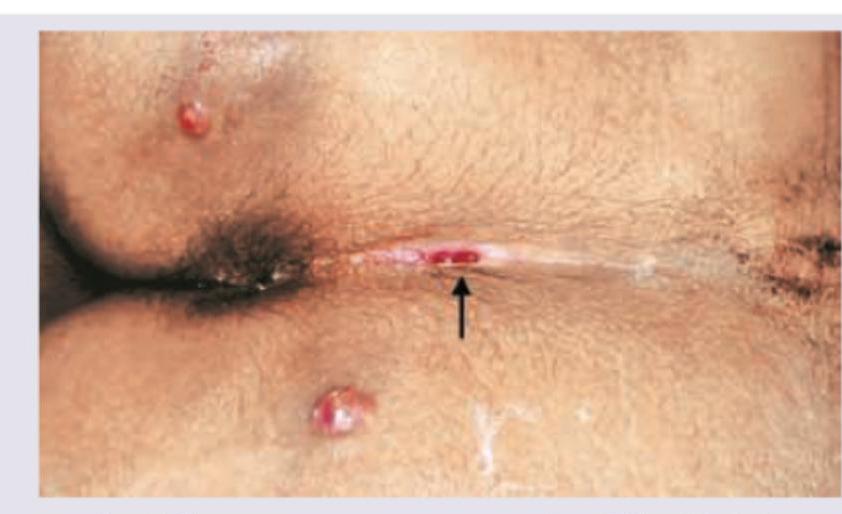
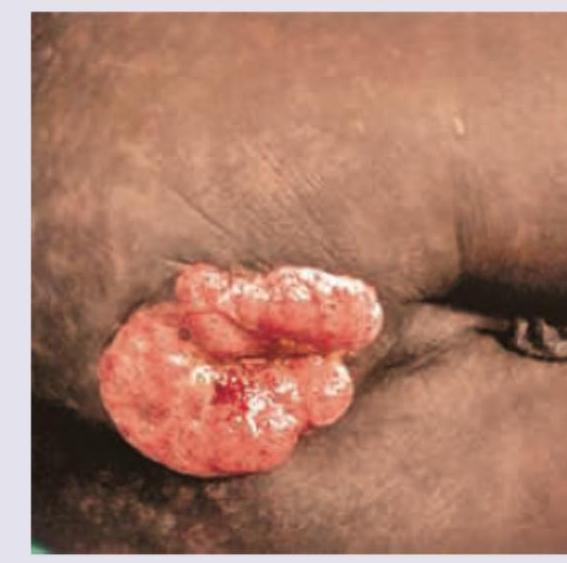
Question 141: What is the preferred treatment for the shown lesion?
- A. 5-fluorouracil + Mitomycin C
- B. Mitomycin C + Cisplatin
- C. 5-FU + Mitomycin C + Radiotherapy (Correct Answer)
- D. Abdominoperineal resection (APR)
Explanation: ***5-FU + Mitomycin C + Radiotherapy*** - The image shows an **exophytic lesion near the anus**, which is highly suggestive of **anal squamous cell carcinoma (SCC)**. The preferred treatment for anal SCC is **chemoradiation**. - The regimen of 5-fluorouracil (5-FU) and Mitomycin C, combined with **radiotherapy**, is the **Nigro protocol**, which is the current standard of care for anal cancer, aiming for organ preservation and cure. - This non-surgical approach has replaced radical surgery for most anal cancers, with excellent cure rates and quality of life preservation. *5-fluorouracil + Mitomycin C* - While these chemotherapy agents are part of the standard treatment for anal SCC, they are typically used in conjunction with **radiotherapy** to achieve optimal outcomes. - Chemotherapy alone without radiation is generally insufficient for curative intent in anal SCC. *Mitomycin C + Cisplatin* - This combination includes two potent chemotherapy drugs, but it is not the standard protocol for anal SCC. - While cisplatin can be used in some anal cancer regimens (particularly as salvage therapy), the combination with Mitomycin C in the absence of 5-FU and radiotherapy is not the primary choice. *Abdominoperineal resection (APR)* - APR was historically the standard treatment for anal cancer but has been largely replaced by chemoradiation (Nigro protocol). - Surgery is now reserved for salvage therapy in cases of persistent or recurrent disease after chemoradiation failure. - The shift to chemoradiation has significantly improved quality of life by preserving the anal sphincter and avoiding permanent colostomy.
Question 142: A 34-year-old male patient complains of sudden severe epigastric pain along with vomiting, tenderness, guarding. On examination there is abdominal rigidity and tachycardia. He admits to taking NSAIDs for pain. The radiological examination of the patient is given below. All statements given below are true except?
- A. Tenderness on per-rectal examination
- B. Blumberg sign is positive
- C. Dullness over flanks is observed
- D. Pain often radiates to groin (Correct Answer)
- E. Obliteration of liver dullness on percussion
Explanation: ***Pain often radiates to groin*** - The clinical presentation (sudden severe epigastric pain, vomiting, tenderness, guarding, rigidity, tachycardia, NSAID use) and the radiological imaging showing **free air under the diaphragm** are highly suggestive of **perforated viscus**, likely a perforated peptic ulcer. - Pain from a perforated ulcer typically **radiates to the shoulder** (due to diaphragmatic irritation) or generalizes throughout the abdomen, but **not typically to the groin**. *Tenderness on per-rectal examination* - **Tenderness on per-rectal examination** can be present in cases of generalized peritonitis, as the inflammation can extend to the pelvic peritoneum. - This finding is consistent with the diffuse inflammation caused by a perforated viscus. *Blumberg sign is positive* - **Blumberg sign**, also known as **rebound tenderness**, is a classic sign of **peritoneal irritation** or peritonitis. - Given the severe abdominal pain, guarding, and rigidity, peritonitis is highly likely in this patient, making a positive Blumberg sign expected. *Dullness over flanks is observed* - **Dullness on percussion over the flanks** indicates the presence of **fluid** in the peritoneal cavity (ascites). - In a perforated viscus, gastric or intestinal contents, along with inflammatory exudates, can accumulate in the dependent areas of the abdomen, leading to dullness in the flanks.
Question 143: Which hernia repair procedure is shown in the image? (Recent NEET Pattern 2016-17)
- A. Lichtenstein repair (Correct Answer)
- B. Bassini herniorrhaphy
- C. Shouldice repair
- D. Lord's procedure
Explanation: ***Lichtenstein repair*** - The image clearly displays a **mesh patch** being used to reinforce the posterior wall of the inguinal canal, which is the hallmark of a **tension-free Lichtenstein repair**. - This technique is widely considered the **gold standard** for **inguinal hernia repair** due to its low recurrence rates and reduced postoperative pain. *Bassini herniorrhaphy* - **Bassini's repair** is a **tissue-based repair** that involves suturing the conjoined tendon and transversalis fascia to the inguinal ligament. - This method does **not use mesh** and is associated with higher tension and recurrence rates compared to mesh-based repairs. *Shouldice repair* - The **Shouldice repair** is another **tissue-based repair** from Canada, renowned for its strong, multilayered closure of the posterior wall of the inguinal canal. - It involves **four layers of suture repair** of the transversalis fascia and conjoined tendon, without the use of synthetic mesh as seen in the image. *Lord's procedure* - **Lord's procedure** is a historical method for **inguinal hernia repair** that primarily involved placing a small, tightly rolled mesh plug into the internal ring. - It is **not commonly used today** and does not involve the broad, flat mesh placement depicted in the image to reinforce the entire posterior wall.
Question 144: A multiparous female presents with the condition shown in the image. This condition can be managed by: (Recent NEET Pattern 2016-17)
- A. Bassini repair
- B. Hunters repair
- C. Shouldice repair
- D. McEvedy repair (Correct Answer)
Explanation: ***McEvedy repair*** - The image shows a **femoral hernia**, characterized by a bulge below the **inguinal ligament** and lateral to the pubic tubercle. The McEvedy repair (high approach) is a surgical technique particularly suited for strangulated femoral hernias, allowing for a better assessment of bowel viability. - This approach involves an incision extending above the inguinal ligament, providing good access to the femoral canal and allowing for reduction and repair from a superior position. *Bassini repair* - This is a traditional **inguinal hernia repair** method where the transversus abdominis muscle, transversalis fascia, and conjoint tendon are sutured to the inguinal ligament. - It is primarily used for **inguinal hernias**, not femoral hernias, and would not provide adequate access or repair for the condition shown. *Hunters repair* - This term does not correspond to a recognized standard surgical repair technique for hernias. It might be a misnomer or an outdated/less commonly used eponym. - Standard hernia repair names typically refer to specific anatomical repairs or named surgeons like Shouldice, Lichtenstein, or McEvedy. *Shouldice repair* - The Shouldice repair is a **tension-free repair** of an **inguinal hernia** that involves four layers of fascia being approximated. - It is specifically designed for inguinal hernias and is not suitable for the repair of a femoral hernia, which requires a different anatomical approach.
Question 145: All of the following conditions are visible in the image except: (Recent NEET Pattern 2016-17)
- A. Right sided femoral hernia
- B. Right sided inguinal hernia
- C. Left sided inguinal hernia
- D. Left sided femoral hernia (Correct Answer)
Explanation: ***Left sided femoral hernia*** - This is the **correct answer** because a left-sided femoral hernia is **NOT visible in the image**. - The image shows bilateral inguinal hernias, with bulges located **above the inguinal ligament**, characteristic of inguinal hernias. - A **femoral hernia** would present as a bulge **below the inguinal ligament**, inferior and lateral to the pubic tubercle, which is **not depicted on the left side**. *Right sided femoral hernia* - This option is also not visible in the image, but since only one answer can be marked correct, the question focuses on the left side. - The prominent right-sided bulge is located **above the inguinal ligament**, characteristic of an **inguinal hernia**, not a femoral hernia. - A femoral hernia would appear in the upper thigh region, which is not shown on the right. *Right sided inguinal hernia* - This condition **IS visible in the image** as a large, prominent bulge in the right groin region. - The bulge is located in the anatomic area of the **inguinal canal**, superior to the inguinal ligament, consistent with a **right-sided inguinal hernia**. *Left sided inguinal hernia* - This condition **IS visible in the image** as a smaller but distinct bulge in the left groin region. - The bulge is in the characteristic location for an **inguinal hernia** above the inguinal ligament on the left side.
Question 146: Hernia that is depicted in the image usually occurs at:
- A. Medial border of the rectus abdominis
- B. Lateral border of the rectus abdominis (Correct Answer)
- C. Medial border of transverse abdominis
- D. Lateral border of transverse abdominis
Explanation: ***Lateral border of the rectus abdominis*** - The image depicts a **Spigelian hernia**, which is a rare type of ventral hernia that occurs through the **Spigelian aponeurosis**. - This aponeurosis is located at the **semilunar line**, which is the curved tendinous intersection found at the lateral border of the rectus abdominis muscle. *Medial border of the rectus abdominis* - Hernias at the medial border of the rectus abdominis are typically **umbilical or epigastric hernias**, which present differently and are not depicted here. - These are located closer to the midline, unlike the more lateral protrusion shown. *Medial border of transverse abdominis* - The transverse abdominis muscle generally lies deeper and its medial border is not a common site for a hernia like the one shown. - Hernias in this region would not typically present as a bulge along the semilunar line. *Lateral border of transverse abdominis* - The lateral border of the transverse abdominis is situated more posteriorly and superiorly, often near the flank or lumbar region. - Hernias in this area are typically **lumbar hernias**, which are distinct from the anterior bulge seen in the image.