General Medicine
1 questionsA 30-year-old AIDS patient presents with complaints as shown below. All are true about the condition except?

NEET-PG 2017 - General Medicine NEET-PG Practice Questions and MCQs
Question 131: A 30-year-old AIDS patient presents with complaints as shown below. All are true about the condition except?
- A. Vascular tumor
- B. Not seen in transfusion related AIDS
- C. HHV 8
- D. Benign tumor (Correct Answer)
Explanation: ***Benign tumor*** - **Kaposi's sarcoma** is a **malignant vascular tumor** characterized by abnormal proliferation of endothelial cells, making the statement that it's a benign tumor incorrect. - The lesions shown in the image (purplish-red to brownish plaques and nodules on the lower leg, typical in an AIDS patient) are highly suggestive of Kaposi's sarcoma, which is definitively not benign. *Vascular tumor* - **Kaposi's sarcoma** is indeed a **vascular tumor** that arises from endothelial cells and is characterized by the formation of new blood vessels. - The appearance of the lesions in the image, with their characteristic color and nodular/plaque-like morphology, is consistent with their vascular origin. *Not seen in transfusion related AIDS* - **Kaposi's sarcoma** can occur in individuals with **AIDS resulting from any mode of transmission**, including transfusion-related AIDS, as it is linked to the immunosuppression caused by HIV, not the specific mode of acquisition. - While it's more commonly associated with certain risk groups (e.g., homosexual men), the underlying immunosuppression is the key factor, meaning it can manifest regardless of how HIV was acquired. *HHV 8* - **Kaposi's sarcoma** is strongly associated with and considered a B-cell lymphotropic infection caused by the **Human Herpesvirus 8 (HHV-8)**, also known as Kaposi's sarcoma-associated herpesvirus (KSHV). - HHV-8 infection is a prerequisite for the development of Kaposi's sarcoma, particularly in immunocompromised individuals like those with AIDS.
Pathology
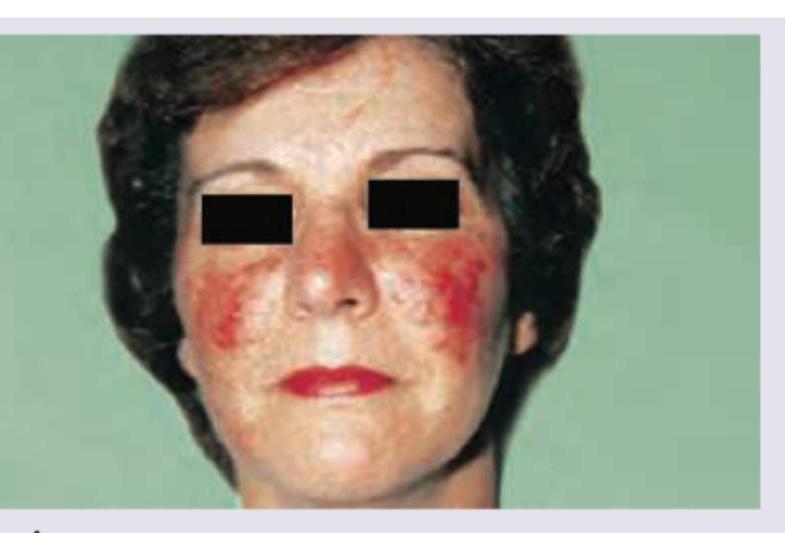
2 questionsAll are true about the condition shown in the image except:

All of the following are true regarding this picture except: (Recent NEET Pattern 2016-17)
NEET-PG 2017 - Pathology NEET-PG Practice Questions and MCQs
Question 131: All are true about the condition shown in the image except:
- A. Occurs due to lymphatics destruction
- B. Overexpression of HER 2/neu shows poor response to adriamycin (Correct Answer)
- C. Peau d'orange
- D. Van Nuys prognostic index
Explanation: ***Overexpression of HER 2/neu shows poor response to adriamycin*** - This statement is **FALSE** and represents the correct answer. **HER2-positive breast cancers** actually show **GOOD response** to anthracycline-based chemotherapy including adriamycin (doxorubicin) [1]. - Multiple clinical trials have demonstrated that **HER2-overexpressing tumors are chemosensitive** to anthracyclines, with improved response rates compared to HER2-negative tumors [1]. - Modern treatment combines adriamycin with **HER2-targeted therapy** (trastuzumab) for optimal outcomes in HER2+ inflammatory breast cancer [1]. *Occurs due to lymphatics destruction* - This is **TRUE** for inflammatory breast cancer. The pathognomonic feature involves **dermal lymphatic invasion** by malignant cells causing obstruction. - This lymphatic blockage leads to the characteristic clinical presentation including **peau d'orange appearance** and rapid onset of breast erythema and edema. *Peau d'orange* - This is **TRUE** and represents a classic sign of inflammatory breast cancer. The **"orange peel" appearance** results from skin edema with tethering at hair follicles. - Caused by **dermal lymphatic obstruction** by tumor emboli, leading to lymphedema that accentuates the skin pores. *Van Nuys prognostic index* - This statement is **TRUE** as written. The **Van Nuys Prognostic Index (VNPI)** is a scoring system specifically developed for **ductal carcinoma in situ (DCIS)**, not for inflammatory breast cancer. - Inflammatory breast cancer is an **aggressive invasive carcinoma** (stage IIIB minimum) and uses different prognostic systems including TNM staging and molecular markers, making VNPI inappropriate for this condition. **References:** [1] Kumar V, Abbas AK, et al.. Robbins and Cotran Pathologic Basis of Disease. 9th ed. The Breast, p. 1066.
Question 132: All of the following are true regarding this picture except: (Recent NEET Pattern 2016-17)
- A. Associated with underlying invasive carcinoma of breast
- B. Itching is a common symptom
- C. Usually bilateral (Correct Answer)
- D. Treatment is simple mastectomy with axillary lymph node dissection
Explanation: ***Usually bilateral*** - Paget's disease of the nipple, as depicted in the image (lesions on the nipple with surrounding dermatitis-like changes), is almost always an **unilateral condition**. - Its bilateral occurrence is exceedingly rare and would suggest a different or coincidental pathology. - **This is the FALSE statement** - Paget's disease is typically unilateral, not bilateral. *Associated with underlying invasive carcinoma of breast* - **Paget's disease of the nipple** is histologically characterized by the presence of **Paget cells** (adenocarcinoma cells) in the epidermis of the nipple and areola [2]. - In a vast majority of cases (90-95%), it is associated with an underlying **ductal carcinoma in situ (DCIS)** or an **invasive ductal carcinoma** originating from the lactiferous ducts [1], [2]. *Itching is a common symptom* - **Itching (pruritus)** is a **prominent and common symptom** of Paget's disease of the nipple, along with burning, pain, and crusting. - The eczematous changes often lead to significant discomfort and itching. *Treatment is simple mastectomy with axillary lymph node dissection* - The standard treatment for Paget's disease of the nipple, especially when associated with an underlying invasive carcinoma, is **surgical excision**. - A **simple mastectomy** removes the entire breast and is often combined with **axillary lymph node dissection** or sentinel lymph node biopsy to assess for nodal involvement [1]. **References:** [1] Cross SS. Underwood's Pathology: A Clinical Approach. 6th ed. Common Clinical Problems From Liver And Biliary System Disease, pp. 456-457. [2] Kumar V, Abbas AK, et al.. Robbins and Cotran Pathologic Basis of Disease. 9th ed. The Breast, pp. 1061-1062.
Surgery
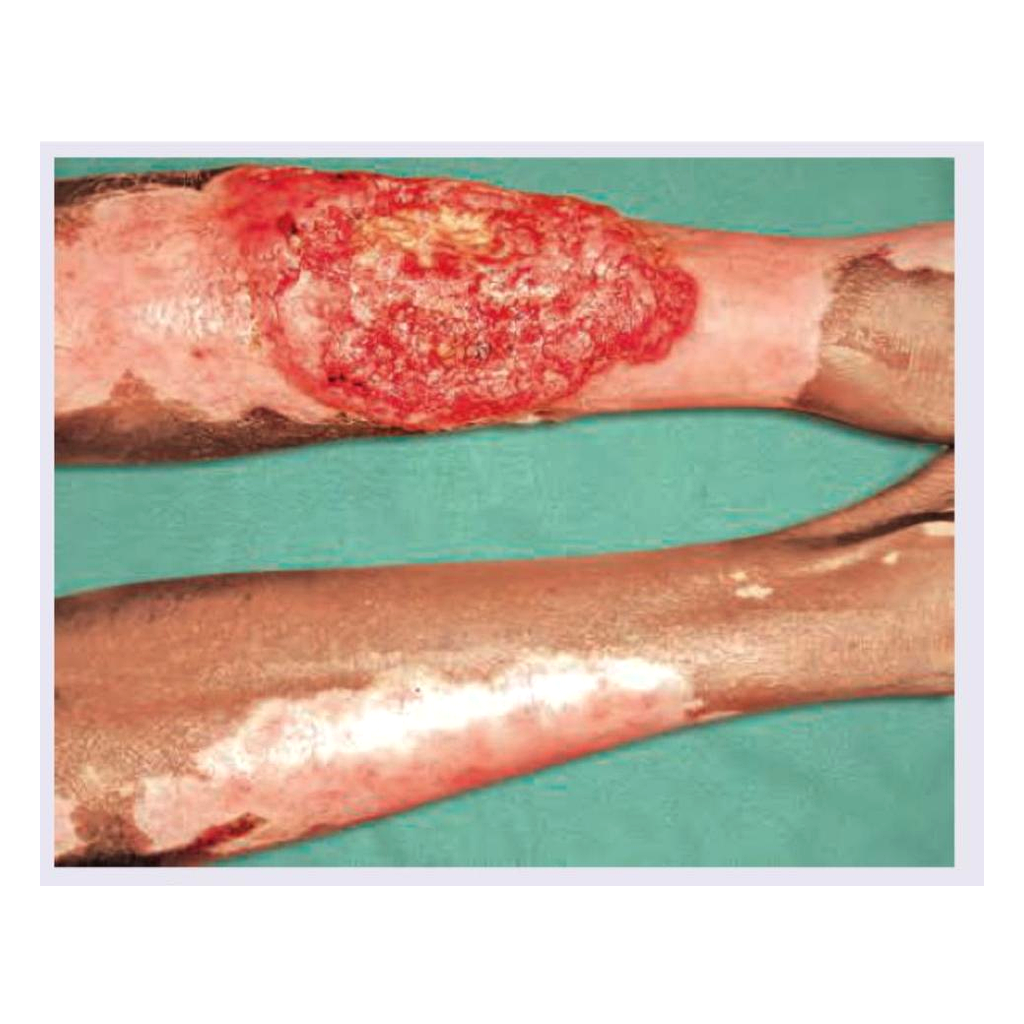
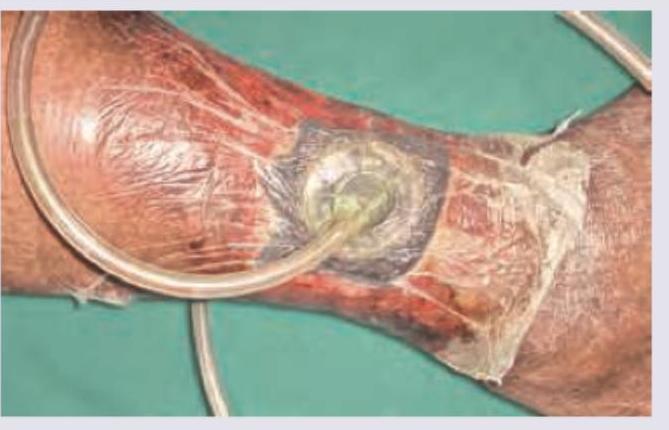
7 questionsWhat is the most likely diagnosis based on the image provided? The patient had a snake bite at this site 5 years ago.

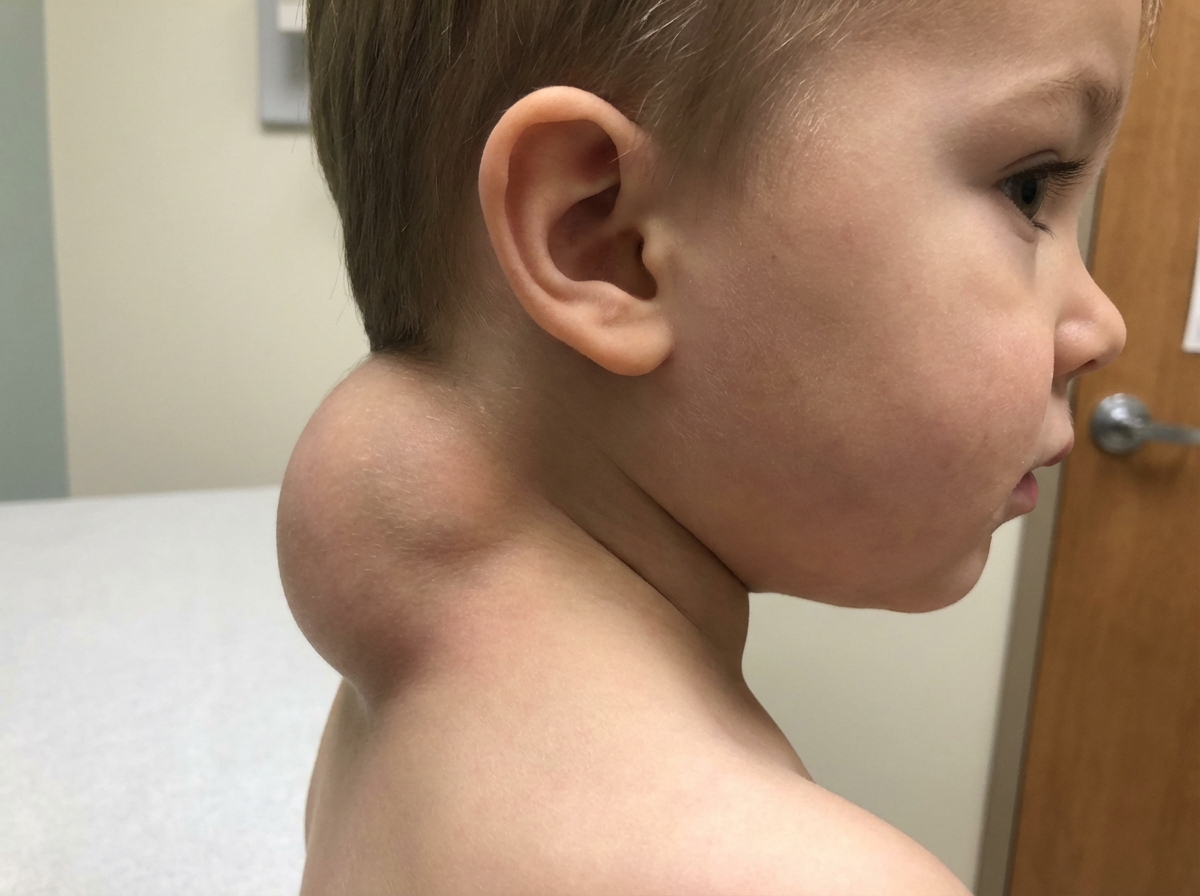
Which of the following is true regarding this condition?

A 51-year-old woman presents with complaints of nervousness and weight loss. She reveals that she has been feeling her heart racing often. On examination, she has a fine tremor, and a large mass in the front of her neck that moves when she swallows. What is the definite treatment of choice for this condition?

A 22-year-old female patient complains of discharge from the neck along with a previous history of midline neck swelling. Image of the patient is given below. All the statements regarding this patient are true except:

A splenorenal shunt procedure may be required for treatment of:
A 12-year-old patient with esophageal varices is managed by the procedure shown in the image. All of the following statements regarding this condition are true except:

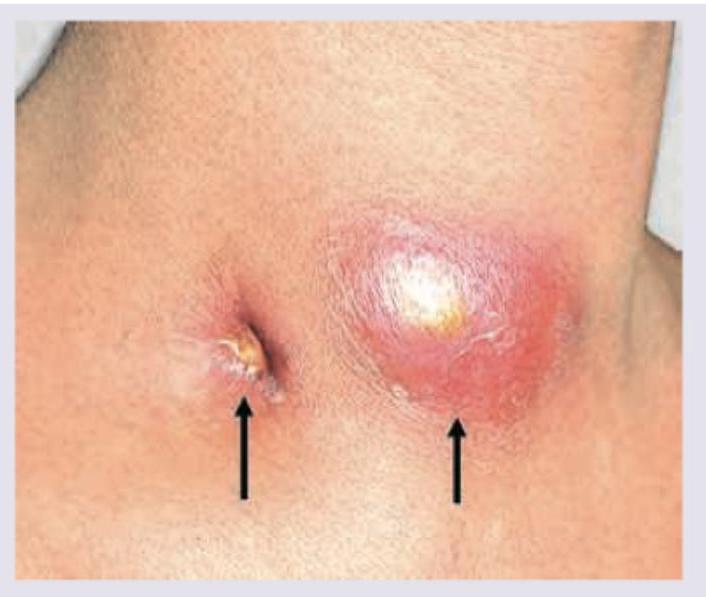
A 29-year-old male who is a doctor by profession, gives a history of prolonged sitting in his OPD hours and presents with discharge and pain. Clinical presentation of the patient is given in the image. What is the most likely diagnosis?

NEET-PG 2017 - Surgery NEET-PG Practice Questions and MCQs
Question 131: What is the most likely diagnosis based on the image provided? The patient had a snake bite at this site 5 years ago.
- A. Marjolin's ulcer (Correct Answer)
- B. Bazin's ulcer
- C. Martorell's ulcer
- D. Meleney's ulcer
Explanation: ***Marjolin's ulcer*** - This is a **squamous cell carcinoma** developing in a chronic wound, burn scar, or chronic inflammatory lesion, often after a long latent period (like the 5 years post-snake bite). The image shows a **fungating, ulcerative lesion** consistent with a malignant transformation in a chronic wound. - The history of a **snake bite 5 years ago** indicates a pre-existing chronic wound site, making Marjolin's ulcer the most probable diagnosis for a subsequent malignant change. *Bazin's ulcer* - Bazin's ulcer, also known as **erythema induratum**, is a chronic, recurrent panniculitis typically affecting the calves of young to middle-aged women. - It is associated with **tuberculosis**, presenting as tender, subcutaneous nodules that can ulcerate, which doesn't match the image or history. *Martorell's ulcer* - This is a form of **ischemic ulcer** caused by severe, uncontrolled hypertension, leading to microangiopathy and skin necrosis, usually on the anterior and lateral aspects of the lower leg. - While it presents as a painful ulcer, it is not typically associated with chronic trauma or previous wounds like a snake bite and lacks the fungating appearance shown. *Meleney's ulcer* - Meleney's ulcer, or **progressive bacterial synergistic gangrene**, is a rare, severe skin infection characterized by painful, undermined ulcers with a necrotic center. - It usually develops post-surgery or trauma and involves a synergistic bacterial infection, which is not suggested by the chronic nature (5 years) or the appearance of the lesion in the image.
Question 132: Which of the following is true regarding this condition?
- A. Most common site is anterior triangle neck
- B. It is due to vascular malformation
- C. Usually decreases on crying
- D. Needle aspiration yields fluid that does not coagulate (Correct Answer)
- E. Typically appears after 5 years of age
Explanation: ***Needle aspiration yields fluid that does not coagulate*** - The image depicts a large, translucent, fluid-filled cystic mass, characteristic of a **cystic hygroma** (lymphatic malformation). - Aspiration of a cystic hygroma typically yields **clear to straw-colored fluid** that is rich in protein but **does not coagulate** because it is lymphatic fluid, not blood. *Most common site is anterior triangle neck* - While cystic hygromas most commonly occur in the **neck**, they are typically found in the **posterior triangle**, not the anterior triangle. - The lesion in the image appears to be a large, diffuse cystic mass extending from the neck into the mediastinum or axilla. *It is due to vascular malformation* - This condition is a **lymphatic malformation**, specifically a cystic hygroma, not a vascular malformation. - **Vascular malformations** involve blood vessels and would typically present with different characteristics, such as being compressible and potentially blanching. *Usually decreases on crying* - Crying or straining typically **increases the size** of a cystic hygroma due to increased intrathoracic pressure, which impedes lymphatic flow and causes distention of the lymphatic sacs. - This characteristic helps differentiate it from conditions that might decrease in size with pressure. *Typically appears after 5 years of age* - Cystic hygromas are **congenital malformations** that are usually present at birth or become apparent within the **first 2 years of life** (approximately 90% by age 2). - Late presentation after 5 years of age is uncommon and would be unusual for this condition.
Question 133: A 51-year-old woman presents with complaints of nervousness and weight loss. She reveals that she has been feeling her heart racing often. On examination, she has a fine tremor, and a large mass in the front of her neck that moves when she swallows. What is the definite treatment of choice for this condition?
- A. Subtotal thyroidectomy
- B. Propranolol
- C. Total thyroidectomy (Correct Answer)
- D. ${ }^{131} \mathrm{I}$ radioablation
- E. Antithyroid drugs (Methimazole)
Explanation: ***Total thyroidectomy*** - The patient exhibits classic symptoms of **hyperthyroidism** (nervousness, weight loss, racing heart, fine tremor) and has a **large goiter** (mass in the front of her neck that moves with swallowing). - The image shows **exophthalmos/proptosis**, indicating **Graves' ophthalmopathy**. - For a **large symptomatic goiter**, **total thyroidectomy** is the definitive treatment of choice, providing immediate resolution of symptoms and removal of the compressive mass. - Surgery is preferred over radioactive iodine when there is a large goiter, as it provides rapid symptom relief and eliminates concerns about gland enlargement from radiation-induced thyroiditis. *Subtotal thyroidectomy* - **Subtotal thyroidectomy** leaves residual thyroid tissue, which carries a **higher risk of recurrent hyperthyroidism** (10-30% recurrence rate). - With a **large goiter** and significant symptoms, **total thyroidectomy** is preferred for definitive cure and to avoid recurrence. *Propranolol* - **Propranolol** is a beta-blocker used to manage **symptomatic effects** of hyperthyroidism (palpitations, tremor, anxiety) but does not address the underlying thyroid hormone excess. - It is an **adjunctive therapy** or temporary measure, not a definitive treatment. *${ }^{131} \\mathrm{I}$ radioablation* - **Radioactive iodine (RAI)** is an effective definitive treatment for Graves' disease and is the most common treatment in the United States. - However, for patients with a **very large goiter** (>80g), RAI may be less effective, can cause transient thyroid enlargement (radiation thyroiditis) with potential airway compromise, and takes months to achieve full effect. - Surgery is preferred for large goiters requiring rapid symptom resolution or when there are compressive symptoms. *Antithyroid drugs (Methimazole)* - **Antithyroid drugs** (methimazole, propylthiouracil) block thyroid hormone synthesis and are used for initial management of hyperthyroidism. - While they can achieve remission in some patients (30-50% after 12-18 months), they are **not considered definitive treatment** as relapse is common after discontinuation. - They do not address the **large goiter**, which may require definitive therapy with surgery or RAI.
Question 134: A 22-year-old female patient complains of discharge from the neck along with a previous history of midline neck swelling. Image of the patient is given below. All the statements regarding this patient are true except:
- A. This is thyroglossal fistula
- B. Sistrunk's operation is the treatment of choice
- C. This discharge site will move upwards on protrusion of tongue
- D. It is a complication of nodular goiter (Correct Answer)
Explanation: ***It is a complication of nodular goiter*** - A **thyroglossal duct cyst** is a congenital anomaly resulting from the incomplete obliteration of the thyroglossal duct, a remnant of thyroid gland development. - While it can become infected or form a fistula, it is not a complication of an acquired thyroid condition like **nodular goiter**, which is an enlargement of the thyroid gland. *This is thyroglossal fistula* - The patient's history of a **midline neck swelling** with **discharge from the neck** is highly suggestive of an infected thyroglossal duct cyst that has ruptured or been incised, forming a thyroglossal fistula. - A fistula is an **abnormal tract** connecting an internal cavity to the surface, in this case, the remnant of the thyroglossal duct to the skin. *Sistrunk's operation is the treatment of choice* - The **Sistrunk procedure** involves excising the thyroglossal duct cyst along with the central portion of the hyoid bone and the core of muscle extending to the foramen cecum at the base of the tongue. - This extensive removal is necessary due to the embryological origin and the high risk of recurrence if any part of the duct system, especially near the hyoid bone, is left behind. *This discharge site will move upwards on protrusion of tongue* - The **thyroglossal duct** travels through the hyoid bone and is embryologically connected to the tongue. - Therefore, structures within the persistent thyroglossal track, including a fistula, will move upwards with the **protrusion of the tongue**, which is a classic diagnostic sign.
Question 135: A splenorenal shunt procedure may be required for treatment of:
- A. Bleeding esophageal varices (Correct Answer)
- B. Mesenteric ischemia
- C. Injury to tail of pancreas
- D. Liver laceration
Explanation: ***Bleeding esophageal varices*** - The image depicts a **splenorenal shunt** (likely a distal splenorenal shunt or Warren shunt), which involves anastomosing the **splenic vein** to the **left renal vein** after ligating or resecting other splenic vein branches. - This procedure is primarily performed to **decompress the portal system** and reduce pressure in **esophageal varices** to prevent or treat life-threatening bleeding. *Mesenteric ischemia* - Mesenteric ischemia is caused by **reduced blood flow to the intestines**, often due to **atherosclerosis** or **embolism** of mesenteric arteries, not issues related to the portal system directly addressed by this shunt. - Treatment typically involves **revascularization** of the affected mesenteric vessels, not shunting the portal system. *Injury to tail of pancreas* - Injuries to the tail of the pancreas require surgical repair or **distal pancreatectomy**, depending on the severity. - This anatomical region and its management are unrelated to the specific surgical maneuver shown, which targets portal hypertension. *Liver laceration* - Liver lacerations are typically managed with **conservative treatment**, **surgical repair**, or **embolization**, depending on the grade of injury and hemodynamic stability. - The image does not illustrate a procedure for liver injury, nor is the depicted shunt a treatment for liver lacerations.
Question 136: A 12-year-old patient with esophageal varices is managed by the procedure shown in the image. All of the following statements regarding this condition are true except:
- A. Sengstaken-Blakemore tube
- B. Gastric balloon is inflated with 400 mL of air
- C. Esophageal balloon is inflated with 40 mm Hg pressure of air
- D. This is the definitive treatment (Correct Answer)
- E. Should be kept inflated for a maximum of 24-48 hours
Explanation: ***This is the definitive treatment*** - The image shows a **Sengstaken-Blakemore tube** being used, which is a temporary measure for controlling **bleeding esophageal varices**. - It is an emergency treatment used for stabilization and does not address the underlying cause of varices or prevent future bleeding. - **Definitive treatments** include endoscopic variceal ligation (EVL), sclerotherapy, or TIPS procedure. *Sengstaken-Blakemore tube* - The device shown in the image, with balloons and multiple lumens, is indeed a **Sengstaken-Blakemore tube**, used for **tamponade of actively bleeding esophageal varices**. - This tube features a gastric balloon and an esophageal balloon, along with lumens for suction, designed to exert pressure on the bleeding varices. *Gastric balloon is inflated with 400 mL of air* - The **gastric balloon** of a Sengstaken-Blakemore tube is typically inflated with **200-500 mL of air** (often around 250-300 ml in adults, 150 ml in children) to anchor the tube and compress gastric varices. - While 400 mL is within the general range, the exact volume can vary based on patient size and clinical protocol. *Esophageal balloon is inflated with 40 mm Hg pressure of air* - The **esophageal balloon** is indeed inflated to a pressure of **20-45 mmHg (typically 30-45 mmHg)** to compress esophageal varices. - This pressure application is critical for achieving local hemostasis in acute bleeding episodes. *Should be kept inflated for a maximum of 24-48 hours* - The balloons should be deflated after **24-48 hours maximum** to prevent complications such as **esophageal necrosis, ulceration, or perforation**. - Prolonged inflation can cause pressure necrosis of the esophageal or gastric mucosa.
Question 137: A 29-year-old male who is a doctor by profession, gives a history of prolonged sitting in his OPD hours and presents with discharge and pain. Clinical presentation of the patient is given in the image. What is the most likely diagnosis?
- A. Anal fissure
- B. Pilonidal sinus (Correct Answer)
- C. Anal fistula
- D. Sentinel pile
Explanation: ***Pilonidal sinus*** - The image shows a **pit** or **opening** in the **natal cleft** with surrounding inflammation and discharge, which is characteristic of a pilonidal sinus. - The history of **prolonged sitting** (*a doctor by profession has prolonged sitting hours in OPD*) and the patient's age (29-year-old male) are common risk factors for pilonidal disease. *Anal fissure* - An anal fissure is a **tear** in the **lining of the anal canal**, typically causing severe pain during and after defecation, and often bright red rectal bleeding. - The lesion in the image is located in the **natal cleft**, not within the anal canal, and presents as a sinus with discharge rather than a linear tear. *Anal fistula* - An anal fistula is an abnormal tunnel connecting the **anal canal to the skin outside** the anus, usually presenting as a small opening with intermittent or persistent discharge of pus or blood. - While it involves discharge, an **anal fistula** typically has an external opening closer to the anus, and the image clearly shows the lesion in the **sacrococcygeal region**, consistent with a pilonidal sinus. *Sentinel pile* - A sentinel pile is a **skin tag** that often accompanies a **chronic anal fissure**, located at the external edge of the fissure. - It is essentially excess skin and usually does not present with **discharge** or the characteristic **sinus tract** seen in the image.