Anesthesiology
1 questionsAll are correct about the pressure recording shown below except: (Recent NEET Pattern 2016-17)

NEET-PG 2017 - Anesthesiology NEET-PG Practice Questions and MCQs
Question 121: All are correct about the pressure recording shown below except: (Recent NEET Pattern 2016-17)
- A. Normal CVP is 2-10 cm of water
- B. Pressure recording of more than 10 cm of water implies restricting IV fluids to the patient
- C. Venous catheter is advanced into subclavicular IVC
- D. Can be used to assess left ventricular function (Correct Answer)
Explanation: ***Can be used to assess left ventricular function*** - Central venous pressure (CVP) primarily reflects **right atrial pressure** and, indirectly, **right ventricular end-diastolic pressure**. - It is **not a reliable indicator** for assessing **left ventricular function**, which is better gauged by pulmonary artery wedge pressure (PAWP) or echocardiography. *Normal CVP is 2-10 cm of water* - The image depicts a manometer measuring CVP in **cm of water**. - The generally accepted normal range for CVP is **2-10 cm H2O** (or 0-8 mmHg), reflecting adequate right heart filling and venous return. *Pressure recording of more than 10 cm of water implies restricting IV fluids to the patient* - A CVP **above 10 cm H2O** (or 8 mmHg) typically indicates **fluid overload**, increased right ventricular preload, or right ventricular dysfunction. - In such cases, **restricting intravenous fluids** is often appropriate to prevent further circulatory congestion and potential complications like pulmonary edema. *Venous catheter is advanced into subclavicular IVC* - For CVP measurement, the catheter tip should ideally be positioned in the **superior vena cava (SVC)**, near its junction with the **right atrium**. - Advancing the catheter into the **inferior vena cava (IVC)** is anatomically incorrect for standard CVP measurement, as it would not reflect right atrial pressure as directly or accurately.
Dermatology
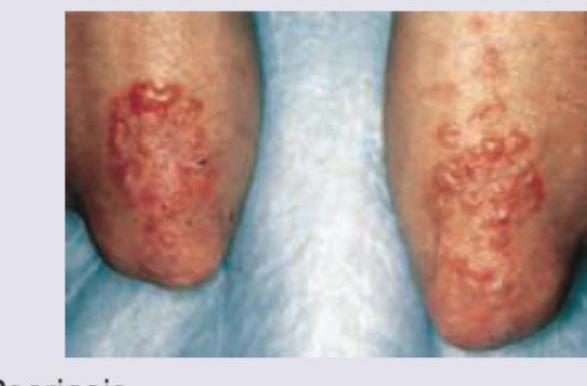
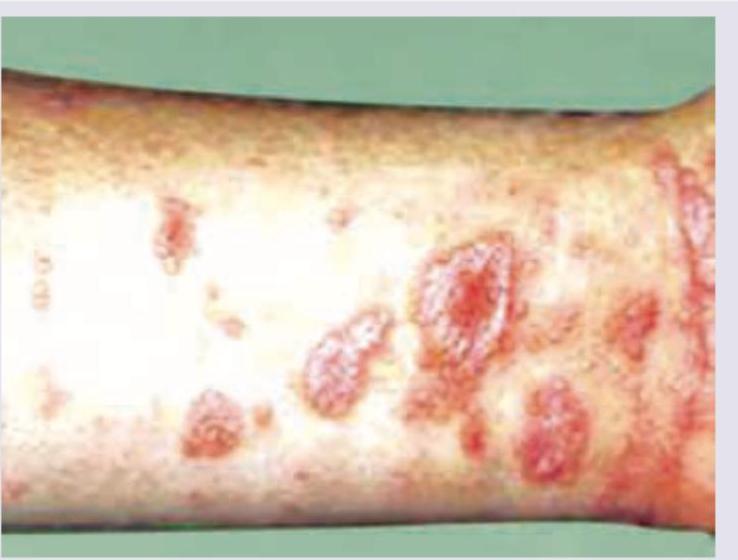
4 questionsA patient presents with intensely pruritic vesicular lesions on extensor surfaces. What is the most likely diagnosis based on the clinical image?
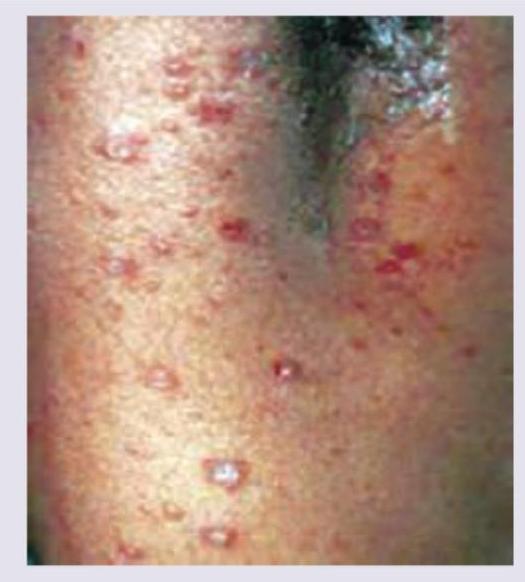
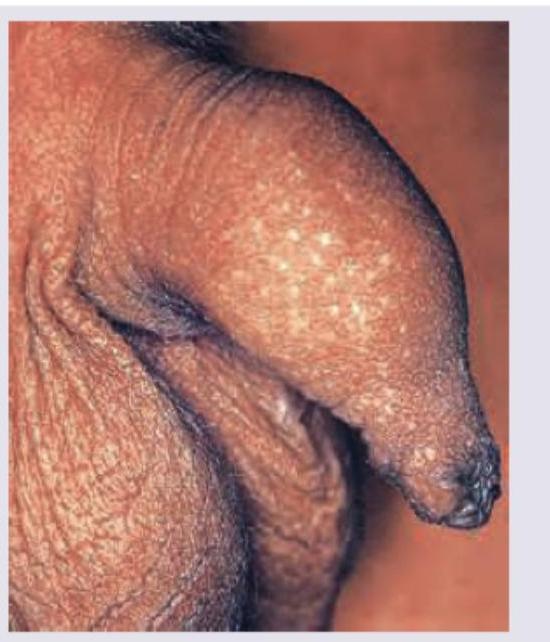
A 20-year-old male with no history of any sexual contact presents with following lesions on his penis. What is the diagnosis?
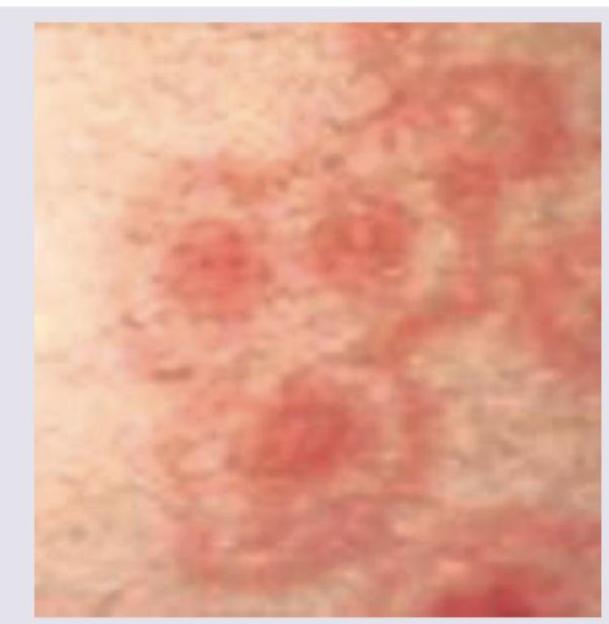
What is the most likely diagnosis of the image given below?

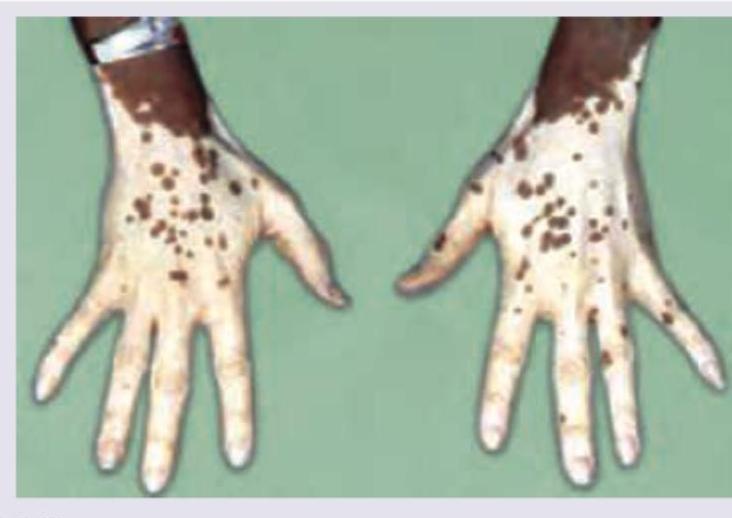
The following clinical presentation is seen in injury to which nerve? (Recent NEET Pattern 2016-17)

NEET-PG 2017 - Dermatology NEET-PG Practice Questions and MCQs
Question 121: A patient presents with intensely pruritic vesicular lesions on extensor surfaces. What is the most likely diagnosis based on the clinical image?
- A. Psoriasis
- B. Dermatitis herpetiformis (Correct Answer)
- C. Erythema marginatum
- D. Lichen planus
Explanation: ***Dermatitis herpetiformis*** - This image shows **urticarial plaques** and **grouped vesicles/bullae**, which are classic features of **dermatitis herpetiformis**. - These lesions are typically **extremely pruritic**, often appearing symmetrically on extensor surfaces like the elbows, knees, and buttocks. *Psoriasis* - Psoriasis typically presents as well-demarcated, **erythematous plaques** with **silvery scales**, predominantly on extensor surfaces and the scalp. - While it can involve various morphologies, the vesicular nature seen in the image is not characteristic of typical psoriasis. *Erythema marginatum* - Erythema marginatum is characterized by **pink or red macular lesions** with **raised, serpiginous borders** that are typically non-pruritic and rapidly migratory. - It is a minor criterion for **rheumatic fever** and looks distinctly different from the vesicular eruption shown. *Lichen planus* - Lichen planus presents with "6 Ps": **pruritic, purple, polygonal, planar, papules, and plaques**, often with **Wickham's striae** (fine white lines). - It usually affects the wrists, ankles, and oral mucosa, and does not typically feature the prominent vesicles or bullae seen in the image.
Question 122: A 20-year-old male with no history of any sexual contact presents with following lesions on his penis. What is the diagnosis?
- A. Lichenoides keratosis
- B. Epstein pearls
- C. Molluscum contagiosum
- D. Lichen nitidus (Correct Answer)
Explanation: ***Lichen nitidus*** - The image shows numerous small, shiny, **pin-head sized papules** on the penis, which are characteristic of lichen nitidus. - This condition is often **asymptomatic** and benign, and it can occur on the penis without any sexual contact history. *Lichenoides keratosis* - This term is broad and often refers to a benign **inflammatory process** with lichenoid features affecting keratinocytes, usually solitary and often in older adults; it does not typically present as widespread, uniform papules on the penis. - Lichenoides keratosis is often a more **solitary lesion** or a reaction pattern, not a diffuse eruption of small papules like those pictured. *Epstein pearls* - **Epstein pearls** are small, white or yellow cysts found in the mouths of newborns, specifically on the gums or palate, and are remnants of epithelial tissue. - They are a normal finding in neonates and are **not found on the penis** or in a 20-year-old male. *Molluscum contagiosum* - Molluscum contagiosum lesions typically present as **dome-shaped, flesh-colored papules with central umbilication**. - While they can appear on the penis and are sexually transmitted, the lesions in the image lack the characteristic **umbilication** of molluscum contagiosum.
Question 123: What is the most likely diagnosis of the image given below?
- A. Acne rosacea
- B. Dermatitis herpetiformis
- C. Erythema marginatum
- D. Dermatomyositis (Correct Answer)
Explanation: ***Dermatomyositis*** - The image displays a characteristic **heliotrope rash** (violaceous/purple-red discoloration) around the eyes and periorbital area, which is pathognomonic for dermatomyositis. - This condition is an **inflammatory myopathy** distinguished by distinct cutaneous manifestations (including Gottron's papules, shawl sign, and V-sign) alongside proximal muscle weakness. - The periorbital violaceous erythema with associated edema is highly characteristic and helps differentiate it from other facial rashes. *Acne rosacea* - Characterized by **facial erythema**, papules, pustules, and telangiectasias, primarily affecting the central face (cheeks, nose, chin, forehead). - Does not typically involve the marked periorbital (heliotrope) rash with violaceous discoloration seen in dermatomyositis. - Usually presents with flushing and visible blood vessels rather than periorbital edema. *Dermatitis herpetiformis* - Presents with intensely **pruritic (itchy) papules and vesicles** (blisters), typically symmetrical on extensor surfaces like elbows, knees, buttocks, and scalp. - Strongly associated with **celiac disease** (gluten-sensitive enteropathy). - Does not present as facial erythema or periorbital discoloration; the lesions are vesicular and intensely itchy. *Erythema marginatum* - A skin manifestation of **acute rheumatic fever**, characterized by an evanescent, **serpiginous (snake-like) migratory rash** with distinct, raised borders and clear centers. - Typically appears on the trunk and proximal limbs, sparing the face. - Does not present as periorbital discoloration and has a distinctive migrating, annular pattern.
Question 124: The following clinical presentation is seen in injury to which nerve? (Recent NEET Pattern 2016-17)
- A. Median nerve (Correct Answer)
- B. Ulnar nerve
- C. Median and ulnar nerve
- D. Radial nerve
Explanation: ***Median nerve*** - The image illustrates **'ape hand' deformity**, characterized by the inability to oppose the thumb and atrophy of the thenar eminence due to paralysis of the **thenar muscles** (abductor pollicis brevis, opponens pollicis, superficial head of flexor pollicis brevis). - These thenar muscles are primarily innervated by the **recurrent branch of the median nerve**. *Ulnar nerve* - Ulnar nerve injury typically causes **'claw hand' deformity** (hyperextension of MCP joints and flexion of IP joints of 4th and 5th digits) due to paralysis of the intrinsic muscles of the hand (interossei and medial two lumbricals). - It would also cause prominent atrophy of the **hypothenar eminence** and interosseous muscles. *Median and ulnar nerve* - Combined median and ulnar nerve injury would result in a **more severe and widespread paralysis** affecting nearly all intrinsic hand muscles, leading to a profound loss of hand function. - This would present with features of both **ape hand** and **claw hand**, commonly referred to as a **'simian hand'** if severe. *Radial nerve* - Radial nerve injury typically causes **'wrist drop'** and inability to extend the fingers and thumb at the metacarpophalangeal joints. - It primarily affects the **extensor muscles of the forearm** and does not directly result in thenar atrophy or the inability to oppose the thumb.
General Medicine
1 questionsA 35-year-old HIV+ patient presents with the following lesion in the neck. What is correct about the management?

NEET-PG 2017 - General Medicine NEET-PG Practice Questions and MCQs
Question 121: A 35-year-old HIV+ patient presents with the following lesion in the neck. What is correct about the management?
- A. ATT for another 6 months
- B. Gravity drainage + ATT (Correct Answer)
- C. Anti-gravity drainage + ATT
- D. Incision and drainage
Explanation: ***Gravity drainage + ATT*** - The image shows a **scrofula**, presenting as an abscess in the cervical lymph nodes, likely due to **tuberculous lymphadenitis**. In such cases, **gravity drainage** is crucial to evacuate the purulent material effectively, especially in the neck region. - **Anti-tubercular therapy (ATT)** is the mainstay for treating tuberculosis, and it must be initiated in combination with drainage to eradicate the infection. *ATT for another 6 months* - While ATT is essential, it is **insufficient as a standalone treatment** for a mature draining abscess like the one depicted. - Simply continuing ATT without addressing the localized collection of pus would likely result in delayed healing and potential complications. *Anti-gravity drainage + ATT* - **Anti-gravity drainage** is generally not feasible or effective for abscesses in the neck, as gravity aids in the natural flow of exudates. - This approach would go against the principles of surgical drainage for fluid collections. *Incision and drainage* - While **incision and drainage (I&D)** is a standard procedure for many abscesses, caution is exercised in tuberculous lymphadenitis (scrofula) due to the risk of creating a **continuous fistula** or **non-healing sinus**. - **Repeat aspirations** or **gravity drainage** with concurrent ATT are preferred over formal incision and drainage to minimize scarring and fistula formation.
Surgery
4 questionsThe method of ulcer healing shown below generates a pressure of: (Recent NEET Pattern 2016-17)

The following instrument used in split skin grafting is called: (Recent NEET Pattern 2016-17)

The following instrument used in split skin grafting is called: (Recent NEET Pattern 2016-17)

A patient complains of pain and boggy swelling in the frontal region which is warm and tender. He also complains of drowsiness at times. What is the diagnosis?
NEET-PG 2017 - Surgery NEET-PG Practice Questions and MCQs
Question 121: The method of ulcer healing shown below generates a pressure of: (Recent NEET Pattern 2016-17)
- A. Minus 100 cm of water
- B. Minus 125 mm Hg (Correct Answer)
- C. Plus 100 cm of water
- D. Plus 125 cm of water
Explanation: ***Minus 125 mm Hg*** - The image depicts **Negative Pressure Wound Therapy (NPWT)**, also known as vacuum-assisted closure (VAC), which applies subatmospheric pressure to promote wound healing. - The standard therapeutic pressure for NPWT is **-125 mmHg**, which aids in wound contraction, granulation tissue formation, removal of exudate, and increased blood flow to the wound bed. - This pressure setting is well-established in clinical practice and supported by surgical literature. *Minus 100 cm of water* - While this represents negative pressure, **mmHg is the standard unit** used for measuring and reporting NPWT pressure settings, not cm H₂O. - Converting -100 cm H₂O to mmHg yields approximately -73.5 mmHg, which is lower than the commonly effective therapeutic pressure range for NPWT. *Plus 100 cm of water* - This indicates **positive pressure**, whereas NPWT fundamentally relies on **negative (subatmospheric) pressure** to achieve its therapeutic effects. - Positive pressure would not facilitate wound fluid removal, tissue contraction, or granulation tissue formation as intended by NPWT. *Plus 125 cm of water* - This represents **positive pressure**, which contradicts the core mechanism of action of **Negative Pressure Wound Therapy**. - Positive pressure would push against the wound rather than creating the suction needed to draw out exudate and promote wound closure.
Question 122: The following instrument used in split skin grafting is called: (Recent NEET Pattern 2016-17)
- A. Humby's knife (Correct Answer)
- B. Mesher
- C. Watson's knife
- D. Blair knife
Explanation: ***Humby's knife*** - The image clearly depicts a **Humby's knife**, which is a type of **manual dermatome** used to harvest split-thickness skin grafts. - This instrument is characterized by its adjustable blade and roller, allowing for collection of skin grafts of varying thicknesses. *Mesher* - A **mesher** is an instrument used to create fenestrations or small slits in a skin graft, allowing it to stretch and cover a larger wound area. - The instrument in the image is designed for harvesting, not for meshing. *Watson's knife* - **Watson's knife** is another type of manual dermatome used for harvesting split-thickness skin grafts. - While similar in purpose to Humby's knife, Watson's knife has distinct design features and the instrument shown in the image is specifically a Humby's knife. *Blair knife* - **Blair knife** is a different type of skin grafting knife, typically used for full-thickness skin graft harvesting. - The instrument in the image has the characteristic roller and adjustable blade design of a Humby's knife, not a Blair knife.
Question 123: The following instrument used in split skin grafting is called: (Recent NEET Pattern 2016-17)
- A. Humby's knife
- B. Mesher (Correct Answer)
- C. Eschmann blade
- D. Down's blade
Explanation: ***Mesher*** - The image depicts a **skin mesher** with a harvested split-thickness skin graft being passed through it, resulting in the characteristic mesh pattern seen below. - A mesher creates perforations in the skin graft, which allows for expansion (covering a larger area), drainage of exudate, and improved graft take. *Humby's knife* - A **Humby's knife** is a type of dermatome (skin grafting knife) used to harvest freehand split-thickness skin grafts. - It does not produce the characteristic mesh pattern seen in the image. *Eschmann blade* - An **Eschmann blade** is a type of surgical blade, often used in specific dermatomes, but it is not the meshing machine itself. - It is used for harvesting, not for perforating skin grafts into a mesh. *Down's blade* - Similar to the Eschmann blade, a **Down's blade** is a type of dermatome blade used for harvesting skin grafts. - It does not perform the meshing function shown in the image.
Question 124: A patient complains of pain and boggy swelling in the frontal region which is warm and tender. He also complains of drowsiness at times. What is the diagnosis?
- A. Pyogenic granuloma
- B. Orbital cellulitis
- C. Cavernous sinus thrombosis
- D. Pott's puffy tumor (Correct Answer)
Explanation: **Pott's puffy tumor** * **Pott's puffy tumor** is characterized by a focal osteomyelitis of the frontal bone, often complicated by a subperiosteal abscess. The description of **pain and boggy swelling in the frontal region, which is warm and tender**, perfectly matches this condition. * The complication of **drowsiness** indicates potential epidural or intracranial extension of the infection, which is a common and severe consequence of Pott's puffy tumor. *Pyogenic granuloma* * A pyogenic granuloma is a **benign vascular lesion** of the skin or mucous membranes. * While it can be warm and tender, it typically presents as an **eruptive, solitary, red papule or nodule** that bleeds easily, and it does not typically cause boggy swelling in the frontal bone or drowsiness. *Orbital cellulitis* * Orbital cellulitis presents with **pain, swelling, redness, and warmth around the eye,** often with proptosis and ophthalmoplegia. * While it is a serious infection, the primary swelling in this case is described in the **frontal region**, not specifically confined to the orbit, and the specific feature of a "boggy" swelling over bone is more indicative of a frontal bone osteomyelitis. *Cavernous sinus thrombosis* * Cavernous sinus thrombosis is characterized by **headache, painful ophthalmoplegia, proptosis, and vision loss**, often with fever and altered mental status. * While **drowsiness** can be a feature, the presentation lacks the prominent **orbital signs** and localizing frontal boggy swelling specific to the described case; instead, it would typically present predominantly with signs related to cranial nerve involvement and venous congestion of the orbit.