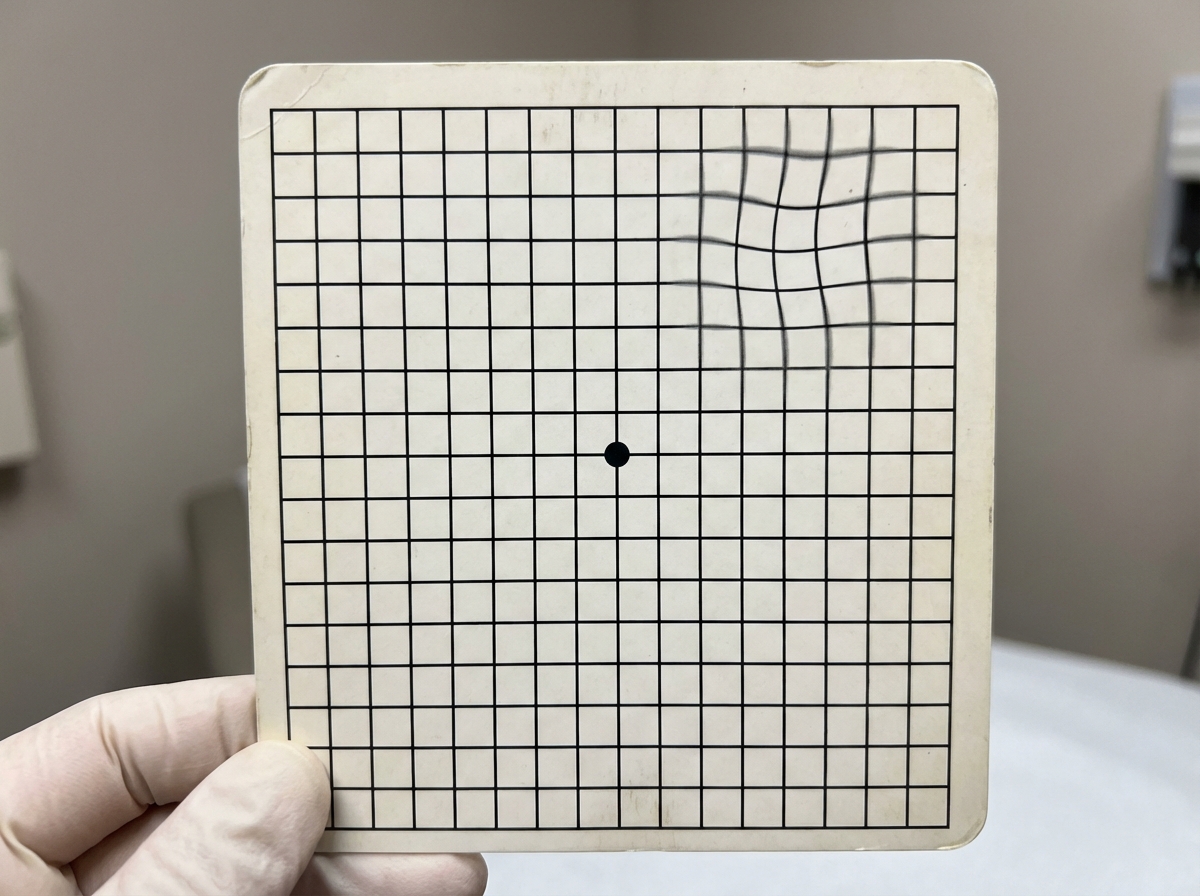
The test shown below is used for the evaluation of
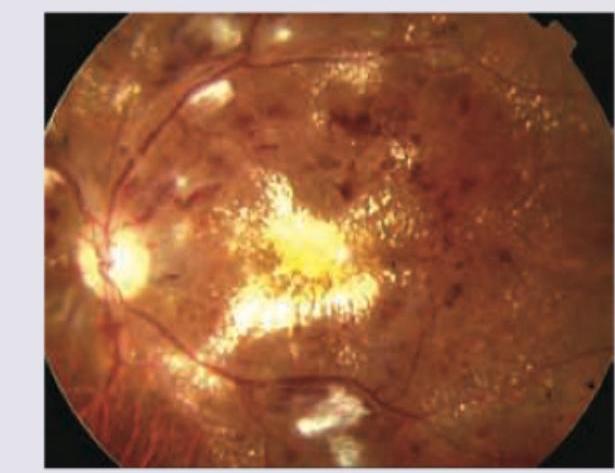
A 60-year-old patient during annual check-up had a report of HbA1C of $10 \%$. What does the given fundus examination show?
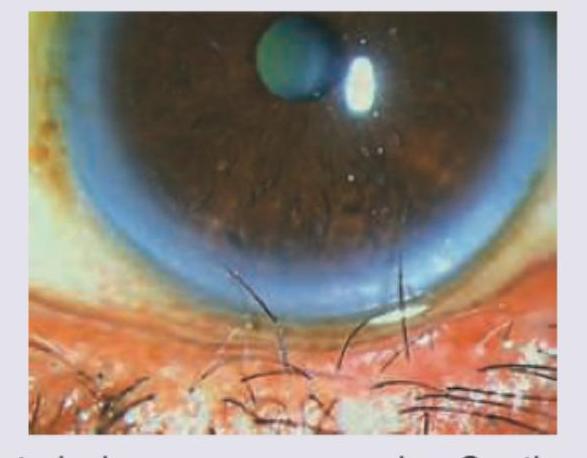
All are used for the treatment of the condition shown below except:
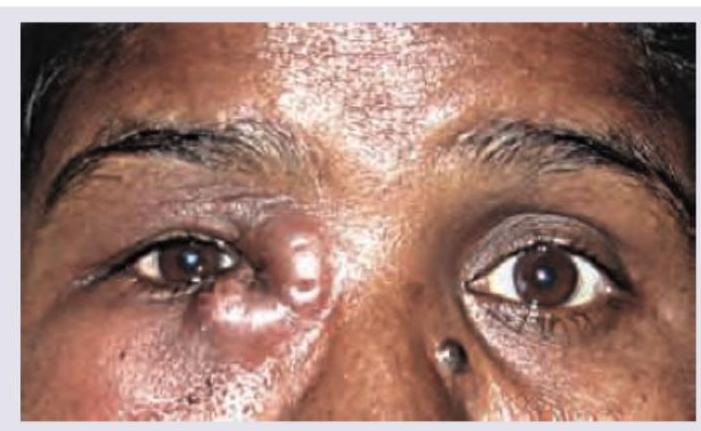
A 30-year-old woman presents with painful eye swelling. Based on the clinical photograph shown, the most likely diagnosis is:
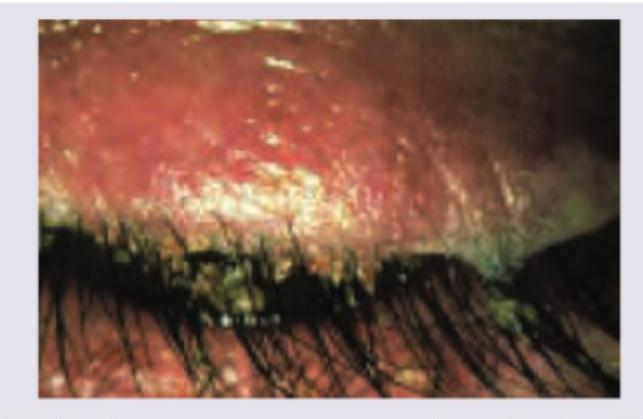
A patient presents with itching in eyes with redness of eyelids. What is correct about the image shown below? (Recent NEET Pattern 2016-17)
A 40-year-old AIDS positive patient complains of seeing floaters followed by progressive reduction in visual acuity over next weeks. Fundus examination was performed. All are true about the causative agent except: (Recent NEET Pattern 2016-17)

NEET-PG 2017 - Ophthalmology NEET-PG Practice Questions and MCQs
Question 11: The test shown below is used for the evaluation of
- A. Macular degeneration (Correct Answer)
- B. Glaucoma
- C. Cataracts
- D. Retinal detachment
Explanation: ***Macular degeneration*** - The image shown is an **Amsler grid**, a diagnostic tool used to detect **visual disturbances** caused by changes in the retina, especially the macula. - The straight lines appearing wavy or distorted, as seen in the right panel, are characteristic findings in **macular degeneration** or other macular pathologies. - The Amsler grid is the standard screening tool for **age-related macular degeneration (AMD)** and other macular disorders. *Glaucoma* - Glaucoma primarily affects the **optic nerve** and typically causes **peripheral vision loss**, which is not directly assessed by an Amsler grid. - Visual field tests (perimetry) are used for glaucoma diagnosis, not the Amsler grid. *Cataracts* - Cataracts involve **clouding of the lens** of the eye, leading to blurred vision, glare, and difficulty with night vision. - They do not typically cause the **distortion of straight lines** that an Amsler grid helps to detect. *Retinal detachment* - Retinal detachment usually presents with symptoms like flashes of light, **floaters**, or a curtain-like shadow in the vision. - While it can affect vision, the Amsler grid specifically detects **macular distortion**, which is the hallmark of macular pathology rather than peripheral retinal detachment.
Question 12: A 60-year-old patient during annual check-up had a report of HbA1C of $10 \%$. What does the given fundus examination show?
- A. Proliferative retinopathy (Correct Answer)
- B. Nonproliferative retinopathy
- C. Neovascularization of the disc
- D. Subhyaloid hemorrhage
Explanation: ***Proliferative retinopathy*** - The image shows **neovascularization**, which are new, abnormal blood vessels growing on the surface of the retina or optic disc. This is the hallmark of proliferative retinopathy. - There are also extensive **hard exudates**, retinal hemorrhages, and signs of significant retinal damage consistent with advanced diabetic retinopathy. *Nonproliferative retinopathy* - This stage is characterized by **microaneurysms**, **dot and blot hemorrhages**, hard exudates, and cotton wool spots, but crucially **lacks neovascularization**. - While many features of nonproliferative retinopathy are present (e.g., hemorrhages, exudates), the presence of visible new vessels confirms progression to the proliferative stage. *Neovascularization of the disc* - While **neovascularization of the disc** (NVD) is indeed a feature seen in the image, characterized by the growth of new abnormal vessels on or within one disc diameter of the optic disc, it is a *component* or *sign* of proliferative retinopathy, not the overarching diagnosis. - Proliferative retinopathy encompasses NVD and/or neovascularization elsewhere (NVE), along with other severe changes. *Subhyaloid hemorrhage* - A **subhyaloid hemorrhage** appears as a boat-shaped or D-shaped collection of blood lying beneath the posterior hyaloid face, often obscuring retinal details. - While hemorrhage is present in the image, there is no distinct subhyaloid collection of blood; instead, the picture shows widespread intraretinal and likely preretinal hemorrhages as part of the severe proliferative process.
Question 13: All are used for the treatment of the condition shown below except:
- A. Electrolysis
- B. Canthoplasty (Correct Answer)
- C. Electrodiathermy
- D. Cryotherapy
Explanation: ***Canthoplasty*** - The image depicts **trichiasis**, a condition where eyelashes grow inwards and rub against the cornea. Canthoplasty is a surgical procedure that **modifies the outer or inner canthus of the eye** (the corners) and is not primarily used to address misdirected eyelashes. - Canthoplasty is typically performed for conditions like **ectropion** or **entropion** to correct eyelid position, or for cosmetic purposes, not for direct removal or redirection of individual eyelashes. *Electrolysis* - **Electrolysis** is a common and effective method for treating trichiasis by destroying the hair follicle with an electric current, preventing regrowth. - This procedure targets individual misdirected eyelashes, providing a long-term solution. *Electrodiathermy* - **Electrodiathermy** (also known as diathermy) uses high-frequency electrical currents to generate heat, which can be applied to destroy hair follicles, similar to electrolysis. - It is an effective treatment for permanent removal of eyelashes in cases of trichiasis. *Cryotherapy* - **Cryotherapy** involves freezing the eyelash follicles to destroy them, preventing further abnormal growth. - This technique is another viable option for the permanent removal of eyelashes in trichiasis and can be applied to a group of misdirected lashes.
Question 14: A 30-year-old woman presents with painful eye swelling. Based on the clinical photograph shown, the most likely diagnosis is:
- A. Acute dacryocystitis (Correct Answer)
- B. Lacrimal gland carcinoma
- C. Orbital cellulitis
- D. Hordeolum externum
Explanation: ***Acute dacryocystitis*** - The image shows a **painful, erythematous, and swollen area** at the medial canthus below the **medial palpebral ligament**, characteristic of acute inflammation of the lacrimal sac. - This condition results from **obstruction of the nasolacrimal duct**, leading to bacterial infection and abscess formation in the lacrimal sac. *Lacrimal gland carcinoma* - This condition typically presents as a **slow-growing mass** in the upper outer quadrant of the orbit, often causing **proptosis and displacement** of the globe, rather than acute inflammation at the medial canthus. - While it can be painful, the **acute inflammatory signs** and specific location seen in the image are not typical of lacrimal gland carcinoma. *Orbital cellulitis* - Orbital cellulitis involves inflammation and infection of the **orbital tissues posterior to the orbital septum**, causing generalized swelling of the eyelids, proptosis, pain with eye movements, and potentially vision loss. - The localized swelling near the medial canthus with obvious inflammatory signs is more consistent with a dacryocystitis, whereas orbital cellulitis would involve a broader area of swelling and often more systemic symptoms. *Hordeolum externum* - A hordeolum externum, or stye, is an acute **localized infection of a hair follicle or sebaceous gland** (gland of Zeis or Moll) along the eyelid margin. - The swelling seen in the image is much larger and more medially located, involving the lacrimal sac area, rather than being confined to the eyelid margin.
Question 15: A patient presents with itching in eyes with redness of eyelids. What is correct about the image shown below? (Recent NEET Pattern 2016-17)
- A. Trichiasis
- B. Blepharitis (Correct Answer)
- C. Blepharospasm
- D. Distichiasis
Explanation: ***Blepharitis*** - The image shows **redness** and **inflammation of the eyelid margins**, often accompanied by scales or crusts at the base of the eyelashes. This is characteristic of blepharitis. - The history of **itching** and **redness of eyelids** further supports the diagnosis, as these are common symptoms of blepharitis, an immune-mediated inflammation. *Trichiasis* - This condition involves **misdirected eyelashes** that grow inwards and rub against the surface of the eye. - While it can cause irritation, the primary feature in the image is inflammation and crusting of the eyelid margin, not just misdirected lashes. *Blepharospasm* - **Blepharospasm** is an involuntary, repetitive, bilateral twitching or forceful closure of the eyelids. - This is a neurological condition affecting eyelid movement and is not depicted by the visible inflammation in the image. *Distichiasis* - **Distichiasis** is a rare condition where there is an extra row of eyelashes growing from the meibomian gland openings on the eyelid margin. - The image does not show an extra row of lashes; instead, it indicates inflammation and debris along the existing lash line.
Question 16: A 40-year-old AIDS positive patient complains of seeing floaters followed by progressive reduction in visual acuity over next weeks. Fundus examination was performed. All are true about the causative agent except: (Recent NEET Pattern 2016-17)
- A. Eosinophilic intranuclear inclusions (Correct Answer)
- B. Shed in semen
- C. Largest virus in human herpes virus
- D. Leads to pizza pie retinopathy
Explanation: ***Eosinophilic intranuclear inclusions*** - The causative agent of **CMV retinitis** (Cytomegalovirus) typically forms **basophilic intranuclear inclusions** (owl's eye inclusions), not eosinophilic ones. - This statement is therefore incorrect regarding CMV. *Shed in semen* - **CMV** is commonly shed in various bodily fluids, including **semen**, urine, and saliva, contributing to its transmission. - This is a true characteristic of CMV. *Largest virus in human herpes virus* - **CMV** (Human herpesvirus 5) is indeed the **largest virus in the human herpesvirus family**, both in terms of genome size and virion size. - This is a true characteristic of CMV. *Leads to pizza pie retinopathy* - The classic description of **CMV retinitis** on fundus examination is often referred to as "**pizza pie retinopathy**" or "cottage cheese and ketchup" appearance, due to its characteristic retinal hemorrhages and white, necrotic areas. - This is a true clinical manifestation of CMV retinitis.