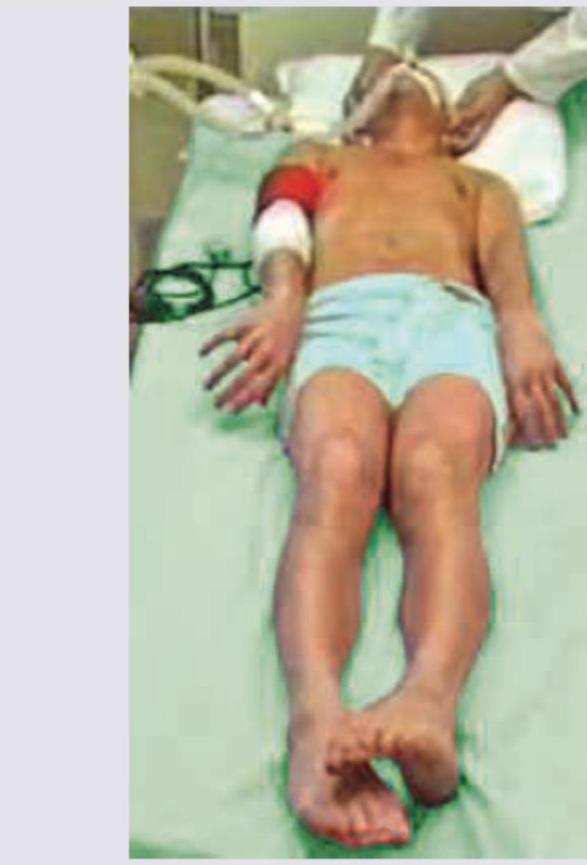
Question 21: A head trauma patient is shown below. Diagnosis is?
- A. Decorticate rigidity
- B. Decerebrate rigidity (Correct Answer)
- C. Acute dystonia
- D. Catatonia
Explanation: ***Decerebrate rigidity***
- The image shows **extension and internal rotation of the arms** with pronation, and **extension of the legs** with plantar flexion. This posture is characteristic of decerebrate rigidity.
- This posturing indicates severe damage to the **brainstem**, specifically below the red nucleus, which is a more ominous sign than decorticate posturing.
*Decorticate rigidity*
- Decorticate rigidity would present with **flexion of the arms** at the elbows and wrists (to the core), adduction of the shoulders, and extension of the lower limbs.
- This posturing is typically due to damage to the **corticospinal tracts above the red nucleus** (e.g., cerebral hemispheres, internal capsule, thalamus).
*Acute dystonia*
- Acute dystonia involves sustained or repetitive muscle contractions leading to **twisting and repetitive movements** or abnormal fixed postures.
- It often affects specific muscle groups, such as the neck (torticollis), eyes (oculogyric crisis), or trunk, and is not typically a generalized rigidity pattern seen in head trauma as extensively as shown.
*Catatonia*
- Catatonia is a neuropsychiatric syndrome characterized by a variety of motor or behavioral abnormalities, including **immobility, mutism, stupor, waxy flexibility, and negativism**.
- While it can involve abnormal posturing, it is a conscious state often associated with psychiatric conditions or general medical conditions, and doesn't manifest as the specific brainstem-related rigidity evident in the image.
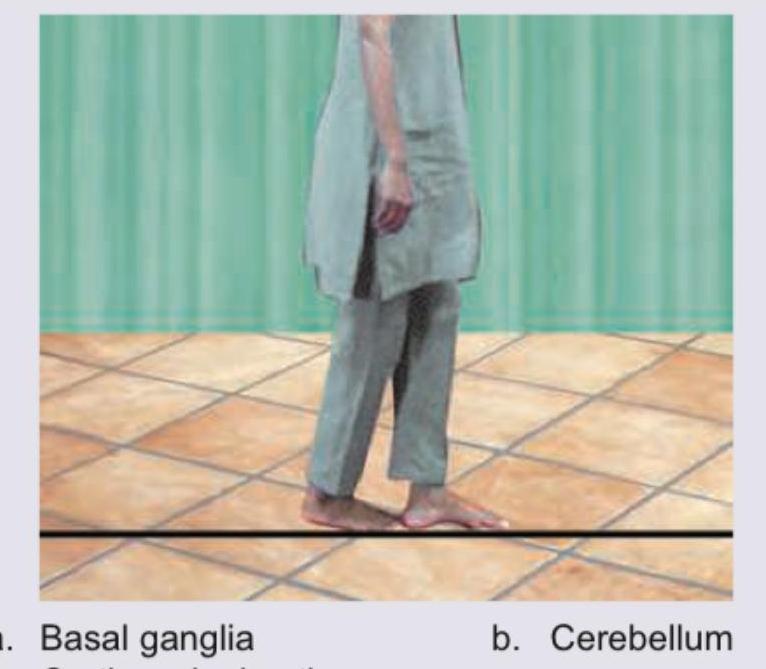
Question 22: The following test is performed for evaluating the integrity of: (Recent NEET Pattern 2016-17)
- A. Basal ganglia
- B. Cerebellum (Correct Answer)
- C. Corticospinal pathway
- D. Spinothalamic pathway
Explanation: ***Cerebellum***
- The image depicts a person performing a **tandem gait** (walking heel-to-toe along a straight line), which is a common test for **cerebellar function**.
- The cerebellum is critical for **coordination**, balance, and **fine motor control**, including the ability to maintain a straight path during walking.
*Basal ganglia*
- The basal ganglia are primarily involved in the **initiation and modulation of movement**, and their dysfunction leads to characteristic movement disorders such as **Parkinsonism (bradykinesia, rigidity, tremor)** or **Huntington's disease (chorea)**.
- While gait can be affected in basal ganglia disorders (e.g., shuffling gait in Parkinson's), tandem gait specifically emphasizes balance and coordination more directly attributed to cerebellar function.
*Corticospinal pathway*
- The **corticospinal pathway** (pyramidal tract) is responsible for **voluntary, skilled movements**, particularly of the distal limbs.
- Damage to this pathway typically results in **weakness (paresis)**, spasticity, and hyperreflexia, which would manifest as difficulty with initiating or executing movements rather than purely balance and coordination issues highlighted by tandem gait.
*Spinothalamic pathway*
- The spinothalamic pathway transmits **pain** and **temperature** sensations from the body to the brain.
- Evaluating this pathway involves sensory testing (e.g., pinprick, hot/cold sensation), which is unrelated to the motor task of tandem walking.