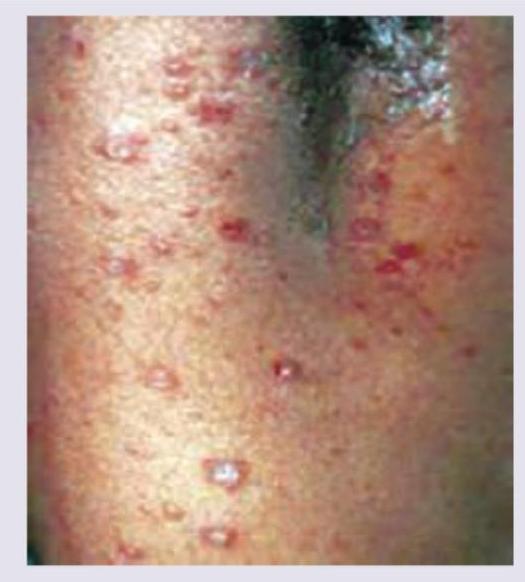
A patient presents with intensely pruritic vesicular lesions on extensor surfaces. What is the most likely diagnosis based on the clinical image?
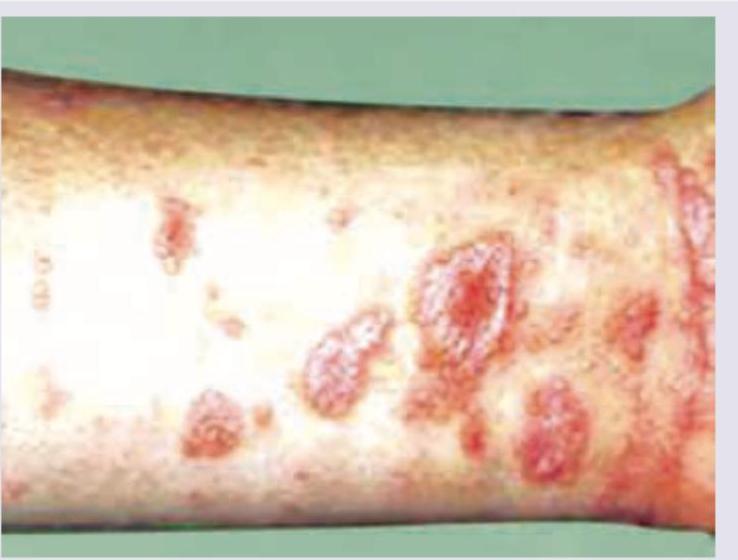
A 20-year-old male with no history of any sexual contact presents with following lesions on his penis. What is the diagnosis?
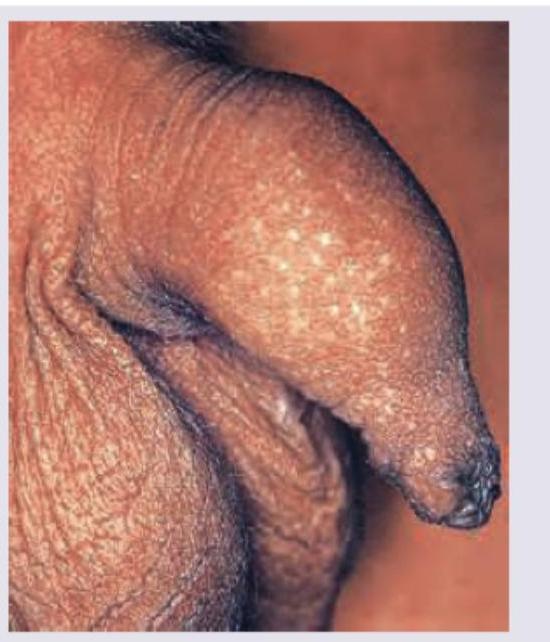
What is the most likely diagnosis of the image given below?
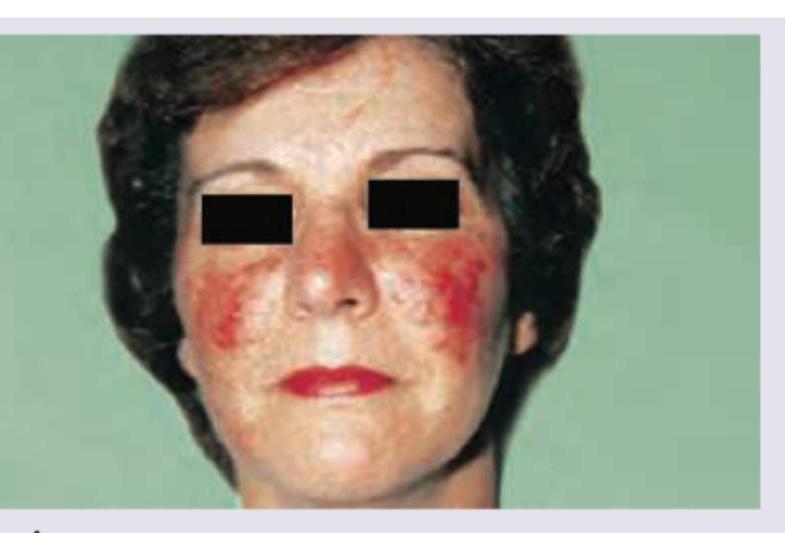
The following clinical presentation is seen in injury to which nerve? (Recent NEET Pattern 2016-17)

Which of the following toxins will produce the condition shown below?

NEET-PG 2017 - Dermatology NEET-PG Practice Questions and MCQs
Question 21: A patient presents with intensely pruritic vesicular lesions on extensor surfaces. What is the most likely diagnosis based on the clinical image?
- A. Psoriasis
- B. Dermatitis herpetiformis (Correct Answer)
- C. Erythema marginatum
- D. Lichen planus
Explanation: ***Dermatitis herpetiformis*** - This image shows **urticarial plaques** and **grouped vesicles/bullae**, which are classic features of **dermatitis herpetiformis**. - These lesions are typically **extremely pruritic**, often appearing symmetrically on extensor surfaces like the elbows, knees, and buttocks. *Psoriasis* - Psoriasis typically presents as well-demarcated, **erythematous plaques** with **silvery scales**, predominantly on extensor surfaces and the scalp. - While it can involve various morphologies, the vesicular nature seen in the image is not characteristic of typical psoriasis. *Erythema marginatum* - Erythema marginatum is characterized by **pink or red macular lesions** with **raised, serpiginous borders** that are typically non-pruritic and rapidly migratory. - It is a minor criterion for **rheumatic fever** and looks distinctly different from the vesicular eruption shown. *Lichen planus* - Lichen planus presents with "6 Ps": **pruritic, purple, polygonal, planar, papules, and plaques**, often with **Wickham's striae** (fine white lines). - It usually affects the wrists, ankles, and oral mucosa, and does not typically feature the prominent vesicles or bullae seen in the image.
Question 22: A 20-year-old male with no history of any sexual contact presents with following lesions on his penis. What is the diagnosis?
- A. Lichenoides keratosis
- B. Epstein pearls
- C. Molluscum contagiosum
- D. Lichen nitidus (Correct Answer)
Explanation: ***Lichen nitidus*** - The image shows numerous small, shiny, **pin-head sized papules** on the penis, which are characteristic of lichen nitidus. - This condition is often **asymptomatic** and benign, and it can occur on the penis without any sexual contact history. *Lichenoides keratosis* - This term is broad and often refers to a benign **inflammatory process** with lichenoid features affecting keratinocytes, usually solitary and often in older adults; it does not typically present as widespread, uniform papules on the penis. - Lichenoides keratosis is often a more **solitary lesion** or a reaction pattern, not a diffuse eruption of small papules like those pictured. *Epstein pearls* - **Epstein pearls** are small, white or yellow cysts found in the mouths of newborns, specifically on the gums or palate, and are remnants of epithelial tissue. - They are a normal finding in neonates and are **not found on the penis** or in a 20-year-old male. *Molluscum contagiosum* - Molluscum contagiosum lesions typically present as **dome-shaped, flesh-colored papules with central umbilication**. - While they can appear on the penis and are sexually transmitted, the lesions in the image lack the characteristic **umbilication** of molluscum contagiosum.
Question 23: What is the most likely diagnosis of the image given below?
- A. Acne rosacea
- B. Dermatitis herpetiformis
- C. Erythema marginatum
- D. Dermatomyositis (Correct Answer)
Explanation: ***Dermatomyositis*** - The image displays a characteristic **heliotrope rash** (violaceous/purple-red discoloration) around the eyes and periorbital area, which is pathognomonic for dermatomyositis. - This condition is an **inflammatory myopathy** distinguished by distinct cutaneous manifestations (including Gottron's papules, shawl sign, and V-sign) alongside proximal muscle weakness. - The periorbital violaceous erythema with associated edema is highly characteristic and helps differentiate it from other facial rashes. *Acne rosacea* - Characterized by **facial erythema**, papules, pustules, and telangiectasias, primarily affecting the central face (cheeks, nose, chin, forehead). - Does not typically involve the marked periorbital (heliotrope) rash with violaceous discoloration seen in dermatomyositis. - Usually presents with flushing and visible blood vessels rather than periorbital edema. *Dermatitis herpetiformis* - Presents with intensely **pruritic (itchy) papules and vesicles** (blisters), typically symmetrical on extensor surfaces like elbows, knees, buttocks, and scalp. - Strongly associated with **celiac disease** (gluten-sensitive enteropathy). - Does not present as facial erythema or periorbital discoloration; the lesions are vesicular and intensely itchy. *Erythema marginatum* - A skin manifestation of **acute rheumatic fever**, characterized by an evanescent, **serpiginous (snake-like) migratory rash** with distinct, raised borders and clear centers. - Typically appears on the trunk and proximal limbs, sparing the face. - Does not present as periorbital discoloration and has a distinctive migrating, annular pattern.
Question 24: The following clinical presentation is seen in injury to which nerve? (Recent NEET Pattern 2016-17)
- A. Median nerve (Correct Answer)
- B. Ulnar nerve
- C. Median and ulnar nerve
- D. Radial nerve
Explanation: ***Median nerve*** - The image illustrates **'ape hand' deformity**, characterized by the inability to oppose the thumb and atrophy of the thenar eminence due to paralysis of the **thenar muscles** (abductor pollicis brevis, opponens pollicis, superficial head of flexor pollicis brevis). - These thenar muscles are primarily innervated by the **recurrent branch of the median nerve**. *Ulnar nerve* - Ulnar nerve injury typically causes **'claw hand' deformity** (hyperextension of MCP joints and flexion of IP joints of 4th and 5th digits) due to paralysis of the intrinsic muscles of the hand (interossei and medial two lumbricals). - It would also cause prominent atrophy of the **hypothenar eminence** and interosseous muscles. *Median and ulnar nerve* - Combined median and ulnar nerve injury would result in a **more severe and widespread paralysis** affecting nearly all intrinsic hand muscles, leading to a profound loss of hand function. - This would present with features of both **ape hand** and **claw hand**, commonly referred to as a **'simian hand'** if severe. *Radial nerve* - Radial nerve injury typically causes **'wrist drop'** and inability to extend the fingers and thumb at the metacarpophalangeal joints. - It primarily affects the **extensor muscles of the forearm** and does not directly result in thenar atrophy or the inability to oppose the thumb.
Question 25: Which of the following toxins will produce the condition shown below?
- A. Leukocidin
- B. TSST-1
- C. ETA and ETB (Correct Answer)
- D. Serum opacity factor
Explanation: ***ETA and ETB*** - The image shows a child with widespread **blistering and epidermal exfoliation**, characteristic of **Staphylococcal Scalded Skin Syndrome (SSSS)**. - SSSS is caused by **exfoliative toxins A (ETA)** and **exfoliative toxins B (ETB)** produced by *Staphylococcus aureus*, which target **desmoglein-1** in the stratum granulosum, leading to intraepidermal cleavage and skin peeling. *Leukocidin* - **Leukocidin** is a cytotoxin produced by *Staphylococcus aureus* that targets and destroys **leukocytes**, particularly neutrophils and macrophages. - It does not directly cause the widespread epidermal blistering and exfoliation seen in the image. *TSST-1* - **Toxic Shock Syndrome Toxin-1 (TSST-1)** is a superantigen produced by *Staphylococcus aureus* that causes **Toxic Shock Syndrome**, characterized by fever, rash, hypotension, and multi-organ failure. - While it can manifest with a diffuse erythematous rash followed by desquamation, it does not typically cause the prominent blistering and extensive epidermal peeling seen in the image. *Serum opacity factor* - **Serum opacity factor** is an enzyme produced by some strains of **Group A Streptococcus** (not *Staphylococcus aureus*) that degrades serum lipoproteins. - It is associated with **rheumatic fever** and **acute glomerulonephritis** but plays no direct role in skin blistering or exfoliation.