INI-CET 2023 — Radiology
3 Previous Year Questions with Answers & Explanations
What condition is associated with the sign seen in the given USG?
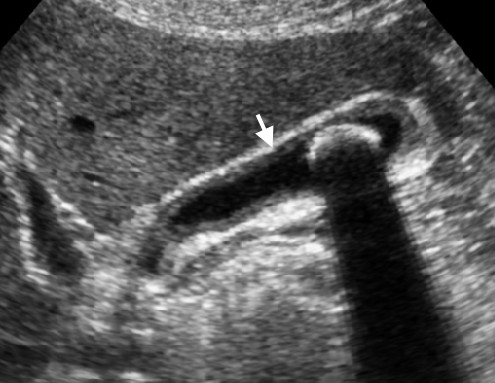
Banana sign is seen in which of the following conditions?
What is not an advantage of USG over mammography?
INI-CET 2023 - Radiology INI-CET Practice Questions and MCQs
Question 1: What condition is associated with the sign seen in the given USG?
- A. Anencephaly
- B. Spina bifida (Correct Answer)
- C. Dandy-Walker malformation
- D. Encephalocele
Explanation: ***Spina bifida*** - The ultrasound image displays the **"lemon sign"** (frontal bone indentation), which is a classic indicator of **spina bifida** on antenatal ultrasound. - The lemon sign is caused by **scalloping of the frontal bones** due to caudal displacement of brain tissue (Arnold-Chiari malformation type II) secondary to an open spinal defect. - This sign is most commonly seen in the **second trimester** and is associated with neural tube defects. *Anencephaly* - **Anencephaly** presents with absence of the cranial vault and cerebral hemispheres on ultrasound. - The characteristic finding is the **"frog-eye appearance"** with protruding orbits, not frontal bone scalloping. - This is incompatible with life and has a distinctly different ultrasound appearance. *Dandy-Walker malformation* - **Dandy-Walker malformation** shows an enlarged posterior fossa with cystic dilatation of the fourth ventricle and hypoplasia of the cerebellar vermis. - It may present with the **"banana sign"** (cerebellar compression), but not the lemon sign. - This is a posterior fossa abnormality, not associated with frontal bone changes. *Encephalocele* - **Encephalocele** presents as a herniation of brain tissue and meninges through a cranial defect, typically occipital. - Ultrasound shows a **cystic mass protruding from the skull**, not frontal bone indentation. - While it's a neural tube defect, it has a different ultrasound appearance than the lemon sign.
Question 2: Banana sign is seen in which of the following conditions?
- A. NCC
- B. Spina bifida (Correct Answer)
- C. Omphalocele
- D. Anencephaly
Explanation: ***Spina bifida*** - The **"banana sign"** is a distinctive ultrasound finding associated with **Chiari II malformation**, which is frequently seen in cases of **spina bifida**. - It refers to the characteristic **flattening and anterior bowing of the cerebellar hemispheres**, compressing them against the skull and giving them a banana-like appearance. *NCC* - **Neurocysticercosis (NCC)** is caused by tapeworm larvae in the central nervous system and is characterized by **cysts** or calcifications on imaging, not a "banana sign." - Imaging findings in NCC typically include **cystic lesions**, **edema**, and calcifications, unrelated to cerebellar shape. *Omphalocele* - **Omphalocele** is an abdominal wall defect where abdominal organs protrude through the navel, covered by a membrane. - The ultrasound findings for omphalocele involve visualization of abdominal contents outside the abdominal cavity, which is distinct from intracranial findings like the "banana sign." *Anencephaly* - **Anencephaly** is a severe birth defect where a baby is born without parts of the brain and skull, typically presenting with an **absent cranial vault** and cerebral hemispheres. - While a severe neural tube defect, anencephaly features agenesis of the brain and skull, rather than the cerebellar distortion seen as a "banana sign."
Question 3: What is not an advantage of USG over mammography?
- A. Can be used for guided biopsy
- B. Superior detection of microcalcifications (Correct Answer)
- C. In young females with dense breasts
- D. Can be used to differentiate solid VS cystic
Explanation: ***Superior detection of microcalcifications*** - **Mammography** is the gold standard for detecting **microcalcifications**, which can be a key indicator of **ductal carcinoma in situ (DCIS)** or early invasive breast cancer. - **Ultrasound (USG)** has limited sensitivity for detecting and characterizing microcalcifications. *Can be used for guided biopsy* - **USG-guided biopsy** is a common and advantageous technique for obtaining tissue samples from suspicious lesions in the breast or other organs. - This allows for **real-time visualization** of the needle, improving accuracy and reducing complications. *Can be used to differentiate solid VS cystic* - **USG** excels at distinguishing between **solid masses and fluid-filled cysts** due to differences in sound wave reflection. - This capability is crucial in characterizing breast lesions and often eliminates the need for further invasive procedures for benign cysts. *In young females with dense breasts* - **Dense breast tissue** in young females can obscure lesions on mammography, making interpretation difficult. - **USG** is particularly valuable in this population because it is not hindered by breast density and can provide a clearer view of underlying pathology.