Biochemistry
1 questionsWhich membrane channel is mainly affected in Cystic fibrosis?
INI-CET 2023 - Biochemistry INI-CET Practice Questions and MCQs
Question 61: Which membrane channel is mainly affected in Cystic fibrosis?
- A. Sodium
- B. Chloride (Correct Answer)
- C. Calcium
- D. Potassium
Explanation: ***Chloride*** - Cystic fibrosis is caused by a mutation in the **CFTR (Cystic Fibrosis Transmembrane Conductance Regulator)** gene, which encodes a chloride channel. - Dysfunction of this **chloride channel** leads to impaired transport of chloride ions, mainly affecting epithelial cells in various organs. *Sodium* - While sodium transport is indirectly affected in cystic fibrosis, the primary defect is not in a sodium channel itself but rather in the **chloride channel**, which influences water and sodium movement. - The abnormal **chloride transport** leads to a compensatory but ineffective increase in sodium absorption in some tissues like the airway. *Calcium* - Calcium channels are not primarily implicated in the pathophysiology of **cystic fibrosis**. - **Calcium dysregulation** can occur secondarily in some CF-related processes, but it is not the main affected membrane channel. *Potassium* - **Potassium channels** are not the main membrane channels affected in cystic fibrosis. - While potassium transport is vital for cellular function, it is not the primary defect underlying the disease's respiratory and gastrointestinal manifestations.
Community Medicine
1 questionsMatch the incubation periods of the following diseases: a. Syphilis b. SARS c. Hepatitis A d. Chickenpox Match with: 1. 10-21 days 2. 21 days (3 weeks) 3. 2-7 days 4. 15-50 days
INI-CET 2023 - Community Medicine INI-CET Practice Questions and MCQs
Question 61: Match the incubation periods of the following diseases: a. Syphilis b. SARS c. Hepatitis A d. Chickenpox Match with: 1. 10-21 days 2. 21 days (3 weeks) 3. 2-7 days 4. 15-50 days
- A. a-2, b-3, c-4, d-1 (Correct Answer)
- B. a-3, b-4, c-2, d-1
- C. a-2, b-3, c-1, d-4
- D. a-4, b-3, c-1, d-2
Explanation: ***a-2, b-3, c-4, d-1*** - This option correctly matches all incubation periods: **Syphilis (a) = 21 days (3 weeks)** - the average incubation for primary chancre appearance is 21 days (range 10-90 days). - **SARS (b) = 2-7 days** - the typical incubation period for SARS-CoV-1 is 2-10 days, with most cases manifesting within 2-7 days. - **Hepatitis A (c) = 15-50 days** - the standard incubation period averages 28-30 days (range 15-50 days). - **Chickenpox (d) = 10-21 days** - varicella has a well-established incubation of 10-21 days, typically 14-16 days. *a-3, b-4, c-2, d-1* - This incorrectly assigns **2-7 days to Syphilis**, which is far too short for the primary chancre to appear (actual: 21 days average). - **15-50 days for SARS** is excessively long; SARS manifests within 2-10 days. - **21 days for Hepatitis A** is at the lower end but not representative of the typical range (15-50 days). *a-2, b-3, c-1, d-4* - This incorrectly pairs **10-21 days with Hepatitis A**, which has a longer incubation (15-50 days). - **15-50 days for Chickenpox** is too long; varicella's incubation is 10-21 days. *a-4, b-3, c-1, d-2* - This incorrectly assigns **15-50 days to Syphilis** (actual: 21 days average) and **10-21 days to Hepatitis A** (actual: 15-50 days). - While these ranges have some overlap with actual values, they represent inversions of the correct assignments.
Dermatology
1 questionsSlapped cheek appearance is associated with which of the following?
INI-CET 2023 - Dermatology INI-CET Practice Questions and MCQs
Question 61: Slapped cheek appearance is associated with which of the following?
- A. Herpes zoster
- B. Parvovirus B19 infection (Correct Answer)
- C. Molluscum contagiosum
- D. Kaposi sarcoma
Explanation: ***Parvovirus B19 infection*** - **Parvovirus B19** infection, also known as Fifth Disease or **Erythema Infectiosum**, classically presents with a **slapped cheek rash** on the face. - This characteristic facial rash is usually followed by a **lacy, reticular rash** on the trunk and extremities. *Herpes zoster* - **Herpes zoster** (shingles) presents as a painful, vesicular rash that follows a **dermatomal distribution**. - It does not cause a **slapped cheek appearance**; its rash is typically unilateral and confined to a single dermatome. *Molluscum contagiosum* - **Molluscum contagiosum** is characterized by small, flesh-colored, **umbilicated papules** with a central dimple. - These lesions can occur anywhere on the body but do not produce a diffuse facial rash like the **slapped cheek appearance**. *Kaposi sarcoma* - **Kaposi sarcoma** is a vascular tumor that manifests as **purple, brown, or reddish skin lesions**, often seen in immunocompromised individuals. - It is not associated with a **widespread facial rash** or the characteristic distribution of a slapped cheek appearance.
Obstetrics and Gynecology
2 questionsA patient has dyspareunia, and dysmenorrhea with adnexal tenderness. What is the first step of investigation?
After delivering a baby boy, a 25 -year-old mother developed acute PPH and hypovolemic shock, and major blood transfusion occurred. All of the following are complications of blood transfusion except?
INI-CET 2023 - Obstetrics and Gynecology INI-CET Practice Questions and MCQs
Question 61: A patient has dyspareunia, and dysmenorrhea with adnexal tenderness. What is the first step of investigation?
- A. Colposcopy
- B. Diagnostic laparoscopy
- C. Transvaginal USG (Correct Answer)
- D. Transabdominal pelvic ultrasound
Explanation: ***Transvaginal USG*** - This is the **first-line investigation** for evaluating pelvic pain, dyspareunia, dysmenorrhea, and adnexal tenderness due to its ability to provide **high-resolution images** of the uterus, ovaries, and surrounding structures to identify potential pathology like **endometriomas** or other adnexal masses. - It allows for detailed assessment of **ovarian cysts**, fibroids, and other pelvic abnormalities, which can explain the patient's symptoms. *Colposcopy* - This procedure is primarily used to closely examine the **cervix, vagina, and vulva** for abnormal cells, often following an abnormal Pap test. - It is not the initial step for investigating generalized pelvic pain, dyspareunia, or adnexal tenderness. *Diagnostic laparoscopy* - While a **diagnostic laparoscopy** can provide a definitive diagnosis for conditions like **endometriosis**, it is an **invasive surgical procedure** and typically reserved for cases where non-invasive imaging, such as transvaginal ultrasound, has not yielded a clear diagnosis or when conservative management has failed. - It is not considered the first-step investigation due to its **invasive nature** and associated risks. *Transabdominal pelvic ultrasound* - A **transabdominal pelvic ultrasound** provides a broader view of the pelvic organs but often has **lower resolution** and is less accurate for detailed assessment of the uterus, ovaries, and adnexa compared to transvaginal ultrasound, especially in obese patients. - It is often used if a transvaginal ultrasound is not feasible or for assessing larger pelvic masses, but the **transvaginal approach** is superior for detailed evaluation of the female reproductive organs.
Question 62: After delivering a baby boy, a 25 -year-old mother developed acute PPH and hypovolemic shock, and major blood transfusion occurred. All of the following are complications of blood transfusion except?
- A. Hypothermia
- B. Hypocalcemia
- C. Hypokalemia (Correct Answer)
- D. Hypomagnesemia
Explanation: ***Hypokalemia*** - **Hypokalemia is NOT a typical complication of massive blood transfusion**. In fact, massive transfusion is characteristically associated with **hyperkalemia**, not hypokalemia. - **Stored blood** contains high levels of extracellular potassium due to **red blood cell lysis** during storage (potassium levels can reach 30-50 mEq/L in units stored >21 days). - Rapid transfusion of multiple units delivers a significant **potassium load**, making **hyperkalemia** the expected electrolyte abnormality. - While hypokalemia could theoretically occur later due to **alkalosis from citrate metabolism** or during the **rewarming/correction phase**, this is **indirect, uncommon, and not a recognized acute complication** of the transfusion itself. - Therefore, hypokalemia is the exception among the listed options. *Hypothermia* - **Direct and common complication** when cold blood products (stored at 1-6°C) are rapidly infused without adequate warming. - Can cause **coagulopathy**, cardiac arrhythmias, decreased drug metabolism, and leftward shift of oxygen-hemoglobin dissociation curve. - Prevention requires use of **blood warmers** during massive transfusion. *Hypocalcemia* - **Very common complication** of massive transfusion due to **citrate toxicity**. - **Citrate** (anticoagulant in stored blood) chelates ionized calcium in the recipient's circulation. - Normally metabolized by the liver, but rapid transfusion overwhelms hepatic metabolism, leading to **symptomatic hypocalcemia**. - Can cause **cardiac dysfunction, hypotension, and prolonged QT interval**. *Hypomagnesemia* - Can occur with massive transfusion as **magnesium is also chelated by citrate**, similar to calcium. - Less commonly recognized than hypocalcemia but documented in massive transfusion protocols. - Can contribute to **cardiac arrhythmias and neuromuscular irritability**.
Pediatrics
1 questionsWhich test is not required for Turner mosaic syndrome?
INI-CET 2023 - Pediatrics INI-CET Practice Questions and MCQs
Question 61: Which test is not required for Turner mosaic syndrome?
- A. Audiometry
- B. Oral glucose tolerance test
- C. Echo
- D. ANA (Correct Answer)
Explanation: ***ANA*** - **Antinuclear antibody (ANA)** testing is primarily used for diagnosing autoimmune diseases like **systemic lupus erythematosus** and is not routinely required for the management of Turner mosaic syndrome. - While autoimmune conditions can rarely co-occur, ANA is not a standard screening or diagnostic test for the common complications of Turner syndrome. *Audiometry* - **Audiometry** is recommended for Turner syndrome patients due to an increased risk of **hearing loss**, particularly **sensorineural hearing loss**. - Regular monitoring helps detect and manage hearing impairments early, which can affect development and quality of life. *Oral glucose tolerance test* - Patients with Turner syndrome have an increased risk of developing **glucose intolerance** and **type 2 diabetes mellitus**. - An **oral glucose tolerance test (OGTT)** is important for screening and early detection of these metabolic abnormalities. *Echo* - **Echocardiography** is crucial for evaluating potential **cardiovascular abnormalities**, which are common in Turner syndrome. - These can include **bicuspid aortic valve**, **coarctation of the aorta**, and other structural heart defects.
Pharmacology
3 questionsA female was given morphine sulphate during labour for pain but she developed respiratory distress. Which of the following will be the correct antidote?
A child went to temple along with his grandmother. He developed altered sensorium, BP of $150 / 90 \mathrm{~mm} \mathrm{Hg}$, sweating, palpitations, priapism, and mouth secretion all at once. What drug can be given to this patient?
A patient presented with dizziness, cool clammy skin, pinpoint pupil with blue lips and fingernails suffering from respiratory depression. The patient was producing a pink frothy sputum on coughing. The drug used to reverse the effects is?
INI-CET 2023 - Pharmacology INI-CET Practice Questions and MCQs
Question 61: A female was given morphine sulphate during labour for pain but she developed respiratory distress. Which of the following will be the correct antidote?
- A. Naloxone (Correct Answer)
- B. Epinephrine
- C. Pralidoxime
- D. Atropine
Explanation: ***Naloxone*** - **Naloxone** is a pure opioid antagonist that rapidly reverses the effects of **opioid overdose** [1, 3], including **respiratory depression** [2], by competitively binding to opioid receptors [1]. - Its short half-life may necessitate repeated doses, especially with longer-acting opioids like morphine, to prevent recurrence of respiratory depression [1]. *Epinephrine* - **Epinephrine** is an adrenergic agonist used to treat **anaphylaxis** and severe allergic reactions, as it causes **vasoconstriction** and **bronchodilation**. - It is not an antidote for opioid-induced respiratory depression, which primarily results from central nervous system effects rather than allergic reactions. *Pralidoxime* - **Pralidoxime** is a **cholinesterase reactivator** used to treat poisoning by **organophosphates**, which inhibit acetylcholinesterase, leading to cholinergic crisis. - It works by restoring the function of the enzyme, thereby breaking down excess acetylcholine, and is not indicated for opioid overdose. *Atropine* - **Atropine** is an **anticholinergic agent** that blocks muscarinic acetylcholine receptors, used to treat **bradycardia** and **organophosphate poisoning**. - It would not reverse opioid-induced respiratory depression, as it primarily affects the parasympathetic nervous system and does not antagonize opioid receptor effects.
Question 62: A child went to temple along with his grandmother. He developed altered sensorium, BP of $150 / 90 \mathrm{~mm} \mathrm{Hg}$, sweating, palpitations, priapism, and mouth secretion all at once. What drug can be given to this patient?
- A. Steroid
- B. Adrenaline
- C. Prazosin (Correct Answer)
- D. ASV
Explanation: ***Prazosin*** * This patient's symptoms (altered sensorium, **hypertension**, sweating, palpitations, **priapism**, and increased mouth secretions) are highly suggestive of **scorpion venom poisoning**, specifically from the Indian red scorpion (*Mesobuthus tamulus*). * **Prazosin**, an **alpha-1 adrenergic receptor blocker**, is the drug of choice for treating systemic manifestations of scorpion envenomation. It helps to counteract the excessive catecholamine release and the resulting sympathetic overdrive, thereby reducing hypertension and cardiac dysfunction. *Steroid* * Steroids are **anti-inflammatory agents** and immunosuppressants, primarily used in conditions like allergic reactions, asthma, or autoimmune diseases. * They are **not indicated** for the acute management of venom-induced symptoms such as those seen in scorpion envenomation. *Adrenaline* * **Adrenaline (epinephrine)** is a potent **vasoconstrictor** and **bronchodilator**, primarily used in anaphylaxis, cardiac arrest, or severe asthma. * It would be **contraindicated** in this patient as it would further exacerbate the existing hypertension and sympathetic stimulation caused by the scorpion venom. *ASV* * **ASV (Anti-Snake Venom)** is an antiserum used to neutralize the toxins found in snake venom. * It is **ineffective** against scorpion venom and is therefore not an appropriate treatment in this scenario.
Question 63: A patient presented with dizziness, cool clammy skin, pinpoint pupil with blue lips and fingernails suffering from respiratory depression. The patient was producing a pink frothy sputum on coughing. The drug used to reverse the effects is?
- A. Atropine
- B. Naloxone (Correct Answer)
- C. Physostigmine
- D. Phentolamine
Explanation: ***Naloxone*** - This patient's presentation with **pinpoint pupils**, **respiratory depression**, and **pink frothy sputum** is highly suggestive of **opioid overdose**. - **Naloxone** is a competitive opioid receptor antagonist used specifically to reverse the effects of opioid-induced respiratory depression and central nervous system depression. *Atropine* - **Atropine** is an anticholinergic drug used to treat **bradycardia** and **organophosphate poisoning**. - It would worsen opioid-induced respiratory depression and is not indicated for this presentation. *Physostigmine* - **Physostigmine** is a cholinesterase inhibitor used to reverse the effects of anticholinergic toxicity, such as from **tricyclic antidepressants** or **atropine overdose**. - It would not treat opioid toxicity and could exacerbate some symptoms. *Phentolamine* - **Phentolamine** is an **alpha-adrenergic blocker** primarily used to treat hypertensive crises, particularly those due to **pheochromocytoma** or in extravasation of vasopressors. - It has no role in the management of opioid overdose.
Radiology
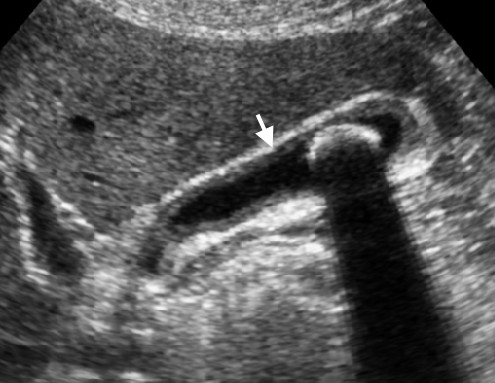
1 questionsWhat condition is associated with the sign seen in the given USG?
INI-CET 2023 - Radiology INI-CET Practice Questions and MCQs
Question 61: What condition is associated with the sign seen in the given USG?
- A. Anencephaly
- B. Spina bifida (Correct Answer)
- C. Dandy-Walker malformation
- D. Encephalocele
Explanation: ***Spina bifida*** - The ultrasound image displays the **"lemon sign"** (frontal bone indentation), which is a classic indicator of **spina bifida** on antenatal ultrasound. - The lemon sign is caused by **scalloping of the frontal bones** due to caudal displacement of brain tissue (Arnold-Chiari malformation type II) secondary to an open spinal defect. - This sign is most commonly seen in the **second trimester** and is associated with neural tube defects. *Anencephaly* - **Anencephaly** presents with absence of the cranial vault and cerebral hemispheres on ultrasound. - The characteristic finding is the **"frog-eye appearance"** with protruding orbits, not frontal bone scalloping. - This is incompatible with life and has a distinctly different ultrasound appearance. *Dandy-Walker malformation* - **Dandy-Walker malformation** shows an enlarged posterior fossa with cystic dilatation of the fourth ventricle and hypoplasia of the cerebellar vermis. - It may present with the **"banana sign"** (cerebellar compression), but not the lemon sign. - This is a posterior fossa abnormality, not associated with frontal bone changes. *Encephalocele* - **Encephalocele** presents as a herniation of brain tissue and meninges through a cranial defect, typically occipital. - Ultrasound shows a **cystic mass protruding from the skull**, not frontal bone indentation. - While it's a neural tube defect, it has a different ultrasound appearance than the lemon sign.