Biochemistry
1 questionsWhich of the following is used to detect abnormal gene sequences EXCEPT?
INI-CET 2023 - Biochemistry INI-CET Practice Questions and MCQs
Question 41: Which of the following is used to detect abnormal gene sequences EXCEPT?
- A. RFLP analysis
- B. Pyrosequencing
- C. Flow cytometry (Correct Answer)
- D. FISH
Explanation: ***Flow cytometry*** - **Flow cytometry** is primarily used to analyze **cell populations** based on their physical and biochemical characteristics (e.g., size, granularity, and protein expression) by passing them single file through a laser beam, not for direct gene sequencing. - It detects and quantifies cells labeled with **fluorescent antibodies**, making it useful for immunophenotyping, cell sorting, and DNA content analysis, but not for identifying specific gene sequences or mutations. *RFLP analysis* - **Restriction fragment length polymorphism (RFLP) analysis** detects variations in **DNA sequences** by using **restriction enzymes** to cut DNA at specific sites. - Differences in fragment lengths indicate **polymorphisms** or **mutations** within the recognition sites, thereby identifying abnormal gene sequences. *Pyrosequencing* - **Pyrosequencing** is a method of **DNA sequencing** that determines the sequence of nucleotides by detecting the release of pyrophosphate during DNA synthesis. - It is used to identify **single nucleotide polymorphisms (SNPs)** and **short genetic variations**, making it suitable for detecting abnormal gene sequences. *FISH* - **Fluorescence in situ hybridization (FISH)** uses **fluorescently labeled DNA probes** that bind to specific complementary **DNA sequences** on chromosomes. - It is a powerful cytogenetic technique for detecting **chromosomal abnormalities**, such as deletions, translocations, and amplifications, thereby identifying abnormal gene sequences.
Internal Medicine
2 questionsA 62-year-old patient presents with pain in the calf muscles while walking. The pain subsides with rest. Which of the following is not typically seen in intermittent claudication?
A 55-year-old female smoker presents with a breast lump and is seeking medical evaluation. On examination, a palpable mass is detected in the breast. The patient's smoking history is significant, with a 30-year smoking habit. Which of the following conditions is strongly associated with smoking in relation to breast health?
INI-CET 2023 - Internal Medicine INI-CET Practice Questions and MCQs
Question 41: A 62-year-old patient presents with pain in the calf muscles while walking. The pain subsides with rest. Which of the following is not typically seen in intermittent claudication?
- A. Pain gradually increases
- B. Caused most commonly by atherosclerosis
- C. Level of occlusion cannot be decided based on symptoms
- D. Rest pain at night in advanced stages (Correct Answer)
Explanation: ***Rest pain at night in advanced stages*** - Intermittent claudication is defined by pain with exercise that resolves with rest [1]. **Rest pain** indicates critical limb ischemia, a more advanced stage of peripheral artery disease, and is distinct from intermittent claudication itself, although it can develop from it [1]. - While rest pain can occur in patients with severe peripheral artery disease, it is **not typically seen in intermittent claudication**, but rather represents progression to a more severe form of the disease. *Pain gradually increases* - The pain of intermittent claudication typically **gradually increases** during physical activity as the oxygen demand of the muscles exceeds the compromised blood supply. - This progressive pain forces the patient to stop activity, at which point the pain subsides with rest. *Caused most commonly by atherosclerosis* - **Atherosclerosis** is the underlying pathology in the vast majority of cases of peripheral artery disease, leading to stenosis or occlusion of the arteries that supply the lower limbs [1]. - This narrowing of the arterial lumen restricts blood flow, causing inadequate oxygen delivery to muscles during exertion. *Level of occlusion cannot be decided based on symptoms* - The **anatomical level of arterial occlusion** can often be inferred to some extent by the location of the claudication pain (e.g., buttock claudication suggests aortoiliac disease, calf claudication suggests femoropopliteal disease) [1]. - However, the precise extent and severity of the occlusion cannot be solely determined by symptoms, and imaging studies like **duplex ultrasound** or angiography are required for definitive diagnosis.
Question 42: A 55-year-old female smoker presents with a breast lump and is seeking medical evaluation. On examination, a palpable mass is detected in the breast. The patient's smoking history is significant, with a 30-year smoking habit. Which of the following conditions is strongly associated with smoking in relation to breast health?
- A. Duct ectasia
- B. Fibroadenoma
- C. Mondor disease
- D. Breast cancer (Correct Answer)
Explanation: ***Breast cancer*** - **Smoking** is a well-established risk factor for various cancers, including **breast cancer**, due to the presence of carcinogens in tobacco smoke [1]. - The patient's age and palpable lump further raise suspicion for malignancy, prompting thorough investigation. [1] *Duct ectasia* - Characterized by widening and inflammation of the **milk ducts**, which can cause nipple discharge, tenderness, and a palpable mass. - While smoking can be a risk factor, the more significant association in this age group and with a palpable lump leans towards malignancy. *Fibroadenoma* - These are **benign breast tumors** composed of glandular and stromal tissue, most common in younger women. - They are typically rubbery, mobile masses and are not strongly linked to smoking. *Mondor disease* - This is a rare, **benign condition** characterized by thrombophlebitis of the superficial veins of the breast or chest wall. - It typically presents as a painful, cord-like structure and is not directly associated with smoking.
Pathology
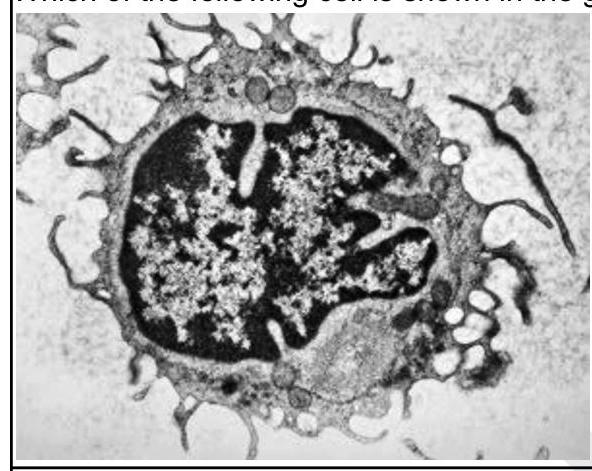
2 questionsWhich of the following cells is shown in the given image?
Match the following? a. Trisomy 13 1. Huntington disease b. Trisomy 18 2. Patau syndrome c. Trinucleotide repeat sequence 3. Sickle cell disease d. Hb point mutation of glutamate to valine 4. Edward syndrome
INI-CET 2023 - Pathology INI-CET Practice Questions and MCQs
Question 41: Which of the following cells is shown in the given image?
- A. Hairy cell (Correct Answer)
- B. Sickle cell
- C. Gaucher cell
- D. Target cell
Explanation: ***Hairy cell*** - The image displays prominent **cytoplasmic projections** or "hairs" on the cell surface, which are characteristic features of **hairy cells** (lymphocytes seen in hairy cell leukemia) [1]. - These cells typically have an irregularly shaped nucleus and cytoplasm rich in ribosomes, as suggested by the granular appearance [1]. *Sickle cell* - **Sickle cells** are **red blood cells** that have a characteristic crescent or sickle shape due to abnormal hemoglobin polymerization. - The cell in the image is a **white blood cell** with a large nucleus and cytoplasmic extensions, clearly not a red blood cell. *Gaucher cell* - **Gaucher cells** are **macrophages** that accumulate glucocerebroside, giving them a characteristic **"crinkled paper"** or **"chicken scratch"** cytoplasm. - While they are large cells, they lack the distinct, fine, hair-like projections seen in the provided image. *Target cell* - **Target cells** are **red blood cells** with a central bullseye appearance due to an abnormal distribution of hemoglobin, often seen in thalassemia or liver disease. - The presented image is not a red blood cell and does not demonstrate the morphology of a target cell. **References:** [1] Kumar V, Abbas AK, et al.. Robbins and Cotran Pathologic Basis of Disease. 9th ed. Diseases of White Blood Cells, Lymph Nodes, Spleen, and Thymus, p. 612.
Question 42: Match the following? a. Trisomy 13 1. Huntington disease b. Trisomy 18 2. Patau syndrome c. Trinucleotide repeat sequence 3. Sickle cell disease d. Hb point mutation of glutamate to valine 4. Edward syndrome
- A. b1-a3-d2-c4
- B. a2-b4-c1-d3 (Correct Answer)
- C. a2-b1-c4-d3
- D. a4-b1-c3-d2
Explanation: ***a2-b4-c1-d3*** - **Trisomy 13 (Patau syndrome)**: Chromosomal disorder with severe CNS malformations, holoprosencephaly, cleft lip/palate, and polydactyly [3] - **Trisomy 18 (Edward syndrome)**: Chromosomal disorder with clenched fists, rocker-bottom feet, and cardiac defects [3] - **Trinucleotide repeat sequence (Huntington disease)**: CAG repeat expansion in HTT gene causing progressive neurodegeneration with chorea and cognitive decline [2] - **Hb point mutation glutamate to valine (Sickle cell disease)**: Point mutation in β-globin gene (Glu6Val) causing hemoglobin polymerization and sickling [1] *b1-a3-d2-c4* - Incorrectly matches Trisomy 13 with sickle cell disease (point mutation, not trisomy) - Incorrectly matches Trisomy 18 with Huntington disease (trinucleotide repeat, not trisomy) - Incorrectly matches trinucleotide repeats with Edward syndrome (trisomy 18, not repeat expansion) *a2-b1-c4-d3* - Incorrectly matches Trisomy 18 with Huntington disease (trinucleotide repeat disorder, not chromosomal) - Incorrectly matches trinucleotide repeats with Edward syndrome (trisomy, not repeat expansion) *a4-b1-c3-d2* - Incorrectly matches Trisomy 13 with Edward syndrome (Trisomy 13 is Patau, not Edward) - Incorrectly matches Trisomy 18 with Huntington disease (trinucleotide repeat, not trisomy) - Incorrectly matches trinucleotide repeats with sickle cell disease (point mutation, not repeat expansion) **References:** [1] Kumar V, Abbas AK, et al.. Robbins and Cotran Pathologic Basis of Disease. 9th ed. Cellular Responses to Stress and Toxic Insults: Adaptation, Injury, and Death, pp. 50-51. [2] Kumar V, Abbas AK, et al.. Robbins and Cotran Pathologic Basis of Disease. 9th ed. Genetic Disorders, p. 177. [3] Cross SS. Underwood's Pathology: A Clinical Approach. 6th ed. (Basic Pathology) introduces the student to key general principles of pathology, both as a medical science and as a clinical activity with a vital role in patient care. Part 2 (Disease Mechanisms) provides fundamental knowledge about the cellular and molecular processes involved in diseases, providing the rationale for their treatment. Part 3 (Systematic Pathology) deals in detail with specific diseases, with emphasis on the clinically important aspects., pp. 92-93.
Pediatrics
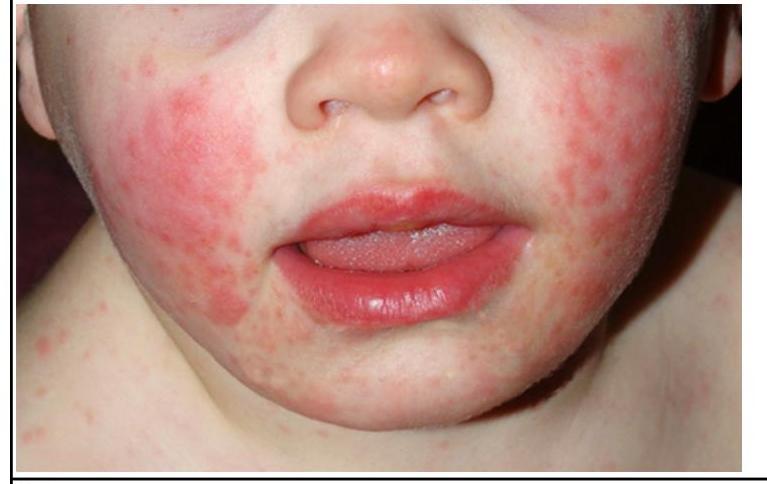
3 questionsA child presenting with the following appearance is at risk of developing?

A child with fever for 6 days, strawberry tongue, conjunctival congestion with peeling of skin. What will be the treatment option for this child?
A 10-week-old baby came for vaccination. The baby had a previous history of inconsolable crying and fever (40°C) after vaccination at 6 weeks. What should be given now?
INI-CET 2023 - Pediatrics INI-CET Practice Questions and MCQs
Question 41: A child presenting with the following appearance is at risk of developing?
- A. Immunodeficiency
- B. Lymphoproliferative disorder
- C. Gingivostomatitis
- D. Pure red cell aplasia (Correct Answer)
Explanation: ***Pure red cell aplasia*** - The image shows a "slapped cheek" rash, which is characteristic of **erythema infectiosum** (fifth disease) caused by **Parvovirus B19**. - Parvovirus B19 has a tropism for **erythroid progenitor cells** in the bone marrow, leading to a temporary cessation of red blood cell production, especially critical in individuals with underlying hemolytic anemias. *Immunodeficiency* - While viral infections can be more severe in immunodeficient individuals, the presented rash is specifically characteristic of **Parvovirus B19 infection**, not a general sign of immunodeficiency. - Immunodeficiency would typically involve recurrent, severe, or unusual infections, which are not directly indicated by the rash alone. *Lymphoproliferative disorder* - Lymphoproliferative disorders involve abnormal proliferation of lymphocytes and typically do not present with a "slapped cheek" rash. - Clinical signs would more likely include **lymphadenopathy**, hepatosplenomegaly, and cytopenias, not the classic facial rash seen here. *Gingivostomatitis* - **Gingivostomatitis** is an inflammation of the gums and oral mucosa, often caused by herpes simplex virus, presenting with **sores and ulcers in the mouth**. - The rash seen in the image is on the **cheeks and body**, not primarily oral, and is a classic presentation of erythema infectiosum.
Question 42: A child with fever for 6 days, strawberry tongue, conjunctival congestion with peeling of skin. What will be the treatment option for this child?
- A. Antibiotics
- B. Steroids
- C. Antipyretics
- D. IVIG (Correct Answer)
Explanation: ***IVIG*** - The constellation of **fever for 6 days (prolonged fever)**, **strawberry tongue**, **conjunctival congestion**, and **peeling skin** is highly indicative of **Kawasaki disease**. - **Intravenous immunoglobulin (IVIG) 2 g/kg as a single infusion** is the cornerstone of treatment for Kawasaki disease to reduce the risk of **coronary artery aneurysms** (from ~25% to <5%). - IVIG should be administered within **10 days of fever onset** for maximum efficacy. - **High-dose aspirin** (80-100 mg/kg/day) is given concurrently until the fever subsides, then switched to low-dose aspirin (3-5 mg/kg/day) for antiplatelet effect. *Antibiotics* - Kawasaki disease is a **vasculitis**, not a bacterial infection, so antibiotics are ineffective. - While other conditions like scarlet fever can present with strawberry tongue, the prolonged fever and other classic Kawasaki features differentiate it. *Steroids* - While steroids can reduce inflammation, they are **not the primary treatment** for Kawasaki disease and are typically used in conjunction with IVIG in **refractory cases** or for IVIG-resistant disease. - **Monotherapy with steroids** is not recommended for acute Kawasaki disease due to potential for increased aneurysm risk. *Antipyretics* - **Antipyretics** like acetaminophen can help manage the fever symptomatically. - However, they **do not treat the underlying vasculitis** or prevent the serious cardiac complications of Kawasaki disease. - Note: **NSAIDs like ibuprofen should be avoided** when high-dose aspirin is being used due to risk of drug interactions.
Question 43: A 10-week-old baby came for vaccination. The baby had a previous history of inconsolable crying and fever (40°C) after vaccination at 6 weeks. What should be given now?
- A. Don't give DPT
- B. Defer for 1 month
- C. Give DPT
- D. Give DT only (Correct Answer)
Explanation: ***Give DT only*** - The previous severe adverse reaction (**inconsolable crying** and **fever of 40°C**) is a specific contraindication to the **pertussis component** of the DPT vaccine. - According to **pediatric vaccination guidelines**, severe reactions (fever ≥40°C, inconsolable crying >3 hours) are absolute contraindications to further pertussis-containing vaccines. - The **diphtheria and tetanus toxoids** were not associated with the adverse reaction and should be safely continued. - **DT vaccine (without pertussis)** provides essential protection against diphtheria and tetanus while avoiding the problematic pertussis component. *Don't give DPT* - This option is imprecise because it doesn't specify what should be given instead. - While it correctly identifies that full DPT should be avoided, it fails to address the need for continued protection against diphtheria and tetanus. - The medically appropriate approach is to give **DT vaccine**, not to simply withhold vaccination. *Defer for 1 month* - Deferring vaccination does not address the core issue that the **pertussis component specifically** caused the severe reaction. - This approach would unnecessarily **delay protection** against diphtheria and tetanus, which the baby can safely receive immediately as DT vaccine. - The problem is not timing but the vaccine component itself. *Give DPT* - Administration of the full DPT vaccine is **absolutely contraindicated** given the history of severe adverse reactions (fever ≥40°C and inconsolable crying). - Repeating DPT risks another severe reaction and potential permanent neurological complications. - This would be a dangerous and inappropriate management decision.
Surgery
2 questionsA 45-year-old woman with early-stage breast cancer is discussing treatment options with her surgeon. Which of the following statements regarding breast conservation surgery is NOT true?
What is the most likely diagnosis for the swelling in the floor of the mouth shown in the image?

INI-CET 2023 - Surgery INI-CET Practice Questions and MCQs
Question 41: A 45-year-old woman with early-stage breast cancer is discussing treatment options with her surgeon. Which of the following statements regarding breast conservation surgery is NOT true?
- A. Post-operative radiotherapy
- B. Axillary dissection (Correct Answer)
- C. Wide local excision
- D. Sentinel lymph node biopsy
Explanation: ***Axillary dissection*** - **Axillary dissection is NOT a routine component of breast conservation surgery** for early-stage breast cancer. - In early-stage disease, **sentinel lymph node biopsy (SLNB)** has largely replaced routine axillary dissection as it provides accurate staging with significantly less morbidity. - Axillary dissection is only performed when there is **proven extensive lymph node involvement** or when SLNB shows metastatic disease requiring further assessment. - Therefore, this statement is **NOT true** regarding routine breast conservation surgery. *Wide local excision* - **Wide local excision (lumpectomy)** is the primary surgical component of breast conservation therapy. - It involves removing the cancerous tumor along with a margin of healthy breast tissue to achieve clear margins while preserving the breast. *Sentinel lymph node biopsy* - **SLNB** is a standard procedure performed with breast conservation surgery to assess for regional lymph node metastasis. - It identifies and removes the first few lymph nodes draining the tumor, allowing accurate staging with minimal morbidity. *Post-operative radiotherapy* - **Post-operative radiotherapy** to the preserved breast is a critical and essential component of breast conservation therapy. - It significantly reduces the risk of local recurrence by treating any microscopic tumor cells that may remain after surgery.
Question 42: What is the most likely diagnosis for the swelling in the floor of the mouth shown in the image?
- A. Dermoid
- B. Ranula (Correct Answer)
- C. Branchial cyst
- D. Cystic hygroma
Explanation: ***Ranula*** - The image shows a **translucent, bluish, dome-shaped swelling** in the **floor of the mouth**, consistent with a ranula. - A ranula is a **mucus extravasation cyst** caused by trauma or obstruction of the **sublingual salivary gland** duct, leading to mucus accumulation. *Dermoid* - A **dermoid cyst** in the floor of the mouth typically presents as a **firm, doughy, non-translucent swelling**, often located in the midline. - Unlike a ranula, dermoid cysts are usually **not bluish** and contain **ectodermal elements** like hair and sebaceous material. *Branchial cyst* - **Branchial cysts** are congenital abnormalities typically found in the **lateral neck**, anterior to the sternocleidomastoid muscle. - They are generally **not found in the floor of the mouth** and arise from remnants of the branchial arches. *Cystic hygroma* - A **cystic hygroma** is a **lymphatic malformation**, commonly appearing as a soft, compressible, transilluminable mass, predominantly in the **neck** and axilla. - While it can be large and cystic, its typical location and presentation are **different from a floor of mouth swelling** like a ranula.