Anatomy
2 questionsIdentify the position of the appendix marked in BLACK in the given image:
What is the incorrect statement?
INI-CET 2023 - Anatomy INI-CET Practice Questions and MCQs
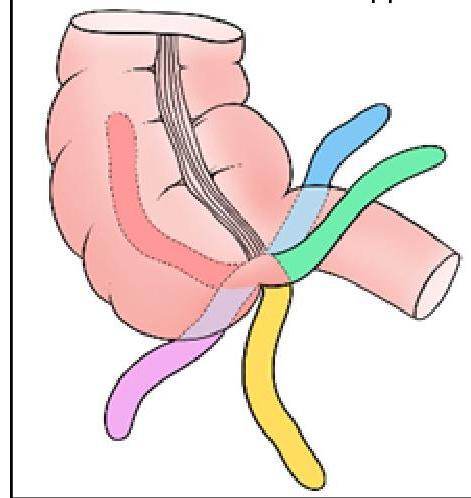
Question 31: Identify the position of the appendix marked in BLACK in the given image:
- A. Pelvic
- B. Subcecal
- C. Retrocecal (Correct Answer)
- D. Preileal
Explanation: ***Retrocecal*** - The **retrocecal** position (represented by the black color in the image) indicates the appendix is located behind the cecum, often a common variant. - This position can make diagnosis of appendicitis challenging as it may cause atypical pain patterns. *Pelvic* - The **pelvic** appendix descends into the true pelvis, which can mimic gynecological or urological conditions. - It usually causes pain that is more generalized in the lower abdomen or suprapubic region. *Subcecal* - The **subcecal** appendix is located directly below the cecum and is a relatively rare position. - While somewhat straightforward in presentation, it is less common than retrocecal or pelvic positions. *Preileal* - The **preileal** position indicates the appendix lies in front of the terminal ileum. - This is a less common anatomical variation, often associated with specific clinical presentations related to its anterior location.
Question 32: What is the incorrect statement?
- A. MIS inhibits the formation of Mullerian duct
- B. WD form male internal genitalia
- C. Zygote is Bipotential at 8 weeks (Correct Answer)
- D. DHT is necessary for the development of external genitals
Explanation: ***Zygote is Bipotential at 8 weeks*** - A **zygote** is formed at conception and is the single-cell diploid organism, not bipotential at 8 weeks. - The **bipotential gonad** can develop into either testes or ovaries, and this stage of sexual differentiation occurs earlier in gestation, typically around the 6th to 7th week, before differentiating into male or female gonads, not at 8 weeks as an entire zygote. *MIS inhibits the formation of Mullerian duct* - **Müllerian Inhibiting Substance (MIS)**, also known as **Anti-Müllerian Hormone (AMH)**, is produced by the Sertoli cells of the developing testes [1]. - Its primary function is to cause the **regression of the Müllerian ducts**, which would otherwise develop into female internal reproductive structures (fallopian tubes, uterus, and upper vagina) [1]. *WD form male internal genitalia* - The **Wolffian ducts (WD)**, also known as mesonephric ducts, are precursors to male internal genitalia in the presence of testosterone [1]. - stimulated by **testosterone** produced by the Leydig cells of the fetal testes, they develop into the **epididymis, vas deferens, and seminal vesicles** [1]. *DHT is necessary for the development of external genitals* - **Dihydrotestosterone (DHT)**, a more potent form of testosterone, is crucial for the development of male external genitalia [1]. - The enzyme **5α-reductase** converts testosterone to DHT in target tissues, leading to the formation of the **penis, scrotum, and prostate** [1].
Internal Medicine
2 questionsHistory of a woman with skin features like limited cutaneous systemic sclerosis (scleroderma) was given. What is the most specific marker?
Which type of amyloidosis is seen in the patients going through dialysis?
INI-CET 2023 - Internal Medicine INI-CET Practice Questions and MCQs
Question 31: History of a woman with skin features like limited cutaneous systemic sclerosis (scleroderma) was given. What is the most specific marker?
- A. Anti centromere (Correct Answer)
- B. Anti U1 Rnp
- C. Anti Jo
- D. Anti La
Explanation: ***Anti centromere*** - **Anti-centromere antibodies** are highly specific for **limited cutaneous systemic sclerosis** (lcSSc), also known as CREST syndrome. - Their presence correlates with a higher risk of **pulmonary hypertension** and less severe organ involvement compared to diffuse SSc [1]. *Anti U1 Rnp* - **Anti-U1 RNP antibodies** are primarily associated with **mixed connective tissue disease** (MCTD) [2]. - While MCTD can have features overlapping with scleroderma, anti-U1 RNP is not the most specific marker for a pure scleroderma presentation. *Anti Jo* - **Anti-Jo-1 antibodies** are characteristic of **polymyositis** and **dermatomyositis**, diseases involving muscle inflammation [2]. - They are primarily associated with the **anti-synthetase syndrome**, which includes myositis, interstitial lung disease, and Raynaud's phenomenon, not directly limited cutaneous systemic sclerosis. *Anti La* - **Anti-La (SS-B) antibodies** are commonly found in patients with **Sjögren's syndrome**, an autoimmune disorder affecting moisture-producing glands [2]. - They can also be present in systemic lupus erythematosus, but are not specific for scleroderma.
Question 32: Which type of amyloidosis is seen in the patients going through dialysis?
- A. A-beta
- B. AL
- C. A-beta 2 (Correct Answer)
- D. aTTR
Explanation: ***A-beta 2*** - **A-beta 2 microglobulin amyloidosis** (also known as dialysis-related amyloidosis) occurs because **beta-2 microglobulin** is not effectively cleared by dialysis and accumulates in tissues [1]. - This condition primarily affects **joints, bones**, and **tendons** in long-term dialysis patients, leading to carpal tunnel syndrome, arthropathy, and bone cysts. *A-beta* - **A-beta amyloidosis** refers to the accumulation of **amyloid-beta peptides** that are characteristic of **Alzheimer's disease**, primarily affecting the brain. - This type of amyloidosis is not directly associated with renal dialysis or systemic amyloid deposits in other organs. *AL* - **AL (light chain) amyloidosis** results from the deposition of **monoclonal immunoglobulin light chains** produced by plasma cells, often associated with multiple myeloma. - While it can affect the kidneys, it is a primary amyloidosis and not caused by dialysis itself, though it can occur in patients who also have kidney failure. *aTTR* - **aTTR (transthyretin) amyloidosis** involves the deposition of **abnormal transthyretin protein**, which can be hereditary (mutated TTR) or wild-type (aging-related) [1]. - This form primarily affects the heart and nervous system and is not typically associated with chronic dialysis as its direct cause.
Microbiology
1 questionsCD40 deficiency in a person signifies?
INI-CET 2023 - Microbiology INI-CET Practice Questions and MCQs
Question 31: CD40 deficiency in a person signifies?
- A. IgG increase
- B. T cell absent
- C. IgM increase (Correct Answer)
- D. B cell absent
Explanation: ***IgM increase*** - A deficiency in **CD40**, or its ligand **CD40L** (found on T helper cells), disrupts **T-cell-dependent B cell activation** and **class switching**. - Without proper signaling through CD40/CD40L, B cells cannot undergo **isotype switching** from **IgM** to IgG, IgA, or IgE, leading to elevated IgM levels and deficiencies in other antibody classes. *IgG increase* - **IgG levels** would likely be **decreased** in CD40 deficiency due to the impaired ability of B cells to undergo **class switching** from IgM to other antibody isotypes. - The primary role of CD40/CD40L interaction is to facilitate this class switching process. *T cell absent* - **CD40 deficiency** does not directly cause the absence of **T cells**; rather, it affects the ability of T cells to adequately activate B cells. - T-cell absence or severe dysfunction would be indicative of a different primary immunodeficiency, such as **SCID (Severe Combined Immunodeficiency)**. *B cell absent* - **CD40 deficiency** does not result in the absence of **B cells**; B cells are present but are dysfunctional in terms of antibody class switching. - Conditions like **X-linked agammaglobulinemia (XLA)** are characterized by the absence or severe deficiency of B cells.
Obstetrics and Gynecology
1 questionsAll are the causes of non-immune hydrops except?
INI-CET 2023 - Obstetrics and Gynecology INI-CET Practice Questions and MCQs
Question 31: All are the causes of non-immune hydrops except?
- A. Thalassemia
- B. Cardiovascular causes
- C. Parvovirus
- D. ABO incompatibility (Correct Answer)
Explanation: ***ABO incompatibility*** - **ABO incompatibility** is a common cause of **immune hydrops fetalis** due to antibody-mediated hemolytic anemia. - Immune hydrops involves red blood cell destruction caused by maternal antibodies crossing the placenta, which is not characteristic of non-immune hydrops. *Thalassemia* - **Alpha-thalassemia major (Hb Barts hydrops fetalis)** is a severe form of thalassemia frequently leading to **non-immune hydrops** due to profound anemia. - The severe chronic anemia leads to **high-output cardiac failure**, diffuse edema, and ascites. *Cardiovascular causes* - **Structural heart defects** and **arrhythmias** can impair fetal circulation and cardiac function, leading to **non-immune hydrops**. - Conditions like **hypoplastic left heart syndrome** or **supraventricular tachycardia** can cause fluid overload and edema. *Parvovirus* - **Parvovirus B19 infection** in the fetus can cause severe **anemia** by targeting erythroid progenitor cells, resulting in bone marrow suppression. - This severe fetal anemia frequently leads to **non-immune hydrops** as a consequence of heart failure.
Pathology
2 questionsWhich of the following are characteristic laboratory findings in Iron Deficiency Anemia (IDA)? 1. Low serum ferritin 2. Low transferrin saturation 3. Low serum iron 4. Increased TIBC
Order of drawing blood in vacutainers should be in the following sequence to prevent contamination:
INI-CET 2023 - Pathology INI-CET Practice Questions and MCQs
Question 31: Which of the following are characteristic laboratory findings in Iron Deficiency Anemia (IDA)? 1. Low serum ferritin 2. Low transferrin saturation 3. Low serum iron 4. Increased TIBC
- A. 3 and 4 only
- B. 1, 3, and 4 only
- C. 1 and 2 only
- D. All of the above (Correct Answer)
Explanation: ***All of the above (1, 2, 3, and 4)*** - **All listed parameters are characteristic findings in Iron Deficiency Anemia (IDA):** - **Low serum ferritin** - Indicates depleted iron stores; most specific early marker [1] - **Low serum iron** - Reflects reduced circulating iron availability [1] - **Low transferrin saturation** - Shows decreased percentage of iron-bound transferrin molecules (typically <15%) [1] - **Increased TIBC** - Compensatory increase in total iron-binding capacity as the liver produces more transferrin to capture available iron [1] *Why not just 1, 2, and 3?* - Increased TIBC is also a hallmark finding in IDA, distinguishing it from anemia of chronic disease (where TIBC is typically low) [1] *Why not just 3 and 4?* - Serum ferritin and transferrin saturation are equally important diagnostic parameters [1] *Why not just 1, 3, and 4?* - Low transferrin saturation is a key diagnostic criterion for IDA [1] **References:** [1] Kumar V, Abbas AK, et al.. Robbins and Cotran Pathologic Basis of Disease. 9th ed. Red Blood Cell and Bleeding Disorders, pp. 657-660.
Question 32: Order of drawing blood in vacutainers should be in the following sequence to prevent contamination:
- A. Plain → Blood culture → Citrate → EDTA → Fluoride
- B. Citrate → Blood culture → Plain → EDTA → Fluoride
- C. Blood culture → Plain → EDTA → Citrate → Fluoride
- D. Blood culture → Citrate → Plain → EDTA → Fluoride (Correct Answer)
Explanation: ***Blood culture → Citrate → Plain → EDTA → Fluoride*** - This sequence is the recommended order of draw to prevent **cross-contamination** between different additives, which could interfere with laboratory test results. - Starting with **blood cultures** minimizes contamination risk for microbiological analysis [1], followed by tubes containing anticoagulants like **citrate** (for coagulation studies), then **plain** tubes (for serum), followed by **EDTA** (for hematology), and finally **fluoride** (for glucose). - This order prevents carryover of additives that could affect subsequent test results. *Plain → Blood culture → Citrate → EDTA → Fluoride* - Drawing a **plain tube** first is incorrect as it might introduce skin flora into the blood culture bottle if performed later. - **Blood culture** should always be drawn first to ensure sterility and prevent contamination from other tube additives [1]. *Citrate → Blood culture → Plain → EDTA → Fluoride* - Drawing the **citrate tube** before blood culture is incorrect due to the risk of introducing citrate anticoagulant into the blood culture, which could inhibit bacterial growth. - The **blood culture** bottle requires the highest priority for sterility [1]. *Blood culture → Plain → EDTA → Citrate → Fluoride* - Placing the **plain tube** before **citrate tube** is incorrect according to CLSI guidelines. - Drawing the **EDTA tube** before the **citrate tube** can lead to contamination of the citrate sample with EDTA, potentially affecting coagulation tests by chelating calcium. **References:** [1] Cross SS. Underwood's Pathology: A Clinical Approach. 6th ed. Common Clinical Problems From Cardiovascular Disease, pp. 296-297.
Surgery
2 questionsWhich of the following is not a known complication associated with the procedure done in the patient?

A 53-year-old patient presents with per rectal bleeding. Which is the most appropriate investigation to evaluate for colorectal pathology?
INI-CET 2023 - Surgery INI-CET Practice Questions and MCQs
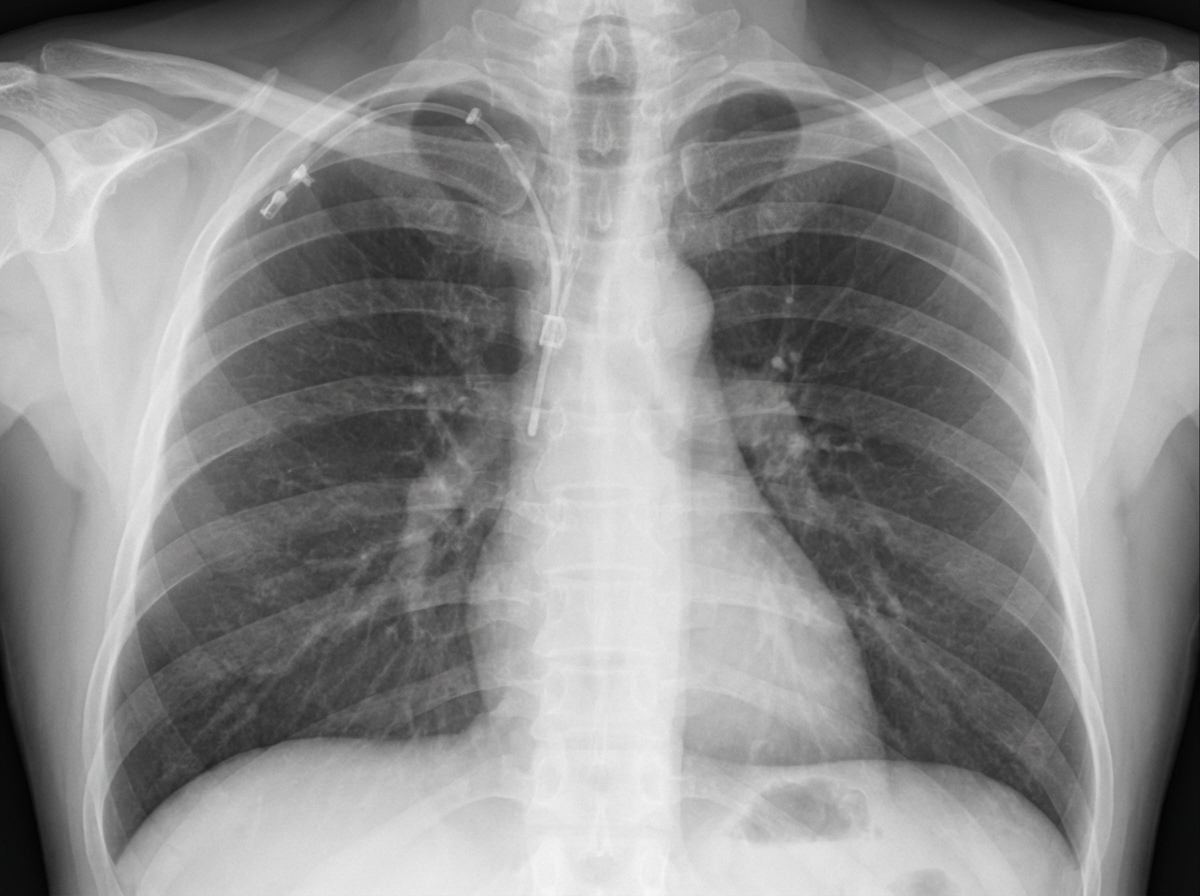
Question 31: Which of the following is not a known complication associated with the procedure done in the patient?
- A. Aspiration
- B. Pneumothorax
- C. Refeeding (Correct Answer)
- D. Arrhythmia
Explanation: ***Refeeding*** - The image shows a **central venous catheter (CVC)**, likely in the internal jugular vein. While CVCs are used for administering nutrition such as **total parenteral nutrition (TPN)**, refeeding syndrome is a metabolic complication that occurs when nutrition is reintroduced too quickly in severely malnourished patients. - **Refeeding syndrome is NOT a direct complication of the CVC insertion procedure itself**—it is a systemic metabolic complication related to the nutritional intervention (characterized by severe shifts in fluids and electrolytes, particularly hypophosphatemia, hypokalemia, and hypomagnesemia). - Therefore, refeeding is **not associated with the procedure** of CVC insertion. *Pneumothorax* - **Pneumothorax** is a well-recognized mechanical complication of central venous catheterization, particularly with subclavian and internal jugular vein approaches. - Occurs due to accidental puncture of the **pleura** during needle insertion, allowing air to enter the pleural space and causing lung collapse. - Incidence ranges from 1-6% depending on the site and operator experience. *Arrhythmia* - **Cardiac arrhythmias** are a known complication during CVC insertion when the guidewire or catheter tip inadvertently advances too far into the heart chambers (right atrium or ventricle). - Mechanical irritation of the myocardium can trigger **premature ventricular contractions (PVCs)** or other arrhythmias. - Usually transient and resolve upon withdrawing the catheter to proper position. *Aspiration* - While **aspiration** can occur in critically ill patients who require CVCs (due to altered consciousness, dysphagia, or ventilator-associated issues), it is **not a direct mechanical complication of the CVC insertion procedure itself**. - Aspiration relates to patient condition rather than the catheter placement technique, though both may coexist in the same clinical scenario.
Question 32: A 53-year-old patient presents with per rectal bleeding. Which is the most appropriate investigation to evaluate for colorectal pathology?
- A. CECT (Contrast-enhanced CT scan)
- B. CA-19-9 levels
- C. Colonoscopy (Correct Answer)
- D. CEA levels
Explanation: ***Colonoscopy*** - **Gold standard investigation** for per rectal bleeding and suspected colorectal pathology - Allows **direct visualization** of the entire colon and rectum - Enables **biopsy** of any suspicious lesions for histopathological diagnosis - Can identify various causes: **polyps, diverticula, inflammatory bowel disease, and colorectal cancer** - Therapeutic potential for polypectomy during the same procedure *CECT (Contrast-enhanced CT scan)* - Can detect large masses and assess for metastasis but not the primary diagnostic tool - Does not allow direct visualization of the mucosa or biopsy capability - Not suitable for identifying subtle mucosal lesions or early pathology - May be used as an adjunct for staging after diagnosis *CA-19-9 levels* - Tumor marker primarily associated with **pancreatic cancer** - Not routinely used for diagnosis or screening of colorectal malignancies - Lacks sensitivity and specificity for colorectal pathology - Not appropriate as initial investigation for per rectal bleeding *CEA levels (Carcinoembryonic antigen)* - Tumor marker that can be elevated in colorectal cancer - Primarily used for **monitoring treatment response** and **detecting recurrence** - Not sensitive or specific enough for initial diagnosis - Cannot replace endoscopic evaluation for per rectal bleeding