Dermatology
4 questionsNon-scarring alopecia is associated with all except?
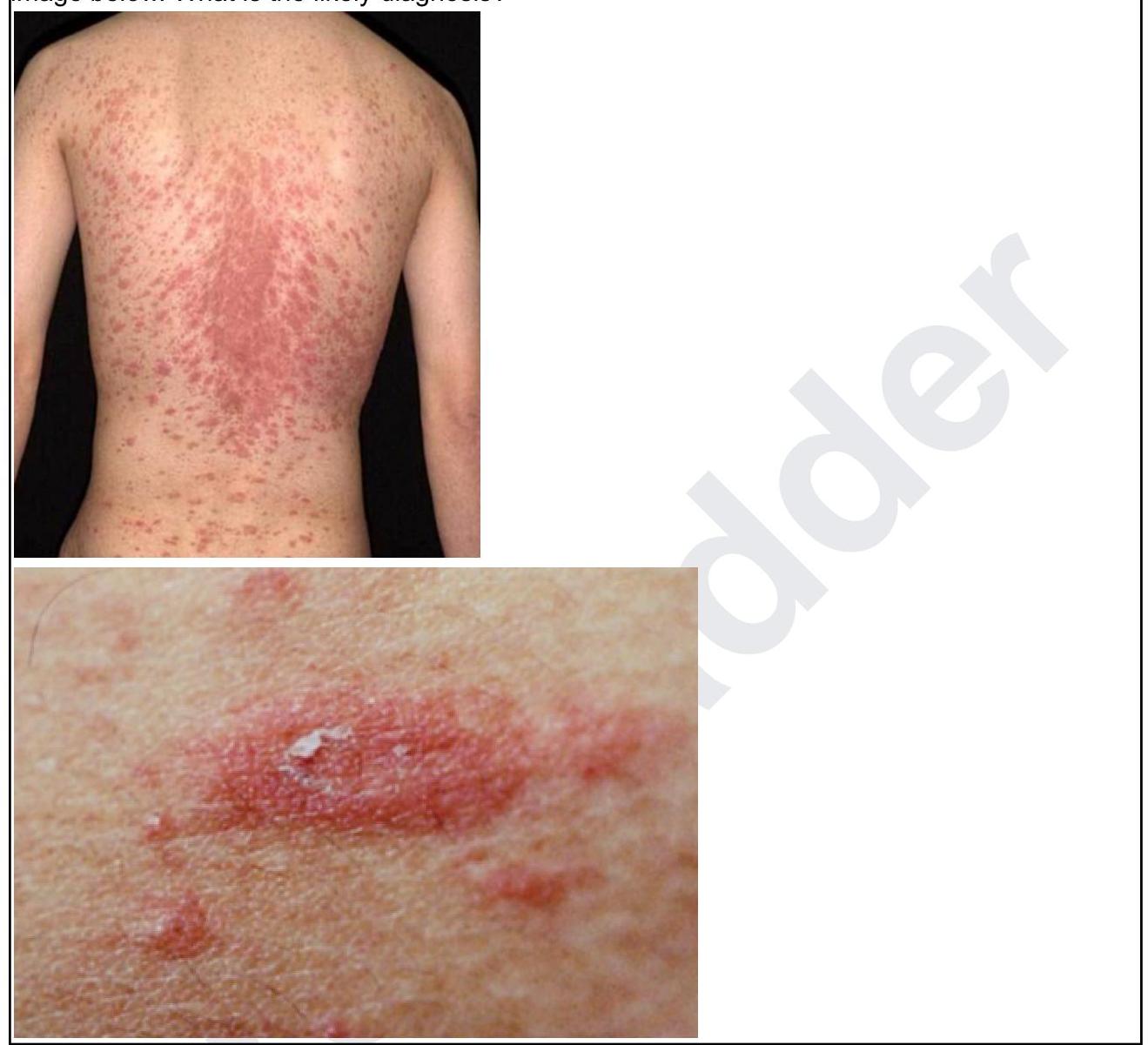
A 24-year-old male presents with asymptomatic scaly lesions over the body as shown in the image below. What is the likely diagnosis?
Statement 1 - A 59-year-old patient presents with flaccid bullae. Histopathology shows a suprabasal acantholytic split. Statement 2 - The row of tombstones appearance is diagnostic of Pemphigus vulgaris.
A 60-year-old female presents with eczematous itching lesions. Biopsy revealed a subepidermal cleft with Direct Immunofluorescence showing Linear C3 & IgG deposition along the basement membrane zone. What is the likely diagnosis?
INI-CET 2023 - Dermatology INI-CET Practice Questions and MCQs
Question 121: Non-scarring alopecia is associated with all except?
- A. Telogen effluvium
- B. Androgenetic alopecia
- C. Alopecia areata
- D. Frontal fibrosing alopecia (Correct Answer)
Explanation: ***Frontal fibrosing alopecia*** - This condition is a form of **lichen planopilaris**, which causes **scarring alopecia** due to destruction of hair follicles and replacement with fibrous tissue. - It results in a **receding hairline** and eyebrow loss, with irreversible hair loss. *Telogen effluvium* - This is a common cause of **non-scarring alopecia**, characterized by diffuse hair shedding triggered by various stressors like illness, stress, or medications. - The hair follicles enter the **telogen phase** prematurely, leading to increased shedding but typically regrowth once the trigger is removed. *Androgenetic alopecia* - Often referred to as **male or female pattern baldness**, this is a form of **non-scarring alopecia** driven by genetic predisposition and androgens. - It causes a progressive miniaturization of hair follicles, leading to thinning hair, but the follicles remain present and capable of producing hair. *Alopecia areata* - This is an **autoimmune condition** that causes **non-scarring hair loss** in patches on the scalp or other parts of the body. - The hair follicles are attacked by the immune system but are not permanently destroyed, allowing for potential regrowth.
Question 122: A 24-year-old male presents with asymptomatic scaly lesions over the body as shown in the image below. What is the likely diagnosis?
- A. Atopic Dermatitis
- B. Lichen planus
- C. Seborrheic Dermatitis
- D. Pityriasis Rosea (Correct Answer)
Explanation: ***Pityriasis Rosea*** - The image shows numerous **scaly, erythematous plaques** distributed over the trunk, with a characteristic "Christmas tree" pattern often observed in Pityriasis Rosea. - The lesions are described as **asymptomatic**, which is consistent with Pityriasis Rosea, although mild pruritus can occur. *Atopic Dermatitis* - Typically presents with **intensely pruritic, erythematous, and eczematous lesions** often found in flexural areas (e.g., antecubital and popliteal fossae). - While it can be widespread, the morphology of the lesions (eczematous vs. scaly plaques) and the absence of pruritus make this less likely. *Lichen planus* - Characterized by **pruritic, violaceous, polygonal papules** and plaques, often appearing on the flexor surfaces of wrists, ankles, and oral mucosa. - The appearance of the lesions in the image does not match the typical morphology of lichen planus. *Seborrheic Dermatitis* - Primarily affects areas with a high density of sebaceous glands, such as the **scalp, face (nasolabial folds, eyebrows), and chest**. - Presents with **greasy, yellowish scales** on an erythematous base, which is distinct from the dry, scaly plaques seen in the image.
Question 123: Statement 1 - A 59-year-old patient presents with flaccid bullae. Histopathology shows a suprabasal acantholytic split. Statement 2 - The row of tombstones appearance is diagnostic of Pemphigus vulgaris.
- A. Statements 1 & 2 are correct, 2 is not explaining 1 (Correct Answer)
- B. Statements 1 and 2 are correct and 2 is the correct explanation for 1
- C. Statements 1 and 2 are incorrect
- D. Statement 1 is incorrect
Explanation: ***Correct: Statements 1 & 2 are correct, 2 is not explaining 1*** **Analysis of Statement 1:** - A 59-year-old patient with **flaccid bullae** and **suprabasal acantholytic split** on histopathology is the classic presentation of **Pemphigus vulgaris** - The flaccid (easily ruptured) nature of bullae distinguishes it from tense bullae seen in bullous pemphigoid - The suprabasal location of the split (just above the basal layer) with acantholysis (loss of cell-to-cell adhesion) is pathognomonic - **Statement 1 is CORRECT** ✓ **Analysis of Statement 2:** - The **"row of tombstones" or "tombstone appearance"** is indeed a diagnostic histopathological feature of Pemphigus vulgaris - This appearance results from basal keratinocytes remaining attached to the basement membrane while suprabasal cells separate due to acantholysis - The intact basal cells standing upright resemble a row of tombstones - **Statement 2 is CORRECT** ✓ **Does Statement 2 explain Statement 1?** - Statement 2 describes a **histopathological appearance** (tombstone pattern) that is a **consequence** of the suprabasal split - However, it does NOT explain the **underlying cause** of the flaccid bullae or the suprabasal split - The true explanation involves **IgG autoantibodies against desmoglein 3 (and desmoglein 1)**, which attack intercellular adhesion structures (desmosomes), causing **acantholysis** - Therefore, **Statement 2 does NOT explain Statement 1** ✗ *Incorrect: Statement 2 is the correct explanation for Statement 1* - While both statements describe features of Pemphigus vulgaris, the tombstone appearance is a descriptive finding, not an explanatory mechanism *Incorrect: Statements 1 and 2 are incorrect* - Both statements are medically accurate descriptions of Pemphigus vulgaris features *Incorrect: Statement 1 is incorrect* - Statement 1 correctly describes the cardinal clinical and histopathological features of Pemphigus vulgaris
Question 124: A 60-year-old female presents with eczematous itching lesions. Biopsy revealed a subepidermal cleft with Direct Immunofluorescence showing Linear C3 & IgG deposition along the basement membrane zone. What is the likely diagnosis?
- A. Pemphigus foliaceus
- B. Pemphigus Vulgaris
- C. Dermatitis herpetiformis
- D. Bullous Pemphigoid (Correct Answer)
Explanation: ***Bullous Pemphigoid*** - The presence of **eczematous itching lesions**, a **subepidermal cleft**, and **linear C3 and IgG deposition along the basement membrane zone** on direct immunofluorescence (DIF) are classic diagnostic features of Bullous Pemphigoid. - This autoimmune blistering disease typically affects older individuals and is characterized by antibodies targeting components of the **hemidesmosomes**, specifically BP180 and BP230. *Pemphigus foliaceus* - This condition involves **intraepidermal blistering**, specifically within the granular layer, rather than a subepidermal cleft. - DIF in Pemphigus foliaceus shows **intercellular IgG deposition** in the epidermis, not linear deposition along the basement membrane zone. *Pemphigus Vulgaris* - Pemphigus Vulgaris is characterized by **intraepidermal blistering** above the basal cell layer (**suprabasal clefting**), leading to fragile bullae that rupture easily. - DIF typically reveals **intercellular IgG and C3 deposition** in a "chicken wire" pattern throughout the epidermis, which differs from the linear pattern seen in this case. *Dermatitis herpetiformis* - While Dermatitis herpetiformis is also an autoimmune blistering disease with itching lesions, its characteristic DIF finding is **granular IgA deposition** in the dermal papillae, not linear C3 and IgG at the basement membrane zone. - Histopathology in Dermatitis herpetiformis shows **subepidermal vesicles** with neutrophil infiltration in the dermal papillae, but the direct immunofluorescence pattern is distinct.
Internal Medicine
2 questionsIdentify the ECG given below?

Which of the following describes aortic regurgitation murmur?
INI-CET 2023 - Internal Medicine INI-CET Practice Questions and MCQs
Question 121: Identify the ECG given below?
- A. Viral myocarditis
- B. Torsades de pointes (Correct Answer)
- C. Cardiac tamponade
- D. Pericarditis
Explanation: ***Torsades de pointes*** - The ECG shows a polymorphic ventricular tachycardia where the **QRS complexes appear to twist around the baseline**, a classic feature of Torsades de pointes. - This condition is often associated with **QT prolongation**, which is evident in some of the strips preceding the tachyarrhythmia. *Viral myocarditis* - While viral myocarditis can lead to various ECG abnormalities, it typically doesn't present with this specific **polymorphic ventricular tachycardia** morphology. - Common ECG findings in myocarditis include non-specific ST-T wave changes, sinus tachycardia, or conduction blocks, rather than the characteristic "twisting" pattern seen here. *Cardiac tamponade* - Cardiac tamponade is characterized by **electrical alternans** (alternating QRS amplitude), low voltage, and sinus tachycardia on ECG. - It does not cause a polymorphic ventricular tachycardia with the appearance of QRS complexes twisting around the baseline. *Pericarditis* - Pericarditis typically presents with **diffuse ST-segment elevation** (often concave up) and PR-segment depression. - It does not manifest as a polymorphic ventricular tachycardia like Torsades de pointes.
Question 122: Which of the following describes aortic regurgitation murmur?
- A. Ejection systolic murmur
- B. Diastolic murmur (Correct Answer)
- C. Ventricular contraction
- D. Systolic murmur
Explanation: ***Diastolic murmur*** - Aortic regurgitation occurs when the **aortic valve does not close completely**, leading to blood flowing back into the **left ventricle during diastole** [1]. - This backflow of blood during the **relaxation phase** of the heart creates the characteristic diastolic murmur [1]. *Ejection systolic murmur* - This murmur type is typically heard during **systole** and is associated with conditions like **aortic stenosis**, where there is turbulent flow across a narrowed aortic valve during ejection [3]. - It does not describe the sound of blood flowing back into the ventricle during **diastole**, which characterizes aortic regurgitation. *Ventricular contraction* - **Ventricular contraction** occurs during **systole** and is the mechanism by which blood is ejected from the ventricles [2]. - While related to cardiac cycle, it does not directly describe the timing or nature of the murmur caused by aortic regurgitation. *Systolic murmur* - A **systolic murmur** is heard when the ventricles contract, such as in conditions like **aortic stenosis** or **mitral regurgitation** [3]. - Aortic regurgitation is specifically a **diastolic event** as blood leaks back into the left ventricle during ventricular relaxation [1].
Pathology
2 questionsA 14 year old male presents with mushroom like tumor in the distal femur for past 2 years. Which of the following features suggest malignant transformation?

Abnormal accumulation of misfolded protein is seen in?
INI-CET 2023 - Pathology INI-CET Practice Questions and MCQs
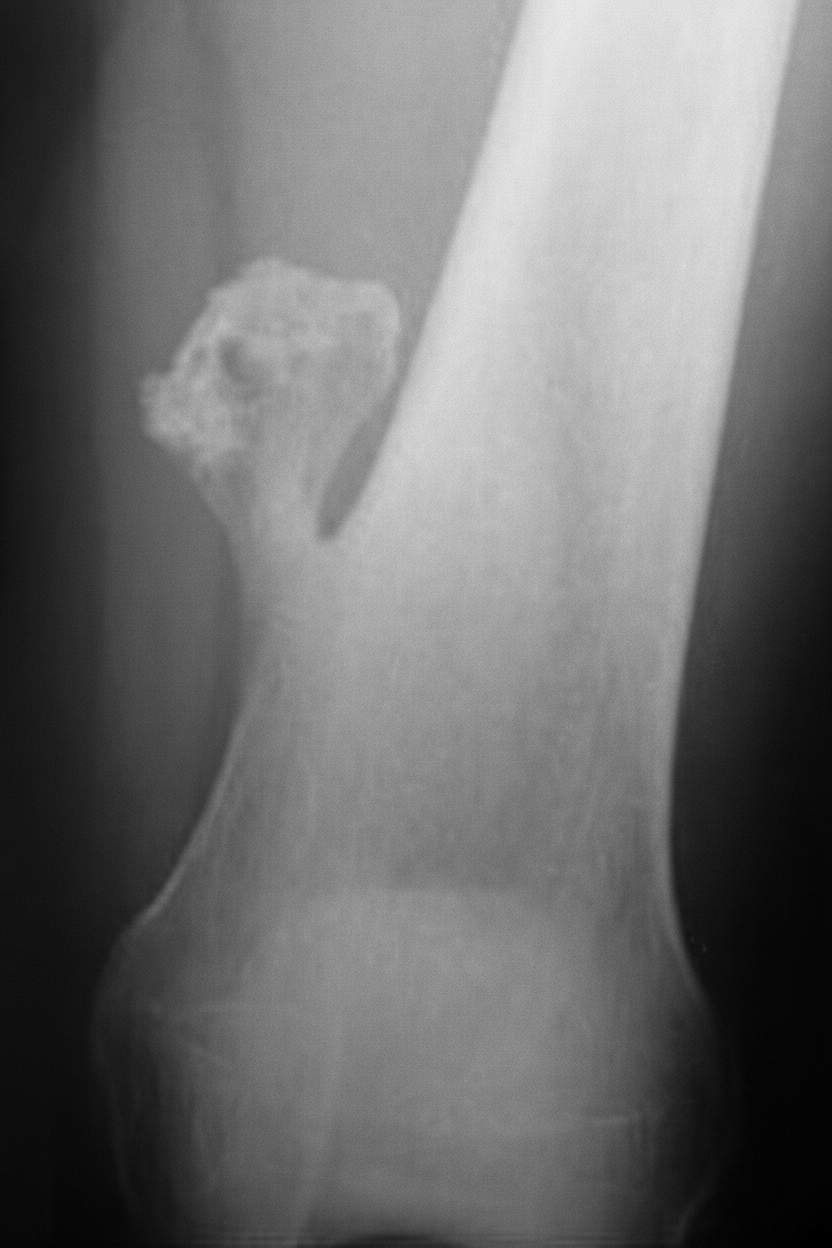
Question 121: A 14 year old male presents with mushroom like tumor in the distal femur for past 2 years. Which of the following features suggest malignant transformation?
- A. Cartilage thickness $>2 \mathrm{~cm}$ (Correct Answer)
- B. Presence of cartilage cap
- C. Location in metaphysis
- D. Size less than 1 cm
Explanation: ***Cartilage thickness >2 cm*** - A **cartilage cap thickness greater than 2 cm** in an osteochondroma in an adult (or >3 cm in children) is a strong indicator of **malignant transformation** into a secondary peripheral **chondrosarcoma**. [2], [3] - **Key imaging finding:** Cartilage cap measured on MRI or CT scan - Other features suggesting malignant transformation include continued growth after skeletal maturity, new or increasing pain, cortical destruction, and new soft tissue mass. [2], [3] *Presence of cartilage cap* - All osteochondromas have a cartilage cap by definition - this is a normal feature, not a sign of malignancy. [1] - The **thickness** of the cap, not its presence, is what matters. *Location in metaphysis* - Osteochondromas typically arise from the metaphysis near the growth plate - this is a normal location. [3] - Location alone does not indicate malignant transformation. *Size less than 1 cm* - Small size suggests a benign, stable lesion. - Malignant transformation is suggested by **increasing size** and growth after skeletal maturity, not small size. [2] **References:** [1] Kumar V, Abbas AK, et al.. Robbins and Cotran Pathologic Basis of Disease. 9th ed. Bones, Joints, and Soft Tissue Tumors, p. 1202. [2] Cross SS. Underwood's Pathology: A Clinical Approach. 6th ed. Common Clinical Problems From Osteoarticular And Connective Tissue Disease, pp. 672-673. [3] Kumar V, Abbas AK, et al.. Robbins and Cotran Pathologic Basis of Disease. 9th ed. Bones, Joints, and Soft Tissue Tumors, pp. 1202-1204.
Question 122: Abnormal accumulation of misfolded protein is seen in?
- A. Nephritic syndrome
- B. Sickle cell anemia
- C. Megaloblastic anemia
- D. Creutzfeldt-Jakob disease (Correct Answer)
Explanation: ***Creutzfeldt-Jakob disease*** - This is a neurodegenerative disease characterized by the accumulation of **abnormally folded prion proteins (PrPSc)** in the brain, leading to spongiform encephalopathy [1]. - The misfolding of normal cellular prion protein (PrPC) into its infectious and pathogenic form is central to the disease's pathology [2]. *Nephritic syndrome* - This syndrome is characterized by inflammation of the **glomeruli** in the kidneys, leading to hematuria, proteinuria, and hypertension. - It involves immune complex deposition and inflammation, not primarily the accumulation of misfolded proteins. *Sickle cell anemia* - This is a **genetic blood disorder** caused by a mutation in the beta-globin gene, leading to abnormal **hemoglobin S**. - While hemoglobin S can polymerize and deform red blood cells, it is not considered a disease of generalized misfolded protein accumulation in the same sense as prion diseases. *Megaloblastic anemia* - This condition is caused by impaired **DNA synthesis**, often due to **vitamin B12 or folate deficiency**, leading to large, immature red blood cells. - The pathology involves defective cell division and maturation, not the accumulation of misfolded proteins. **References:** [1] Kumar V, Abbas AK, et al.. Robbins and Cotran Pathologic Basis of Disease. 9th ed. The Central Nervous System, pp. 1284-1286. [2] Cross SS. Underwood's Pathology: A Clinical Approach. 6th ed. Common Clinical Manifestations Of Central And Peripheral Nervous System Disease, pp. 712-713.
Pharmacology
1 questionsA 35-year-old male patient presents to surgery emergency with painful erection for past 7 hours. He has a history of mood disorder and was recently prescribed a medication by treating psychiatrist. Which is the likely offending drug?
INI-CET 2023 - Pharmacology INI-CET Practice Questions and MCQs
Question 121: A 35-year-old male patient presents to surgery emergency with painful erection for past 7 hours. He has a history of mood disorder and was recently prescribed a medication by treating psychiatrist. Which is the likely offending drug?
- A. Venlafaxine
- B. Tianeptine
- C. Trazodone (Correct Answer)
- D. Mirtazapine
Explanation: ***Trazodone*** - **Trazodone** is a commonly known antidepressant that can cause **priapism** as a side effect, especially at higher doses, due to its alpha-adrenergic blocking activity. [1] - The patient's presentation of a **painful erection lasting 7 hours** after starting a new psychiatric medication strongly points towards a drug-induced cause, for which trazodone is a well-established culprit. [1] *Venlafaxine* - **Venlafaxine** is an SNRI antidepressant that generally does not cause priapism as a recognized side effect. - Its adverse effect profile primarily includes nausea, insomnia, and sexual dysfunction (e.g., erectile dysfunction, anorgasmia), rather than prolonged erections. *Tianeptine* - **Tianeptine** is an atypical antidepressant that is not known to cause priapism. - It works by enhancing serotonin reuptake and is more commonly associated with side effects such as nausea, constipation, and dizziness. *Mirtazapine* - **Mirtazapine** is a tetracyclic antidepressant that works by blocking alpha-2 adrenergic receptors and certain serotonin receptors. - While it can cause sedation and weight gain, priapism is not a typical or recognized side effect of mirtazapine.
Surgery
1 questionsWhat should be done as an immediate measure for ongoing bleeding in a patient with pelvic bone fracture?
INI-CET 2023 - Surgery INI-CET Practice Questions and MCQs
Question 121: What should be done as an immediate measure for ongoing bleeding in a patient with pelvic bone fracture?
- A. Use Pelvic Binders (Correct Answer)
- B. Rapid blood transfusion
- C. External fixation
- D. Internal definitive fixation
Explanation: **Use Pelvic Binders** - **Pelvic binders** apply circumferential compression, which helps to stabilize the fracture and reduce the pelvic volume. - This mechanical stabilization significantly reduces ongoing hemorrhage from venous and bone surface bleeding in unstable pelvic fractures. *Rapid blood transfusion* - While critically important for managing **hemorrhagic shock**, blood transfusion alone does not address the source of ongoing bleeding. - It is a supportive measure, not an immediate means to stop the bleeding from an unstable pelvic fracture. *Internal definitive fixation* - **Internal definitive fixation** is a surgical procedure aimed at permanently stabilizing the fracture and would typically be performed after initial resuscitation and bleeding control. - It is not an immediate measure for **ongoing life-threatening hemorrhage** and carries procedural risks. *External fixation* - **External fixation** can stabilize an unstable pelvic fracture and helps in controlling bleeding, but applying a **pelvic binder** is a quicker and less invasive initial step. - External fixation is usually performed by a surgeon in a controlled environment, not as the very first immediate bedside measure to stop bleeding.