Anatomy
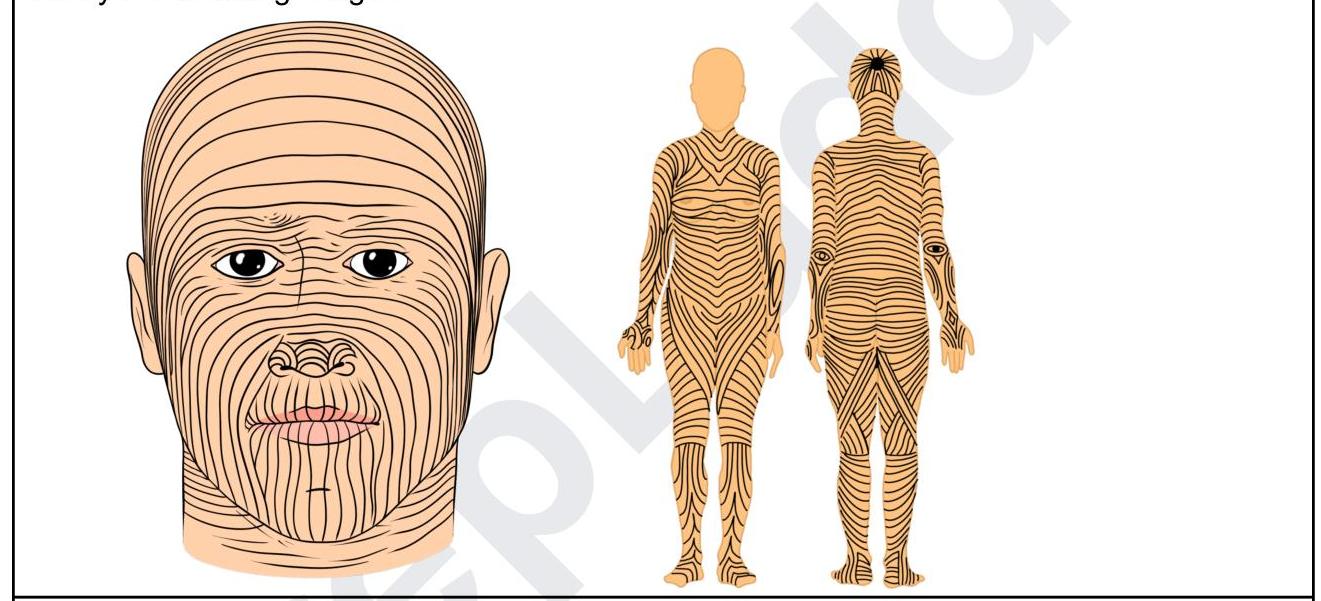
1 questionsIdentify the lines shown in the following image:
INI-CET 2023 - Anatomy INI-CET Practice Questions and MCQs
Question 91: Identify the lines shown in the following image:
- A. Hinderer's lines
- B. Dermatomes
- C. Langer's lines (Correct Answer)
- D. Blaschko's lines
Explanation: ***Langer's lines*** - The image displays lines that represent the **natural orientation of collagen fibers** within the human skin, which are known as Langer's lines (also called cleavage lines). - Making surgical incisions **parallel to these lines** can result in better wound healing and less scarring. - Named after **Karl Langer**, an Austrian anatomist who described these lines in 1861. *Hinderer's lines* - While **Hinderer** described relaxed skin tension lines (RSTLs) used in plastic surgery, these are **different from Langer's lines**. - The image shows Langer's lines specifically, which are based on **collagen fiber orientation**, not relaxed skin tension. *Dermatomes* - **Dermatomes** are areas of skin mainly supplied by a single **spinal nerve root**. - They represent **neurologic segments** and do not correspond to the collagen fiber orientation shown in the image. *Blaschko's lines* - **Blaschko's lines** are invisible lines of skin cell migration that become visible in certain **genetic or acquired dermatological conditions**. - They represent a **mosaic pattern** due to different cell populations and are distinctly different from the structural collagen lines shown.
ENT
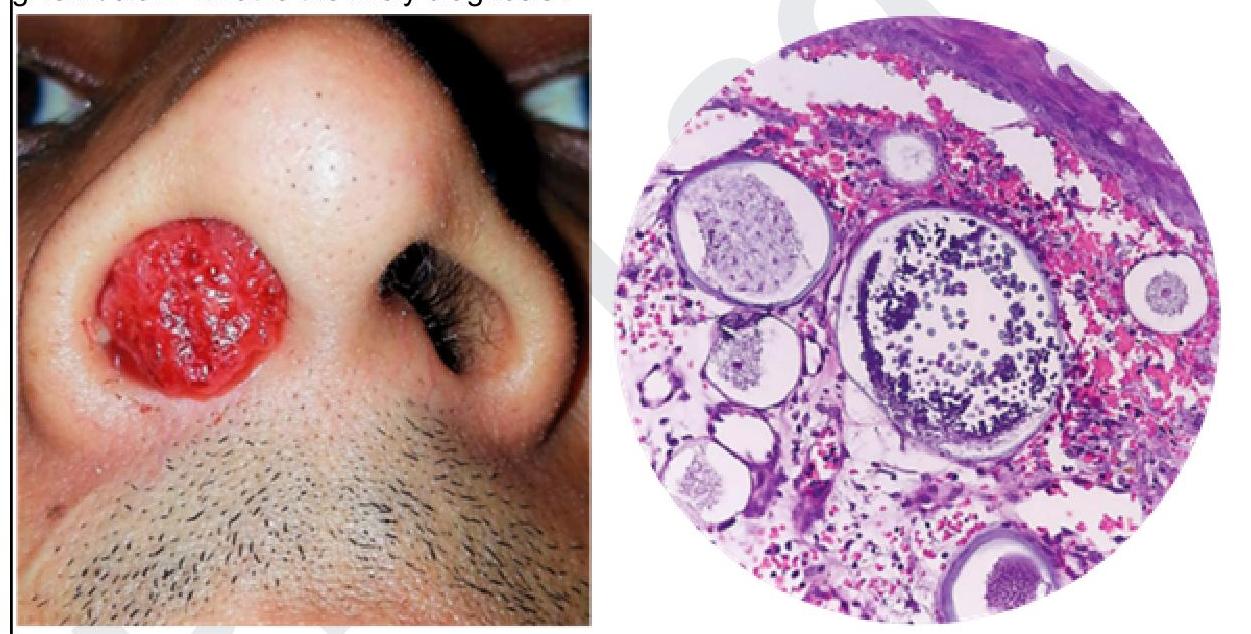
1 questionsA South Indian male farmer presents to the ENT OPD with complaints of reddish mass coming out from the nose as shown in the image below and the histopathology examination is also given below. What is the likely diagnosis?

INI-CET 2023 - ENT INI-CET Practice Questions and MCQs
Question 91: A South Indian male farmer presents to the ENT OPD with complaints of reddish mass coming out from the nose as shown in the image below and the histopathology examination is also given below. What is the likely diagnosis?
- A. Nasal polyp
- B. Inverted papilloma
- C. Antrochoanal polyp
- D. Rhinosporidiosis (Correct Answer)
Explanation: **Rhinosporidiosis** - The image shows a **reddish, friable mass** in the nose, and the histopathology reveals **large sporangia** containing endospores, which are characteristic findings of *Rhinosporidium seeberi*, the causative agent of rhinosporidiosis. - The patient's demographic (South Indian male farmer) is also consistent, as rhinosporidiosis is **endemic in India and Sri Lanka** and is often associated with exposure to **stagnant water**. *Nasal polyp* - Nasal polyps are typically **pale, yellowish-grey, glistening, and translucent** masses, contrasting with the reddish appearance in the image. - Histologically, they show **edematous stroma** with inflammatory cells but lack the distinct sporangia seen in the provided image. *Inverted papilloma* - Inverted papillomas are characterized by **endophytic growth** of squamous or transitional epithelium into the underlying stroma. - Although they can be reddish, their histopathology shows **inverted papillary projections**, not fragmented sporangia. *Antrochoanal polyp* - An antrochoanal polyp typically originates from the **maxillary sinus** and extends into the choana and nasopharynx, which may not be overtly visible as a mass presenting anteriorly in the nostril without further examination. - Like other nasal polyps, its histological appearance would be **edematous inflammatory tissue** without the parasitic structures seen here.
Physiology
7 questionsWindkessel effect is not shown by which of the following vessel?
Cystic fibrosis leads to defect in which of the following channels?
Find the correct Auditory pathway sequence.
Arrange the following parts of sarcomere from periphery to center. 1. Z line 2. M line 3. A band 4. H zone
Blood pressure changes in radial artery were measured. Which of the following is the reason for initial rise in BP while performing Valsalva maneuver?

Assertion: RMP depends on proteins and phosphate ions. Reason: Diffusion potential can be calculated using nernst equation. Choose the best statement regarding the assertion and reason.
CO poisoning causes which type of hypoxia?
INI-CET 2023 - Physiology INI-CET Practice Questions and MCQs
Question 91: Windkessel effect is not shown by which of the following vessel?
- A. Radial (Correct Answer)
- B. Renal
- C. Aorta
- D. Abdominal aorta
Explanation: ***Radial*** - The **radial artery** is a muscular artery, and these vessels primarily regulate blood flow and pressure through vasoconstriction and vasodilation, rather than storing elastic energy. - While all arteries have some elasticity, the **Windkessel effect** is most prominent in large elastic arteries, which are structurally different from muscular arteries like the radial artery. *Renal* - The **renal artery** is a highly compliant, distensible artery that assists in dampening pulsatile flow and ensuring continuous, stable perfusion to the kidneys. - As a major artery off the aorta, it contributes to the **Windkessel effect** by accommodating changes in pressure during the cardiac cycle. *Aorta* - The **aorta** is the primary vessel demonstrating the **Windkessel effect** due to its high elasticity and large diameter. - During systole, it stretches and stores a significant volume of blood, releasing it during diastole to maintain a continuous flow. *Abdominal* - The **abdominal aorta** is a large elastic artery that, like the thoracic aorta, is crucial for expressing the **Windkessel effect**. - Its elastic recoil during diastole helps to sustain blood flow to the lower body and abdominal organs.
Question 92: Cystic fibrosis leads to defect in which of the following channels?
- A. Cl- (Correct Answer)
- B. K+
- C. Ca2+
- D. Na+
Explanation: ***Cl-*** - Cystic fibrosis is caused by a mutation in the **CFTR gene**, which encodes for the **Cystic Fibrosis Transmembrane Conductance Regulator protein**. - This protein functions primarily as a **chloride channel**, and its dysfunction leads to impaired chloride transport across epithelial cell membranes. *K+* - While potassium channels are crucial for many physiological processes, their primary dysfunction is **not directly linked to the pathogenesis of cystic fibrosis**. - Defects in potassium channels are associated with conditions like **long QT syndrome** or certain forms of epilepsy. *Ca2+* - **Calcium channels play a role in various cellular signaling pathways**, but their direct defect is not the underlying cause of cystic fibrosis. - Conditions like **Lambert-Eaton myasthenic syndrome** involve antibodies affecting presynaptic calcium channels. *Na+* - **Sodium channels are involved in maintaining membrane potential and fluid balance**, and while they interact with CFTR, their primary defect is not the cause of cystic fibrosis. - Dysregulation of sodium transport can occur secondary to CFTR dysfunction, leading to **dehydrated mucus**, but the initial defect is in chloride.
Question 93: Find the correct Auditory pathway sequence.
- A. Eight nerve → cochlear nuclei → superior olivary nucleus → lateral lemniscus → inferior colliculus → medial geniculate body → auditory cortex (Correct Answer)
- B. Superior olivary nucleus → lateral lemniscus → inferior colliculus → medial geniculate body → auditory cortex → Eight nerve → Cochlear nuclei
- C. Cochlear nuclei → superior olivary nucleus → lateral lemniscus → inferior colliculus → medial geniculate body → auditory cortex → Eight nerve
- D. Superior olivary nucleus → inferior colliculus → medial geniculate body → auditory cortex → Eight nerve → Cochlear nuclei → lateral lemniscus
Explanation: ***Eight nerve → cochlear nuclei → superior olivary nucleus → lateral lemniscus → inferior colliculus → medial geniculate body → auditory cortex*** - This sequence accurately traces the path of auditory information from the **vestibulocochlear nerve (cranial nerve VIII)**, through various brainstem and thalamic nuclei, to the **auditory cortex** for processing. - Each component plays a crucial role in the **processing and relay of sound signals**, including localization, integration, and perception. *Superior olivary nucleus → lateral lemniscus → inferior colliculus → medial geniculate body → auditory cortex → Eight nerve → Cochlear nuclei* - This sequence is incorrect because it begins with the **superior olivary nucleus**, which receives input from the cochlear nuclei, not the initial auditory input. - The **eight nerve (vestibulocochlear nerve)** and **cochlear nuclei** are placed at the end, whereas they are the primary initial structures in the pathway. *Cochlear nuclei → superior olivary nucleus → lateral lemniscus → inferior colliculus → medial geniculate body → auditory cortex → Eight nerve* - This sequence incorrectly places the **eight nerve** at the very end of the pathway, instead of at the beginning where it transmits signals from the cochlea. - The **cochlear nuclei** are the first central nervous system stations for auditory processing, receiving direct input from the eight nerve. *Superior olivary nucleus → inferior colliculus → medial geniculate body → auditory cortex → Eight nerve → Cochlear nuclei → lateral lemniscus* - This sequence is incorrect as it starts with the **superior olivary nucleus**, bypassing the initial input from the **eight nerve** and **cochlear nuclei**. - The order of several components, such as the placement of the **eight nerve** and **cochlear nuclei** near the end and the delayed appearance of the **lateral lemniscus**, disrupts the physiological pathway.
Question 94: Arrange the following parts of sarcomere from periphery to center. 1. Z line 2. M line 3. A band 4. H zone
- A. 2,3,4,1
- B. 4,2,3,1
- C. 3,1,4,2
- D. 1,3,4,2 (Correct Answer)
Explanation: ***1,3,4,2*** - The **Z line** is found at the **periphery** of the sarcomere, defining its boundaries and anchoring the **actin filaments**. - Moving inwards, the **A band** is next, representing the entire length of the **myosin filament**, which may also overlap with actin. - The **H zone** is located within the A band, comprising only **myosin filaments** without actin overlap. - Finally, the **M line** is at the **center** of the sarcomere, bisecting the H zone and anchoring the myosin filaments. *2,3,4,1* - This sequence is incorrect because the **M line** is at the **center** and the **Z line** is at the **periphery**, which is the reverse of the expected order for from periphery to center. - Such an arrangement would place the innermost structure first and outermost last, not reflecting the correct spatial organisation. *4,2,3,1* - This order is incorrect as the **H zone** and **M line** are more central, while the **Z line** is peripheral. - Placing structures like the H zone and M line at the beginning does not align with arrangement from periphery to center. *3,1,4,2* - This option is incorrect because the **A band** includes both actin and myosin filaments, while the **Z line** is at the periphery of the sarcomere. - The given order does not represent a progression from the periphery to the center of the sarcomere.
Question 95: Blood pressure changes in radial artery were measured. Which of the following is the reason for initial rise in BP while performing Valsalva maneuver?
- A. Increase in Left ventricular volume
- B. Increase in Left ventricular pressure
- C. Decrease in aortic pressure
- D. Increase in aortic pressure (Correct Answer)
Explanation: ***Increase in aortic pressure*** - During the initial phase (Phase I) of the Valsalva maneuver, the sudden **increase in intrathoracic pressure** is transmitted directly to the aorta and other large arteries. - This transient increase in external pressure on the great vessels directly causes a brief **rise in aortic blood pressure** before other compensatory mechanisms take effect. *Increase in Left ventricular volume* - The Valsalva maneuver actually **decreases left ventricular volume** over time due to reduced venous return. - An increase in left ventricular volume would typically lead to a sustained increase in cardiac output and blood pressure, which is not what is observed initially during the Valsalva maneuver. *Increase in Left ventricular pressure* - While increased intrathoracic pressure can transiently affect left ventricular pressure, the initial blood pressure rise is primarily due to direct compression of the **aorta and systemic arteries**, not an intrinsic increase in myocardial contractility or ventricular filling pressure. - Ultimately, the Valsalva maneuver generally leads to a decrease in **left ventricular preload** and subsequent decrease in stroke volume during the prolonged straining phase. *Decrease in aortic pressure* - The graph clearly shows an **initial spike in mean aortic pressure** (Phase I) at the onset of the Valsalva maneuver. - A decrease in aortic pressure is characteristic of the later part of the straining phase (Phase II) due to **reduced cardiac output**.
Question 96: Assertion: RMP depends on proteins and phosphate ions. Reason: Diffusion potential can be calculated using nernst equation. Choose the best statement regarding the assertion and reason.
- A. Assertion false, Reason true
- B. Both true, Reason is the explanation of assertion
- C. Assertion true, Reason false
- D. Both true, Reason is not the explanation of assertion (Correct Answer)
Explanation: ***Both true, Reason is not the explanation of assertion*** - The **Assertion is TRUE**: The resting membrane potential (RMP) does depend on intracellular **proteins and phosphate ions**, which are large, non-diffusible anions that remain trapped inside the cell. These molecules contribute significantly to the **net negative charge** of the intracellular compartment and create the **Gibbs-Donnan effect**. At physiological pH, most intracellular proteins are negatively charged, and phosphate ions (HPO₄²⁻, H₂PO₄⁻) are major intracellular anions. While the primary determinants of RMP are the concentration gradients and membrane permeabilities of K⁺, Na⁺, and Cl⁻ ions, the presence of non-diffusible anions (proteins and phosphates) is essential for establishing the baseline negative intracellular environment. - The **Reason is TRUE**: The **Nernst equation** (E = RT/zF × ln[ion]out/[ion]in) is indeed used to calculate the **equilibrium potential** (also called diffusion potential) for a single permeable ion. This equation determines the membrane potential at which the electrical gradient exactly balances the concentration gradient for that specific ion, resulting in no net ion movement. - **However, the Reason does NOT explain the Assertion**: The Nernst equation calculates equilibrium potentials for diffusible ions like K⁺, Na⁺, and Cl⁻. It does NOT explain the contribution of **non-diffusible** anions (proteins and phosphates) to the RMP. The actual RMP, which involves multiple ions with different permeabilities, is calculated using the **Goldman-Hodgkin-Katz (GHK) equation**, not the Nernst equation. The two statements are independently true but address different aspects of membrane potential physiology. *Assertion false, Reason true* - This is **incorrect** because the assertion is actually TRUE. Intracellular proteins and phosphate ions do contribute to the RMP by providing fixed negative charges that influence the distribution of diffusible ions and create the electrochemical environment necessary for RMP establishment. *Both true, Reason is the explanation of assertion* - This is **incorrect** because while both statements are true, the Nernst equation (Reason) does not explain how proteins and phosphate ions contribute to RMP (Assertion). The Nernst equation applies only to permeable ions, whereas proteins and phosphates are impermeant molecules whose role is explained by the Gibbs-Donnan equilibrium and their contribution to fixed negative charges. *Assertion true, Reason false* - This is **incorrect** because the reason is TRUE. The Nernst equation is a fundamental and valid equation in membrane physiology that accurately calculates the equilibrium potential for any permeable ion based on its concentration gradient.
Question 97: CO poisoning causes which type of hypoxia?
- A. Anemic hypoxia (Correct Answer)
- B. Hypoxic hypoxia
- C. Stagnant hypoxia
- D. Histotoxic hypoxia
Explanation: ***Anemic hypoxia*** - **Carbon monoxide (CO)** binds to **hemoglobin** with an affinity much higher than oxygen, forming **carboxyhemoglobin**. - This effectively reduces the **oxygen-carrying capacity of the blood**, mimicking a severe anemia, despite normal arterial PO2. *Hypoxic hypoxia* - Occurs when there is **insufficient oxygen delivery to the blood** due to low arterial PO2, as seen in high altitudes or respiratory diseases. - In CO poisoning, **arterial PO2 is typically normal**, distinguishing it from hypoxic hypoxia. *Stagnant hypoxia* - Results from **inadequate blood flow** to tissues, leading to reduced oxygen delivery, as observed in heart failure or shock. - CO poisoning primarily affects oxygen transport by hemoglobin, not the **rate of blood flow**. *Histotoxic hypoxia* - Characterized by the **inability of tissues to utilize oxygen** effectively, even when oxygen delivery is adequate, as seen in cyanide poisoning inhibiting cytochrome oxidase. - In CO poisoning, tissues can utilize oxygen; the problem is the **reduced availability of oxygen** from hemoglobin.
Psychiatry
1 questionsA 14-year-old female patient presents to the ENT OPD and complains that she can hear sounds clearly but has difficulty processing and understanding what is being said. Her Pure tone audiometry and ABR are normal. What is the likely diagnosis in this patient?
INI-CET 2023 - Psychiatry INI-CET Practice Questions and MCQs
Question 91: A 14-year-old female patient presents to the ENT OPD and complains that she can hear sounds clearly but has difficulty processing and understanding what is being said. Her Pure tone audiometry and ABR are normal. What is the likely diagnosis in this patient?
- A. Auditory cortex lesion
- B. Central Auditory Processing Disorder (CAPD) (Correct Answer)
- C. Malingering
- D. Sensorineural hearing loss
Explanation: ***Central Auditory Processing Disorder (CAPD)*** - **CAPD** is characterized by difficulty processing and understanding auditory information despite normal peripheral hearing, as indicated by normal pure tone audiometry and ABR. - The patient's inability to comprehend spoken words despite hearing them clearly is a hallmark symptom of **CAPD**. *Auditory cortex lesion* - While an **auditory cortex lesion** could impair sound processing, it would likely result in more profound and specific deficits in sound localization, discrimination, or recognition, rather than just difficulty understanding speech with otherwise normal hearing tests. - **Unilateral lesions** might cause mild or transient auditory issues, but bilateral lesions typically lead to **cortical deafness**, which contradicts the patient's ability to "hear sounds clearly." *Malingering* - **Malingering** involves deliberately fabricating or exaggerating symptoms for secondary gain, which is unlikely given the consistent presentation of difficulty understanding speech despite normal, objective hearing tests like ABR. - There are no indications in the case of **inconsistent test results** or other behaviors suggestive of feigned symptoms. *Sensorineural hearing loss* - **Sensorineural hearing loss** involves damage to the inner ear or auditory nerve, which would result in abnormal pure tone audiometry results and/or abnormal ABR findings. - The patient's **normal pure tone audiometry and ABR** rule out sensorineural hearing loss as the primary cause of her symptoms.