What is the possible cause of irreversible dementia?
What is the correct order for cardiac auscultation on the left side, from superior to inferior? a. Pulmonary b. Tricuspid c. Mitral
Match the following: A) Caplan syndrome- 1) Found first in coal worker B) Asbestosis- 2) Upper lobe predominance C) Mesothelioma- 3) Involves lower lobe D) Sarcoidosis- 4) Pleural effusion is seen
A patient presented with complaints of pain in the flank region with hematuria. On investigation, X-ray shows multiple calcification (stones) in both kidneys. What is the probable diagnosis?
KEYNOTE-189 trial for pembrolizumab is done for?
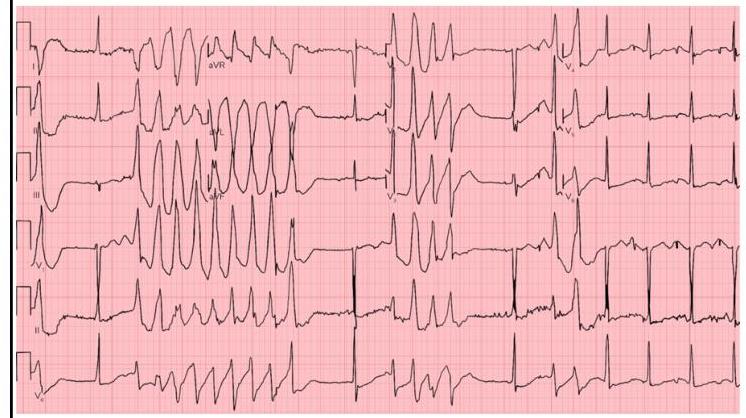
Identify the ECG given below?

Which of the following describes aortic regurgitation murmur?
All of the following are the causes of High output cardiac failure, except?
INI-CET 2023 - Internal Medicine INI-CET Practice Questions and MCQs
Question 11: What is the possible cause of irreversible dementia?
- A. Vitamin B12 deficiency
- B. NPH
- C. Hypothyroid
- D. Lewy body (Correct Answer)
Explanation: ***Lewy body*** - **Lewy body dementia** is a progressive, irreversible neurodegenerative disorder characterized by the abnormal accumulation of **alpha-synuclein proteins** within neurons [1]. - It presents with fluctuating cognition, recurrent visual hallucinations, and spontaneous **parkinsonism**, eventually leading to severe and irreversible cognitive decline [1]. *Vitamin B12 deficiency* - **Vitamin B12 deficiency** can cause cognitive impairment and dementia-like symptoms, but these are often **reversible** with appropriate B12 supplementation [2]. - Symptoms include **anemia**, peripheral neuropathy, and psychiatric changes, which can improve with treatment. *NPH* - **Normal Pressure Hydrocephalus (NPH)** presents with a classic triad of gait disturbance, urinary incontinence, and dementia [2]. - While it causes dementia, it is often **reversible** with surgical placement of a **ventriculoperitoneal shunt** to drain excess CSF [2]. *Hypothyroid* - **Hypothyroidism** can lead to cognitive slowing, memory impairment, and confusion, resembling dementia. - These symptoms are typically **reversible** and improve significantly with **thyroid hormone replacement therapy**.
Question 12: What is the correct order for cardiac auscultation on the left side, from superior to inferior? a. Pulmonary b. Tricuspid c. Mitral
- A. c>b>a (Mitral > Tricuspid > Pulmonary)
- B. a>b>c (Pulmonary > Tricuspid > Mitral) (Correct Answer)
- C. b>a>c (Tricuspid > Pulmonary > Mitral)
- D. c>a>b (Mitral > Pulmonary > Tricuspid)
Explanation: **a>b>c (Pulmonary > Tricuspid > Mitral)** - This order accurately reflects the anatomical positions of the **auscultation points** on the left side of the chest, moving from the superior aspect (second intercostal space) down to the inferior aspect (fifth intercostal space). - The **pulmonary area** is auscultated at the second left intercostal space, the **tricuspid area** at the fourth or fifth left intercostal space near the sternum, and the **mitral (apical) area** at the fifth left intercostal space at the midclavicular line [1]. *c>b>a (Mitral > Tricuspid > Pulmonary)* - This order is incorrect as it places the **mitral area** (inferior) superior to the **tricuspid** and **pulmonary areas**, which contradicts the anatomical arrangement for auscultation. - Auscultating in this sequence would involve moving from an inferior left position upwards, which is not the standard superior-to-inferior left-sided auscultation approach. *b>a>c (Tricuspid > Pulmonary > Mitral)* - This order is incorrect because it places the **tricuspid area** superior to the **pulmonary area**, which is factually wrong. - The **pulmonary area** is at the second left intercostal space, making it superior to the tricuspid area (fourth or fifth left intercostal space) [1]. *c>a>b (Mitral > Pulmonary > Tricuspid)* - This order is incorrect as it incorrectly positions the **mitral area** as the most superior point on the left side, which is anatomically inaccurate for auscultation. - The **pulmonary area** is located more superiorly than both the tricuspid and mitral areas in the standard auscultation sequence [1].
Question 13: Match the following: A) Caplan syndrome- 1) Found first in coal worker B) Asbestosis- 2) Upper lobe predominance C) Mesothelioma- 3) Involves lower lobe D) Sarcoidosis- 4) Pleural effusion is seen
- A. A-3, B-4, C-2, D-1
- B. A-1, B-4, C-3, D-2 (Correct Answer)
- C. A-4, B-2, C-3, D-1
- D. A-2, B-4, C-3, D-1
Explanation: **A-1, B-4, C-3, D-2** - **Caplan syndrome** was first described in **coal workers** with **rheumatoid arthritis** and progressive massive fibrosis. - **Asbestosis** is often associated with **pleural effusion**, which can be benign or malignant. - **Mesothelioma** typically involves the **lower lobes** of the lungs, specifically the pleura, and is strongly linked to asbestos exposure. - **Sarcoidosis** is characterized by **non-caseating granulomas**, which have a predilection for the **upper lobes** of the lungs. *A-3, B-4, C-2, D-1* - This option incorrectly states that Caplan syndrome involves the lower lobe; **Caplan syndrome** is defined by the presence of large nodules in the lungs of coal workers with rheumatoid arthritis, and their specific lobar distribution is not a defining characteristic. - This option incorrectly states that Mesothelioma has an upper lobe predominance; **Mesothelioma** is a pleural malignancy and typically involves the **lower lobes**, extending along the pleura. *A-4, B-2, C-3, D-1* - This option incorrectly associates Caplan syndrome with pleural effusion; **Caplan syndrome** manifests as rheumatoid nodules in the lungs, not primarily pleural effusion. - This option incorrectly states that Asbestosis has an upper lobe predominance; **Asbestosis** predominantly affects the **lower lobes** of the lungs, causing interstitial fibrosis. *A-2, B-4, C-3, D-1* - This option incorrectly states that Caplan syndrome has an upper lobe predominance; the defining feature of **Caplan syndrome** is the combination of rheumatoid arthritis and pneumoconiosis, not specific lobar involvement. - This option correctly identifies pleural effusion with asbestosis and lower lobe involvement with mesothelioma, but **Caplan syndrome** is not characterized by upper lobe predominance.
Question 14: A patient presented with complaints of pain in the flank region with hematuria. On investigation, X-ray shows multiple calcification (stones) in both kidneys. What is the probable diagnosis?
- A. Polycystic kidney disease
- B. Parathyroid Adenoma
- C. Renal calculi (Correct Answer)
- D. CKD
Explanation: ***Renal calculi*** - The presence of **flank pain**, **hematuria**, and **multiple calcifications (stones) in both kidneys** on X-ray directly points to a diagnosis of renal calculi (kidney stones) [1]. - These stones can cause pain due to obstruction and irritation, leading to blood in the urine [1]. *Polycystic kidney disease* - This condition is characterized by the development of numerous **cysts in the kidneys**, which are fluid-filled sacs, not calcifications or stones [2]. - While it can cause flank pain and hematuria, the imaging finding of **multiple calcifications** is inconsistent with typical PCKD presentation [2]. *Parathyroid Adenoma* - A parathyroid adenoma leads to **hyperparathyroidism**, which can cause **hypercalcemia** and subsequently increase the risk of **calcium kidney stones** [1]. - However, the diagnosis directly relates to the presence of stones as seen on X-ray, not the underlying cause of stone formation, and the question does not provide enough information to confirm hyperparathyroidism. *CKD* - **Chronic kidney disease (CKD)** is a progressive loss of kidney function over time, representing a *spectrum* of kidney damage. - While kidney stones can lead to CKD, and CKD can present with various symptoms, the direct finding of **multiple calcifications (stones)** on imaging is a specific indicator of renal calculi rather than CKD itself as the primary diagnosis.
Question 15: KEYNOTE-189 trial for pembrolizumab is done for?
- A. Nivolumab with chemo given for NSCLC
- B. Only Pembrolizumab for NSCLC
- C. Pembrolizumab with chemo given for NSCLC (Correct Answer)
- D. Only nivolumab for NSCLC
Explanation: ***Pembrolizumab with chemo given for NSCLC*** - The **KEYNOTE-189 trial** investigated the efficacy of **pembrolizumab** in combination with chemotherapy as first-line treatment for **metastatic nonsquamous non-small cell lung cancer (NSCLC)**. - This trial demonstrated significant improvements in overall survival and progression-free survival, leading to the approval of pembrolizumab in this setting. *Nivolumab with chemo given for NSCLC* - **Nivolumab** is another PD-1 inhibitor, but studies specifically combining nivolumab with chemotherapy for NSCLC (e.g., CheckMate 227) are distinct from KEYNOTE-189. - While both drugs are used in NSCLC, their pivotal trials and specific combination regimens differ. *Only Pembrolizumab for NSCLC* - Although pembrolizumab monotherapy is approved for certain NSCLC patients with high PD-L1 expression, the **KEYNOTE-189 trial specifically focused on a combination approach** with chemotherapy. - Other KEYNOTE trials, like KEYNOTE-024, evaluated pembrolizumab monotherapy in NSCLC. *Only nivolumab for NSCLC* - **Nivolumab monotherapy** has been studied and approved for NSCLC, particularly in the second-line setting or for patients with high PD-L1 expression, but this was not the focus of the KEYNOTE-189 trial. - Trials like CheckMate 017 and 057 investigated nivolumab as a single agent in NSCLC.
Question 16: Identify the ECG given below?
- A. Viral myocarditis
- B. Torsades de pointes (Correct Answer)
- C. Cardiac tamponade
- D. Pericarditis
Explanation: ***Torsades de pointes*** - The ECG shows a polymorphic ventricular tachycardia where the **QRS complexes appear to twist around the baseline**, a classic feature of Torsades de pointes. - This condition is often associated with **QT prolongation**, which is evident in some of the strips preceding the tachyarrhythmia. *Viral myocarditis* - While viral myocarditis can lead to various ECG abnormalities, it typically doesn't present with this specific **polymorphic ventricular tachycardia** morphology. - Common ECG findings in myocarditis include non-specific ST-T wave changes, sinus tachycardia, or conduction blocks, rather than the characteristic "twisting" pattern seen here. *Cardiac tamponade* - Cardiac tamponade is characterized by **electrical alternans** (alternating QRS amplitude), low voltage, and sinus tachycardia on ECG. - It does not cause a polymorphic ventricular tachycardia with the appearance of QRS complexes twisting around the baseline. *Pericarditis* - Pericarditis typically presents with **diffuse ST-segment elevation** (often concave up) and PR-segment depression. - It does not manifest as a polymorphic ventricular tachycardia like Torsades de pointes.
Question 17: Which of the following describes aortic regurgitation murmur?
- A. Ejection systolic murmur
- B. Diastolic murmur (Correct Answer)
- C. Ventricular contraction
- D. Systolic murmur
Explanation: ***Diastolic murmur*** - Aortic regurgitation occurs when the **aortic valve does not close completely**, leading to blood flowing back into the **left ventricle during diastole** [1]. - This backflow of blood during the **relaxation phase** of the heart creates the characteristic diastolic murmur [1]. *Ejection systolic murmur* - This murmur type is typically heard during **systole** and is associated with conditions like **aortic stenosis**, where there is turbulent flow across a narrowed aortic valve during ejection [3]. - It does not describe the sound of blood flowing back into the ventricle during **diastole**, which characterizes aortic regurgitation. *Ventricular contraction* - **Ventricular contraction** occurs during **systole** and is the mechanism by which blood is ejected from the ventricles [2]. - While related to cardiac cycle, it does not directly describe the timing or nature of the murmur caused by aortic regurgitation. *Systolic murmur* - A **systolic murmur** is heard when the ventricles contract, such as in conditions like **aortic stenosis** or **mitral regurgitation** [3]. - Aortic regurgitation is specifically a **diastolic event** as blood leaks back into the left ventricle during ventricular relaxation [1].
Question 18: All of the following are the causes of High output cardiac failure, except?
- A. Systemic AV shunt
- B. Beri beri
- C. Anemia
- D. Cor pulmonale (Correct Answer)
Explanation: ***Cor pulmonale*** - **Cor pulmonale** is **right-sided heart failure** [1] caused by **pulmonary hypertension**, which is typically a low-output state unless accompanied by other contributing factors. - While it affects cardiac function, it fundamentally involves increased pulmonary vascular resistance leading to ventricular dysfunction, not an increase in **cardiac output**. *Systemic AV shunt* - A **systemic AV shunt** can cause high-output heart failure by diverting a significant volume of blood directly from the arterial to the venous system, bypassing the capillary beds. - This significantly **increases venous return** and **cardiac preload**, requiring the heart to pump more blood to maintain adequate systemic perfusion. *Beri beri* - **Beri-beri heart disease**, caused by severe **thiamine (vitamin B1) deficiency**, leads to high-output cardiac failure due to **peripheral vasodilation**. - This vasodilation markedly **reduces systemic vascular resistance**, increasing venous return and necessitating a higher cardiac output to maintain blood pressure. *Anemia* - **Severe anemia** causes high-output cardiac failure because the reduced oxygen-carrying capacity of the blood forces the heart to significantly **increase cardiac output** to meet the body's metabolic demands. - This compensatory mechanism involves both an **increased heart rate** and **stroke volume** to ensure adequate tissue oxygenation despite lower hemoglobin levels.