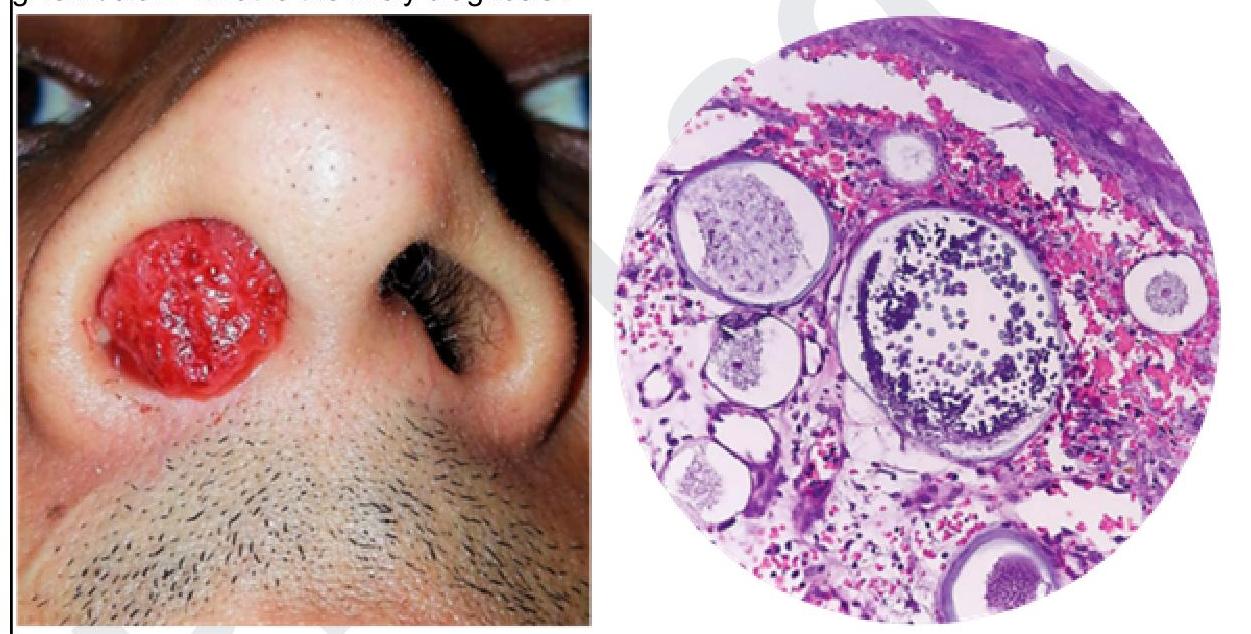
Question 1: A South Indian male farmer presents to the ENT OPD with complaints of reddish mass coming out from the nose as shown in the image below and the histopathology examination is also given below. What is the likely diagnosis?
- A. Nasal polyp
- B. Inverted papilloma
- C. Antrochoanal polyp
- D. Rhinosporidiosis (Correct Answer)
Explanation: **Rhinosporidiosis**
- The image shows a **reddish, friable mass** in the nose, and the histopathology reveals **large sporangia** containing endospores, which are characteristic findings of *Rhinosporidium seeberi*, the causative agent of rhinosporidiosis.
- The patient's demographic (South Indian male farmer) is also consistent, as rhinosporidiosis is **endemic in India and Sri Lanka** and is often associated with exposure to **stagnant water**.
*Nasal polyp*
- Nasal polyps are typically **pale, yellowish-grey, glistening, and translucent** masses, contrasting with the reddish appearance in the image.
- Histologically, they show **edematous stroma** with inflammatory cells but lack the distinct sporangia seen in the provided image.
*Inverted papilloma*
- Inverted papillomas are characterized by **endophytic growth** of squamous or transitional epithelium into the underlying stroma.
- Although they can be reddish, their histopathology shows **inverted papillary projections**, not fragmented sporangia.
*Antrochoanal polyp*
- An antrochoanal polyp typically originates from the **maxillary sinus** and extends into the choana and nasopharynx, which may not be overtly visible as a mass presenting anteriorly in the nostril without further examination.
- Like other nasal polyps, its histological appearance would be **edematous inflammatory tissue** without the parasitic structures seen here.