INI-CET 2023
142 Previous Year Questions with Answers & Explanations
Biochemistry
3 questionsPompe disease is seen due to deficiency of?
Xanthurenic aciduria is seen in which vitamin deficiency?
BARTH syndrome is caused by deficiency of?
INI-CET 2023 - Biochemistry INI-CET Practice Questions and MCQs
Question 1: Pompe disease is seen due to deficiency of?
- A. β-galactocerebrosidase
- B. β-glucocerebrosidase
- C. Lysosomal acid alpha glucosidase (Correct Answer)
- D. β-hexosaminidase-A
Explanation: ***Lysosomal acid alpha glucosidase*** - **Pompe disease**, also known as **glycogen storage disease type II**, is caused by the deficiency of **acid alpha-glucosidase (GAA)**, a lysosomal enzyme. - This deficiency leads to the accumulation of **glycogen** within lysosomes in various tissues, particularly muscle, liver, and heart, causing muscle weakness and cardiomegaly. *β-galactocerebrosidase* - Deficiency of **β-galactocerebrosidase** is associated with **Krabbe disease** (globoid cell leukodystrophy). - Krabbe disease involves the buildup of **galactocerebroside**, leading to progressive destruction of the myelin sheath in the central and peripheral nervous systems. *β-glucocerebrosidase* - Deficiency in **β-glucocerebrosidase** causes **Gaucher disease**, the most common lysosomal storage disorder. - This results in the accumulation of **glucocerebroside** in macrophages, leading to hepatosplenomegaly, bone pain, and neurologic symptoms in some forms. *β-hexosaminidase-A* - Deficiency of **β-hexosaminidase-A** is the underlying cause of **Tay-Sachs disease**. - Tay-Sachs disease is characterized by the accumulation of **GM2 gangliosides** in neurons, leading to progressive neurodegeneration, developmental delay, and a characteristic cherry-red spot in the retina.
Question 2: Xanthurenic aciduria is seen in which vitamin deficiency?
- A. Vitamin B5
- B. Vitamin B12
- C. Vitamin B6 (Correct Answer)
- D. Vitamin B7
Explanation: ***Vitamin B6*** - **Xanthurenic aciduria** is a classic sign of **Vitamin B6 (pyridoxine) deficiency** because B6 is a crucial coenzyme for **kynureninase**, an enzyme in the **tryptophan metabolic pathway**. - Without sufficient B6, tryptophan cannot be properly metabolized, leading to the accumulation and excretion of xanthurenic acid. *Vitamin B5* - **Vitamin B5 (pantothenic acid)** is a precursor to **coenzyme A (CoA)**, essential for fatty acid metabolism and the **Krebs cycle**. - Its deficiency is associated with symptoms like paresthesia and fatigue, not xanthurenic aciduria. *Vitamin B12* - **Vitamin B12 (cobalamin)** is critical for DNA synthesis and the formation of **red blood cells**, and its deficiency causes **megaloblastic anemia** and neurological symptoms. - It plays no direct role in the tryptophan-kynurenine pathway, so its deficiency does not lead to xanthurenic aciduria. *Vitamin B7* - **Vitamin B7 (biotin)** acts as a coenzyme in **carboxylase reactions**, involved in fatty acid synthesis, gluconeogenesis, and amino acid metabolism. - Deficiency can cause dermatitis, hair loss, and neurological issues, but it is not linked to xanthurenic acid accumulation.
Question 3: BARTH syndrome is caused by deficiency of?
- A. Glycolipids
- B. Sphingomyelin
- C. Cardiolipin (Correct Answer)
- D. Cerebroside
Explanation: ***Cardiolipin*** - **BARTH syndrome** is a rare, X-linked genetic disorder caused by mutations in the **TAZ gene**, which encodes for the enzyme **tafazzin**. - **Tafazzin** is crucial for the remodeling of **cardiolipin**, a phospholipid essential for mitochondrial membrane integrity and function. Deficiency of properly remodeled (mature) cardiolipin leads to the characteristic cardiomyopathy, skeletal myopathy, neutropenia, and growth delay seen in BARTH syndrome. *Glycolipids* - **Glycolipids** are lipids with a carbohydrate attached, important for cell recognition and signaling. - Their deficiency or abnormal metabolism is associated with conditions like **glycosphingolipidoses** (e.g., Gaucher disease, Fabry disease), not BARTH syndrome. *Sphingomyelin* - **Sphingomyelin** is a type of sphingolipid found in animal cell membranes, particularly in the myelin sheath. - Its deficiency or accumulation is linked to **Niemann-Pick disease**, which presents with hepatosplenomegaly and neurodegeneration, distinct from BARTH syndrome. *Cerebroside* - **Cerebrosides** are a type of glycosphingolipid found in the myelin sheath and nerve cell membranes. - Disorders involving cerebroside metabolism include **Krabbe disease** (globoid cell leukodystrophy) and **Gaucher disease**, which are pathologically distinct from BARTH syndrome.
Forensic Medicine
1 questionsA girl from the village was found dead in the lake and was taken out. It is a case of ante mortem drowning. All are true about this case except?
INI-CET 2023 - Forensic Medicine INI-CET Practice Questions and MCQs
Question 1: A girl from the village was found dead in the lake and was taken out. It is a case of ante mortem drowning. All are true about this case except?
- A. Froth on nose and mouth
- B. Cadaveric spasm in hand muscle
- C. Washerman hand and finger (Correct Answer)
- D. Water in the stomach
- E. Diatoms test positive
Explanation: ***Washerman hand and finger*** - **Washerman's hand and feet** (cutis anserina) refers to the wrinkled, sodden appearance of skin on the palms and soles due to prolonged immersion in water. - This is a **post-mortem change** that develops after death as a result of water absorption into the skin, typically appearing after **2-3 hours** of immersion. - While it indicates immersion in water, it does **not specifically signify ante-mortem drowning** as it can occur in bodies submerged after death (post-mortem submersion). - This is the **correct answer** to the "except" question as it is not a vital sign of ante-mortem drowning. *Froth on nose and mouth* - **Fine, white, tenacious froth** (mushroom-like foam) at the nose and mouth is a classic sign of **ante-mortem drowning**. - Results from violent mixing of air, mucus, and water in the airways during respiratory efforts while drowning. - This is a **vital sign** indicating the person was alive during submersion. *Cadaveric spasm in hand muscle* - **Cadaveric spasm** (instantaneous rigor mortis) can occur in **ante-mortem drowning** when the victim grasps objects like weeds, mud, or clothes in the final moments before death. - This represents a **vital phenomenon** reflecting a final act of vitality and strongly suggests the person was alive and conscious at the moment of submersion. *Water in the stomach* - Presence of water in the stomach is a common finding in **ante-mortem drowning** as the victim actively swallows water during the struggle and aspiration phase. - Indicates **vital swallowing** during life, supporting the diagnosis of ante-mortem drowning. - Typically, more than **500 mL** of water in stomach suggests ante-mortem drowning.
Microbiology
2 questionsA person handling cat feces is at risk of transmitting an infection. Which of the following is the infective stage of the organism transmitted through cat feces?
A man has undergone renal transplant and is taking immunosuppressant drug. On biopsy there was presence of budding cells with pseudohyphae. Identify the organism?
INI-CET 2023 - Microbiology INI-CET Practice Questions and MCQs
Question 1: A person handling cat feces is at risk of transmitting an infection. Which of the following is the infective stage of the organism transmitted through cat feces?
- A. Bradyzoite
- B. Tachyzoite
- C. Gametocyte
- D. Oocyst (Correct Answer)
Explanation: ***Oocyst*** - The **oocyst** is the infective stage of *Toxoplasma gondii* that is shed in cat feces. - Cats are the definitive host where sexual reproduction occurs in the intestinal epithelium, producing oocysts. - Humans can become infected by ingesting these **oocysts** directly from contaminated cat litter or soil, or indirectly through contaminated food or water. - Oocysts become infective (sporulated) after 1-5 days in the environment. *Bradyzoite* - **Bradyzoites** are slow-growing forms of *Toxoplasma gondii* found within tissue cysts, particularly in muscle and brain tissue. - While they can be infective if undercooked meat containing cysts is consumed, they are not present in cat feces. - This represents a different route of transmission (foodborne via tissue cysts). *Tachyzoite* - **Tachyzoites** are rapidly multiplying forms of *Toxoplasma gondii* responsible for acute infection and tissue damage. - They are found within host cells during active infection and are not shed in cat feces. - They can cross the placenta causing congenital toxoplasmosis. *Gametocyte* - While **gametocytes** (sexual stages) do develop in the cat's intestinal epithelium during *Toxoplasma gondii* reproduction, they are not the stage shed in feces. - The product of sexual reproduction—the **oocyst**—is what gets excreted and serves as the infective stage. - In contrast, gametocytes of *Plasmodium* species remain in blood and are relevant for malaria transmission.
Question 2: A man has undergone renal transplant and is taking immunosuppressant drug. On biopsy there was presence of budding cells with pseudohyphae. Identify the organism?
- A. Invasive candidiasis (Correct Answer)
- B. Pneumocystis
- C. Invasive aspergillosis
- D. Histoplasmosis
Explanation: ***Invasive candidiasis*** - The presence of **budding cells** and **pseudohyphae** on biopsy is a classic histological finding for *Candida* species. - Individuals who have undergone **renal transplant** and are on **immunosuppressant drugs** are at high risk for opportunistic fungal infections, including invasive candidiasis. *Pneumocystis* - *Pneumocystis jirovecii* typically causes pneumonia and is characterized by cysts or trophic forms in lung tissue, not budding cells and pseudohyphae. - While common in immunocompromised patients, its microscopic morphology is distinctly different from *Candida*. *Invasive aspergillosis* - *Aspergillus* species are characterized by **septate hyphae with acute angle branching** (typically 45-degree angles) on microscopy. - They do not form budding cells or pseudohyphae, which are characteristic of *Candida*. *Histoplasmosis* - *Histoplasma capsulatum* appears as **small, oval-shaped yeast cells** (2-4 µm) often found within macrophages. - It does not form pseudohyphae or large budding cells as described in the question.
Ophthalmology
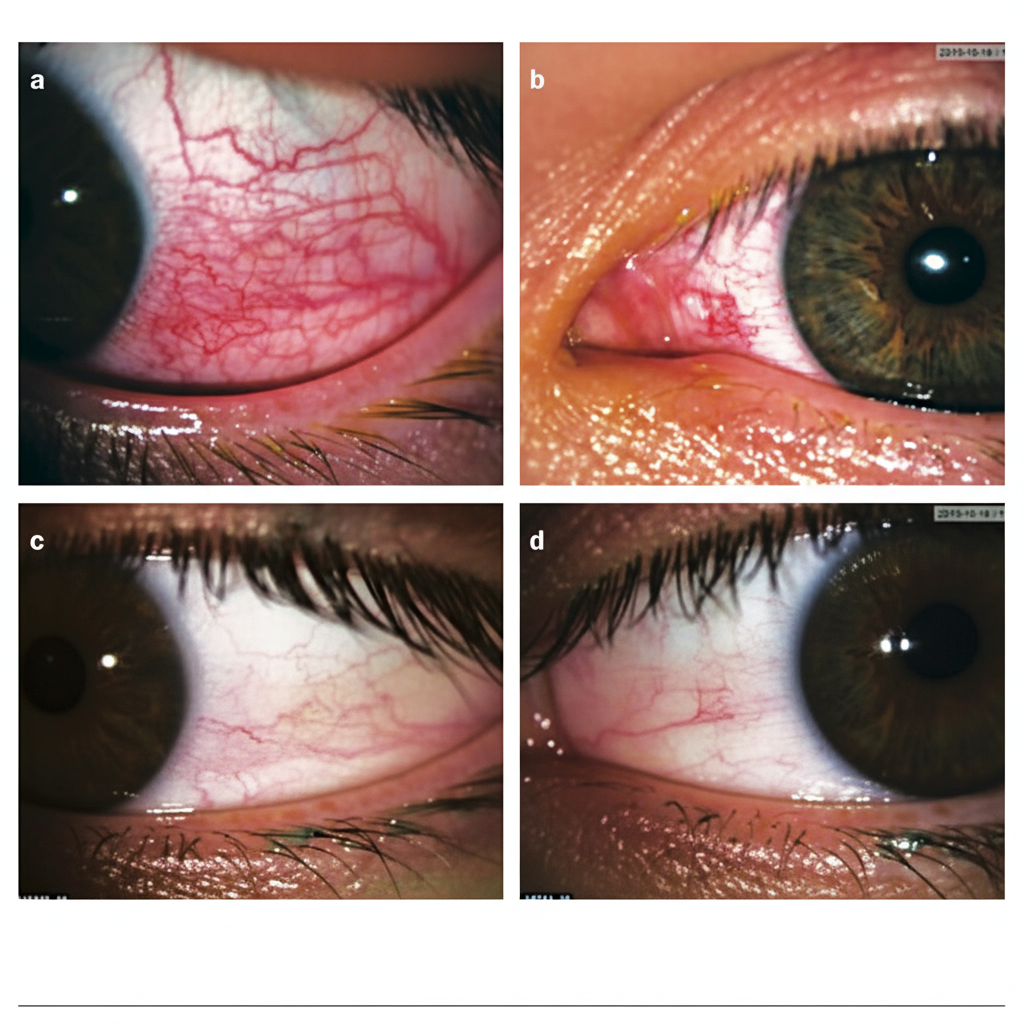
1 questionsThe given image shows blanching of vascularity after the phenylephrine use. What is the likely diagnosis?
INI-CET 2023 - Ophthalmology INI-CET Practice Questions and MCQs
Question 1: The given image shows blanching of vascularity after the phenylephrine use. What is the likely diagnosis?
- A. Nodular scleritis
- B. Nodular episcleritis (Correct Answer)
- C. Conjunctivitis
- D. Anterior uveitis
Explanation: ***Nodular episcleritis*** - The image shows a **nodule** on the episclera with surrounding injection that significantly **blanches** after phenylephrine application, which is characteristic of episcleritis. - Episcleritis involves the **superficial episcleral vessels** which respond to topical vasoconstrictors like **phenylephrine (2.5% or 10%)**, leading to blanching. - This is a benign, self-limiting condition that typically presents with **mild discomfort** rather than severe pain. - The **phenylephrine test** is positive in episcleritis (vessels blanch) and helps differentiate it from scleritis. *Nodular scleritis* - Scleritis involves the **deep scleral vessels** which do NOT blanch with phenylephrine application. - Presents with **severe boring pain** that radiates to the forehead, jaw, and face, often waking the patient at night. - The condition is associated with **systemic autoimmune diseases** in 50% of cases (rheumatoid arthritis, SLE, Wegener's granulomatosis). - Requires **systemic treatment** with NSAIDs or immunosuppressives, unlike episcleritis which is self-limiting. *Conjunctivitis* - Presents with **diffuse conjunctival injection** rather than a localized nodule. - Characterized by **discharge** (purulent, mucopurulent, or watery) and typically no pain. - Vessels blanch with phenylephrine, but the clinical presentation lacks the nodular appearance seen in episcleritis. - Associated with symptoms like **itching, foreign body sensation**, and eyelid matting in morning. *Anterior uveitis* - Presents with **circumcorneal (perilimbal) injection** rather than episcleral nodules. - Characterized by **photophobia, blurred vision**, and cells in the anterior chamber on slit-lamp examination. - The injection pattern is **deep ciliary injection** which does not blanch with phenylephrine. - Associated with **hypopyon** in severe cases and requires urgent treatment to prevent complications.
Pharmacology
1 questionsWhich of the following is true about lithium?
INI-CET 2023 - Pharmacology INI-CET Practice Questions and MCQs
Question 1: Which of the following is true about lithium?
- A. It is also used for treatment of absence seizures
- B. It is not teratogenic
- C. It can cause fine postural tremors at therapeutic dosage (Correct Answer)
- D. It is not absorbed from the gut
Explanation: ***It can cause fine postural tremors at therapeutic dosage*** - **Fine postural tremors** are a common and well-known side effect of lithium, even within its therapeutic range. - This side effect can be dose-dependent and may worsen with higher lithium concentrations. *It is also used for treatment of absence seizures* - Lithium is primarily used as a **mood stabilizer** for bipolar disorder and is not indicated for the treatment of **absence seizures**. - **Absence seizures** are typically treated with drugs like ethosuximide or valproate. *It is not teratogenic* - Lithium is known to be **teratogenic**, especially during the first trimester of pregnancy. - It is associated with an increased risk of **Ebstein's anomaly**, a congenital heart defect. *It is not absorbed from the gut* - Lithium is **rapidly and completely absorbed** from the gastrointestinal tract after oral administration. - Its absorption is not significantly affected by food, and peak plasma concentrations are usually reached within 1-3 hours.
Psychiatry
2 questionsLa belle indifference is seen in?
A patient tells psychiatrist: "My brain is missing. What is the point of me eating anything. I am already dead". The patient has which type of delusion?
INI-CET 2023 - Psychiatry INI-CET Practice Questions and MCQs
Question 1: La belle indifference is seen in?
- A. Depression
- B. Cotard syndrome
- C. Conversion disorder (Correct Answer)
- D. Schizophrenia
Explanation: ***Conversion disorder*** - **La belle indifference** refers to a patient's unconcerned attitude towards their symptoms, which are often dramatic, and is a classic but not pathognomonic feature of conversion disorder. - In **conversion disorder**, psychological stress is "converted" into physical symptoms affecting voluntary motor or sensory function, such as paralysis or blindness, without a neurological explanation. *Depression* - Patients with depression typically exhibit significant **distress** and concern over their symptoms, such as **sadness**, loss of interest, and functional impairment. - The emotional state in depression is characterized by dysphoria and often includes pronounced feelings of **helplessness** and **hopelessness**. *Cotard syndrome* - Is a rare psychiatric disorder characterized by a **nihilistic delusion**, where a person believes they are dead, do not exist, or have lost their organs or blood. - Patients with Cotard syndrome often show severe **anxiety**, **distress**, and sometimes withdrawal, rather than indifference to their bizarre symptoms. *Schizophrenia* - Patients with schizophrenia may display a range of emotional responses, including **flat affect** or **inappropriate affect**, but not typically "la belle indifference." - Their symptoms often include **hallucinations**, **delusions**, and disorganized thought, which usually cause significant impairment and distress, sometimes leading to significant isolation or perceived threats.
Question 2: A patient tells psychiatrist: "My brain is missing. What is the point of me eating anything. I am already dead". The patient has which type of delusion?
- A. Nihilistic delusion (Correct Answer)
- B. Delusion of misidentification
- C. Bizarre Delusion
- D. Hypochondriacal Delusion
Explanation: ***Nihilistic delusion*** - The patient's statements ("**My brain is missing**," "**I am already dead**," "What is the point of me eating anything") are characteristic of **nihilistic delusions**, specifically Cotard's syndrome. - This type of delusion involves a belief in the non-existence of oneself, parts of one's body, or the entire world. *Delusion of misidentification* - This involves a belief that familiar people or objects have been replaced by imposters, or that someone is a different person entirely. - The patient's statements do not describe the misidentification of another person or object. *Bizarre Delusion* - While the statements could be considered bizarre, **bizarre delusions** are defined as clearly implausible, not understandable, and not derived from ordinary life experiences (e.g., aliens implanted a chip in my brain). - Nihilistic delusions, especially in the context of Cotard's syndrome, are a specific subtype of delusion that can be bizarre, but "nihilistic delusion" is a more precise characterization here. *Hypochondriacal Delusion* - This involves a false belief of having a severe disease despite medical reassurance. - While there is a physical component to the delusion ("my brain is missing"), the overarching theme of non-existence and being dead goes beyond a simple preoccupation with illness.
About INI-CET 2023 Questions
This page contains 142 questions from the INI-CET 2023 paper, organised across 18 subjects for focused practice. Every question comes with the correct answer and a detailed explanation to help you understand the underlying concept. Subject-wise organisation lets you target specific areas and identify which topics carried the most weight in this particular year.
Practising year-wise papers is essential for understanding how the INI-CET exam evolves — you can spot trending topics, gauge difficulty shifts, and benchmark your readiness against a real paper. To take your preparation further, download the Oncourse app for AI-driven performance insights, spaced repetition of questions you got wrong, and a personalised study plan built around your INI-CET goals.