Internal Medicine
1 questionsA patient presented with violent, flinging movements. Where is the lesion causing the hemiballismus seen?
INI-CET 2022 - Internal Medicine INI-CET Practice Questions and MCQs
Question 71: A patient presented with violent, flinging movements. Where is the lesion causing the hemiballismus seen?
- A. Putamen
- B. Subthalamic nucleus (Correct Answer)
- C. Globus pallidus
- D. Caudate nucleus
Explanation: ***Subthalamic nucleus*** - **Hemiballismus** is characterized by **violent, flinging movements** of one side of the body, most commonly affecting the proximal limbs [1]. - This involuntary movement disorder is typically caused by a lesion, often an **infarct** or **hemorrhage**, in the **contralateral subthalamic nucleus (STN)** [1]. *Putamen* - Lesions in the **putamen** are more commonly associated with other movement disorders such as **dystonia** or **chorea**. - The putamen is part of the **striatum** and plays a key role in the direct and indirect pathways of the basal ganglia. *Globus pallidus* - Damage to the **globus pallidus (GP)**, particularly the external segment (GPe), can lead to conditions like **dystonia** or contribute to Parkinsonian symptoms depending on the specific region affected [2]. - The globus pallidus is a central component of the **basal ganglia output** to the thalamus. *Caudate nucleus* - Lesions in the **caudate nucleus** are closely linked to **Huntington's disease**, which primarily manifests as **chorea** and cognitive decline [1]. - The caudate nucleus is primarily involved in **cognitive functions** and motor control planning.
Pharmacology
4 questionsWhich among the following drugs is the new FDA approved immune checkpoint inhibitor for endometrial carcinoma?
Identify the correct match, regarding the drug and its adverse effect.
A lady who had undergone mastectomy for breast cancer is being treated with tamoxifen. How long should it be stopped before she can conceive?
A man was brought to the emergency room after poisoning with an unknown substance. Muscarinic poisoning was suspected and he was treated for the same. What is the possible presenting feature which led to the diagnosis?
INI-CET 2022 - Pharmacology INI-CET Practice Questions and MCQs
Question 71: Which among the following drugs is the new FDA approved immune checkpoint inhibitor for endometrial carcinoma?
- A. Ipilimumab
- B. Pembrolizumab (Correct Answer)
- C. Trastuzumab
- D. Nivolumab
Explanation: **Pembrolizumab** * **Pembrolizumab** (Keytruda), a **PD-1 inhibitor**, received accelerated FDA approval for patients with **advanced endometrial carcinoma** that is mismatch repair deficient (dMMR) or microsatellite instability-high (MSI-H), and has progressed following prior systemic therapy or is not a candidate for curative surgery or radiation. * This approval was based on data from the KEYNOTE-158 study, demonstrating **durable responses** in these specific subsets of endometrial cancer, highlighting its role in precision oncology. *Ipilimumab* * **Ipilimumab** (Yervoy) is a **CTLA-4 inhibitor** primarily approved for the treatment of **melanoma** and renal cell carcinoma, often in combination with nivolumab. * While it is an immune checkpoint inhibitor, its primary indications and specific FDA approvals do not include **endometrial carcinoma**. *Trastuzumab* * **Trastuzumab** (Herceptin) is a **monoclonal antibody** that targets the **HER2 protein**, commonly used in the treatment of **HER2-positive breast cancer** and certain types of gastric cancer. * It is not an immune checkpoint inhibitor and its mechanism of action is distinct from blocking immune checkpoints like PD-1 or CTLA-4. *Nivolumab* * **Nivolumab** (Opdivo) is a **PD-1 inhibitor** with broad FDA approvals for various cancers, including melanoma, non-small cell lung cancer, renal cell carcinoma, classical Hodgkin lymphoma, and others. * While a potent immune checkpoint inhibitor, **pembrolizumab** received the specific accelerated approval for advanced endometrial carcinoma in the context described, making it the most direct answer for the "new FDA approved" status in this specific indication.
Question 72: Identify the correct match, regarding the drug and its adverse effect.
- A. Aliskiren - hypokalemia
- B. Hydralazine - heart failure
- C. Atenolol - hemolytic anemia
- D. Verapamil - constipation (Correct Answer)
Explanation: ***Verapamil - Constipation*** - **Verapamil**, a **non-dihydropyridine calcium channel blocker**, frequently causes constipation due to its effect on smooth muscle in the gastrointestinal tract, leading to **decreased intestinal motility**. - This adverse effect is common and often dose-dependent, making it a significant consideration in patient management. *Aliskiren - hypokalemia* - **Aliskiren**, a **direct renin inhibitor**, can cause **hyperkalemia** by reducing angiotensin II levels, which normally stimulate aldosterone secretion. - It does not typically cause hypokalemia; rather, potassium-sparing effects are often observed. *Hydralazine - heart failure* - **Hydralazine** is a **vasodilator** used to treat hypertension and **heart failure** with reduced ejection fraction by reducing afterload. - It does not cause heart failure; instead, it is often prescribed to improve cardiac function in patients with heart failure. *Atenolol - hemolytic anemia* - **Atenolol** is a **beta-blocker** primarily used for hypertension, angina, and arrhythmias. - **Hemolytic anemia** is a rare adverse effect associated with certain drugs, but it is not a known or common side effect of atenolol.
Question 73: A lady who had undergone mastectomy for breast cancer is being treated with tamoxifen. How long should it be stopped before she can conceive?
- A. No need to stop
- B. 3 months (Correct Answer)
- C. Can be stopped and conceived soon after stopping
- D. 1 month
Explanation: ***3 months*** - Tamoxifen has a long half-life, and it can remain in the body for up to several weeks after the last dose. A washout period of **at least 3 months** is recommended to minimize exposure of a developing fetus to the drug. - Exposure to tamoxifen during pregnancy is associated with potential risks such as **birth defects** and impaired fetal development due to its anti-estrogenic effects disrupting hormonal balance. *No need to stop* - This is incorrect because tamoxifen is **teratogenic**, meaning it can cause birth defects if taken during pregnancy. - Continuing tamoxifen during pregnancy would expose the fetus to serious risks, necessitating a planned discontinuation before conception. *Can be stopped and conceived soon after stopping* - This is incorrect because tamoxifen has a relatively **long half-life**, meaning it takes time for the drug to be completely eliminated from the body. - A washout period is necessary to ensure the drug levels are low enough to prevent fetal exposure and potential harm. *1 month* - A 1-month washout period is generally considered **insufficient** given tamoxifen's pharmacokinetic profile. - This shorter period does not adequately account for the drug's long half-life, increasing the risk of fetal exposure and potential complications.
Question 74: A man was brought to the emergency room after poisoning with an unknown substance. Muscarinic poisoning was suspected and he was treated for the same. What is the possible presenting feature which led to the diagnosis?
- A. Diuresis
- B. Bradycardia (Correct Answer)
- C. Mydriasis
- D. Muscle fasciculations
Explanation: ***Bradycardia*** - Muscarinic poisoning stimulates **parasympathetic nervous system** activity, leading to a decrease in heart rate. - This **bradycardia** is a classic sign of excessive muscarinic receptor activation, as seen with organophosphate or carbamate poisoning [1, 2].*Diuresis* - While muscarinic receptor activation can increase bladder detrusor contraction (leading to urinary urgency and frequency) [1, 2], **diuresis** (increased urine production) is not a primary or direct presenting feature of muscarinic poisoning. - Instead, the focus is on incontinence rather than simply increased urine output.*Mydriasis* - **Mydriasis** (pupil dilation) is associated with **anticholinergic poisoning**, which blocks muscarinic receptors. - Muscarinic poisoning, conversely, causes **miosis** (pupil constriction) due to excessive stimulation of muscarinic receptors in the iris sphincter muscle.*Muscle fasciculations* - **Muscle fasciculations** are a characteristic sign of **nicotinic receptor overstimulation**, not muscarinic [1, 3]. - While both nicotinic and muscarinic receptors are activated in organophosphate poisoning, fasciculations point to the **nicotinic effects** at the neuromuscular junction [1, 3].
Physiology
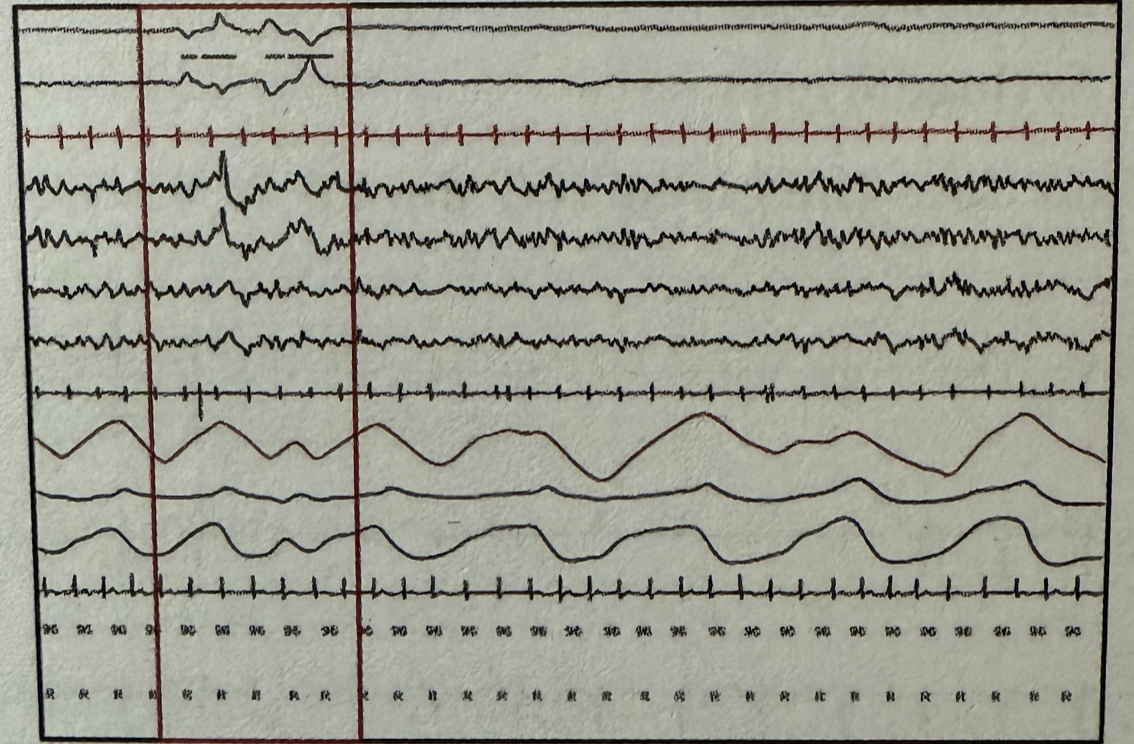
1 questionsDuring polysomnography, which stage of sleep is represented by the marked areas when observing the following wave patterns? EOG (Electrooculography) EEG (Electroencephalography) EMG (Electromyography)

INI-CET 2022 - Physiology INI-CET Practice Questions and MCQs
Question 71: During polysomnography, which stage of sleep is represented by the marked areas when observing the following wave patterns? EOG (Electrooculography) EEG (Electroencephalography) EMG (Electromyography)
- A. REM sleep
- B. NREM I sleep (Correct Answer)
- C. NREM II sleep
- D. NREM III sleep
Explanation: ***NREM I sleep*** - This stage is characterized by a transition from wakefulness to sleep, identifiable by the appearance of **slow eye movements** in the EOG and a reduction in EEG frequency with the presence of **theta waves**. - The EMG shows a decrease in muscle tone but without the complete atonia seen in REM sleep. *REM sleep* - **Rapid eye movements** are characteristic in the EOG, and the EEG shows **low-amplitude, mixed-frequency waves** similar to wakefulness. - The EMG would display profound muscle atonia, which is not evident in the provided tracing. *NREM II sleep* - This stage is marked by the presence of **sleep spindles** and **K-complexes** in the EEG, which are absent in the marked area. - Eye movements are generally absent, and muscle activity continues to be low. *NREM III sleep* - This is the deepest stage of sleep, characterized by **high-amplitude, slow-delta waves** (20-50% of the epoch) in the EEG. - Eye movements are typically absent, and muscle tone is very low but not completely absent.
Psychiatry
3 questionsMatch the following: 1. Kleptomania 2. Pyromania 3. Mutilomania 4. Dipsomania A. Intense desire to drink alcoholic drinks B. Intense desire to mutilate C. Intense desire to steal items of trivial value D. Intense desire to burn things
A 14-year-old girl presented with sudden-onset blindness for the past 4 hours. However, on history taking, it is noted that she is not concerned about it. However, she is concerned that her mother passed away recently and that she should have spent more time with her. Physical examination findings are normal. Which of the following is true about the condition?
A 29 year old lady came to psychiatry OPD with symptoms of hypomania. She has a past history of manic episode. Now, she is planning to conceive. Which drug should be avoided for being highly teratogenic to the fetus?
INI-CET 2022 - Psychiatry INI-CET Practice Questions and MCQs
Question 71: Match the following: 1. Kleptomania 2. Pyromania 3. Mutilomania 4. Dipsomania A. Intense desire to drink alcoholic drinks B. Intense desire to mutilate C. Intense desire to steal items of trivial value D. Intense desire to burn things
- A. 1-C, 2-B, 3-D, 4-A
- B. 1-D, 2-B, 3-A, 4-C
- C. 1-D, 2-C, 3-B, 4-A
- D. 1-C, 2-D, 3-B, 4-A (Correct Answer)
Explanation: **1-C, 2-D, 3-B, 4-A** - **Kleptomania** is characterized by an **irresistible urge to steal objects** that are often of little value and not needed for personal use or monetary gain. - **Pyromania** involves a **preoccupation with fire** and an overwhelming urge to set fires and witness their effects. - **Mutilomania** is a rare impulse control disorder that involves an **intense desire to self-mutilate**. - **Dipsomania** describes an **uncontrollable craving for alcohol**, leading to recurrent bouts of excessive drinking. *1-C, 2-B, 3-D, 4-A* - This option incorrectly matches Pyromania with an intense desire to mutilate and Mutilomania with an intense desire to burn things. - **Pyromania** is specifically about fire, and **Mutilomania** is about self-harm. *1-D, 2-B, 3-A, 4-C* - This option incorrectly matches Kleptomania with the desire to burn things, Pyromania with the desire to mutilate, and Dipsomania with the desire to steal. - The core definitions of these terms are not aligned in this pairing. *1-D, 2-C, 3-B, 4-A* - This option incorrectly matches Kleptomania with the desire to burn things and Pyromania with the desire to steal. - The defining characteristics of these impulse control disorders are mismatched here.
Question 72: A 14-year-old girl presented with sudden-onset blindness for the past 4 hours. However, on history taking, it is noted that she is not concerned about it. However, she is concerned that her mother passed away recently and that she should have spent more time with her. Physical examination findings are normal. Which of the following is true about the condition?
- A. In adults, equally among males and females
- B. In children, it occurs more in females than in males (Correct Answer)
- C. In children, equally among males and females
- D. In adults, it occurs more in males than in females
Explanation: **In children, it occurs more in females than in males** - **Conversion disorders** (functional neurological symptom disorder) are more prevalent in **females** across childhood, adolescence, and adulthood. - The patient's **sudden-onset blindness** without medical cause, coupled with a lack of concern (**la belle indifférence**) and a psychological stressor (mother's death), points to a conversion disorder, which aligns with higher female prevalence in this age group. *In adults, equally among males and females* - This statement is incorrect as conversion disorders, including sudden-onset blindness, are generally more common in **adult females** than males. - The prevalence in adults is not equal; there is a clear gender disparity, with women being more affected. *In children, equally among males and females* - While it can occur in both sexes, the prevalence of conversion disorder in children is not equal; it is observed more frequently in **females**. - Studies consistently report a female-to-male ratio greater than 1 in pediatric populations. *In adults, it occurs more in males than in females* - This statement is incorrect; in adults, conversion disorders are significantly more common in **females**. - The classic presentation, as seen in this case, fits the typical profile observed in female patients experiencing significant psychological distress.
Question 73: A 29 year old lady came to psychiatry OPD with symptoms of hypomania. She has a past history of manic episode. Now, she is planning to conceive. Which drug should be avoided for being highly teratogenic to the fetus?
- A. Oxcarbazepine
- B. Lithium
- C. Olanzapine
- D. Valproate (Correct Answer)
Explanation: ***Valproate*** - **Valproate** is highly **teratogenic** and is associated with multiple birth defects, including **neural tube defects** (e.g., spina bifida), cardiac anomalies, and craniofacial defects. - Due to its significant risks, it is generally **contraindicated** in women of childbearing potential, especially during pregnancy, unless no other suitable alternatives exist. *Oxcarbazepine* - While it has some teratogenic risk (e.g., cleft palate), the risk is generally considered **lower than valproate**. - It is often favored over valproate in pregnant women requiring mood stabilizers, but still requires careful risk-benefit assessment. *Lithium* - **Lithium** is associated with an increased risk of **Ebstein's anomaly**, a specific cardiac defect, if used during the first trimester. - However, the overall risk of major malformations is still **lower than valproate**, and it can be used with careful monitoring if other options are not viable. *Olanzapine* - **Olanzapine** is an **atypical antipsychotic** that can be used as a mood stabilizer and is considered to have a **relatively lower teratogenic risk** compared to anticonvulsants like valproate. - While it's not entirely risk-free (associated with gestational diabetes and fetal growth issues), it's often a safer option in pregnancy for bipolar disorder than valproate.
Surgery
1 questionsIdentify the given bone marrow biopsy instrument

INI-CET 2022 - Surgery INI-CET Practice Questions and MCQs
Question 71: Identify the given bone marrow biopsy instrument
- A. Jamshidi needle (Correct Answer)
- B. Salah needle
- C. Tru-cut needle
- D. Vim Silverman needle
Explanation: ***Jamshidi needle*** - The image displays a **Jamshidi needle**, characterized by its **tapered, beveled tip** designed to facilitate entry into the bone and procure an intact core of bone marrow. - This needle is widely considered the **gold standard** for bone marrow biopsy due to its effectiveness in obtaining high-quality trephine samples. *Salah needle* - A Salah needle is primarily used for **bone marrow aspiration**, not typically for a trephine biopsy, and it has a different design meant for aspirating liquid marrow. - It features a **shorter, sturdier design** with a sharp bevel, optimized for safely extracting marrow fluid. *Tru-cut needle* - The Tru-cut needle is primarily designed for obtaining **soft tissue biopsies** (e.g., liver, kidney, prostate) and is not typically used for bone marrow biopsies. - Its mechanism involves an inner cutting stylet and an outer cutting cannula, which is unsuitable for penetrating dense bone and retrieving a bone core. *Vim Silverman needle* - The Vim Silverman needle is also designed for **soft tissue biopsies**, similar to the Tru-cut, and not specifically for bone marrow. - It utilizes a split needle design to capture tissue, which is not appropriate for obtaining a solid bone marrow core.