Internal Medicine
5 questionsWhich of the following is not a first-line drug for the management of a patient with rheumatoid arthritis?
The following are parvovirus - related disease - population pairs. Identify the incorrect pair. 1. Aplastic anemia - Patient with hereditary hemolytic anemia 2. Non - immune hydrops - pregnant women 3. Erythema infectiosum - infants 4. Non - erosive arthritis - Patients of SLE
Mark the correct statement regarding inflammatory bowel disease.

A person presents to the hospital with fever and chills. Fever profile is ordered and is found to be negative for malaria and dengue. Rk39 test is found to be positive. What is the treatment of choice?
Incorrect statement regarding the management of frostbite:
INI-CET 2022 - Internal Medicine INI-CET Practice Questions and MCQs
Question 51: Which of the following is not a first-line drug for the management of a patient with rheumatoid arthritis?
- A. Hydroxychloroquine
- B. Sulfasalazine
- C. Azathioprine (Correct Answer)
- D. Methotrexate
Explanation: ***Azathioprine*** - While an **immunosuppressant**, azathioprine is generally reserved for patients with **refractory rheumatoid arthritis (RA)** or those who cannot tolerate or have failed first-line DMARDs. - Its use often comes with a higher risk of side effects, making it less suitable as an initial agent compared to other conventional synthetic DMARDs. *Hydroxychloroquine* - This is a **first-line DMARD** for RA, particularly in patients with **mild disease**, due to its relatively favorable safety profile. - It is often used in combination with other DMARDs like methotrexate. *Sulfasalazine* - Sulfasalazine is a common **first-line conventional synthetic DMARD** for RA, especially effective in patients with peripheral arthritis. - It is frequently used when methotrexate is contraindicated or not tolerated, or as part of combination therapy. *Methotrexate* - **Methotrexate is considered the cornerstone** and **first-line treatment** for most patients with rheumatoid arthritis due to its efficacy and tolerability [1]. - It is recommended for early initiation in newly diagnosed patients to prevent joint damage and improve outcomes [2].
Question 52: The following are parvovirus - related disease - population pairs. Identify the incorrect pair. 1. Aplastic anemia - Patient with hereditary hemolytic anemia 2. Non - immune hydrops - pregnant women 3. Erythema infectiosum - infants 4. Non - erosive arthritis - Patients of SLE
- A. 1
- B. 2
- C. 3
- D. 4 (Correct Answer)
Explanation: ***Non - erosive arthritis - Patients of SLE*** - While parvovirus B19 can cause **non-erosive arthritis**, it is not specifically associated with patients with **systemic lupus erythematosus (SLE)** as a common or unique presentation. Parvovirus B19-induced arthritis typically resolves spontaneously. [1] - The given pairing implies a direct and specific link between parvovirus B19 arthritis and SLE patients, which is inaccurate. *Aplastic anemia - Patient with hereditary hemolytic anemia* - This is a **correct pairing**. Parvovirus B19 preferentially infects and destroys erythroid progenitor cells, leading to a temporary cessation of red blood cell production. [1] - In patients with **hereditary hemolytic anemias** (e.g., sickle cell anemia, thalassemia), who have a rapid red blood cell turnover and depend on continuous erythropoiesis, this cessation can lead to a severe and life-threatening **aplastic crisis**. [1] *Non - immune hydrops - pregnant women* - This is a **correct pairing**. Parvovirus B19 infection in a pregnant woman can cross the placenta and infect the fetus. - Fetal infection can cause severe anemia and heart failure, leading to **non-immune hydrops fetalis**, a condition characterized by abnormal fluid accumulation in two or more fetal compartments. *Erythema infectiosum - infants* - This is a **correct pairing**. **Erythema infectiosum**, also known as "fifth disease," is the most common clinical manifestation of parvovirus B19 infection. [1] - It primarily affects **children** (including infants) and is characterized by a "slapped cheek" rash on the face followed by a lacy rash on the trunk and extremities. [1]
Question 53: Mark the correct statement regarding inflammatory bowel disease.
- A. Skip lesions are present in Crohn's disease (Correct Answer)
- B. Inflammatory bowel disease doesn't have a genetic predisposition
- C. Crohn's is curable through surgical resection of the affected segment
- D. Mucosal layers are involved in Crohn's while transmural involvement seen in ulcerative colitis
Explanation: ***Skip lesions are present in Crohn's disease*** - **Skip lesions** refer to the characteristic patchy, discontinuous areas of inflammation seen in **Crohn's disease**, where affected segments of the bowel are separated by healthy areas. - This feature is a key differentiator from ulcerative colitis, which typically exhibits **continuous inflammation**. *Inflammatory bowel disease doesn't have a genetic predisposition* - **Genetic predisposition** plays a significant role in both Crohn's disease and ulcerative colitis, with multiple genes identified that increase susceptibility. - A family history of IBD is a well-established risk factor, indicating its genetic component. *Crohn's is curable through surgical resection of the affected segment* - Crohn's disease is a **chronic, relapsing condition** that can affect any part of the gastrointestinal tract, and while surgery can remove affected segments, it is not curative. - Disease often **recurs in other parts** of the GI tract even after surgical resection. *Mucosal layers are involved in Crohn's while transmural involvement seen in ulcerative colitis* - This statement is incorrect; **Crohn's disease** is characterized by **transmural inflammation** (involving all layers of the bowel wall). - **Ulcerative colitis** primarily affects the **mucosal and submucosal layers** of the large intestine.
Question 54: A person presents to the hospital with fever and chills. Fever profile is ordered and is found to be negative for malaria and dengue. Rk39 test is found to be positive. What is the treatment of choice?
- A. Amphotericin B (Correct Answer)
- B. Dapsone
- C. Hydroxychloroquine
- D. Griseofulvin
Explanation: Amphotericin B - A positive RK39 test suggests visceral leishmaniasis (kala-azar), especially with fever and chills in an endemic area [1]. - Amphotericin B (specifically liposomal Amphotericin B) is a highly effective and often the drug of choice for treating visceral leishmaniasis, particularly in severe cases or regions with antimonial resistance. Dapsone - Dapsone is primarily used in the treatment of leprosy and بعض forms of dermatitis (e.g., dermatitis herpetiformis). - It has no significant role in treating leishmaniasis. Hydroxychloroquine - Hydroxychloroquine is an antimalarial drug also used for certain autoimmune diseases like lupus and rheumatoid arthritis [2]. - It is ineffective against leishmaniasis. Griseofulvin - Griseofulvin is an antifungal medication used to treat dermatophyte infections (e.g., ringworm of the skin, hair, or nails). - It has no activity against Leishmania parasites.
Question 55: Incorrect statement regarding the management of frostbite:
- A. Antibiotics and analgesics not used (Correct Answer)
- B. Amputation in severe cases
- C. Rewarming is done
- D. The area is dried and cleaned
Explanation: ***Antibiotics and analgesics not used*** - This statement is incorrect as **antibiotics are used** in the management of frostbite for prophylaxis against infection, especially in severe cases or open wounds. - **Analgesics are also crucial** to manage the significant pain associated with frostbite and the rewarming process [1]. *Amputation in severe cases* - **Amputation** is a necessary intervention for severe, irreversible tissue damage and necrosis caused by frostbite, typically reserved as a last resort [1]. - This decision is usually made after sufficient time has passed to demarcate viable from non-viable tissue, often several weeks post-injury [1]. *Rewarming is done* - **Rapid rewarming** of the affected area in a warm water bath (37-39°C) is the most critical initial treatment for frostbite to minimize tissue damage. - This process is painful and should be done only when there is no risk of refreezing. *The area is dried and cleaned* - After rewarming, the affected area should be **gently dried** to prevent further skin breakdown and the development of maceration. - **Cleaning the wound** helps prevent infection and maintains a sterile environment for healing.
Microbiology
4 questionsWhich virus can be identified by a PCR method and is endemic to India?
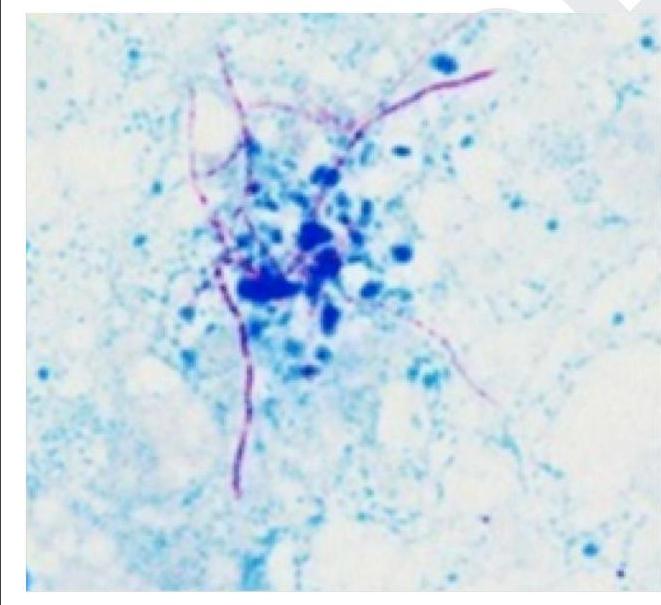
Which of the following is a gram-positive organism that shows the following appearance on Ziehl-Neelsen staining?
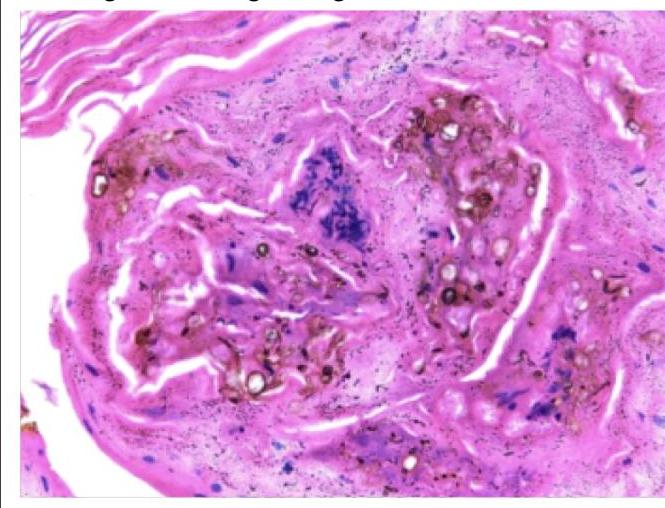
A forest worker developed skin lesions over the forearm, which initially started as macules but then became nodules. Histology of the nodule shows the following findings. Which of the following is true regarding this condition?
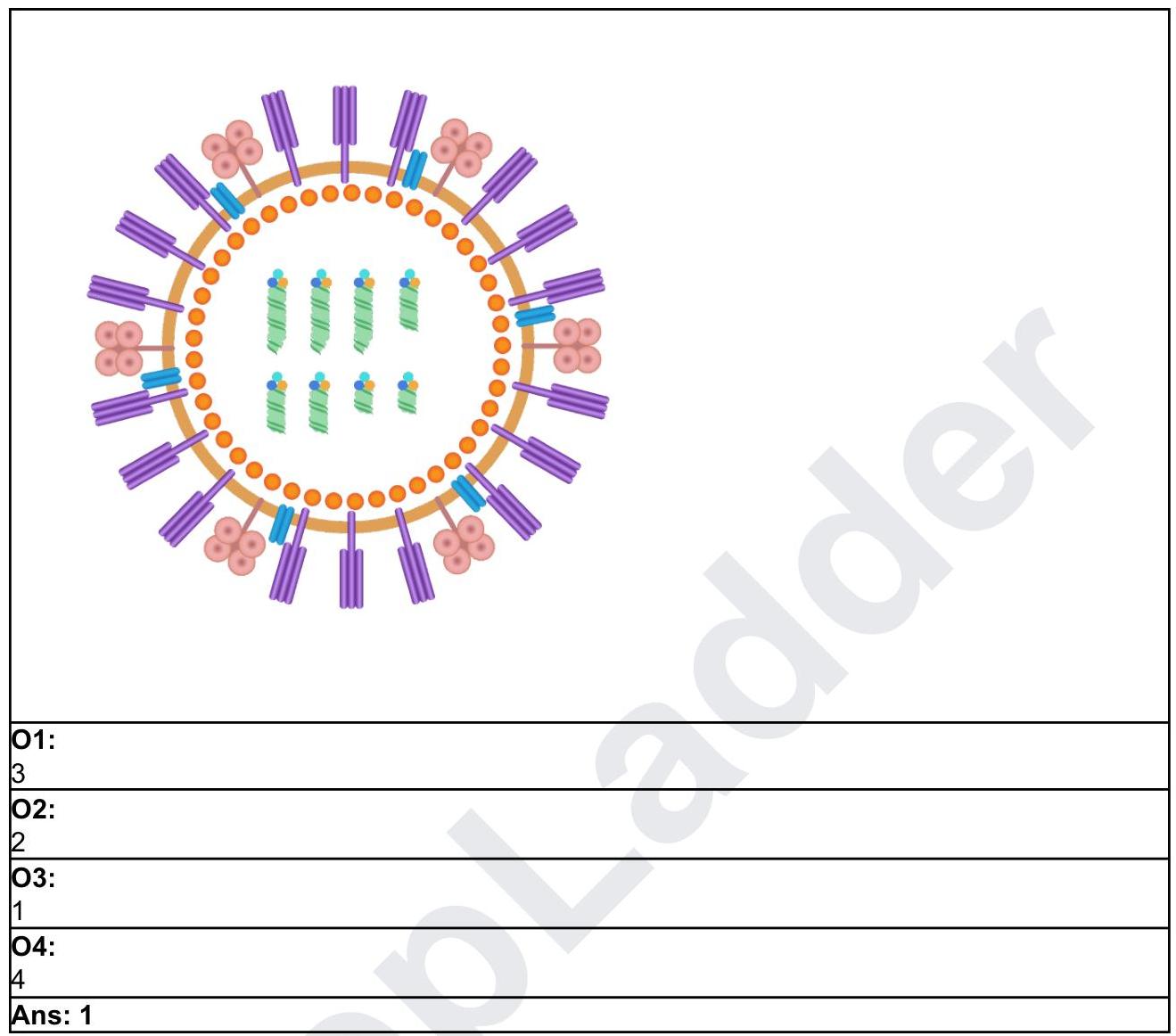
The viruses of the Filoviridae family like Ebola and Marburg resemble which of the following morphologies?
INI-CET 2022 - Microbiology INI-CET Practice Questions and MCQs
Question 51: Which virus can be identified by a PCR method and is endemic to India?
- A. Chikungunya virus (Correct Answer)
- B. Ebola virus
- C. Yellow fever
- D. Hendra virus
Explanation: ***Chikungunya virus*** - The **Chikungunya virus** is a mosquito-borne alphavirus that causes fever, severe joint pain, and rash, and is **endemic to India** and other tropical regions. - Diagnosis is commonly confirmed using **PCR** (polymerase chain reaction) to detect viral RNA in acute samples. *Ebola virus* - The **Ebola virus** causes severe hemorrhagic fever and is primarily prevalent in **Sub-Saharan Africa**, not endemic to India. - While it can be detected by **PCR**, its geographical distribution does not match the endemic criteria for India. *Yellow fever* - **Yellow fever virus** is transmitted by mosquitoes and is endemic to **tropical and subtropical areas of South America and Africa**. - India is not considered an endemic area for yellow fever, though it can be detected by **PCR**. *Hendra virus* - The **Hendra virus** is a zoonotic virus primarily found in **Australia**, transmitted from bats to horses and then to humans. - It is not endemic to India and thus does not fit the criteria of the question.
Question 52: Which of the following is a gram-positive organism that shows the following appearance on Ziehl-Neelsen staining?
- A. Nocardia (Correct Answer)
- B. Mycobacterium tuberculosis
- C. Actinomyces
- D. Rhodococcus
Explanation: ***Nocardia*** * The image displays delicate, branching, **filamentous rods** that are stained **red/pink** against a blue background, which is characteristic of partially acid-fast organisms like *Nocardia* on a Ziehl-Neelsen stain. * *Nocardia* species are **gram-positive**, aerobic bacteria that can cause opportunistic infections, particularly in immunocompromised individuals. They are distinguished by their **partial acid-fastness** due to their mycolic acid content, similar to mycobacteria but to a lesser degree. * The characteristic **branching filamentous morphology** combined with partial acid-fastness on Ziehl-Neelsen staining is pathognomonic for *Nocardia*. *Incorrect: Mycobacterium tuberculosis* * While *M. tuberculosis* is **strongly acid-fast** on Ziehl-Neelsen staining (appearing red), it is **not truly gram-positive**—it is gram-variable or weakly gram-positive. * *Mycobacterium* appears as **straight or slightly curved rods**, NOT branching filaments like those shown in the image. *Incorrect: Actinomyces* * *Actinomyces* is a **gram-positive**, filamentous, branching organism that can morphologically resemble *Nocardia*. * However, *Actinomyces* is **NOT acid-fast** and would appear **blue** (not red/pink) on Ziehl-Neelsen staining as it takes up the counterstain. * *Actinomyces* is also anaerobic, whereas *Nocardia* is aerobic. *Incorrect: Rhodococcus* * *Rhodococcus* is a gram-positive organism that can show **partial acid-fastness**, similar to *Nocardia*. * However, *Rhodococcus* typically appears as **coccoid to short rods**, occasionally forming short chains, but does NOT show the extensive **branching filamentous** pattern characteristic of *Nocardia* seen in the image.
Question 53: A forest worker developed skin lesions over the forearm, which initially started as macules but then became nodules. Histology of the nodule shows the following findings. Which of the following is true regarding this condition?
- A. Angioinvasion is common especially in people with hemolytic anemia
- B. These bodies are formed by engulfment of the dead fungi by the macrophages
- C. It is a dematiaceous fungus (Correct Answer)
- D. Infection commonly spreads to involve tendon, muscle and bone
Explanation: The image displays **chromoblastomycosis**, a fungal infection characterized by **medlar bodies** or **sclerotic bodies**. These are thick-walled, septate, dematiaceous (pigmented) fungal cells that resemble copper pennies. The patient's history of being a forest worker with skin lesions progressing from macules to nodules is consistent with this diagnosis as it's often associated with **traumatic inoculation** from contaminated plant material. ***It is a dematiaceous fungus*** - The image shows **"copper pennies"** or **sclerotic bodies**, which are characteristic of dematiaceous (pigmented) fungi causing chromoblastomycosis. - These fungi contain **melanin** in their cell walls, which contributes to their characteristic dark appearance. - Common causative agents include *Fonsecaea pedrosoi*, *Phialophora verrucosa*, and *Cladophialophora carrionii*. *Angioinvasion is common especially in people with hemolytic anemia* - **Angioinvasion** is not a feature of chromoblastomycosis, which typically remains confined to the **skin and subcutaneous tissue**. - Angioinvasion is characteristic of **mucormycosis** and **aspergillosis**, particularly in immunocompromised patients, not chromoblastomycosis. *These bodies are formed by engulfment of the dead fungi by the macrophages* - The **sclerotic bodies** are **living fungal cells** in their tissue-specific form, not dead fungi engulfed by macrophages. - They are a distinct morphological form of the fungus, adapting to growth within the host tissue, and are **actively pathogenic**. - These thick-walled structures allow the fungus to persist in tissue and resist host defenses. *Infection commonly spreads to involve tendon, muscle and bone* - Chromoblastomycosis causes **chronic, localized infections** primarily of the **skin and subcutaneous tissue**. - While local tissue destruction can occur, **deep invasion** into tendons, muscles, or bones is **rare** and occurs only in severe, long-standing cases. - The infection typically remains confined to cutaneous and subcutaneous layers without dissemination.
Question 54: The viruses of the Filoviridae family like Ebola and Marburg resemble which of the following morphologies?
- A. Brick shaped
- B. Bullet shaped
- C. Spherical
- D. Filamentous (Correct Answer)
Explanation: ***Filamentous*** - Viruses in the **Filoviridae family**, including **Ebola** and **Marburg**, are characterized by their distinct **long, filamentous shape**. - This morphology is a key distinguishing feature visible under electron microscopy, contributing to their namesake ("filo" meaning "thread-like"). *Brick shaped* - **Brick-shaped morphology** is characteristic of **Poxviridae**, such as the **variola virus** (smallpox). - This shape is distinctly different from the thread-like structure of filoviruses. *Bullet shaped* - **Bullet-shaped viruses** are typical of the **Rhabdoviridae family**, which includes the **rabies virus**. - This shape is consistent and easily recognizable for this family, contrasting with the much longer and flexible filaments of filoviruses. *Spherical* - **Spherical morphology** is common among many virus families, including **influenza virus** (Orthomyxoviridae) and **human immunodeficiency virus (HIV)** (Retroviridae). - While many viruses are roughly spherical, filoviruses are specifically known for their elongated, non-spherical appearance.
Pharmacology
1 questionsWhich of the following drugs is not used for the emergency (immediate) management of hyperkalaemia?
INI-CET 2022 - Pharmacology INI-CET Practice Questions and MCQs
Question 51: Which of the following drugs is not used for the emergency (immediate) management of hyperkalaemia?
- A. 10% calcium gluconate over 10 min
- B. Insulin-dextrose
- C. Injection MgSO4 (Correct Answer)
- D. Salbutamol nebulisation
Explanation: ***Injection MgSO4*** - Magnesium sulfate is not a direct treatment for hyperkalaemia; its primary use is for conditions like **eclampsia**, **asthma exacerbations**, or **torsades de pointes**. - It does not directly affect potassium levels or cardiac membrane stability in the context of hyperkalaemia. *10% calcium gluconate over 10 min* - **Calcium gluconate** is used for immediate cardioprotection in hyperkalaemia by stabilizing the **cardiac membrane**, thereby reducing the risk of arrhythmias. - It does not lower serum potassium levels but mitigates the dangerous cardiac effects. *Insulin-dextrose* - This combination is an effective treatment for hyperkalaemia as **insulin** drives potassium from the extracellular to the intracellular space. - **Dextrose** is administered concurrently to prevent hypoglycaemia induced by insulin. *Salbutamol nebulisation* - **Beta-2 agonists** like salbutamol promote the uptake of potassium into cells, thus lowering serum potassium levels. - While effective, its action is generally less rapid and potent than insulin-dextrose or calcium gluconate in severe cases.