Dermatology
4 questionsA 12-week pregnant woman on multidrug therapy for leprosy presents with type 2 lepra reaction. What is the treatment of choice for this patient?
Match the following scale types with their lesions. | Scales | Lesions | | :-- | :-- | | 1. Collarette scales | a. Pityriasis versicolour | | 2. Silvery scales | b. Pityriasis rosea | | 3. Mica-like scales | c. Psoriasis | | 4. Branny scales | d. Pityriasis lichenoides |
A 60-year-old patient presents with unilateral vesicular lesions in a dermatomal distribution on the torso. The lesions are painful and appeared over the past 2-3 days, progressing from erythematous patches to fluid-filled vesicles. The patient reports prodromal burning and tingling sensation in the affected area. Which of the following is the most likely diagnosis?
Consider the following causes of alopecia: 1. Androgenetic alopecia 2. Alopecia areata 3. Telogen effluvium 4. Lichen planopilaris. Which among the following causes non-scarring alopecia?
INI-CET 2022 - Dermatology INI-CET Practice Questions and MCQs
Question 41: A 12-week pregnant woman on multidrug therapy for leprosy presents with type 2 lepra reaction. What is the treatment of choice for this patient?
- A. Continue MDT and add oral steroids (Correct Answer)
- B. Antibiotics
- C. Stop MDT and start oral steroids
- D. Thalidomide
Explanation: ***Continue MDT and add oral steroids*** - **Type 2 lepra reactions (erythema nodosum leprosum)** are inflammatory complications of leprosy and require systemic anti-inflammatory treatment. **Oral corticosteroids** are the mainstay for managing these reactions, particularly in pregnant patients where other immunomodulators are contraindicated. - **Multidrug therapy (MDT)** for leprosy should be continued throughout the reaction, even during pregnancy, to ensure eradication of <b>*Mycobacterium leprae*</b> and prevent drug resistance. Interrupting MDT can lead to relapse and increased neurological damage. *Antibiotics* - This option is incorrect because the type 2 lepra reaction is an **immunological complication** of leprosy, not a bacterial infection requiring additional antibiotics beyond the standard MDT. - The symptoms are due to the immune system's response to dying bacteria, not a new or secondary bacterial infection. *Stop MDT and start oral steroids* - Stopping MDT is inappropriate as the underlying **leprosy infection** still needs to be treated to prevent further progression and drug resistance. - While steroids are crucial for managing the reaction, stopping MDT would compromise the **curative treatment** for leprosy. *Thalidomide* - **Thalidomide** is highly effective in treating **erythema nodosum leprosum (ENL)**. - However, it is an absolute **contraindication** during pregnancy due to its severe **teratogenicity**, causing severe birth defects.
Question 42: Match the following scale types with their lesions. | Scales | Lesions | | :-- | :-- | | 1. Collarette scales | a. Pityriasis versicolour | | 2. Silvery scales | b. Pityriasis rosea | | 3. Mica-like scales | c. Psoriasis | | 4. Branny scales | d. Pityriasis lichenoides |
- A. 1-d, 2-c, 3-a, 4-b
- B. 1-c, 2-b, 3-d, 4-a
- C. 1-a, 2-b, 3-d, 4-c
- D. 1-b, 2-c, 3-d, 4-a (Correct Answer)
Explanation: ***1-b, 2-c, 3-d, 4-a*** - **Collarette scales** are pathognomonic of **Pityriasis rosea**, appearing as fine, trailing scales around the periphery of oval lesions in a "Christmas tree" distribution. - **Silvery scales** are the classic hallmark of **Psoriasis**, presenting as thick, adherent, silvery-white scales overlying well-demarcated erythematous plaques. - **Mica-like scales** are characteristic of **Pityriasis lichenoides**, appearing as thick, shiny, adherent scales that can be peeled off like mica sheets. - **Branny scales** are typical of **Pityriasis versicolor**, presenting as fine, powdery scales caused by **Malassezia** yeast overgrowth. *1-d, 2-c, 3-a, 4-b* - Incorrectly matches **collarette scales with Pityriasis lichenoides**, which typically presents with mica-like scales, not collarette scales. - Misassociates **mica-like scales with Pityriasis versicolor**, which characteristically has branny (fine, powdery) scales. *1-c, 2-b, 3-d, 4-a* - Wrongly pairs **collarette scales with Psoriasis**, which is known for thick silvery scales, not peripheral collarette scales. - Incorrectly matches **silvery scales with Pityriasis rosea**, which has collarette scales at lesion periphery, not silvery scales. *1-a, 2-b, 3-d, 4-c* - Falsely associates **collarette scales with Pityriasis versicolor**, which has branny scales from yeast infection, not collarette scales. - Mismatches **branny scales with Psoriasis**, which has characteristic thick silvery scales, not fine powdery scales.
Question 43: A 60-year-old patient presents with unilateral vesicular lesions in a dermatomal distribution on the torso. The lesions are painful and appeared over the past 2-3 days, progressing from erythematous patches to fluid-filled vesicles. The patient reports prodromal burning and tingling sensation in the affected area. Which of the following is the most likely diagnosis?
- A. Herpes zoster infection (Correct Answer)
- B. Irritant contact dermatitis
- C. Allergic contact dermatitis
- D. Herpes Simplex Infection
Explanation: ***Herpes zoster infection*** - The patient's presentation of **unilateral vesicular lesions** in a **dermatomal distribution**, accompanied by severe pain and a **prodromal burning and tingling sensation**, is classic for herpes zoster (shingles). - Herpes zoster results from the **reactivation of latent varicella-zoster virus (VZV)** in a sensory ganglion, leading to painful rash along the affected nerve path. *Irritant contact dermatitis* - This condition involves inflammation due to direct contact with an irritating substance, often presenting with **eczematous lesions**, redness, itching, and sometimes vesicles. - However, it typically lacks the characteristic **dermatomal distribution** and severe neuropathic pain seen in herpes zoster. *Allergic contact dermatitis* - Allergic contact dermatitis is an immune-mediated reaction to an allergen, causing intensely pruritic, erythematous, and often **vesicular or bullous eruptions** that tend to spread beyond the initial contact area over time. - While it can cause vesicles, it does not follow a **dermatomal pattern** and is usually very itchy, rather than primarily painful and burning, with a distinct prodrome. *Herpes Simplex Infection* - Herpes simplex virus (HSV) infections also cause **vesicular lesions** but typically present as clusters of vesicles on an **erythematous base** in a localized area, often around the mouth (cold sores) or genitals. - Unlike herpes zoster, HSV lesions are usually **recurrent** in the same small area and typically do not exhibit a widespread, **unilateral dermatomal pattern** or the associated severe, persistent neuropathic pain.
Question 44: Consider the following causes of alopecia: 1. Androgenetic alopecia 2. Alopecia areata 3. Telogen effluvium 4. Lichen planopilaris. Which among the following causes non-scarring alopecia?
- A. 1, 2 and 3 (Correct Answer)
- B. Only 4
- C. 3 and 4
- D. 2, 3 and 4
Explanation: **1, 2, and 3** - **Androgenetic alopecia**, **alopecia areata**, and **telogen effluvium** are all forms of **non-scarring alopecia**, meaning the hair follicles are primarily affected without permanent destruction. - In these conditions, there is potential for hair regrowth as the follicular structures remain intact. *Only 4* - **Lichen planopilaris** is a type of **scarring alopecia**, characterized by permanent destruction of hair follicles and replacement with fibrous tissue. - This leads to irreversible hair loss in the affected areas. *3 and 4* - While **telogen effluvium** causes non-scarring alopecia, **lichen planopilaris** is a scarring alopecia. - Therefore, this option incorrectly groups a non-scarring and a scarring condition. *2, 3, and 4* - This option correctly identifies **alopecia areata** and **telogen effluvium** as non-scarring but incorrectly includes **lichen planopilaris**, which results in scarring alopecia. - **Lichen planopilaris** has inflammatory infiltrates that lead to permanent follicular damage.
Internal Medicine
1 questionsA diabetic patient's fasting blood glucose level is found to be $160 \mathrm{mg} / \mathrm{dL}$. What will you advise the patient regarding non-pharmacological management?
INI-CET 2022 - Internal Medicine INI-CET Practice Questions and MCQs
Question 41: A diabetic patient's fasting blood glucose level is found to be $160 \mathrm{mg} / \mathrm{dL}$. What will you advise the patient regarding non-pharmacological management?
- A. At least 25-35 g of dietary fibre
- B. <30 % of the calories should come from fat (Correct Answer)
- C. Dietary cholesterol <300 mg per day
- D. <2.3 g sodium intake every day
Explanation: ***<30 % of the calories should come from fat*** - Reducing dietary fat intake to less than 30% of total calories is a crucial non-pharmacological strategy for diabetic patients to manage blood glucose levels and prevent cardiovascular complications [1]. - Excess dietary fat, especially saturated and trans fats, can contribute to insulin resistance and weight gain, both of which negatively impact glycemic control [1]. *At least 25-35 g of dietary fibre* - While adequate dietary fiber (typically 25-30g for adults, sometimes up to 35g for men) is beneficial for managing blood glucose, it is generally recommended as a baseline for healthy eating and not the primary or most impactful intervention to address a fasting glucose of 160 mg/dL [1]. - Fiber helps slow glucose absorption and can improve insulin sensitivity, but a specific "at least 25-35g" statement without further context on total caloric intake or other macronutrient distribution might not be the most targeted advice for this specific glucose level [1]. *Dietary cholesterol <300 mg per day* - Limiting dietary cholesterol to less than 300 mg per day is a general recommendation for cardiovascular health, which is particularly important for diabetic patients due to their increased risk of atherosclerosis [2]. - However, for directly addressing a fasting blood glucose of 160 mg/dL, focusing on overall fat intake and carbohydrate quality would have a more immediate impact on glucose control than dietary cholesterol alone. *<2.3 g sodium intake every day* - Restricting sodium intake to less than 2.3 g per day is recommended for managing hypertension and reducing cardiovascular risk, which is often comorbid with diabetes [2]. - While important for overall health in diabetic patients, this recommendation does not directly target blood glucose control and would not be the primary non-pharmacological advice for a fasting glucose of 160 mg/dL.
Microbiology
3 questionsWhich of the following statements regarding the given image is correct?
Which of the following are acid-fast staining organisms? 1. Nocardia 2. Mycobacterium leprae 3. Actinomyces 4. Cryptosporidium parvum 5. Isospora belli
A young man presents with skin lesions as shown in the image below. All of the following organisms can spread through dermal and subcutaneous lymphatics, except

INI-CET 2022 - Microbiology INI-CET Practice Questions and MCQs
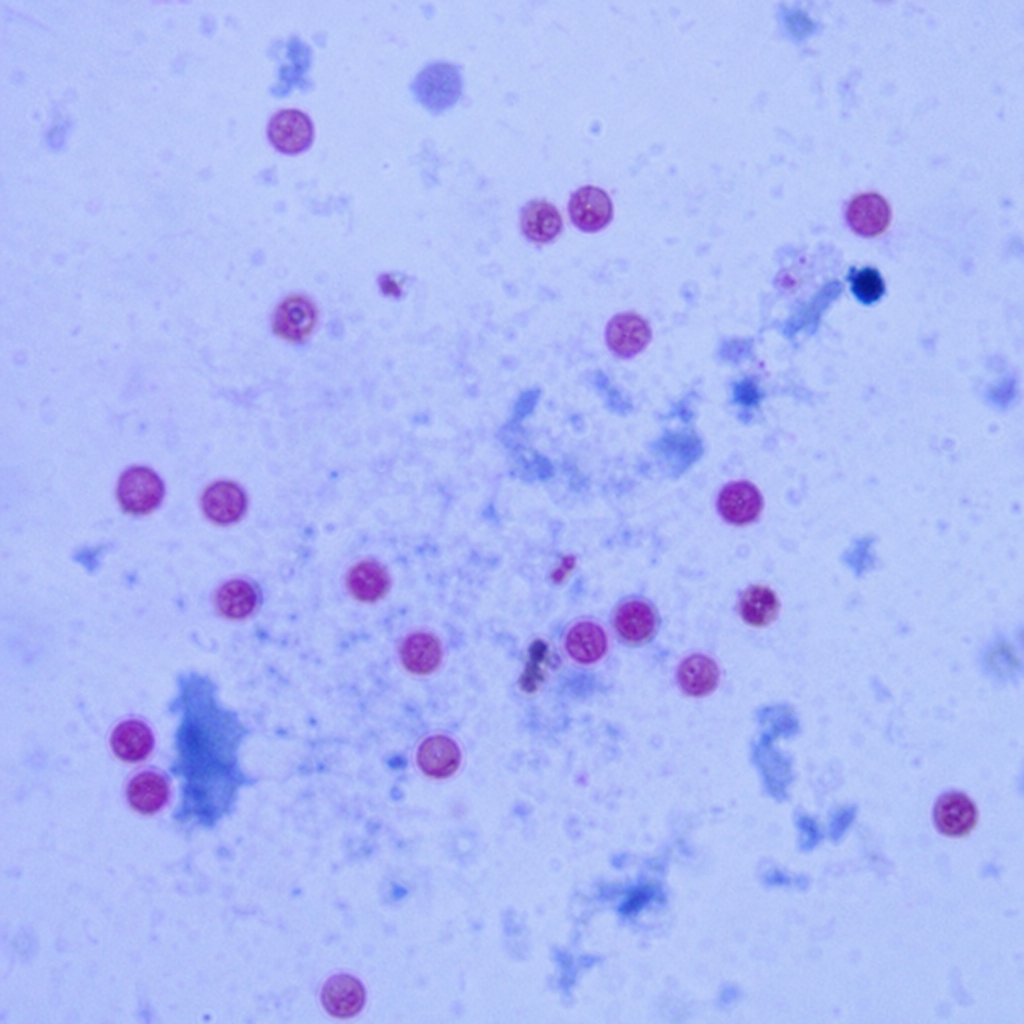
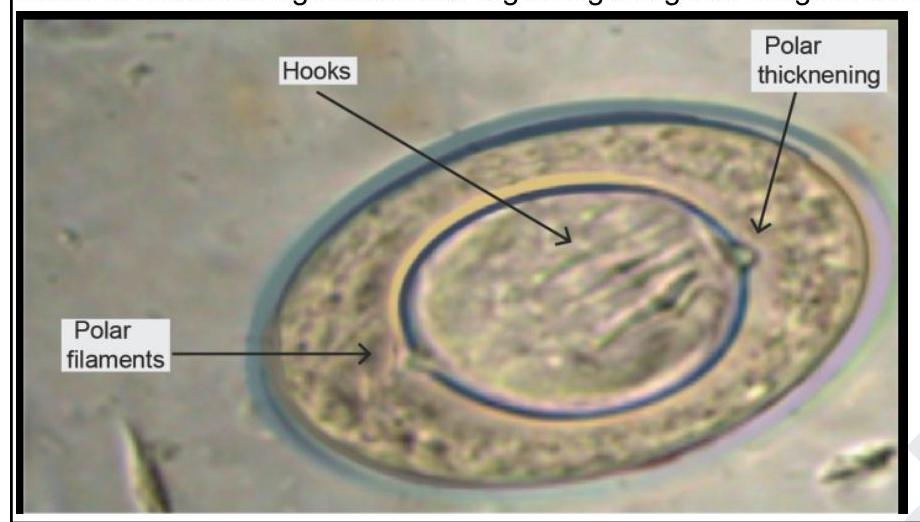
Question 41: Which of the following statements regarding the given image is correct?
- A. Albendazole is the drug of choice
- B. Infection is acquired by ingestion of undercooked freshwater fish
- C. It is the largest tapeworm infecting humans
- D. Majority of infections are asymptomatic in humans (Correct Answer)
Explanation: ***Majority of infections are asymptomatic in humans*** - The image depicts an egg of *Hymenolepis nana*, also known as the **dwarf tapeworm**, identifiable by its characteristic **polar filaments** and **polar thickenings** on the inner membrane. - While heavy infections can cause symptoms, most *Hymenolepis nana* infections are **asymptomatic** or present with only mild, nonspecific gastrointestinal complaints. *Infection is acquired by ingestion of undercooked freshwater fish* - Infection with *Hymenolepis nana* is typically acquired through the **ingestion of eggs** directly from contaminated food or water, or via **fecally-contaminated hands**. - Ingestion of undercooked freshwater fish is associated with trematode (fluke) infections like **Clonorchis sinensis** or **Opisthorchis viverrini**, not *Hymenolepis nana*. *Albendazole is the drug of choice* - The drug of choice for *Hymenolepis nana* infection is **Praziquantel**, given as a single dose. - While albendazole might be used for some helminth infections, it is **less effective** than praziquantel for *Hymenolepis nana*. *It is the largest tapeworm infecting humans* - *Hymenolepis nana* is known as the **dwarf tapeworm** and is generally the **smallest tapeworm** that infects humans, typically measuring a few centimeters in length. - The largest tapeworm infecting humans is *Diphyllobothrium latum* (fish tapeworm), which can reach lengths of several meters.
Question 42: Which of the following are acid-fast staining organisms? 1. Nocardia 2. Mycobacterium leprae 3. Actinomyces 4. Cryptosporidium parvum 5. Isospora belli
- A. 1,2,3
- B. 1,2,3,4,5
- C. 1,2,4,5 (Correct Answer)
- D. 3,4,5
Explanation: ***1,2,4,5*** - **Nocardia**, **Mycobacterium leprae**, **Cryptosporidium parvum**, and **Isospora belli** all exhibit acid-fast properties, meaning they retain carbolfuchsin stain even after decolorization with acid alcohol due to the presence of mycolic acid in their cell walls or unique cyst structures. - This characteristic is crucial for their identification in clinical microbiology and distinguishes them from many other microorganisms. *1,2,3* - This option incorrectly includes **Actinomyces** as an acid-fast organism. **Actinomyces** are Gram-positive, filamentous bacteria that are **not acid-fast**. - While Nocardia and Mycobacterium leprae are acid-fast, the inclusion of Actinomyces makes this choice incorrect. *1,2,3,4,5* - This option is incorrect because it includes **Actinomyces** as an acid-fast organism, which is not true. - **Actinomyces** are Gram-positive, non-acid-fast bacteria, differentiating them from the other listed organisms that do possess acid-fast properties. *3,4,5* - This option is incorrect because it excludes **Nocardia** and **Mycobacterium leprae**, both of which are prominent acid-fast organisms. - While Cryptosporidium parvum and Isospora belli are acid-fast, the omission of Nocardia and Mycobacterium leprae makes this answer incomplete and incorrect.
Question 43: A young man presents with skin lesions as shown in the image below. All of the following organisms can spread through dermal and subcutaneous lymphatics, except
- A. Sporothrix schenckii
- B. Staphylococcus aureus (Correct Answer)
- C. Nocardia asteroides
- D. Mycobacterium marinum
Explanation: ***Staphylococcus aureus*** - While *Staphylococcus aureus* can cause various skin infections, it primarily spreads through **direct extension** or the **bloodstream**, not typically through the dermal and subcutaneous lymphatics in a pattern like the one shown. - Infections like cellulitis, abscesses, and impetigo caused by *Staphylococcus aureus* are usually localized or spread via contiguous tissue, rather than forming **linear nodular lesions** along lymphatic channels. *Sporothrix schenckii* - This fungus is a classic cause of **sporotrichosis**, which often presents with **lymphocutaneous spread** following traumatic inoculation. - The image shows **linearly arranged subcutaneous nodules** proximally along the arm, characteristic of lymphatic dissemination, often seen in sporotrichosis. *Nocardia asteroides* - **Nocardia infections** can also cause **lymphocutaneous disease** with a similar appearance to sporotrichosis, especially in immunocompromised individuals. - It can lead to a **chain of subcutaneous nodules and abscesses** tracking along lymphatic vessels from the initial site of infection. *Mycobacterium marinum* - **Mycobacterium marinum** causes **fish tank granuloma** or **swimming pool granuloma** following skin trauma in contaminated water. - It characteristically produces **ascending lymphocutaneous nodules** along lymphatic channels, similar to sporotrichosis, creating a **sporotrichoid pattern**. - The infection typically starts as a papule at the inoculation site and spreads proximally along lymphatics.
Pathology
1 questionsThe image below shows the life cycle of a virus. Which of the proteins of the virus act as oncogenes?

INI-CET 2022 - Pathology INI-CET Practice Questions and MCQs
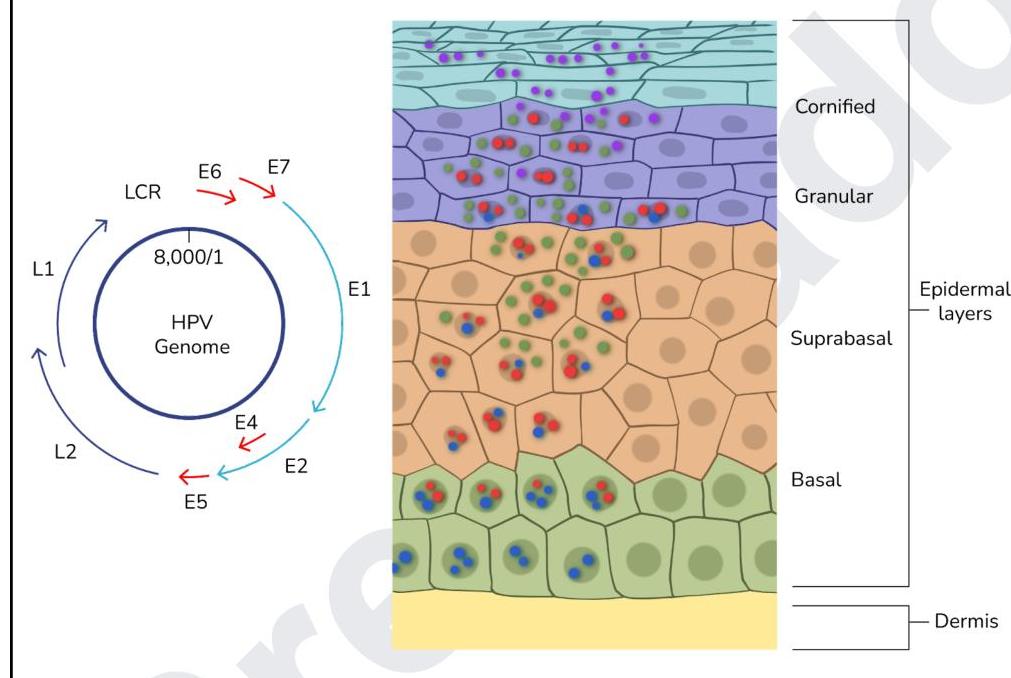
Question 41: The image below shows the life cycle of a virus. Which of the proteins of the virus act as oncogenes?
- A. L1, L2
- B. E1, E2, E5
- C. E1, E2
- D. E6, E7 (Correct Answer)
Explanation: ***E6, E7*** - The **E6** and **E7** proteins of high-risk human papillomaviruses (HPVs) are considered **oncogenes** because they interfere with critical tumor suppressor pathways [1][2]. - **E6** promotes the degradation of **p53**, a tumor suppressor protein, while **E7** inactivates **retinoblastoma protein (pRb)**, leading to uncontrolled cell proliferation and increased risk of malignant transformation [2]. *L1, L2* - **L1** and **L2** are **late proteins** (structural proteins) that form the **viral capsid** (outer shell) of the HPV virion. - They are essential for assembling new viral particles but do not directly contribute to the oncogenic process by disrupting host cell cycle regulation. *E1, E2, E5* - **E1** is involved in **viral DNA replication**, acting as a helicase and ATPase. - **E2** regulates **viral gene expression** and DNA replication, while **E5** is a small transmembrane protein that can contribute to cell growth but is generally considered less potent in oncogenesis than E6 and E7, and its exact role varies by HPV type. *E1, E2* - **E1** is critical for **viral DNA replication**, and **E2** regulates viral gene transcription and DNA replication. - While important for the viral life cycle, neither E1 nor E2 are the primary drivers of oncogenesis in the way E6 and E7 are, as they do not directly target key tumor suppressor proteins like p53 and pRb. **References:** [1] Kumar V, Abbas AK, et al.. Robbins and Cotran Pathologic Basis of Disease. 9th ed. The Female Genital Tract, pp. 1007-1008. [2] Kumar V, Abbas AK, et al.. Robbins and Cotran Pathologic Basis of Disease. 9th ed. Neoplasia, pp. 334-335.
Physiology
1 questionsWhat is the ratio of T cells to B cells in a healthy adult?
INI-CET 2022 - Physiology INI-CET Practice Questions and MCQs
Question 41: What is the ratio of T cells to B cells in a healthy adult?
- A. 3:1 (Correct Answer)
- B. 1:3
- C. 1:1
- D. 1:2
Explanation: ***3:1*** - In healthy adults, a typical peripheral blood sample shows a **predominance of T cells** over B cells. - This ratio reflects the differing roles and distributions of these lymphocytes; **T cells are more numerous** in circulation. *1:3* - This ratio would indicate **more B cells than T cells**, which is not typical for peripheral blood in a healthy individual. - An inversion of the usual T:B cell ratio could suggest certain disease states, such as specific **lymphoid malignancies**. *1:1* - While possible in some specific lymphoid tissues, a **1:1 ratio is not the standard** for circulating T and B cells in healthy adults. - This ratio would represent a **significantly higher proportion of B cells** than usually found in peripheral blood. *1:2* - This ratio implies **twice as many B cells as T cells**, which is significantly skewed compared to normal physiological levels in peripheral blood. - Such a high proportion of B cells is typically observed in states of **B-cell proliferation** or specific immune dysregulation.